Could a simple material oversight be the silent architect of your next system failure? Whilst standard tubing serves many general-purpose applications adequately, there is a definitive technical threshold where its structural integrity begins to compromise your operations. Knowing exactly when to use reinforced PVC over standard tubing is not merely a matter of preference; it's a critical engineering decision that prevents costly kinking, hose bursts, and unscheduled downtime in demanding industrial environments.
We understand that selecting the right material involves balancing initial procurement costs with long-term reliability and UK safety compliance. This article provides the technical criteria you need to identify when your fluid system requires the added strength of polyester braiding or spiral reinforcement. We shall examine specific performance thresholds, including pressure ratings and temperature variables, whilst ensuring your installations remain compliant with food-grade and fuel-transfer regulations to reduce maintenance overheads across your facility.
Key Takeaways
- Identify the specific pressure thresholds where standard unreinforced tubing fails and braided reinforcement becomes a structural necessity for system safety.
- Learn when to use reinforced PVC over standard tubing to prevent flow restrictions and material fatigue caused by kinking in complex industrial layouts.
- Navigate UK regulatory standards for food-grade and fuel-transfer systems to ensure your material selection meets all safety and compliance requirements.
- Understand why high-precision tolerances are essential for maintaining secure connections and preventing leaks in bespoke engineering projects.
- Discover how selecting the correct hose construction reduces long-term maintenance costs and prevents unscheduled downtime across your facility.
For technical assistance in selecting the correct specification for your industrial application, please reach out to our engineering team through our contact page.
Understanding the Construction of Standard and Reinforced PVC Tubing
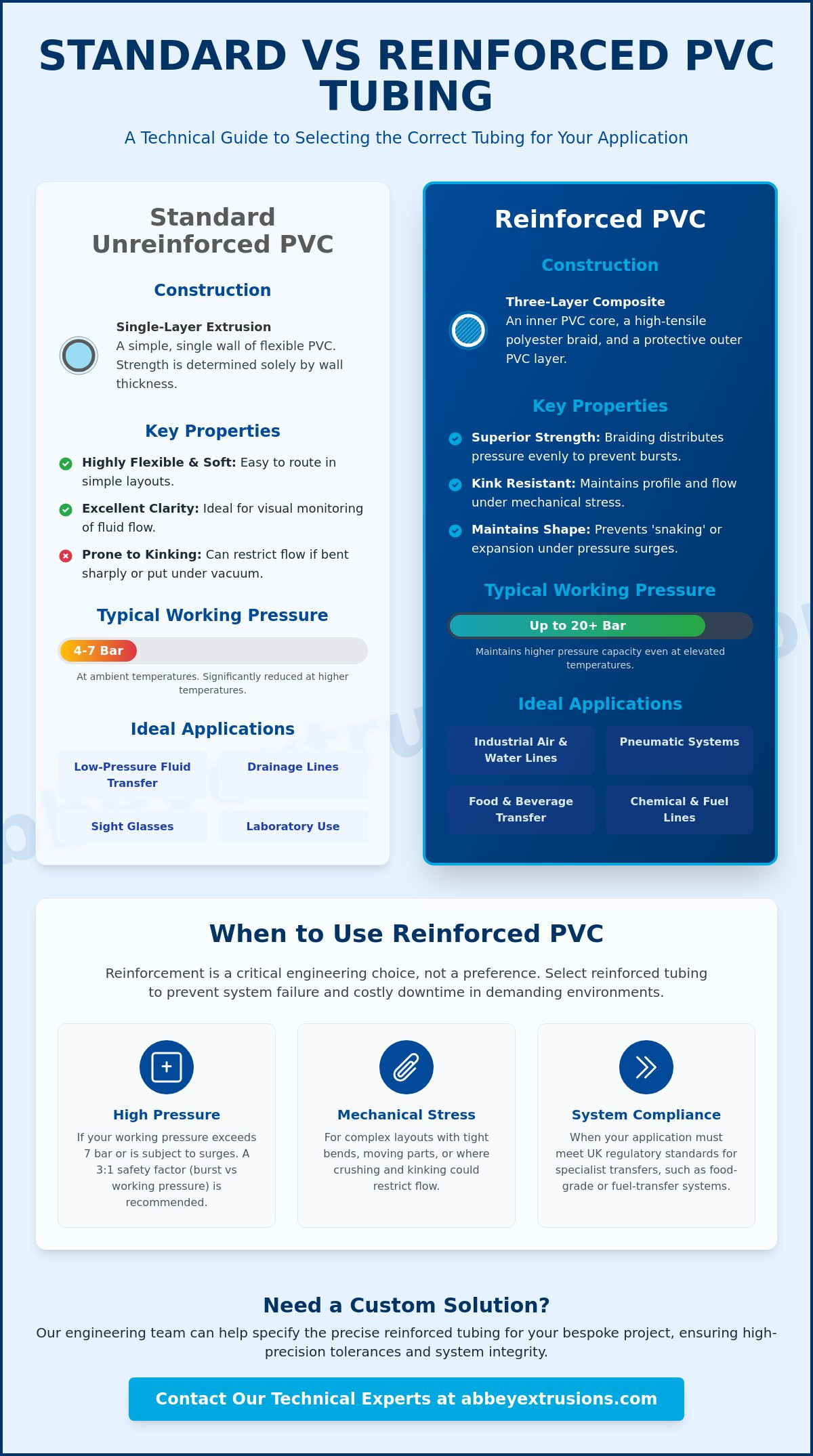
The choice between a single-layer extrusion and a multi-layered composite is a fundamental decision in fluid system design. We manufacture standard unreinforced tubing through a continuous extrusion process where molten polymer is forced through a precision die to create a consistent wall thickness and diameter. This resulting PVC Tube is flexible, smooth, and ideal for low-pressure transfers where visual monitoring is essential. However, the decision regarding when to use reinforced PVC over standard tubing often rests on the mechanical demands of the environment and the required safety margins.
Whilst unreinforced options rely solely on the polymer wall thickness for strength, our reinforced variants incorporate a high tensile polyester yarn. This braiding is applied over an inner core before a second outer layer is extruded over the top, creating a unified three-layer structure. You will notice a distinct tactile difference; standard tubing feels soft and pliable, whilst reinforced hose is firmer and exhibits a characteristic diamond-patterned texture beneath the surface. This multi-stage manufacturing process ensures that the reinforcement is fully encapsulated, protecting it from external abrasion and environmental contaminants.
The Material Properties of Flexible PVC
Flexible Polyvinyl chloride (PVC) is a versatile industrial polymer that we customise using specific plasticisers to achieve a precise Shore A hardness. This rating determines how the material behaves under stress, ensuring it remains flexible enough for easy routing whilst being rigid enough to maintain its profile during operation. Our formulations provide excellent resistance to UV degradation and a broad range of chemicals, making them suitable for diverse industrial settings. Transparent variants remain a popular choice amongst engineers because they allow for the immediate detection of air bubbles, sediment, or blockages within the fluid stream without interrupting the workflow.
How Polyester Braiding Enhances Structural Integrity
The integration of a polyester braid fundamentally transforms the performance characteristics of the hose. This cross-over pattern is engineered to distribute mechanical stress evenly across the entire surface area, significantly increasing the burst pressure. By anchoring the polymer layers, the braid prevents the hose from expanding or "snaking" when subjected to internal pressure. This structural bond amongst the inner tube, the yarn, and the outer cover ensures that our Reinforced PVC Tube maintains its shape even in high-cycle applications. Understanding this internal architecture is the first step in determining when to use reinforced PVC over standard tubing for your specific project.
For technical specifications and pressure testing data, you can speak with our technical department to ensure your system design meets the necessary safety margins.
Evaluating Pressure Ratings and Burst Strength Requirements
In industrial fluid management, distinguishing between working pressure and burst pressure is vital for system safety. Working pressure represents the maximum load a hose can consistently handle during normal operation. Conversely, burst strength is the pressure at which a hose fails. Whilst the ASTM D1785 standard provides guidance for rigid piping, flexible tubing requires even more stringent evaluation. Determining when to use reinforced PVC over standard tubing often comes down to the required safety margin. We typically advise a 3 to 1 safety factor for industrial applications, meaning the burst pressure should be at least three times the intended working pressure.
Standard unreinforced PVC tubing is generally limited to low-pressure environments. At ambient temperatures, unreinforced tubes rarely exceed 4 to 7 bar depending on wall thickness. However, these ratings are not static. As the operating temperature increases, the polymer softens; this causes a significant reduction in pressure capacity. If your application operates at elevated temperatures or involves fluctuating loads, the structural support of a braid becomes essential to prevent material fatigue.
When Standard PVC Reaches Its Operational Limit
Standard tube begins to lose its structural integrity as internal pressures approach the upper limits of its Shore A hardness. You may observe a ballooning effect, where the tube wall thins and expands under stress. This deformation is a precursor to catastrophic failure. Using unreinforced tube for compressed air lines is particularly hazardous because if the tube bursts, the rapid release of stored energy can cause significant damage or injury. This risk is a primary indicator of when to use reinforced PVC over standard tubing for pneumatic or high-velocity fluid transfers.
Safety Factors for High Pressure Fluid Systems
Reinforced hoses utilise polyester braiding to bridge the gap between polymer flexibility and high-pressure requirements. Our Reinforced PVC Tube can withstand pressures reaching up to 50 bar when correctly specified. These specialised hoses maintain their diameter even under pressure spikes, ensuring consistent flow rates and reducing the strain on fittings. If your system involves hydraulic surges or high-pressure cleaning, unreinforced options are insufficient. For bespoke requirements involving high-pressure transfer, our engineering team can provide detailed performance data to help you organise your system safely.
If you require specific technical guidance regarding the minimum bend radii for your bespoke installation, please visit our contact page to consult with our engineering specialists.
Overcoming Mechanical Stress and Kinking in Industrial Layouts
Mechanical stress in industrial plumbing often manifests as kinking, particularly in compact machine layouts where space is at a premium. Whilst unreinforced PVC is inherently flexible, it lacks the lateral support required to maintain its internal diameter when subjected to torque or tight bends. Knowing when to use reinforced PVC over standard tubing is often dictated by these spatial constraints. If a standard tube kinks, it creates a localised pinch point that severely restricts fluid velocity and increases backpressure on the pump.
In vacuum or suction applications, the structural difference becomes even more pronounced. Standard tubing is designed to contain internal pressure but frequently collapses under negative pressure. The structural braid or spiral reinforcement within a Reinforced PVC Tube provides the necessary hoop strength to resist atmospheric pressure. This ensures that the hose remains open and functional, preventing the total system failure that occurs when unreinforced walls cave in amongst high-vacuum environments.
Bend Radii and the Risk of Flow Restriction
The minimum bend radius is a critical specification for any machine designer. It defines the smallest curve a hose can achieve before the wall begins to deform. When comparing different hose types at a 50mm radius, standard unreinforced tubing often fails by flattening into an oval shape. This collapse increases flow turbulence, which can lead to cavitation in pumps and inconsistent dosing in chemical applications. By contrast, the polyester braiding in reinforced variants distributes the bending force across the polymer matrix, allowing for tighter routing without compromising the circular cross section.
Abrasion Resistance in Heavy Duty Environments
Industrial environments often subject hoses to constant dragging across concrete floors or vibration against metal chassis. The multi-layer construction of reinforced hose provides a sacrificial outer cover that protects the internal structural braid from mechanical wear. This durability is essential amongst high-traffic production lines where hose replacement causes expensive downtime. For environments where extreme external friction is unavoidable, we recommend the addition of a Nylon Spiral Cut Hose Guard to provide a robust secondary barrier against abrasion and prolong the service life of your fluid systems.
To ensure your facility remains compliant with the latest industry safety standards, please contact our specialist team for a technical consultation regarding material specifications.
Selecting the Correct Hose for Specialist Transfer Applications
Determining when to use reinforced PVC over standard tubing is frequently dictated by the specific medium being transported and the regulatory environment of the facility. Whilst standard tubing is suitable for basic water discharge or low-pressure sight glasses, it lacks the chemical resilience and structural fortitude required for volatile or sensitive fluids. In industries such as petrochemical processing or large-scale food production, the use of unreinforced tubing can lead to premature material degradation. This results in fluid contamination or hazardous leaks that compromise site safety.
Specialist variants are engineered to address these precise industrial challenges. For instance, a Brewery hose must maintain its structural integrity whilst subjected to frequent high-temperature washdowns and acidic cleaning agents. Similarly, standard PVC is entirely unsuitable for high-vibration fuel transfer. The constant mechanical oscillation in engine compartments causes unreinforced walls to fatigue rapidly. In these scenarios, a dedicated Diesel Fuel Hose with integrated reinforcement is the only viable solution to ensure long-term reliability and fire safety.
Food Grade Compliance and Material Standards
Food and beverage production lines are governed by strict FDA and European food contact regulations. We ensure that our food-grade hoses are manufactured from high-purity resins that do not leach harmful substances into the product stream. Reinforced hoses are the preferred choice for high-pressure cleaning systems within food plants because they can withstand the rigorous sanitation cycles that standard tubing cannot. For sensitive transfer applications, we provide phthalate-free formulations to meet the most demanding health and safety requirements amongst modern processing facilities.
Fuel and Hydrocarbon Resistance Specifications
Standard PVC exhibits poor resistance to hydrocarbons; exposure to diesel or industrial oils causes the material to leach plasticisers. This process leads to rapid stiffening and cracking, which creates a significant risk of environmental contamination. Our reinforced fuel hoses utilise specific formulations designed to resist this chemical attack whilst maintaining flexibility. The internal braiding ensures the hose does not burst if the system experiences a pressure surge during refuelling operations. If you are designing a fuel delivery system, you can request a technical data sheet to verify the chemical compatibility of our reinforced hoses with your specific hydrocarbon blend.
For technical assistance with bespoke extrusion specifications, please contact our specialist team.
Specifying Custom Reinforced PVC for Bespoke Engineering Projects
We recognise that off-the-shelf reinforced hoses frequently fall short when integrated into sophisticated engineering systems. Whilst mass-produced options cater to general utility, they often fail to provide the exact physical properties required for high-cycle industrial machinery. Determining when to use reinforced PVC over standard tubing for a bespoke project requires an analysis of the specific operating environment and the mechanical interface of the fittings. We specialise in manufacturing custom solutions that go beyond the limitations of standard stock items, ensuring that every millimetre of the hose serves a functional purpose.
A primary advantage of bespoke manufacturing is the ability to specify a custom Shore A hardness. This allows engineers to dictate the exact degree of flexibility or rigidity needed amongst various system components. If a standard unreinforced tube is too pliable but a generic braided hose is too stiff for a particular routing, we can adjust the polymer formulation to find the optimal balance. This level of precision is essential for reducing mechanical strain on connectors and ensuring long-term system stability. We encourage you to contact the technical team for bespoke extrusion advice tailored to your unique requirements.
The Importance of Precise Tolerance Control
Variances in the internal diameter (ID) and outer diameter (OD) of a hose can compromise seal integrity, leading to gradual pressure loss or catastrophic leaks. If you don't have precise tolerances, the risk of leakage increases significantly during high-pressure cycles. Maintaining tight tolerances in braided extrusions is notoriously challenging because the layering process adds complexity to the final dimensions. Abbey Extrusions provides tolerances as tight as +/- 0.05mm. This technical rigour ensures that our reinforced hoses integrate perfectly with your existing hardware, eliminating the need for excessive clamping or sealant. Deciding when to use reinforced PVC over standard tubing is often a matter of achieving this superior fitting security.
Sourcing Directly from a British Manufacturer
Engaging with a UK-based manufacturer provides a direct line of communication with the engineers who oversee the production of your materials. This proximity ensures rigorous quality control and allows for rapid technical support when navigating complex design challenges. Direct manufacturing also facilitates the production of custom lengths and specific colour coding, which organises maintenance procedures and prevents cross-contamination in multi-fluid systems. For layouts that require permanent bends or pre-shaped profiles, we offer Custom Tube Forming to ensure the hose retains its exact shape without internal stress. By choosing a bespoke path, you gain total control over the performance and aesthetics of your industrial fluid systems.
To discuss your specific technical requirements with our engineering team, please visit our contact page.
Securing Long Term System Reliability
Selecting the appropriate material is a fundamental step in ensuring the longevity and safety of your industrial operations. We have explored how technical variables such as pressure thresholds, mechanical kinking, and specialist chemical compatibility dictate when to use reinforced PVC over standard tubing. Whilst unreinforced options serve low-pressure sight glasses adequately, it's essential to recognise that high-performance systems requiring ratings up to 50 bar depend on the structural support of high tensile braiding.
As UK manufacturing specialists since 1985, we provide the technical expertise necessary to bridge the gap between generic components and precision-engineered solutions. Our production processes allow for precise tolerances of +/- 0.05mm, ensuring that every bespoke fitting maintains a secure and leak-free connection. By prioritising material integrity and regulatory compliance, you can significantly reduce maintenance costs and prevent unscheduled system downtime.
We are ready to assist with your next engineering project. Please request a bespoke quote for reinforced PVC hose from Abbey Extrusions to discuss your specific performance requirements. Don't settle for generic specifications when precision is paramount; we look forward to partnering with you to achieve a more efficient and secure fluid transfer environment.
Frequently Asked Questions
Is reinforced PVC hose more expensive than standard PVC tubing
Yes, the unit price for reinforced hose is higher because of the additional raw materials and the complex multi-stage extrusion process. Whilst the upfront investment is greater, it's the more economical choice when considering the total cost of ownership. The increased service life and reduced risk of system failure amongst demanding industrial environments provide superior long-term value compared to frequent replacements of unreinforced tube.
Can I use standard PVC tubing for high pressure air lines
No, you shouldn't use unreinforced tubing for high-pressure pneumatic applications. Standard PVC lacks the necessary burst strength to safely contain compressed air, which stores significant energy that can be dangerous if released suddenly. This is a primary scenario of when to use reinforced PVC over standard tubing to prevent catastrophic failure and ensure the safety of your operators.
What is the maximum temperature for reinforced PVC hose
Most industrial reinforced PVC hoses are rated for continuous use up to 60 degrees Celsius. It's vital to remember that the pressure rating of the hose decreases as the temperature rises because the polymer softens. If your application operates near this thermal limit, you must verify that the reduced burst strength still meets your required safety margins for the system.
How do I know if my PVC hose is food grade
You can identify food-grade hoses by checking for specific compliance markings such as FDA or European Regulation 10/2011. We provide technical data sheets and certificates of conformity to verify that the materials used are phthalate-free and safe for contact with consumables. Always request these documents from your manufacturer to ensure your facility remains compliant with UK food safety standards.
Does reinforced PVC hose kink as easily as standard tubing
No, the integrated polyester braiding provides significant resistance to kinking and crushing. The reinforcement helps maintain the circular cross section of the hose even when it's bent around tight radii in compact machine layouts. This structural support is essential amongst complex systems where flow restriction could lead to pump cavitation or inconsistent chemical dosing.
What is the difference between braided and wire reinforced PVC
Braided reinforcement uses high-tensile yarn to increase internal pressure capacity whilst maintaining a high degree of flexibility. Wire reinforcement involves a steel or plastic spiral embedded in the wall to prevent the hose from collapsing under vacuum or suction forces. Choosing the right type depends on whether your system primarily faces internal pressure or external atmospheric force.
Can reinforced PVC hose be used for suction or vacuum
Yes, but you must specify a hose with a rigid spiral reinforcement rather than just a polyester braid. Whilst braiding handles internal pressure effectively, it doesn't always prevent a hose from collapsing under negative pressure. Understanding this mechanical distinction is key when deciding when to use reinforced PVC over standard tubing for suction lines or vacuum pumps.
How do I choose the right internal diameter for my reinforced hose
You should select the internal diameter based on the required flow rate of your fluid and the dimensions of your existing fittings. A diameter that is too small increases friction and heat; one that is too large can reduce fluid velocity and pressure. Our technical team can help you organise these specifications to ensure a secure, leak-free connection for your bespoke engineering project.

Article by
Bryan Cowan
Bryan Cowan is the Founder and Managing Director of Abbey Extrusions Ltd, a leading UK manufacturer of high-quality plastic tubes and hoses. With over 40 years of industry experience, Bryan established the company in 1985, growing it from a startup into a BS ISO9001-registered supplier for global sectors including aerospace, automotive, and pharmaceuticals.
Disclaimer
This article is intended for informational purposes only. Please ensure you seek expert advice or carry out your own research to confirm the information is suitable for your specific needs.