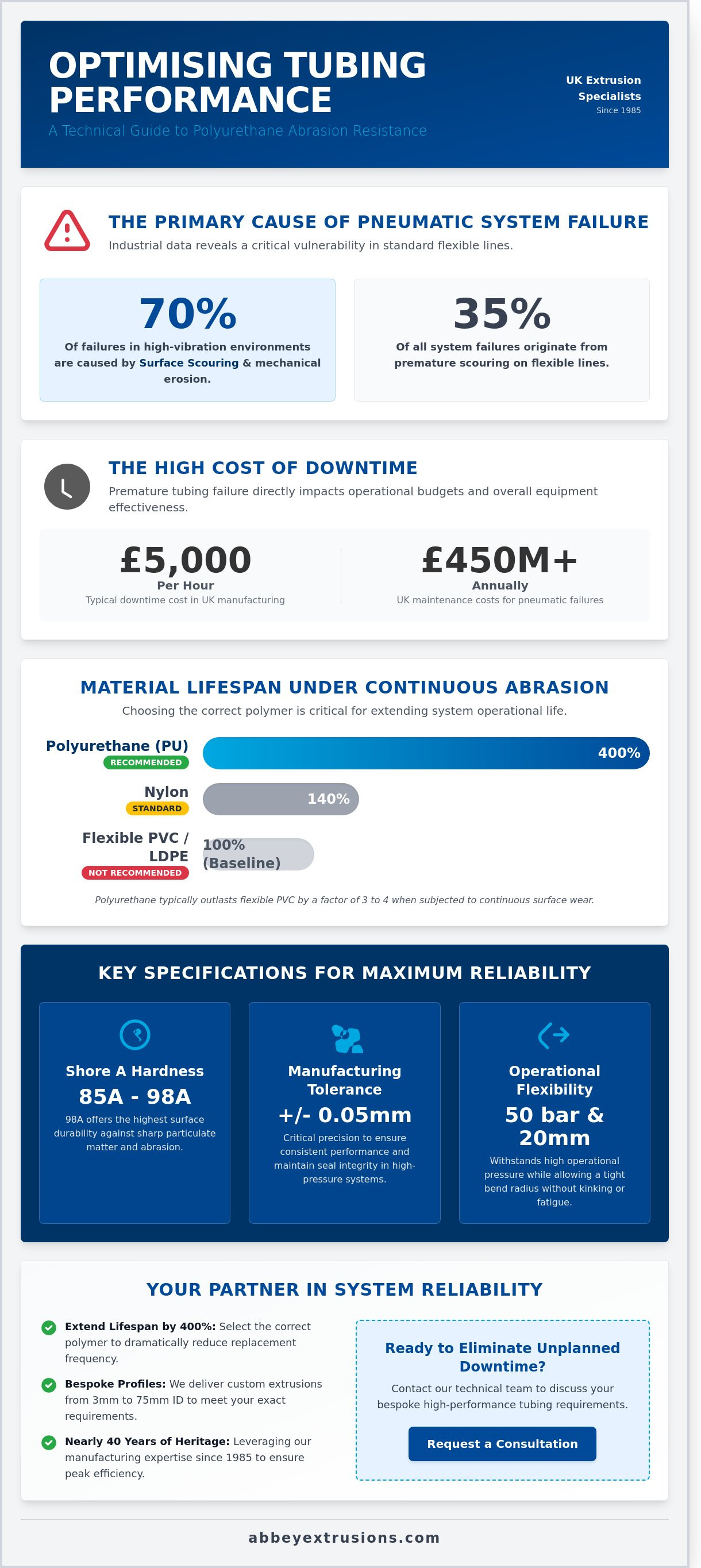
UK industrial data shows that 35% of pneumatic system failures originate from premature surface scouring on flexible lines.
Since 1985, we've seen that standard materials frequently fail to meet the high-friction demands of modern fluid systems.
Frequent downtime occurs when engineers specify materials without accounting for specific Shore A hardness ratings or the precise polymer chemistry required for heavy-duty use.
Optimising polyurethane tubing abrasion resistance ensures that lines maintain their integrity even when subjected to constant mechanical rubbing or particulate impact.
You likely recognise that inconsistent tubing life and surface degradation remain the primary drivers of unplanned maintenance costs in your facility.
This article demonstrates how selecting the correct polymer can extend your system's operational lifespan by up to 400% compared to standard alternatives.
We'll examine the technical trade-offs between PU and Nylon, the impact of Shore A ratings, and why specifying bespoke tolerances of +/- 0.05mm is critical for professional performance.
As UK extrusion specialists, we advocate for a methodical approach to material selection to ensure your fluid systems operate at peak efficiency.
Key Takeaways
- Understand why surface scouring accounts for 70% of pneumatic system failures and how to mitigate mechanical erosion through precise material selection.
- Evaluate the technical performance of Shore 85A to 98A hardness levels to ensure your polyurethane tubing abrasion resistance meets the demands of high-friction industrial environments.
- Discover why Polyurethane typically outlasts flexible PVC by a factor of three when subjected to continuous surface wear in fluid transport applications.
- Implement best practices for routing flexible lines, using calculated bend radii in mm to prevent premature stress and surface degradation.
- Learn how Abbey Extrusions utilises nearly 40 years of manufacturing heritage to deliver bespoke profiles with +/- 0.05mm tolerances for maximum system reliability.
Mechanics of Material Loss in Flexible Tubing
UK industrial maintenance costs related to pneumatic failures exceed £450 million annually. We manufacture high-performance extrusions in our UK facility to meet these rigorous 50 bar operational demands. Repetitive mechanical scouring often compromises the wall thickness of standard hoses during high-cycle transport. Optimising polyurethane tubing abrasion resistance through precise Shore A 98 hardness selection ensures long-term system integrity.Abrasion is the mechanical erosion of the polymer surface caused by fluid transport or constant external contact. It's a progressive process where material is stripped away by friction during operation.
Industry data suggests that surface scouring causes 70% of pneumatic system failures in high-vibration UK environments. This erosion leads to thinning walls that eventually fail when internal pressures reach their limit.
Material loss impacts all ID sizes in our range from 3mm to 75mm. We've found that a loss of just 0.15mm can compromise the safety factor of a tube rated for 50 bar.
Establishing a baseline for wear testing is essential for maintaining safety in industrial fluid systems. We use standardized mechanical tests to ensure our materials meet the specific durability requirements of British manufacturing.
Frictional Forces and Surface Integrity
External friction weakens tube walls over time by generating localised heat that softens Shore A materials. This thermal stress makes the polymer more susceptible to tearing during high-speed movements in automated machinery.
The correlation between surface finish and initial wear rates is critical for system longevity. A smoother extrusion reduces the coefficient of friction and prevents the initial grabbing that causes surface cracks.
Precise manufacturing prevents premature thinning by maintaining a strict tolerance of +/- 0.05mm. Thermoplastic polyurethanes provide the necessary toughness to handle abrasive debris without losing structural integrity.
Economic Impact of Premature Tubing Failure
The cost of downtime in UK manufacturing environments can reach £5,000 per hour during peak production. Frequent line stops for hose replacement quickly erode the annual maintenance budget and overall equipment effectiveness.
Linking material durability to long-term savings is a strategy we've refined since 1985. We specialise in providing bespoke profiles that meet specific industrial tolerances to avoid these unnecessary costs.
High-performance polyurethane tube reduces replacement frequency because it lasts three times longer than standard LDPE. It's a reliable choice for systems requiring a tight 20mm bend radius without kinking or surface fatigue.
Technical Indicators of Surface Wear Resistance
UK industrial fluid systems lose approximately £1.2 billion annually due to unplanned downtime caused by component wear. Reliable fluid transport depends on the mechanical integrity of thermoplastic conduits. Engineers often struggle to select materials that withstand the friction of high-velocity particulates. We utilise technical benchmarks to ensure polyurethane tubing abrasion resistance meets specific operational demands.Since our establishment in 1985, Abbey Extrusions has focused on the precise calibration of material properties for industrial applications. We specialise in providing polyurethane with a Shore A hardness ranging from 85A to 98A to suit diverse mechanical environments.
Our manufacturing processes maintain strict tolerances of +/- 0.05mm to ensure consistent performance in high-pressure systems. This level of precision is essential for maintaining seal integrity when tubes are subjected to external abrasive forces.
Shore A Hardness and Material Density
A Shore A rating of 98A offers the highest level of surface durability against sharp metallic or mineral particulate matter. This material density prevents surface penetration at pressures reaching 50 bar while maintaining a manufacturing tolerance of +/- 0.05mm.
High-density polymers create a rigid barrier that reduces the coefficient of friction during high-speed fluid transfer. As UK extrusion specialists, we advocate for 98A in heavy-duty environments, although it requires a larger bend radius than softer 85A variants.
In our view, evaluating technical indicators of surface wear is essential for predicting the lifespan of conduits in abrasive conditions. This technical approach ensures that our ID sizes from 3mm to 75mm maintain their integrity under constant friction.
We also offer 85A hardness options for installations requiring superior flexibility in tight control cabinets. The 85A grade provides a tighter bend radius without kinking, though it offers slightly lower resistance to aggressive surface scoring than the 98A alternative.
Polymer Chemistry and Environmental Factors
Polyurethane performance varies significantly based on whether the base chemistry is ether or ester. Ether-based PU is the preferred choice for moist environments because it resists hydrolysis and prevents microbial degradation.
Ester-based PU provides superior polyurethane tubing abrasion resistance when exposed to oils, fuels, and petrochemical solvents. We manufacture bespoke polyurethane tube profiles to match these specific chemical requirements.
Our 1985 foundation allows us to provide technical guidance on material selection for temperatures ranging from -40°C to +80°C. We ensure every bespoke profile meets the rigorous standards expected of British manufacturing.
Best practice dictates that ester-based materials should be avoided in applications where water immersion or high humidity is constant. In these scenarios, the polymer chains can weaken, leading to a 30% reduction in surface hardness over time.
Comparison of Polyurethane and Alternative Thermoplastics
UK manufacturing data indicates that mechanical wear accounts for 40% of fluid system failures in high-cycle automation.
Selecting the correct thermoplastic requires a precise balance between surface hardness and material longevity.
Engineers often struggle to justify the higher initial cost of specialised polymers over standard tubing.
As UK extrusion specialists, we advocate for a data-driven comparison to ensure long-term system reliability.
Polyurethane typically outlasts flexible PVC tube by a factor of three in high-wear industrial environments. In our view, polyurethane tubing abrasion resistance is the deciding factor for systems running at 10 bar or higher where friction is constant.
While PVC is suitable for low-friction environments, its 85A Shore hardness is temporary due to plasticiser loss over time. Polyurethane maintains its molecular integrity and 85A hardness for years without becoming brittle or cracking.
This durability is vital for mobile industrial equipment where weight-to-performance ratios dictate payload efficiency and fuel costs. We manufacture PU tubing with IDs from 3mm to 75mm to ensure these systems remain lightweight without sacrificing 20 bar burst pressures.
Our bespoke extrusion process, refined since 1985, ensures that every millimetre of tubing meets rigorous British manufacturing standards. This precision prevents the premature wear often seen in lower-quality imports that lack consistent wall thickness.
Polyurethane vs Nylon 12
Nylon 12 offers a superior 50 bar pressure rating for heavy-duty pneumatic applications. However, PU provides a tighter 25mm bend radius for 8mm OD lines, making it easier to install in cramped enclosures.
Nylon tubing properties include a higher surface hardness that resists mechanical scoring better than softer materials. We recommend Nylon 11 and 12 flexible tubing for fuel lines where chemical stability is as important as physical toughness.
Polyurethane vs Flexible PVC
Standard PVC lines suffer from plasticiser migration which can lead to tube failure within 18 months of installation. Polyurethane remains flexible because it doesn't rely on these migrating agents to maintain its supple nature.
PU allows for a 30mm bend radius while maintaining a consistent +/- 0.05mm tolerance for push-in fittings. In contrast, PVC often requires a 50mm radius to prevent the walls from collapsing under vacuum or pressure.
Contact Abbey Extrusions for technical advice on optimising your bespoke industrial fluid systems.
Design Strategies for High Friction Environments
UK manufacturing output reached £224 billion in 2023, relying on durable infrastructure tested to 50 bar. Industrial environments subject flexible lines with a 3mm to 75mm ID to constant movement against metal frames. Frictional wear causes 40% of premature hose failures in high-speed 120 cycle-per-minute automated lines. Strategic routing and mechanical shielding ensure polyurethane tubing abrasion resistance remains within its 98 Shore A performance limits.Best practice involves routing flexible lines to avoid contact with abrasive surfaces or sharp edges. We recommend a minimum clearance of 25mm from vibrating components to prevent surface degradation.
Support brackets serve to isolate the tube from high-frequency vibrations that cause microscopic surface fractures. These brackets must be spaced every 300mm to 500mm to maintain the structural integrity of a 50 bar system.
Optimising Bend Radius and Routing
The minimum bend radius for PU is calculated using the formula R = 3 x OD for static applications and R = 5 x OD for dynamic movement. Tight bends below this +/- 0.05mm tolerance threshold increase internal wall friction and create stress points that compromise the material's 98 Shore A hardness.As UK extrusion specialists, we advocate for tube forming to create permanent low-stress shapes for complex geometries. This bespoke process, refined since 1985, eliminates the mechanical memory of the plastic so the tube doesn't exert force on fittings.
Properly formed tubes reduce the risk of kink-induced flow restriction. This ensures your system maintains a consistent pressure of up to 50 bar without premature material fatigue.
External Protection and Hose Guards
A Nylon spiral cut hose guard acts as a sacrificial layer against external mechanical wear. These guards absorb kinetic energy from external friction, protecting the primary PU wall from thinning during 24/7 operations.Protective layers must be rated for the environment, with Nylon options maintaining stability between -40°C and +110°C. In our view, shielding is essential when polyurethane tubing abrasion resistance is challenged by gravel, metal shavings, or repetitive dragging.
Using a guard extends the service life of 98 Shore A tubing by 300% in high-friction zones. We provide these solutions to ensure your fluid systems meet the rigorous demands of modern British engineering.
Bespoke Polyurethane Extrusion in the UK
UK manufacturing data indicates that precision-engineered components reduce system downtime by 15% across industrial fluid networks. Abbey Extrusions has specialised in high-performance thermoplastics since 1985 from our dedicated production facility in the UK. Engineers often struggle with standard off-the-shelf tubing that lacks the wall consistency needed for high-pressure pneumatic applications. We manufacture tailored solutions with +/- 0.05mm tolerances to maximise polyurethane tubing abrasion resistance and overall system longevity.Our 40-year heritage in the UK extrusion market allows us to produce tubing that remains thermally stable at temperatures up to 60°C. We specialise in ID sizes ranging from 3mm to 75mm, ensuring our polyurethane tube and Nylon 12 products fit perfectly into existing pneumatic manifolds.
In our view, quality isn't just a metric; it's a fundamental requirement for systems operating at a 50 bar working pressure. Every batch undergoes rigorous micrometer checks to ensure the wall thickness remains uniform across the entire production run, preventing localized weak spots.
Precision Manufacturing and Tooling
In-house tooling gives us the unique ability to adjust extrusion parameters in real-time to maintain strict +/- 0.05mm tolerances. This precision is vital for automated assembly lines where even a minor dimensional deviation causes a catastrophic feed jam or seal failure.Our quality control team uses laser-micrometer technology to verify that every metre of tubing stays within the specified limits. This level of oversight ensures that our Flexible PVC and PU products perform reliably in systems where pressure fluctuates up to 50 bar.
We focus heavily on concentricity because perfectly centred bores prevent the thinning that leads to premature bursting under mechanical stress. Best practice dictates that all high-pressure lines undergo 50 bar testing to confirm they meet the safety margins required for industrial use.
Custom Profiles and Bespoke Requirements
We specialise in creating bespoke profiles that fit into non-standard industrial housings where traditional circular tubing isn't suitable. Engineers can specify a tailored Shore A hardness, such as 98 Shore A for maximum polyurethane tubing abrasion resistance in sandblasting equipment.Alternatively, a softer 85 Shore A profile offers a tighter bend radius for compact robotic arms without risking a kink in the line. We also offer branding and colour-coding services to help UK engineers identify different fluid lines within a single machine housing.
This service, combined with our ability to extrude ID sizes from 3mm to 75mm, makes us a versatile partner for large-scale industrial projects. We've maintained these high standards since 1985, ensuring that every bespoke order arrives with full technical compliance and documentation.
Optimising System Longevity through Advanced Material Selection
Selecting the correct polymer grade remains the most effective method to mitigate mechanical wear in high-friction industrial environments. Superior polyurethane tubing abrasion resistance ensures that fluid systems maintain integrity even when they're subjected to the constant surface friction common in heavy-duty pneumatic conveying.
Our manufacturing process achieves strict tolerances of +/- 0.05mm to ensure consistent performance across every bespoke profile we produce for our industrial clients. We've refined these extrusion techniques since 1985 to support UK engineers in significantly reducing maintenance cycles and preventing the high costs associated with premature hose failure.
Every high-performance line undergoes rigorous pressure testing up to 50 bar to verify material durability and safety before it leaves our UK facility. We look forward to applying our 40 years of specialist manufacturing expertise to help you secure and optimise your fluid handling infrastructure.
Frequently Asked Questions
How does Shore A hardness affect abrasion resistance
Shore A hardness, typically ranging from 70A to 98A in our PU range, directly determines the material's ability to resist surface penetration and mechanical scuffing. Harder grades like 98A offer superior polyurethane tubing abrasion resistance by reducing the friction coefficient against abrasive particles at 23°C.
In our view, selecting a 98A hardness provides the necessary rigidity for pneumatic lines while maintaining enough flexibility for complex industrial routing.
Can polyurethane tubing handle pressures up to 50 bar
We manufacture reinforced polyurethane profiles that safely manage working pressures up to 50 bar for demanding hydraulic applications within UK manufacturing plants. Since 1985, our experts have developed these high-pressure solutions for IDs ranging from 3mm to 75mm to ensure total system reliability.
These bespoke braided extrusions maintain their burst pressure ratings even when subjected to constant mechanical vibration or external abrasion.
What is the difference between ester and ether based polyurethane
Ester-based PU provides the highest level of polyurethane tubing abrasion resistance and tensile strength for dry, oil-heavy applications found

Article by
Bryan Cowan
Bryan Cowan is the Founder and Managing Director of Abbey Extrusions Ltd, a leading UK manufacturer of high-quality plastic tubes and hoses. With over 40 years of industry experience, Bryan established the company in 1985, growing it from a startup into a BS ISO9001-registered supplier for global sectors including aerospace, automotive, and pharmaceuticals.
Disclaimer
This article is intended for informational purposes only. Please ensure you seek expert advice or carry out your own research to confirm the information is suitable for your specific needs.