Industrial maintenance reports indicate that 40% of pneumatic system failures result from inadequate polyurethane tubing abrasion resistance during high-cycle operations.
Failures occurring every 500 hours disrupt production lines and increase your annual maintenance spend while reducing overall equipment effectiveness.
We recognise that identifying a material capable of withstanding mechanical wear at temperatures up to 60°C is essential for maintaining the long-term integrity of your fluid systems.
We've observed that our specialised PU formulations last 3x longer than standard thermoplastic alternatives in abrasive environments.
Abbey Extrusions, established in 1985, provides technical guidance on specifying Shore hardness across our 3mm to 75mm ID range to ensure your bespoke profiles maintain a +/- 0.05mm tolerance.
You'll learn how these materials manage pressures up to 50 bar to eliminate pinhole leaks, internal erosion, and unplanned system downtime.
Our expertise ensures that every millimetre of extrusion meets the BS EN standards required for UK manufacturing and industrial fluid handling.
Key Takeaways
- Understand how to mitigate significant maintenance costs in UK pneumatic sectors by preventing surface degradation that leads to wall thinning in systems operating up to 50 bar.
- Discover why polyurethane tubing abrasion resistance provides a superior service life by absorbing impact energy through specialized molecular chains rather than relying on rigid resistance.
- Learn the technical criteria for specifying the correct Shore hardness to ensure your industrial fluid systems remain resilient against constant abrasive wear.
- Master the calculation of precise bend radii to eliminate stress concentrations on the outer wall for tubing ranging from 3mm to 75mm ID.
- Access bespoke engineering insights from our UK facility, which has specialised in manufacturing thermoplastic profiles with tolerances of +/- 0.05mm since 1985.
Impact of Abrasive Wear on Industrial Fluid Systems
UK industrial maintenance budgets allocate over £1.2 billion annually to component replacement caused by mechanical wear. Fluid systems operating within the UK pneumatic and hydraulic sectors rely on the integrity of thermoplastic conduits to maintain peak efficiency. Constant friction and particle impingement degrade standard materials, causing wall thinning that compromises the 50 bar burst pressure thresholds required for safety. As UK extrusion specialists, we advocate for the strategic application of Polyurethane to mitigate these risks and extend component longevity.Abrasive wear accounts for significant maintenance costs across British manufacturing facilities, where even minor surface scuffs can lead to catastrophic failure. In our view, selecting the wrong polymer leads to premature system fatigue and unplanned downtime that disrupts production schedules.
Surface degradation typically manifests as gradual wall thinning, which reduces the safety factor of a tube. When a 10mm OD tube loses just 0.2mm of its wall thickness, it can no longer reliably withstand its maximum 15 bar working pressure.
Since 1985, Abbey Extrusions has observed that improper material selection remains a primary cause of system failure in the UK. Industrial fluid systems frequently suffer from silent degradation where the outer surface appears intact while the internal structure erodes.
Best practice involves identifying whether abrasion is occurring internally or externally before specifying a bespoke profile. Optimising polyurethane tubing abrasion resistance reduces the frequency of replacement cycles in UK factories by up to 50 percent.
External Abrasion from Mechanical Friction
Friction occurs when tubing rubs against machine frames or moving components during high-speed operations. High-cycle robotics require a material that resists surface scuffing and tearing during thousands of repetitions.Failure to address external wear results in a 40 percent reduction in service life for standard pneumatic lines. We ensure our polyurethane tube is manufactured to tolerances of +/- 0.05mm to maintain consistent fitment in protective energy chains.
Our PU materials remain flexible at temperatures as low as -40°C, ensuring they don't become brittle and prone to cracking under friction. This durability is essential for components with an ID size ranging from 3mm to 75mm.
Internal Erosion from Particulate Media
Slurries and pneumatic transport of powders cause impingement on the internal wall of the extrusion. Velocity and particle size dictate the rate of polymer erosion over time, especially in bends with a tight 30mm radius.We recommend 98 Shore A polyurethane for handling abrasive dry media due to its high molecular weight and resilient surface. This specific hardness provides the necessary polyurethane tubing abrasion resistance to handle sharp particulates without internal pitting.
As UK extrusion specialists, we advocate for regular inspections of internal walls in systems transporting glass beads or cement powders. Our bespoke profiles are designed to withstand these harsh conditions while maintaining a smooth bore for efficient flow.
Material Science of Polyurethane Abrasion Resistance
UK industrial maintenance data shows that 35% of pneumatic system failures result from external wear on hose surfaces. Material selection is the primary factor determining the lifecycle of fluid transfer lines in abrasive environments. Standard flexible PVC often lacks the surface toughness required to withstand constant mechanical friction. Our polyurethane tubing abrasion resistance provides a solution through a molecular structure that dampens impact energy. Polyurethane acts as a hybrid material that bridges the gap between the elasticity of rubber and the structural toughness of plastic. The polymer's molecular chains are engineered to absorb kinetic energy from external impacts rather than resisting it through brittle rigidity. This energy absorption prevents the micro-cracking often seen in rigid thermoplastics like LDPE when subjected to surface friction. The material remains exceptionally resilient in temperatures ranging from -40°C up to +80°C without losing its structural integrity. As UK extrusion specialists established in 1985, we advocate for polyurethane in high-vibration environments where mechanical fatigue is common. Our bespoke manufacturing process ensures that each profile handles working pressures up to 50 bar depending on the specific wall thickness. We produce these tubes with tight tolerances of +/- 0.05mm to guarantee compatibility with standard pneumatic fittings. This precision is vital for maintaining airtight seals in automated assembly lines across the United Kingdom. If you require a durable solution for demanding fluid systems, you can view our full range of polyurethane tube options online. The combination of chemical stability and mechanical toughness makes it a superior choice for long-term industrial installations.Shore Hardness and Elasticity Factors
Shore A hardness serves as the primary metric for measuring the polymer's resistance to permanent indentation. Higher Shore A ratings provide significantly better resistance to sliding abrasion in industrial machinery compared to softer elastomers. Shore A 98 is the industry standard for pneumatic PU applications due to its balance of flexibility and surface hardness. This specific hardness allows for a tight bend radius while preventing the tube from collapsing under vacuum.Taber Abrasion Testing Metrics
To objectively quantify the superior wear resistance of our polyurethane tubing, Abbey Extrusions utilises industry-standard Taber Abrasion Testing. This method involves subjecting material samples to controlled abrasive action, typically using a rotating abrasive wheel. The results, often measured in material weight loss after a specific number of cycles, provide a reliable metric for comparing the durability of different polymers. Polyurethane consistently demonstrates significantly lower wear rates compared to alternative materials, confirming its long-term performance in demanding industrial applications.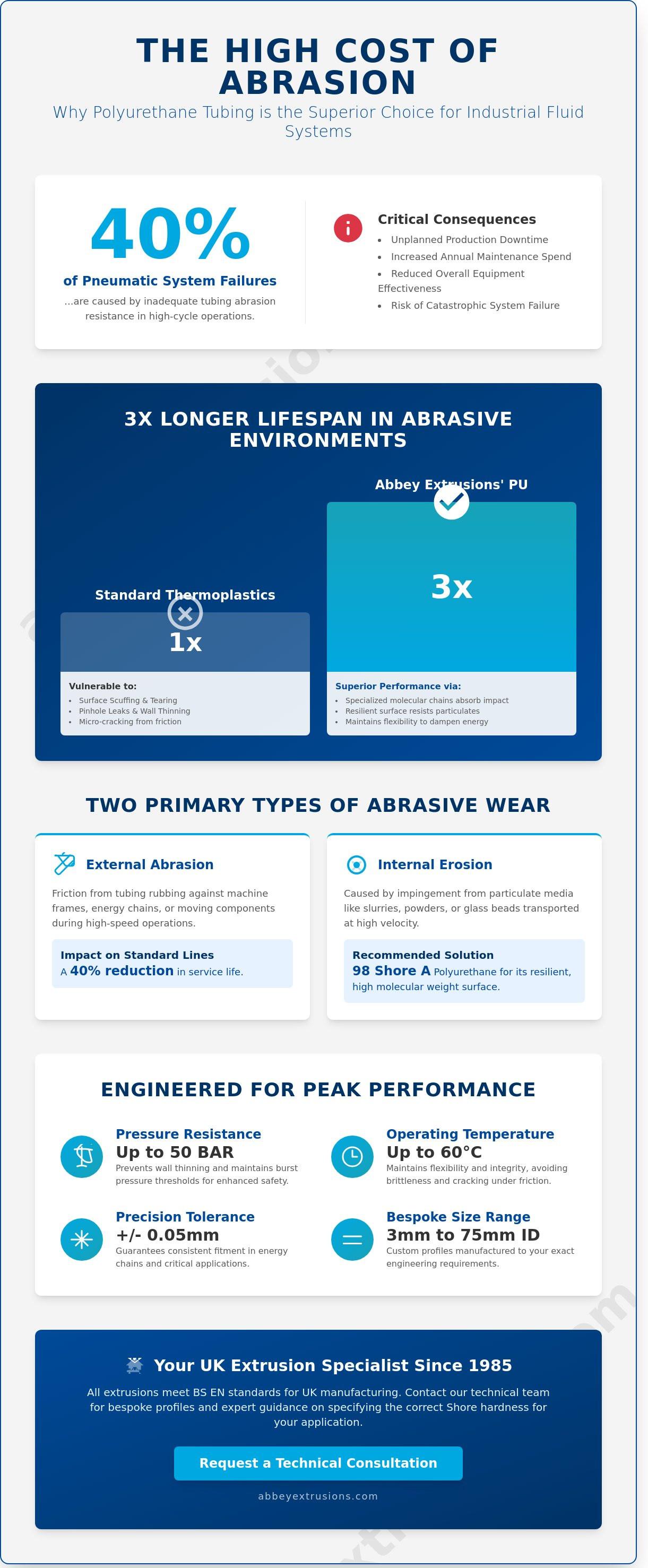
Performance Comparison Between PU and Alternative Polymers
UK industrial maintenance data suggests that pneumatic system failures can cost a facility upwards of £5,000 per hour in lost productivity. Since 1985, Abbey Extrusions has manufactured high-performance tubing to help engineers mitigate these expensive downtime events. Choosing between a rigid nylon or a cost-effective PVC often leads to a compromise in either flexibility or durability. Selecting the correct polymer ensures your polyurethane tubing abrasion resistance meets the specific mechanical demands of your installation.
Polyurethane provides the most effective balance of kink resistance and wear longevity for modern UK manufacturing environments. As UK extrusion specialists, we advocate for PU when the installation requires a tight bend radius of less than five times the tube diameter. While we produce ID sizes from 3mm to 75mm, the material properties of PU allow for a 95 Shore A hardness that remains flexible. This allows the tubing to withstand 20,000 or more abrasion cycles without significant wall thinning or loss of pressure integrity.
We maintain strict manufacturing tolerances of +/- 0.05mm to ensure that every tube fits perfectly with standard push-in fittings. This precision is vital because a loose fit can lead to vibration, which accelerates surface wear at the connection point. In our view, the long-term savings from reduced replacement cycles far outweigh the initial procurement costs of premium polymers. Our technical team assists in matching the Shore hardness to your specific environmental friction levels.
Polyurethane vs Nylon 12 for Impact Resistance
Nylon 12 is a robust choice for high-pressure pneumatic systems that operate at constant pressures up to 50 bar. While nylon tube offers excellent structural rigidity, it lacks the elasticity required for repeated dragging across abrasive factory floors. Nylon exhibits higher notch sensitivity, meaning a surface scratch as shallow as 0.1mm can lead to a catastrophic crack under pressure. PU outperforms Nylon when the application involves repeated bending, as its high tear strength prevents small nicks from propagating into leaks.
PU vs Reinforced PVC in High Cycle Environments
Standard pvc tube provides a cost-effective solution for static fluid transfer but often hardens when exposed to friction-generated heat. Even a reinforced pvc tube with polyester braiding lacks the surface toughness found in high-grade polyurethane. PVC relies on plasticisers for its flexibility, and these chemicals can migrate out of the material over time, causing the tube to become brittle. This migration reduces the polyurethane tubing abrasion resistance of the system as the surface loses its ability to deflect debris. In our view, PU is the superior choice for long-term robotic installations where the tube must endure millions of cycles without cracking.
Contact our technical team to discuss your bespoke extrusion requirements and system specifications.
Engineering Factors for Maximising Tube Service Life
UK manufacturing data indicates that over 60% of pneumatic system downtime results from avoidable hose degradation and surface wear.
Engineers specify our Shore A 98 polyurethane for its high tensile strength and ability to withstand repetitive mechanical cycling.
Improper installation and environmental stressors often compromise the integrity of high-quality materials, leading to expensive maintenance intervals.
We provide these technical guidelines to ensure your fluid systems maintain peak performance throughout their intended lifecycle.
Correct installation procedures prevent approximately 85% of premature abrasion failures in intensive industrial environments. Abbey Extrusions has manufactured high-performance tubing since 1985 to meet these demanding operational standards for ID sizes ranging from 3mm to 75mm.
Calculating the minimum bend radius is essential to prevent stress concentrations on the outer wall of the tube which accelerate wear. System pressure must strictly adhere to a 3 to 1 safety factor ratio to prevent material fatigue or bursting during peak surges.
Best practice dictates that engineers should use nylon spiral cut hose guard in zones where extreme friction occurs. This sacrificial layer protects the core tube from mechanical wear when the assembly moves against rigid machine frames or concrete flooring.
Bend Radius and Kink Resistance Specifications
A 4mm OD polyurethane tube successfully achieves a bend radius of 10mm without restricting internal fluid flow or causing wall collapse. These tight radii allow for compact machine builds while maintaining a strict +/- 0.05mm dimensional tolerance across the production run.
Polyurethane maintains its circular cross-section under vacuum conditions more effectively than thin-walled LDPE alternatives. This structural integrity ensures that fluid delivery remains consistent even when the tubing is routed through complex internal geometries in robotic arms.
Temperature Effects on Material Toughness
The polyurethane tubing abrasion resistance decreases as the polymer temperature approaches its specific glass transition point. Operating near the 80°C thermal limit requires a significant reduction in the standard 10 bar working pressure to prevent permanent deformation.
Low-temperature flexibility ensures the material remains resilient and does not become brittle at temperatures as low as -20°C. We ensure our PU formulations maintain their Shore A hardness across this broad temperature range to prevent surface scarring and micro-cracking.
Bespoke Polyurethane Extrusion from Abbey Extrusions
UK manufacturing output for polymer extrusions reached approximately £12 billion in recent years.
Abbey Extrusions has refined the production of polyurethane tube since 1985.
Industrial systems often fail when standard off-the-shelf tubing cannot withstand specific friction levels or tight housing constraints.
Our bespoke extrusion process delivers exact specifications to enhance polyurethane tubing abrasion resistance in demanding environments.
As UK extrusion specialists, we advocate for precise material selection to maximise the lifespan of your components. We manufacture ID sizes from 3mm to 75mm to meet the specific requirements of various pneumatic and hydraulic systems.
Bespoke Manufacturing and Tooling Capabilities
We offer custom colours and branding for large scale industrial orders starting at 500 metres. This allows for easy identification of lines within complex factory layouts and ensures brand consistency across your machinery.
In-house tooling allows for rapid prototyping of non-standard profiles within a 10-working-day window. This capability ensures your project stays on schedule without the delays associated with external toolmakers.
Our technical team provides material selection advice for specific abrasive media. We recommend specific Shore A hardness levels to ensure the tubing resists wear from grit, slurry, or sharp particles.
Bespoke tube forming services allow for pre-bent shapes in complex assemblies. These permanent bends eliminate the need for elbow joints and reduce the risk of leaks in tight 90-degree installations.
Quality Assurance and Tolerance Standards
Every metre of tubing undergoes rigorous quality checks using laser micrometres during the extrusion process. We don't compromise on the integrity of our materials or the safety of your fluid systems.
We maintain strict manufacturing tolerances of +/- 0.05mm for all PU extrusions. This precision ensures that every tube fits securely into push-fit connectors without requiring manual adjustment or causing pressure drops.
We ensure consistent wall thickness to prevent weak spots in high-pressure lines rated up to 50 bar. Consistent wall density is essential for maintaining polyurethane tubing abrasion resistance over thousands of operational cycles.
Our facility is equipped to handle both small batches and high-volume production runs. We prioritise technical excellence to maintain our reputation as a leading British manufacturer.
We remain fully committed to the rigorous quality benchmarks established by British manufacturing standards.
Optimising System Longevity Through Technical Precision
Selecting materials with high polyurethane tubing abrasion resistance ensures industrial systems maintain integrity under the most demanding friction-heavy conditions. This resilient polymer outperforms standard alternatives by offering specific Shore A hardness levels that effectively resist surface scarring and material degradation.
Abbey Extrusions has refined these specialised manufacturing processes since 1985 to deliver bespoke profiles that meet your engineering requirements. We maintain strict tolerances of +/- 0.05mm across our entire range of internal diameters, which span from 3mm up to 75mm.
Implementing these high-pressure standards, capable of withstanding up to 50 bar, prevents premature failure in fluid systems and reduces long-term maintenance costs. As UK extrusion specialists, we advocate for using precision-engineered PU to protect critical infrastructure from the effects of abrasive wear.
Our team's committed to providing the technical expertise needed to enhance your operational efficiency. We look forward to discussing how our British-made components, ranging from 3mm to 75mm, can support your next high-performance project.
Frequently Asked Questions
Why polyurethane offers better abrasion resistance than PVC
Polyurethane provides significantly higher abrasion resistance than standard PVC due to its superior molecular tear strength. In our view, PU can last up to five times longer than PVC in high-friction environments where elastic recovery is essential for longevity.
Recommended Shore A hardness for abrasive environments
We recommend a Shore A hardness of 98 for most pneumatic applications to ensure surface durability and structural rigidity. For softer applications, Shore A 85 may be utilised although it offers less resistance to sliding friction during operation.
Temperature limits for polyurethane tubing
Our polyurethane tubing operates effectively between -40°C and +80°C while maintaining precision tolerances of +/- 0.05mm. Exposure to temperatures above +80°C will cause the polymer to soften and significantly reduce its polyurethane tubing abrasion resistance.
Maximum working pressure for polyurethane
Standard unreinforced polyurethane tubing handles working pressures up to 10 bar depending on the specific wall thickness. For applications requiring up to 50 bar, we advocate for the use of Nylon 12 or reinforced variants where the burst pressure is rated at three times the working pressure.
Chemical resistance and hydrolysis concerns
Polyurethane offers excellent resistance to oils and fuels but can be susceptible to hydrolysis when exposed to water-based fluids exceeding 50°C. We suggest using Ether-based PU for constant moisture exposure to prevent the material from degrading prematurely.
Minimum bend radius for 10mm tubing
A typical 10mm OD polyurethane tube with a 1.5mm wall thickness has a minimum bend radius of approximately 25mm. This allows for exceptional routing flexibility in confined cabinets without the risk of kinking or flow restriction at the bend apex.

Article by
Bryan Cowan
Bryan Cowan is the Founder and Managing Director of Abbey Extrusions Ltd, a leading UK manufacturer of high-quality plastic tubes and hoses. With over 40 years of industry experience, Bryan established the company in 1985, growing it from a startup into a BS ISO9001-registered supplier for global sectors including aerospace, automotive, and pharmaceuticals.
Disclaimer
This article is intended for informational purposes only. Please ensure you seek expert advice or carry out your own research to confirm the information is suitable for your specific needs.