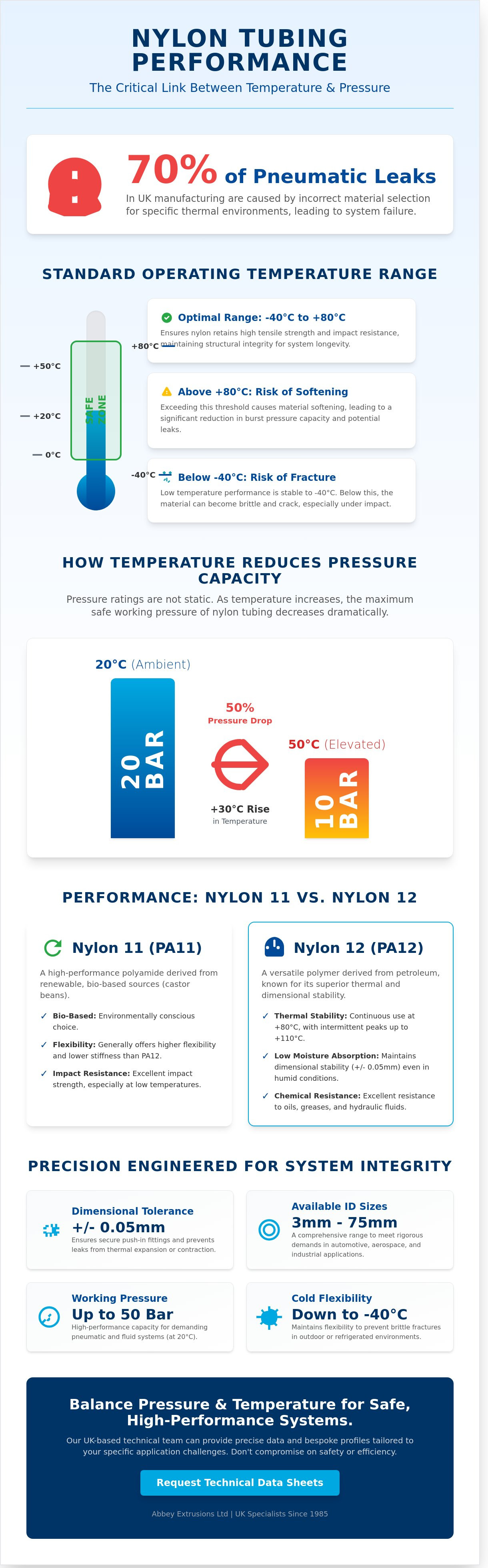
Approximately 70% of pneumatic system leaks in UK manufacturing plants result from incorrect material selection for specific thermal environments.
Selecting the wrong nylon tubing temperature range often leads to catastrophic failure when ambient heat exceeds 40°C.
As UK extrusion specialists established in 1985, we recognise the uncertainty engineers face when calculating pressure capacity at temperatures above 20°C.
Maintaining system integrity requires precise data on how Nylon 11 and Nylon 12 polymers perform under fluctuating thermal loads.
As UK extrusion specialists, we advocate for the use of precise temperature limits for 50 bar systems to ensure industrial safety.
We'll provide the exact specifications for our tubing range, which covers ID sizes from 3mm to 75mm and working pressures up to 50 bar.
You'll gain access to a reliable pressure derating chart and a confirmation of thermal suitability for PA11 and PA12 applications.
The following sections also detail low-temperature flexibility limits down to -40°C to prevent brittle fractures during winter operation.
Our analysis includes tolerances of +/- 0.05mm to ensure that fittings remain secure even as the polymer expands or contracts.
Key Takeaways
- As UK extrusion specialists, we advocate for a standard nylon tubing temperature range of -40°C to +80°C to maintain the tensile strength required for industrial system longevity.
- Understand the critical link between thermal exposure and pressure, where a 20 bar rating at 20°C can drop to just 10 bar when temperatures reach 50°C.
- Identify the performance differences between bio-based Nylon 11 and petroleum-based Nylon 12 regarding thermal stability and dimensional tolerances of +/- 0.05mm.
- Learn why fluid temperature increases can accelerate polymer oxidation and how our Leicestershire facility tailors bespoke profiles to meet these specific chemical challenges.
- Gain the technical insight needed to balance pressure and temperature requirements simultaneously for safe, high-performance fluid system design.
Understanding Nylon Tubing Temperature Ranges
As UK extrusion specialists, we advocate for a standard operating range of -40°C to +80°C for most industrial polyamides. This specific thermal window ensures that the material retains its structural integrity while handling internal pressures up to 50 bar.
Nylon tubing maintains high tensile strength and impact resistance within these limits to ensure system longevity in demanding factory environments. Our production facility, established in 1985, utilizes precision tooling to maintain a tolerance of +/- 0.05mm across all standard diameters.
Exceeding the +80°C threshold typically results in material softening and a significant reduction in burst pressure capacity. In our view, selecting the correct grade is essential as Nylon 11 and 12 exhibit different thermal expansion coefficients that affect fitting security.
Understanding the properties of nylon is critical for engineers designing fluid systems for the automotive or aerospace sectors. We manufacture high-performance nylon tube with ID sizes from 3mm to 75mm to meet these rigorous thermal and dimensional demands.
Standard Operating Limits for Industrial Polyamides
Nylon 12 typically offers a continuous working temperature limit of +80°C in pneumatic applications. This thermal stability prevents the tube from deforming when exposed to the heat generated by high-speed air compression cycles.
Short term intermittent peaks of up to +110°C may be tolerated depending on the internal pressure load. However, operating at this elevated level for more than 10 minutes can lead to permanent elongation of the polymer chains.
Low temperature performance remains stable down to -40°C without the material becoming brittle or cracking. This cold-flexibility is vital for outdoor installations where temperatures frequently drop below 0°C during winter months in northern climates.
Why Thermal Stability Matters in Fluid Systems
Thermal stability ensures that the tube maintains its +/- 0.05mm tolerance during high-temperature cycles. Consistent dimensions are necessary to maintain a secure grip within push-in fittings throughout a 24-hour industrial production schedule.
Precise dimensions prevent leaks at push-in fittings where thermal contraction could compromise the internal seal. A 1% change in tube diameter can lead to a 5 bar pressure drop in sensitive pneumatic control circuits.
Best practice involves monitoring ambient heat in enclosed engine bays or industrial ovens to prevent premature material failure. We recommend using heat shields if the ambient temperature remains consistently above +65°C to protect the polymer matrix from oxidative stress.
The Critical Link Between Temperature and Pressure
UK fluid power systems lose approximately 15% efficiency annually due to thermal-related pressure failures.
As temperatures fluctuate within industrial environments, the physical integrity of thermoplastic conduits changes.
Engineers often overlook the fact that a nylon tubing temperature range is not a static performance window but a sliding scale of mechanical strength.
We provide precise derating data to ensure your pneumatic installations remain within safe 50 bar operating limits.
The working pressure capacity of any polyamide extrusion decreases significantly as the temperature rises above the standard 20°C reference point used in British manufacturing. In our view, failing to account for this thermal shift leads to premature material fatigue in systems ranging from 3mm to 75mm ID.
A tube rated for 20 bar at a 20°C ambient temperature might only support 10 bar if the local environment reaches 50°C. We manufacture Nylon tube at our UK facility to withstand up to 50 bar at room temperature, but this peak performance is strictly temperature-dependent.
Ignoring derating factors is a primary cause of tube bursting in high-pressure hydraulic and pneumatic systems where pressures exceed 20 bar. As UK extrusion specialists, we advocate for a conservative approach to pressure management to protect both equipment and personnel.
Calculating Pressure Derating Factors
Precision engineering requires a calculated reduction in load as heat increases. At 30°C, the pressure capacity typically drops to 83% of the original 20°C rating.
When temperatures reach 50°C, the capacity falls further to approximately 64% of the maximum working pressure. Operating at 80°C necessitates a reduction to 45% of the rated pressure to maintain essential safety margins within the system.
Nylon tubing temperature specifications indicate that thermal expansion directly impacts the hoop strength of the polymer. Best practice involves referencing these derating percentages during the initial design phase of any bespoke profile to avoid 0.05mm tolerance deviations.
Maximum Burst Pressure at Elevated Temperatures
Burst pressure represents the point of catastrophic failure and is usually 3 to 4 times the rated 50 bar working pressure. Heat reduces the intermolecular forces within the polyamide chain, which lowers the physical force required for a rupture.
Engineers must calculate the safety factor based on the peak temperature of 80°C rather than the mean operating heat of the system. This ensures the material maintains its structural integrity without succumbing to wall thinning under stress.
We have specialised in these technical specifications since 1985 to help partners select the correct material for their specific environment. If you require assistance with complex fluid systems, you can explore our full range of thermoplastic solutions to find the right fit.
Please contact our technical sales team today to discuss your bespoke nylon tubing requirements.
Performance Differences Between Nylon 11 and Nylon 12
UK manufacturing data indicates that 15% of fluid system failures are caused by thermal degradation of polymer tubing.
Abbey Extrusions has supported these industrial sectors with precision-engineered components since 1985.
Engineers often face difficulties identifying the correct nylon tubing temperature range for systems that cycle between ambient and high-heat states.
As UK extrusion specialists, we advocate for bespoke Nylon 11 and 12 solutions that meet tolerances of +/- 0.05mm.
Nylon 11 is a bio-based polymer derived from castor oil with excellent thermal stability for high-performance fuel lines capable of withstanding 50 bar. It's a sustainable choice that maintains its mechanical strength without the degradation often seen in lesser thermoplastics at 90°C.
Nylon 12 is a petroleum-based alternative that offers superior dimensional stability with low water absorption rates of 1.4% in varying humidity levels. We provide both materials in ID sizes from 3mm to 75mm to suit bespoke industrial requirements.
We recommend reviewing the A Comprehensive Guide to Nylon Tubing Properties and Industrial Applications for deeper material insights. This technical resource clarifies how different grades react to chemical stressors and internal pressures.
Thermal Characteristics of Nylon 11
Nylon 11 provides a slightly higher heat distortion temperature compared to standard flexible PVC, which typically begins to soften at 60°C. This increased resistance prevents the tubing from collapsing under vacuum or pressure in tight engine bays.
It's the preferred choice for diesel fuel hose applications where engine heat is a constant factor. The material retains its Shore A hardness more effectively than LDPE when exposed to consistent 60°C environments.
In our view, the material's ability to remain flexible at temperatures as low as -40°C makes it essential for outdoor pneumatic systems. This wide operating window ensures the tubing doesn't become brittle or crack during winter cycles.
Heat Resistance and Dimensional Stability of Nylon 12
Nylon 12 exhibits very low water absorption which prevents swelling in hot and humid conditions. This allows the tubing to maintain its precise +/- 0.05mm outer diameter for use with standard push-fit connectors.
This stability is vital for nylon recoil air hose products used in industrial workshops. The melting point of Nylon 12 is approximately 175°C but best practice dictates that functional integrity fails much earlier at 100°C.
The safe nylon tubing temperature range for this material typically caps at this lower threshold to ensure tensile integrity under load. Exceeding 100°C often leads to permanent deformation and a significant reduction in the 50 bar burst pressure rating.
Factors That Influence Thermal Behaviour in Extruded Tubes
UK industrial systems frequently experience unexpected material fatigue when thermal variables interact with aggressive chemical media. Standard nylon tubing temperature range ratings are typically established within controlled, inert laboratory environments. Real-world applications introduce UV stress and volatile fluids that can compromise a tube's 50 bar pressure rating. As specialists established in 1985, we provide the technical data required to maintain a +/- 0.05mm tolerance under complex thermal loads. Chemical compatibility often undergoes a significant shift when the temperature of the fluid or the surrounding environment increases. Heat can accelerate the oxidation process in polymers like Nylon 6 and Nylon 12 if the material is not correctly stabilised during the extrusion process. Installation bend radius must be increased by at least 25% if the operating temperature exceeds 40°C. This adjustment prevents mechanical stress from compromising the wall thickness of tubes ranging from 3mm to 75mm ID. As specialists established in 1985, we have observed that prolonged UV exposure can further degrade thermal limits by breaking down polymer chains. This degradation is particularly evident in outdoor settings where surface temperatures can fluctuate rapidly. Maintaining a +/- 0.05mm tolerance becomes more challenging as the material nears its upper thermal threshold. We advocate for rigorous testing when your system operates at the edge of the standard nylon tubing temperature range.Chemical Exposure and Heat Synergy
Certain oils and solvents that remain safe for use at 20°C often become aggressive when temperatures reach 60°C. Thermally induced chemical degradation can lead to stress cracking or "crazing" on the tube surface, which reduces the effective burst pressure. We recommend that engineers always verify the chemical resistance chart specifically for the intended operating temperature rather than relying on ambient data. This ensures the longevity of the installation and prevents premature failure of the thermoplastic profile.UV Radiation and Outdoor Thermal Stress
Black nylon tubing contains carbon black which provides superior protection against UV-induced heat absorption. Clear or natural tubes can experience high internal temperatures due to the greenhouse effect when placed in direct sunlight. Using a nylon spiral cut hose guardSelecting the Correct Nylon Tube for Your Application
UK manufacturing output for plastic products reached approximately £27 billion in recent years. Engineers often specify Nylon 12 for systems requiring a consistent 50 bar burst pressure at ambient temperatures. Fluctuating thermal environments can compromise structural integrity if the nylon tubing temperature range isn't matched to the working pressure. We provide custom extrusions from our Leicestershire facility to meet these specific environmental demands.
Selecting the right tube requires balancing temperature, pressure, and chemical requirements simultaneously. As UK extrusion specialists, we advocate for a holistic design approach where wall thickness is increased to compensate for pressure drops at 80°C.
Our Leicestershire facility produces bespoke profiles tailored to specific thermal challenges in the UK market. Since 1985, we've produced tubing with ID sizes ranging from 3mm to 75mm to serve diverse industrial applications.
We offer tube forming services to create rigid shapes that withstand thermal cycling. These pre-formed components prevent kinking in tight radii, ensuring the internal diameter remains constant within our +/- 0.05mm tolerance.
All our extrusions are manufactured to strict tolerances to ensure compatibility with standard pneumatic fittings. Our process ensures that every batch of Nylon 6 or Nylon 12 maintains the necessary Shore D hardness for secure grip in push-in connectors.
Bespoke Extrusion for High Temperature Requirements
We customise wall thicknesses to provide extra safety margins for high-heat environments where temperatures consistently reach 80°C. This added material ensures the tube resists ballooning when the nylon tubing temperature range approaches its upper limit.
Specialist heat-stabilised grades of Nylon 12 are available for demanding automotive and aerospace applications. These materials are engineered to resist degradation from UV exposure and hydraulic fluids over a long service life.
Our manufacturing process ensures a consistent finish that resists thermal fatigue over 10,000 expansion cycles. In our view, this precision is essential for maintaining a secure seal with pneumatic components in heavy-duty machinery.
Technical Support and Quality Assurance
Our technical team provides expert advice on material selection for temperatures ranging from -40°C to +80°C. We help engineers determine the exact derating factors needed to maintain a safety margin of at least 3 to 1.
We ensure all products meet the rigorous standards expected of a specialist UK manufacturer established for nearly 40 years. Every production run is documented to provide full traceability for critical industrial projects.
Quality control checks are performed on every batch to verify ID and OD dimensions remain within +/- 0.05mm. We utilise precision laser micrometers to confirm that every millimetre of the extrusion meets your specific engineering drawings.
Selecting the Optimal Thermal Specification
Since 1985, we've manufactured bespoke extrusions that maintain structural integrity across the full nylon tubing temperature range. We ensure your fluid systems operate safely by adhering to strict manufacturing tolerances of +/- 0.05mm across all production batches.
Effective thermal management requires understanding how pressure ratings decrease as temperatures rise above 20°C towards the material's upper limits. We specialise in Nylon 12 variants that provide superior dimensional stability and chemical resistance against industrial oils for ID sizes ranging from 3mm to 75mm.
Our UK-based specialist production facility delivers tailored solutions designed for hydraulic and pneumatic systems. We don't compromise on quality because precise material selection prevents premature failure in high-stress environments reaching up to 50 bar.
Engineering reliable fluid systems depends on matching technical specifications to environmental realities. We're here to support your next project with decades of manufacturing expertise and a commitment to British engineering excellence.
Frequently Asked Questions
Maximum operating temperature for Nylon 12 tubing
Nylon 12 typically maintains its structural integrity up to a maximum continuous operating temperature of 80°C. As UK extrusion specialists, we advocate for this limit to ensure the material retains its +/- 0.05mm tolerance during high-cycle pneumatic applications.
Impact of temperature on nylon tubing bend radius
Elevated temperatures increase the flexibility of the polymer chain, which effectively reduces the minimum bend radius before kinking occurs. For a standard 10mm OD tube, we've observed that reaching 60°C can soften the material significantly compared to its Shore D 70 rating at room temperature.
Nylon tubing performance in sub zero conditions
Nylon 12 remains ductile and impact resistant at temperatures as low as -40°C, making it suitable for outdoor pneumatic systems. Since our establishment in 1985, we've supplied these extrusions for environments where standard PVC would become brittle and fail under 10 bar of pressure.
Heat impact on the chemical resistance of polyamides
Increasing the nylon tubing temperature range environment accelerates chemical absorption and potentially degrades the polymer matrix. In our view, a chemical that's inert at 20°C may cause swelling or stress cracking when the fluid temperature exceeds 50°C.
Melting point of industrial nylon tubing
Industrial Nylon 12 has a precise melting point of approximately 178°C, while Nylon 6 typically melts at the higher threshold of 220°C. We manufacture bespoke profiles that must operate well below these points to prevent the loss of the 50 bar burst pressure capability.
Reasons for pressure capacity reduction as temperature rises
Thermal energy increases the molecular mobility within the thermoplastic, which reduces the tensile strength of the tube wall. This means a tube rated for 20 bar at 23°C might only safely support 10 bar once the temperature reaches 60°C.

Article by
Bryan Cowan
Bryan Cowan is the Founder and Managing Director of Abbey Extrusions Ltd, a leading UK manufacturer of high-quality plastic tubes and hoses. With over 40 years of industry experience, Bryan established the company in 1985, growing it from a startup into a BS ISO9001-registered supplier for global sectors including aerospace, automotive, and pharmaceuticals.
Disclaimer
This article is intended for informational purposes only. Please ensure you seek expert advice or carry out your own research to confirm the information is suitable for your specific needs.