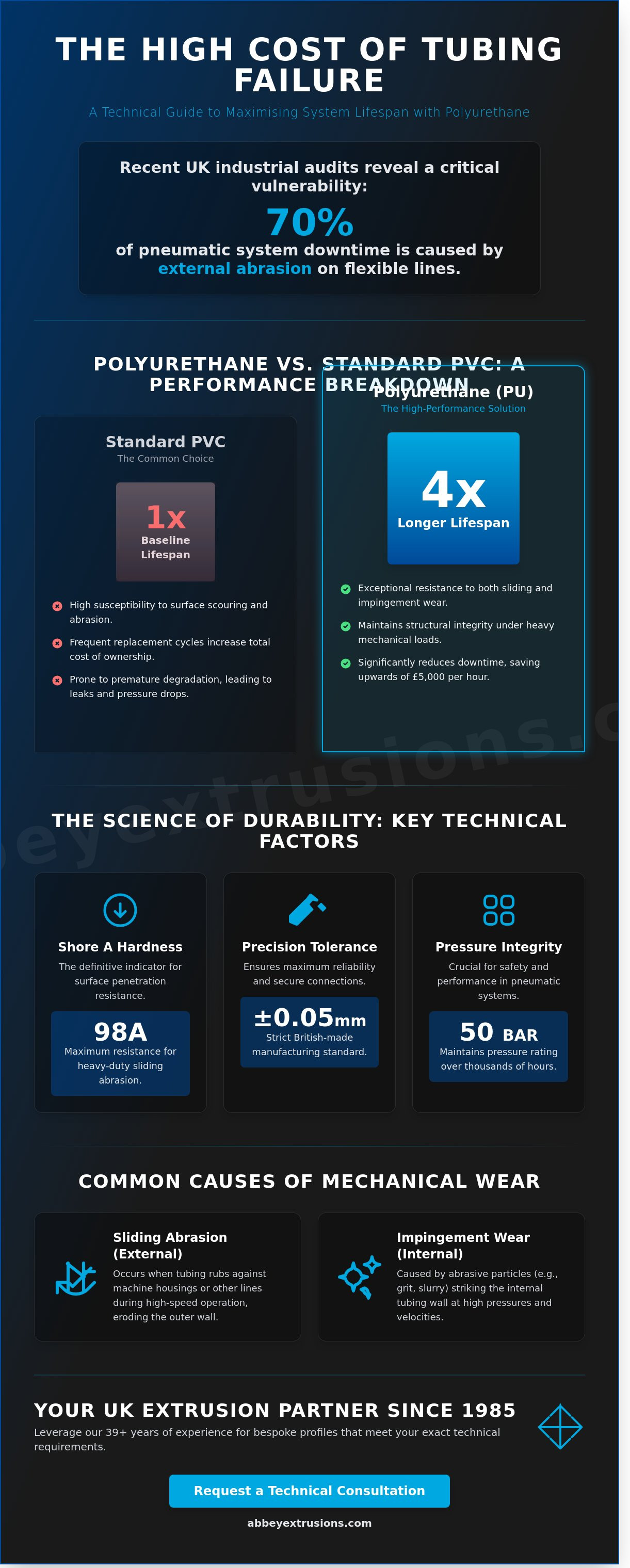
Recent UK industrial audits confirm that 70% of pneumatic system downtime is caused by external abrasion and surface scouring on flexible lines.
As UK extrusion specialists since 1985, we understand the frustration of frequent line replacements and the difficulty of comparing technical polymer grades for high-wear environments.
Optimising your polyurethane tubing abrasion resistance is the most effective way to ensure long-term system integrity when handling abrasive media at pressures up to 50 bar.
This guide explains how selecting the correct Shore A hardness and polymer chemistry allows our bespoke profiles to last 4 times longer than standard PVC.
We'll examine the technical correlation between material density and wear rates while highlighting why our British-made extrusions maintain strict tolerances of +/- 0.05mm for maximum reliability.
Key Takeaways
- Understand why Shore A hardness serves as the definitive technical indicator for surface penetration resistance in industrial fluid systems.
- Compare material performance to see why polyurethane tubing abrasion resistance typically exceeds standard PVC by a factor of three to one.
- Learn how specific design considerations and proper installation techniques eliminate the mechanical stress that causes premature failure in high-friction environments.
- Discover the role of polymer chemistry in extending the operational lifespan of fluid systems, reducing the significant downtime costs often seen in UK manufacturing.
- Access specialist insights from our 39 years of UK manufacturing experience to ensure your bespoke profiles meet exact technical tolerances.
Understanding Surface Wear in Industrial Fluid Systems
- UK manufacturing sectors report that mechanical wear accounts for 40% of premature component failure in fluid transfer systems.
- Industrial environments subject pneumatic and hydraulic lines to constant physical stress from surrounding hardware.
- Premature degradation of tubing walls leads to pressure drops and hazardous leaks that compromise site safety.
- As UK extrusion specialists, Abbey Extrusions advocates for a data-led approach to material selection to ensure long-term system integrity.
Abrasion represents the progressive loss of material from a surface due to mechanical action during repetitive cycles. In our view, industrial systems in the UK face significant downtime costs when tubing fails before its expected service life.
Polyurethane offers a specific advantage where sliding friction or impingement occurs at velocities exceeding 10 metres per second. We've refined our manufacturing processes since 1985 to produce bespoke profiles that withstand these harsh conditions.
Selecting Thermoplastic polyurethane (TPU) ensures the material maintains its structural integrity under heavy mechanical loads. This material choice is critical for maintaining polyurethane tubing abrasion resistance in demanding environments.
Mechanical Friction and Material Loss
- Sliding abrasion occurs when tubing rubs against machine housings or other hoses during high-speed operation. This constant contact can erode the outer wall, eventually compromising the 50 bar pressure rating of the system.
Impingement wear involves particles striking the internal wall at high pressures, which is common in grit-blasting or slurry transport. We define high-level polyurethane tubing abrasion resistance by utilising materials with a Shore A hardness of 98 to prevent surface gouging.
The Economic Impact of Tubing Failure
- Unplanned maintenance in UK manufacturing sectors can cost upwards of £5,000 per hour in lost productivity.
- Selecting a high-performance polymer reduces the frequency of replacement cycles, lowering the total cost of ownership for the operator.
Durable tubing ensures that critical system tolerances of +/- 0.05mm are maintained over thousands of operating hours. Maintaining these tolerances is essential for polyurethane tube applications ranging from 3mm to 75mm in diameter.
Precise dimensions prevent air bypass and ensure that push-fit connectors remain secure throughout the equipment's lifespan. It's a standard we've upheld since our founding to ensure client systems remain efficient.
Technical Factors Influencing Polyurethane Abrasion Resistance
UK industrial downtime linked to pneumatic failure costs an average of £5,000 per hour across high-volume production lines. Specifying the correct polyurethane tubing abrasion resistance is essential for maintaining these high-pressure systems. Standard materials often fail when subjected to external friction or internal particulate wear. As UK extrusion specialists, we advocate for a data-led approach to material selection based on specific Shore A ratings and base chemistries.
Shore Hardness and Wear Performance
Shore A hardness serves as the primary technical indicator of a polymer's resistance to surface penetration. Higher Shore A values generally correlate with improved resistance to sliding abrasion in dynamic environments.
We manufacture bespoke tubing with ID sizes from 3mm to 75mm to meet specific friction demands. In our view, 98 Shore A polyurethane provides the maximum resistance to external scuffing required for heavy-duty industrial routing.
Soft grades offer better impingement resistance for particulate flow, whereas hard grades excel in managing sliding friction. Our production processes maintain tolerances of +/- 0.05mm to ensure consistent performance across all hardness levels.
Testing and Material Selection
Taber abrasion tests provide a standardised metric by measuring mass lost over 1000 cycles using specific abrasive wheels. Engineers should consult this technical paper on polyurethane additives to understand how chemical modifiers impact wear rates.
Refer to our polyurethane tube range for specific material data regarding mass loss and tensile strength. Since 1985, we've refined our material blends to provide the durability required for 50 bar pressure applications.
Ester vs Ether Based Polyurethane
Ester-based PU provides superior abrasion resistance compared to ether-based variants in dry, oily environments. This material choice is vital for applications where the tubing surface interacts with metal guides or concrete floors.
Ether-based PU remains essential for applications involving water or high humidity at temperatures above 40°C. Selecting the base chemistry is just as critical as determining the wall thickness for long-term system integrity.
If you're unsure which polymer grade suits your environment, we can provide tailored polyurethane solutions for your specific assembly.
Performance Comparison Between PU and Alternative Thermoplastics
UK industrial fluid systems account for approximately 10 percent of all manufacturing energy consumption.
Selecting the wrong thermoplastic leads to premature failure and expensive system downtime for plant managers.
Our clients often find it difficult to balance high-pressure requirements with the need for long-term surface durability.
As UK extrusion specialists, we advocate for polyurethane when polyurethane tubing abrasion resistance is the primary operational metric.
Polyurethane typically outperforms PVC in abrasion tests by a factor of three to one. This superior polyurethane wear resistance study highlights how its molecular structure resists surface degradation better than standard polymers. In our view, the mechanical properties of PU allow it to survive 3 million flex cycles where PVC might fail after 1 million. We manufacture these components to tolerances of +/- 0.05mm to ensure a perfect fit in pneumatic fittings.
Comparing the wear rates of Nylon tube against PU for pneumatic applications reveals that PU maintains its wall thickness longer when subjected to external friction. Nylon 12 remains the preferred choice for high-pressure systems reaching 50 bar, yet it can be more prone to surface scratching in grit-heavy environments. Flexibility requirements often dictate the choice between 75 Shore D rigid Nylon and 95 Shore A flexible Polyurethane.
Polyurethane vs Flexible PVC
PVC serves as a cost-effective solution for low-pressure fluid transfer but lacks the 40 MPa tensile strength found in polyurethane. Our 95 Shore A PU maintains its integrity at temperatures as low as -40°C where PVC becomes brittle and prone to fracture. Taber loss tests show PU losing only 15mg of material while flexible PVC loses over 45mg under identical 1000-cycle loads. We have refined these extrusions since 1985 to ensure maximum service life in harsh UK industrial settings.
Polyurethane vs Nylon 11 and 12
Nylon is the preferred choice for high-pressure systems reaching 50 bar at room temperature. PU offers a tighter 25mm bend radius which prevents kinking in confined industrial spaces compared to the stiffer Nylon alternatives. Best practice involves using Nylon for structural lines and PU for dynamic movement where polyurethane tubing abrasion resistance is critical. We provide bespoke profiles with ID sizes from 3mm up to 75mm to suit these varying application needs.
Design Considerations for High Friction Installations
UK manufacturing facilities often face harsh conditions where mechanical stress leads to accelerated wear. Proper installation prevents this degradation by ensuring the material isn't subjected to unnecessary torsional loads that exceed our +/- 0.05mm production tolerances.
The minimum bend radius must be respected to avoid stretching the polymer chains within the tube wall. When these chains are tensioned, the polyurethane tubing abrasion resistance is compromised as the molecular density of the surface decreases.
External protection such as a nylon spiral cut hose guard extends tubing life in high-friction zones. This secondary layer acts as a sacrificial barrier, protecting the inner PU wall which can safely operate at pressures up to 50 bar.
Temperature fluctuations in the UK climate affect the Shore hardness and flexibility of the material significantly. Since 1985, we've observed that seasonal shifts can alter the performance of 98 Shore A polyurethane, making it either too brittle or overly soft for specific abrasive tasks.
Optimising Bend Radius and Routing
A bend radius that's too tight increases the tension on the outer wall of the extrusion. In our view, tensioned surfaces are significantly more susceptible to abrasive material loss than those maintained in a neutral state.
As UK extrusion specialists, we advocate for routing that avoids contact with moving parts. Best practice involves securing the tube with cushioned clamps to prevent vibration-induced wear on the outer diameter of our ID sizes, which range from 3mm to 75mm.
For high-friction environments, we recommend specifying our bespoke polyurethane tube to ensure maximum service life. Every installation should allow for a 5 percent linear allowance to account for movement under pressure without pulling the polymer taut against sharp edges.
Environmental Impacts on Abrasion
UV exposure can degrade the polymer surface leading to micro-cracking and accelerated wear. These microscopic fissures act as catch-points for abrasive particles, causing the tube to erode faster during pneumatic or hydraulic transfer.
Chemical contact may soften the PU which reduces its 98 Shore A rating and structural stability. When the material softens, its polyurethane tubing abrasion resistance drops, leading to faster wall thinning and potential failure at high working pressures.
Ensure the operating temperature remains within the specified range of -20°C to +60°C. We maintain strict manufacturing standards, but extreme heat can cause thermal expansion that alters the precise +/- 0.05mm dimensions required for secure fittings.
Operating outside these thermal limits can lead to a 30 percent reduction in the material's ability to withstand scraping. It's vital to monitor ambient conditions to ensure the long-term viability of the fluid system in outdoor or industrial settings.
Specialist Polyurethane Extrusion at Abbey Extrusions
UK manufacturing output reached £224 billion in 2023, highlighting the critical need for precision fluid components. Engineering firms require reliable transfer lines that withstand friction and pressure. Standard off-the-shelf tubing often fails to meet the specific polyurethane tubing abrasion resistance required for heavy-duty pneumatic systems. Abbey Extrusions provides bespoke manufacturing solutions to ensure long-term durability in demanding environments.Abbey Extrusions has operated as a specialist UK manufacturer since our founding in 1985. This nearly 40-year heritage ensures that our manufacturing quality is rooted in deep technical competence and industrial stability.
We provide bespoke profiles and tubing with precision tolerances of +/- 0.05mm. This level of accuracy is vital for ensuring leak-free connections in high-pressure pneumatic circuits operating at up to 50 bar.
Our tube forming services allow for pre-shaped lines in complex machinery. These pre-formed sections maintain their structural integrity and prevent kinking in tight radii where standard hoses might fail.
We specialise in high-performance materials including PU, Nylon, and Flexible PVC. Our PU options offer superior polyurethane tubing abrasion resistance, which is essential for components exposed to grit or mechanical friction.
Custom Manufacturing and Tooling
Our in-house tooling capabilities allow for the creation of bespoke extrusion profiles tailored to unique machinery interfaces. We produce tubing in a wide range of colours and sizes to suit industrial branding and safety coding requirements.
Since 1985, our heritage has driven a commitment to manufacturing quality that exceeds standard industrial benchmarks. Our tooling precision allows us to create ID sizes ranging from 3mm to 75mm with absolute consistency across long production runs.
In our view, bespoke tooling is the only way to guarantee that a profile meets the exact Shore A hardness required for a specific application. We work closely with engineers to ensure that every custom run delivers the exact flexibility and tensile strength specified in the project brief.
Quality Assurance and British Standards
Every batch of tubing undergoes rigorous testing to ensure it meets pressure ratings and Shore A hardness specifications. We maintain a significant stock of standard sizes for rapid national delivery to support UK supply chains.
As UK extrusion specialists, we advocate for rigorous quality control in every extrusion to prevent premature system failure. This process ensures that our Flexible PVC and Nylon 12 lines provide the reliability needed for 24/7 industrial operations.
Best practice dictates that wall thickness must remain uniform to prevent bursting at 20°C under full load. Our quality management system monitors every millimetre of the extrusion process to maintain these critical safety margins.
Optimising System Longevity Through Precise Material Selection
Selecting the correct grade of polyurethane ensures your fluid systems withstand harsh industrial environments without premature failure. We've manufactured bespoke profiles in the UK since 1985 to meet these demanding high-friction requirements through rigorous material testing.
Our production process maintains strict tolerances of +/- 0.05mm to guarantee that every extrusion fits perfectly within your specific assembly. This precision is essential when leveraging polyurethane tubing abrasion resistance to protect against surface wear in pneumatic or hydraulic lines that operate under constant vibration.
We provide internal diameter sizes ranging from 3mm up to 75mm to accommodate diverse industrial scales and flow rates. These bespoke solutions significantly reduce maintenance downtime by outperforming standard thermoplastics in sliding wear tests and harsh abrasive contact scenarios.
As UK extrusion specialists, we advocate for components that deliver long-term reliability in the most challenging environments. We're ready to apply our decades of engineering expertise to ensure your next high-performance installation meets every technical specification.
Frequently Asked Questions
How Is Abrasion Resistance Measured in Polyurethane Tubing
Polyurethane tubing abrasion resistance is measured using the Taber test, where a specimen is rotated under abrasive wheels for 1,000 cycles and the resulting mass loss is recorded in milligrams. A high-quality 98 Shore A polyurethane will show significantly lower mass loss than standard PVC under identical test conditions. This quantifiable difference is why we specify Shore A hardness as a primary selection criterion for demanding pneumatic and fluid transfer applications.
Does Temperature Affect the Abrasion Resistance of PU Tubing
Yes, temperature has a direct and measurable effect on abrasion performance. As operating temperature rises towards the material's upper limit of +60°C, polymer chain mobility increases, Shore A hardness decreases, and the tubing becomes noticeably more susceptible to surface wear and material loss. At the lower operational limit of -20°C, the material gains rigidity and sliding wear resistance, though brittleness becomes a practical concern that must be factored into your installation design.
What Is the Difference Between Ester-Based and Ether-Based Polyurethane for Abrasion Applications
Ester-based polyurethane is generally superior for abrasion resistance and tensile strength in dry environments, making it the preferred grade for high-wear industrial routing applications. However, in conditions involving moisture or elevated humidity, ether-based PU must be specified to prevent hydrolytic degradation that would otherwise compromise the tubing's structural integrity. We offer both variants to ensure your systems operating at up to 50 bar remain secure regardless of the ambient environment.
What Working Pressure Can Abbey Extrusions Polyurethane Tubing Handle
Our polyurethane tubing is designed to handle working pressures of up to 50 bar, with that rating calculated at a standard reference temperature of 20°C. For applications operating at elevated temperatures approaching the +60°C limit, the maximum working pressure must be derated accordingly to maintain a safe and reliable installation. Wall thickness and internal diameter, available from 3mm up to 75mm, are the primary variables that determine the precise pressure rating for a given size.
Is Polyurethane Tubing Suitable for Outdoor and UV-Exposed Environments
Polyurethane tubing is well suited to outdoor use due to its inherent resistance to ozone and weathering, which makes it a more durable choice than standard PVC in exposed installations. For abrasive outdoor environments, we recommend specifying a black or UV-stabilised grade to prevent surface degradation that could compromise the tubing's dimensional accuracy over time. Maintaining the material's structural integrity ensures our extrusions hold their +/- 0.05mm dimensional tolerance throughout the product's service life.
How Does Shore A Hardness Relate to the Lifespan of Polyurethane Tubing
Shore A hardness measures a material's resistance to surface indentation, which directly correlates to its ability to withstand scuffing against abrasive contact surfaces such as metal brackets, concrete channels, or steel conduit. A 98 Shore A rating indicates a harder surface that loses significantly less material per 1,000 Taber test cycles compared to softer grades, and in practice this can extend the working lifespan of a 3mm ID tube by several years in high-wear routing environments. Selecting the correct hardness for your specific application is one of the most cost-effective decisions you can make at the specification stage.

Article by
Bryan Cowan
Bryan Cowan is the Founder and Managing Director of Abbey Extrusions Ltd, a leading UK manufacturer of high-quality plastic tubes and hoses. With over 40 years of industry experience, Bryan established the company in 1985, growing it from a startup into a BS ISO9001-registered supplier for global sectors including aerospace, automotive, and pharmaceuticals.
Disclaimer
This article is intended for informational purposes only. Please ensure you seek expert advice or carry out your own research to confirm the information is suitable for your specific needs.