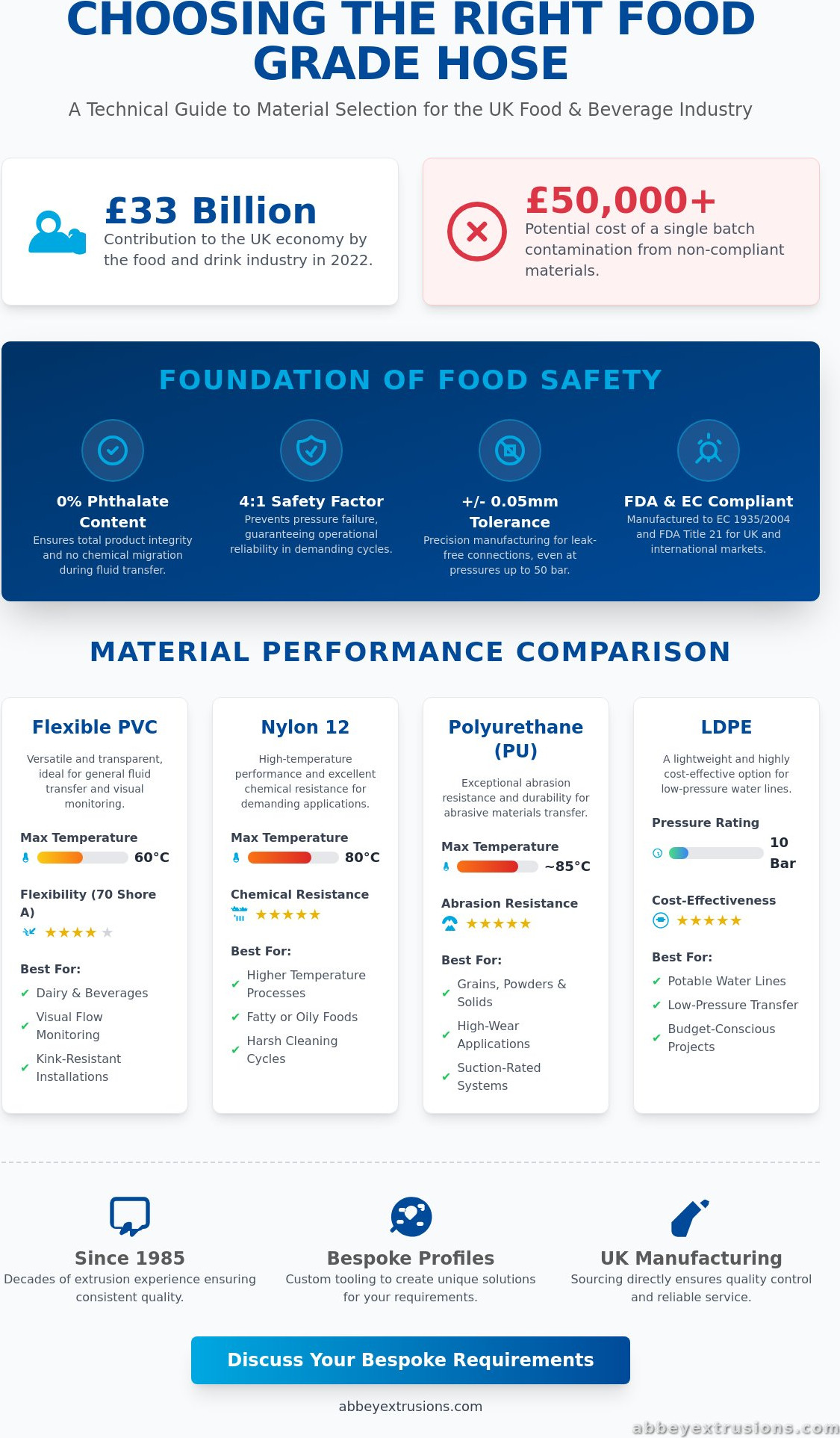
The UK food and drink industry contributed £33 billion to the economy in 2022, yet a single batch contamination from non-compliant polymers can cost a manufacturer over £50,000 in wasted stock.
You likely understand that maintaining a sterile environment at 60°C for Flexible PVC or 80°C for Nylon 12 is the foundation of any successful British bottling facility.
We recognise that many engineers struggle with premature failure when internal pressures reach 50 bar or when leaching polymers compromise FDA compliance, so this guide provides the technical data needed to select the correct food grade hoses for your specific application.
As UK extrusion specialists, we advocate for a systematic approach to material selection, examining the performance differences between PU and LDPE for bespoke profiles meeting a +/- 0.05mm tolerance manufactured here since 1985.
Key Takeaways
- Learn how the Anchor Rule ensures 0% phthalate content in our conduits to maintain total product integrity during fluid transfer.
- Compare the chemical resistance of Nylon 12 against Flexible PVC to determine the most durable material for your dairy or beverage application.
- Discover how a 4:1 safety factor prevents pressure failure in food grade hoses and how specific centigrade intervals affect working pressure.
- Evaluate the benefits of suction-rated vacuum systems and learn how our bespoke tooling process creates unique profiles tailored to your manufacturing requirements.
- Understand the technical advantages of sourcing directly from a UK manufacturer established in 1985 to ensure consistent quality and service.
The UK food and beverage sector generates approximately £33 billion in gross value added each year.
Manufacturers require precise fluid transfer systems to maintain the purity of these high-volume consumable goods.
Standard tubing often fails to meet hygiene requirements due to the migration of toxic plasticisers into the product stream.
We provide certified food grade hoses that eliminate contamination risks through advanced thermoplastic engineering.
Understanding Food Grade Hoses and Safety Standards
Food grade hoses are non-toxic conduits specifically engineered for zero-leach fluid transfer in sterile environments. Our commitment to product integrity is demonstrated through a 0% phthalate content, ensuring no chemical migration occurs during contact with consumables.
In our view, compliance is the foundation of any successful manufacturing partnership. We manufacture these solutions in accordance with EC 1935/2004 and FDA regulations to guarantee safety for both UK and international markets.
Since our foundation in 1985, we've refined our extrusion processes to deliver the technical excellence required by the food industry. This decades-long experience allows us to maintain strict quality control over every batch of food grade hoses we produce.
We specialise in working with approved materials such as Flexible PVC, Polyurethane (PU), and LDPE. These materials are selected for their inert properties and their ability to withstand the thermal demands of modern production lines.
Regulatory compliance for food contact
FDA Title 21 dictates the chemical composition of thermoplastic polymers used for transferring aqueous and fatty liquids. This regulation ensures that every component in the material matrix is safe for human consumption.
Strict migration testing is essential for materials in contact with fatty foods to prevent the absorption of non-polar contaminants. We verify that our polymers remain stable and don't leach substances into oils or fats during prolonged contact.
Our specialist brewery hose adheres to these hygienic standards while offering the flexibility of a 70 Shore A material. This specific hardness ensures the hose remains easy to handle while resisting kinks in tight installation spaces.
Hygienic design principles for fluid systems
We employ smooth-bore extrusion to eliminate internal crevices where bacteria could accumulate in 3mm to 75mm tubes. A mirror-smooth internal surface reduces turbulence and prevents the entrapment of organic particles during the cleaning cycle.
Best practice involves using a clear finish to allow for constant visual flow monitoring during high-pressure cycles. This transparency is vital for identifying air bubbles or blockages that could disrupt a production run.
Food quality variants are distinct from industrial hoses because they don't impart any detectable odour or taste to the fluid. This neutrality is critical for maintaining the sensory profile of delicate products like spring water or dairy.
As UK extrusion specialists, we advocate for tolerances of +/- 0.05mm to ensure leak-free connections at pressures up to 50 bar. Precise dimensions are necessary to prevent fluid bypass at the coupling point, which is a common source of contamination.
Material Options for Food Grade Hoses and Tubing
UK food and beverage manufacturing sectors invest over £4 billion in new capital equipment annually to maintain rigorous safety standards. Selecting the correct polymer for food grade hoses ensures these systems operate within strict hygiene and pressure parameters. Mismatched materials often result in production downtime or non-compliance with UK food safety regulations. We utilise our manufacturing experience since 1985 to produce bespoke profiles that meet these precise technical demands.
Best practice in fluid transfer requires a balance between chemical inertness and mechanical durability. As UK extrusion specialists, we advocate for material selection based on the specific fatty acid or alcohol content of the media being moved. Our production facility handles ID sizes from 3mm to 75mm, allowing for precise integration into existing plant infrastructure.
In our view, LDPE or Polyethene provides a highly cost-effective solution for low-pressure water transfer tasks. This material remains stable under working pressures up to 10 bar and offers a lightweight alternative to heavier rubber alternatives. It's particularly effective for potable water lines where complex chemical resistance isn't the primary engineering requirement.
Flexible PVC and Reinforced variants
Clear PVC properties are ideal for ambient temperature food and beverage delivery between 5°C and 60°C. We maintain a Shore A hardness of 65 to 80 for these extrusions, which ensures the tubing remains flexible enough for a 25mm bend radius during installation.
For more demanding tasks, we manufacture reinforced PVC tube that incorporates high-tensile polyester braiding. This internal structure increases the burst pressure up to 50 bar, preventing tube deformation in high-pressure washdown environments. The braiding is encapsulated within the PVC wall to maintain a smooth internal bore, which is essential for preventing bacterial growth.
Advanced polymers for demanding environments
Polyurethane (PU) offers 100% abrasion resistance for dry food transfer, such as grain or sugar processing. This material outlasts standard PVC in high-friction scenarios and maintains its 85 Shore A flexibility even in colder UK warehouse environments. It's a robust choice for systems requiring frequent movement or mechanical vibration.
Our Nylon 12 tubing provides superior chemical resistance for dairy applications where lactic acid exposure is constant. We manufacture these tubes to tight tolerances of +/- 0.05mm to ensure leak-free connections with standard push-fit or compression fittings. You can refer to our technical guide on reinforced PVC hose to compare these advanced polymers against standard grades.
We recommend Nylon 11 or 12 for high-purity applications that require high burst pressures and minimal moisture absorption. These materials ensure the integrity of the food grade hoses remains intact during long production cycles. Our technical specialists can help you select the exact Nylon grade required for your specific temperature and pressure variables.
Technical Performance and Pressure Specifications
UK food processing facilities report that 15% of fluid system downtime originates from hose fatigue under fluctuating pressures. We manufacture components that must withstand rigorous cleaning cycles and high-velocity throughput. The primary risk involves pressure surges that exceed the nominal ratings of standard components. Our manufacturing process addresses this by applying a 4:1 safety factor across our entire range of food grade hoses.In our view, a 4:1 safety factor is the only way to prevent catastrophic failures during high-pressure washdown cycles. If a hose is rated for a 10 bar working pressure, it's engineered to withstand a burst pressure of 40 bar at ambient temperatures.
We maintain a wall thickness tolerance of +/- 0.05mm to ensure that internal friction remains constant across the entire length of the run. This precision prevents the formation of turbulent zones that can trap bacteria or impede the flow of viscous food products.
Calculating working pressure and burst ratings
Technical performance is measured against a standard testing temperature of 23°C. As UK extrusion specialists, we advocate for adjusting pressure expectations when operating near our upper thermal limits.
Our maximum threshold for reinforced variants reaches 50 bar, providing a robust solution for demanding pneumatic or hydraulic food applications. Best practice involves selecting the correct ID size from our available range of 3mm to 75mm to manage system velocity effectively.
Choosing an ID that's too small increases friction, which raises the temperature and reduces the effective working pressure of the material.
Thermal limits and chemical compatibility
Standard flexible PVC components operate reliably within a temperature range of -20°C to +65°C. Our PVC tube is formulated to maintain its Shore A hardness and flexibility even when temperatures drop toward the lower limit.
Harsh cleaning chemicals like sodium hydroxide can degrade polymer chains if the material isn't specifically matched to the chemical concentration. Since 1985, we've refined our thermoplastic blends to resist the oxidative stress common in British dairy and beverage production lines.
This chemical resistance ensures that the hose wall doesn't become brittle or leach plasticisers into the food stream during long-term use.
Selecting Food Grade Hoses for Specific Applications
UK food manufacturing turnover reached £116 billion in 2022, necessitating highly specialised transfer systems for diverse production lines. Selecting the correct food grade hoses requires a technical understanding of how different media interact with thermoplastic walls. Incorrect material choice leads to batch contamination or premature hose failure when exposed to abrasive or high-temperature environments. We specialise in matching material specifications to the unique demands of British food processing plants to ensure operational longevity.
Liquid beverage transfer and dry bulk handling require fundamentally different thermoplastic properties. In our view, the primary distinction lies in the material's reaction to constant liquid contact versus mechanical abrasion from granular solids.
As UK extrusion specialists, we advocate for suction-rated hoses in vacuum systems to ensure structural integrity during high-volume transfer. We anchor suction performance to specific vacuum ratings, often reaching 700mm of Mercury (mmHg) for high-capacity industrial pumps.
Without these specific ratings, hoses risk internal wall collapse when internal pressures drop significantly below atmospheric levels. Abbey Extrusions has been a leading manufacturer since 1985, providing solutions for these complex fluid dynamic challenges.
We produce hoses with ID sizes ranging from 3mm to 75mm to suit diverse factory configurations and machinery scales. Bespoke extrusion profiles solve integration challenges where standard circular hoses don't fit specific machinery housings or proprietary connectors.
We manufacture these profiles with tolerances of +/- 0.05mm to guarantee airtight seals in complex food processing assemblies. Our engineering team develops custom tooling to meet these exact requirements for the British manufacturing sector.
Beverage and dairy transfer requirements
Brewery and winery environments require non-tainting materials that don't leach chemicals or alter the organoleptic properties of the liquid. Nylon 12 is the preferred choice for milk and dairy lines because it resists bacterial growth and maintains structural integrity up to 50 bar pressure.
Our nylon tube provides the high-purity environment necessary for sensitive liquid transfer in sterile environments. This material's low moisture absorption, typically under 1.5% at saturation, prevents the hose from swelling or degrading during intensive CIP (Clean-In-Place) cycles.
Flexible PVC remains a cost-effective solution for general liquid transfer where transparency is required for visual flow monitoring. We ensure our PVC formulations are phthalate-free to comply with stringent UK safety standards for human consumption.
Dry food and granular material handling
Polyurethane is best practice for abrasive grains or sugar transfer due to its Shore A 98 hardness and superior tear strength. It offers five times the resistance to internal scoring compared to standard PVC when transporting sharp-edged particulates like rice or crystalline sugar.
We incorporate anti-static additives in our PU formulations to prevent dust ignition during high-speed granular movement. This safety feature is essential for UK facilities handling combustible powders where static build-up poses a significant explosion risk.
- Anti-static properties reduce surface resistivity to prevent spark discharge.
- Wall thickness of 2.0mm provides the necessary durability for high-impact grain transfer.
- Smooth internal bores minimise material hang-up and facilitate easier cleaning between batches.
A specific wall thickness impacts the installation as it defines the minimum bend radius for tight conveyor setups. We recommend a 1.5mm wall for applications requiring a 45mm bend radius to ensure the hose doesn't kink during operation.
Custom Manufacturing of Food Grade Hoses in the UK
UK food manufacturing turnover exceeds £100 billion annually, requiring high-specification component support. As UK extrusion specialists, we advocate for locally manufactured components to maintain strict hygiene standards. Generic components often lack the +/- 0.05mm precision needed for automated assembly interfaces. We offer bespoke manufacturing that aligns material properties with specific mechanical demands.Abbey Extrusions has refined its manufacturing processes since being established in 1985. We specialise in producing bespoke profiles with ID sizes ranging from 3mm to 75mm using materials such as Flexible PVC and Nylon 12.
Our internal tooling department develops custom dies to meet precise application requirements for high-volume production. This technical control allows us to maintain strict tolerances of +/- 0.05mm across all production runs to ensure a perfect fit with standard industrial couplings.
Best practice dictates that food grade hoses must be matched to the specific mechanical stresses of the production line. We select polymer grades that ensure performance at working pressures reaching 50 bar while maintaining the necessary flexibility for dynamic machinery.
Bespoke extrusion and profile development
We offer precise colour matching services to facilitate clear line identification within complex processing environments. This ensures operators can distinguish between different fluid paths during maintenance or cleaning cycles to prevent cross-contamination.
Our engineers develop specific ID and OD combinations to fit existing OEM hardware without the need for additional adapters. We provide wall thicknesses that maintain a specific Shore A hardness to prevent vacuum collapse during high-speed suction cycles.
For complex fluid paths, our tube forming capabilities provide permanent, pre-bent shapes. These pre-formed sections eliminate the risk of kinking in tight 20mm bend radii, ensuring consistent flow rates throughout the system.
Quality control and dispatch protocols
Every batch undergoes rigorous dimensional testing to confirm adherence to our +/- 0.05mm accuracy standard. We inspect surface finishes to ensure a smooth bore that prevents bacterial buildup in food grade hoses.
In our view, high-quality extrusion requires consistent material purity and documented batch traceability. We archive production samples and test data to maintain a historical record of technical performance for every client we serve.
Operating from our UK base allows us to provide competitive lead times for national delivery. This proximity reduces logistics costs and ensures technical support is available within the same time zone as your facility.
Choosing Abbey Extrusions ensures your technical fluid solutions benefit from nearly four decades of British engineering expertise. We combine traditional reliability with modern thermoplastic capabilities to support the evolving needs of the UK food industry.
Optimising Your Food Grade Fluid Systems
Maintaining strict hygiene standards requires an approach backed by our 1985 founding principles for material selection and technical specifications. Since our establishment, we've refined our manufacturing processes to deliver bespoke solutions that meet the demands of the UK food sector where we've operated for 39 years.
High-performance food grade hoses must withstand pressures up to 50 bar while maintaining tight tolerances of +/- 0.05mm to ensure leak-free connections. These technical benchmarks prevent contamination and minimise downtime in UK facilities operating 24 hours a day.
Our specialists work with Flexible PVC, Nylon 12, and Polyurethane to create profiles tailored to your specific temperature requirements up to 60°C. We believe that combining materials compliant with 50 bar pressure ratings with our +/- 0.05mm manufacturing precision provides the most reliable foundation for your production lines.
We look forward to supporting your next engineering project with components manufactured to our +/- 0.05mm standard.
Contact our technical team for bespoke specifications at https://www.abbeyextrusions.com/contactus
Frequently Asked Questions
Temperature range for food grade PVC
Standard food grade PVC extrusions typically operate within a temperature range of -20°C to +60°C. Above +60°C, the material loses its structural integrity and working pressure ratings decrease by 50% depending on the specific Shore A hardness.
Dairy product suitability
We manufacture specific food grade hoses using phthalate-free flexible PVC that's suitable for the transfer of milk and dairy products. These hoses meet EU 10/2011 regulations for fatty food contact, ensuring no chemical migration occurs during standard 24-hour production cycles.
Maximum pressure for reinforced food hoses
Our reinforced food grade hoses are engineered to withstand working pressures up to 50 bar at a base temperature of 20°C. This high-pressure capability is achieved through precision polyester braiding that maintains a consistent +/- 0.05mm tolerance during our extrusion process.
Cleaning food grade hosing safely
Best practice involves using diluted alkaline cleaners or a 2% nitric acid solution at temperatures not exceeding +60°C for standard PVC. As UK extrusion specialists, we advocate for a flushing cycle that doesn't exceed the material's thermal limit to prevent permanent deformation of the 3mm to 75mm ID tubing.
Clear plastic hoses food safety
Not all clear plastic hoses are food safe because many industrial-grade extrusions contain heavy metal stabilisers or non-compliant plasticisers. Our food grade hoses are specifically formulated to be BPA-free and meet UK food safety standards, which we've maintained since our establishment in 1985.
ID sizes available for food grade tubing
We provide bespoke food grade tubing in a comprehensive range of internal diameters from 3mm to 75mm. Each custom profile is manufactured to exact specifications with a standard tolerance of +/- 0.05mm to ensure leak-free connections in high-speed bottling lines.

Article by
Bryan Cowan
Bryan Cowan is the Founder and Managing Director of Abbey Extrusions Ltd, a leading UK manufacturer of high-quality plastic tubes and hoses. With over 40 years of industry experience, Bryan established the company in 1985, growing it from a startup into a BS ISO9001-registered supplier for global sectors including aerospace, automotive, and pharmaceuticals.
Disclaimer
This article is intended for informational purposes only. Please ensure you seek expert advice or carry out your own research to confirm the information is suitable for your specific needs.