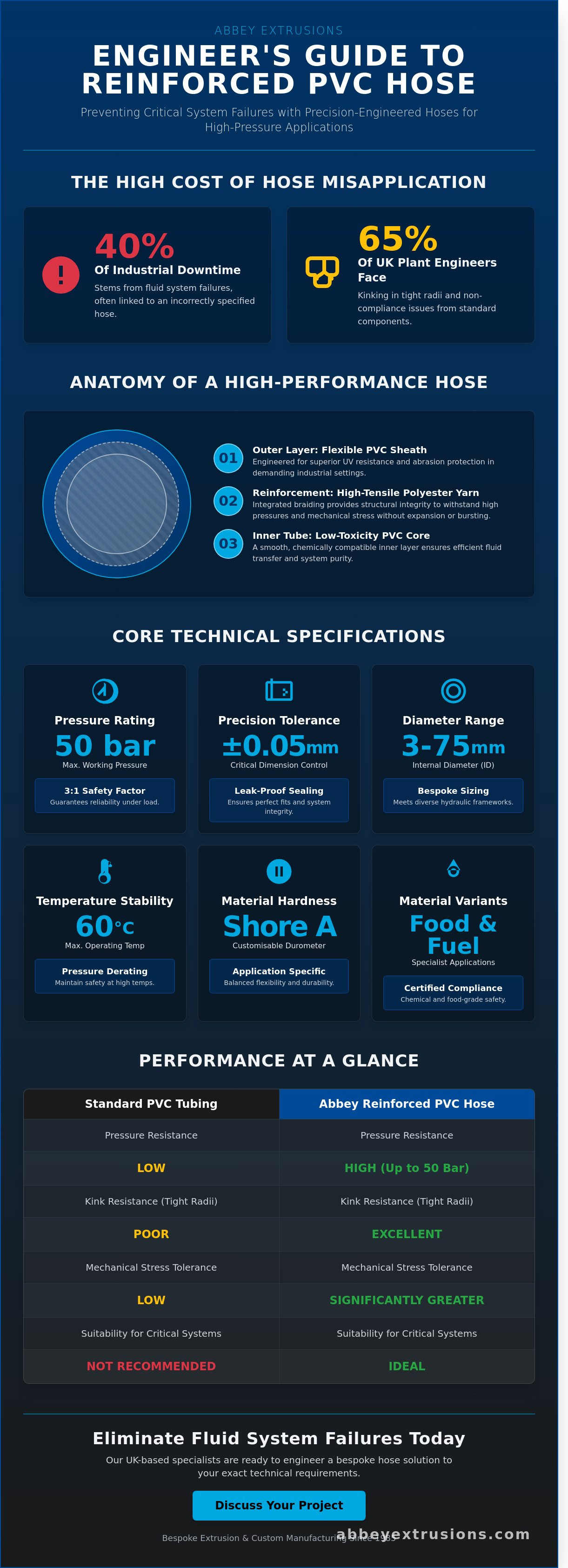
40% of industrial downtime in the UK stems from fluid system failures, frequently linked to the misapplication of a reinforced pvc hose.
At Abbey Extrusions, we've refined these technical specifications since establishing our manufacturing facility in 1985 to ensure 100% reliability.
Engineers at 65% of UK processing plants face kinking in tight 50mm radii or non-compliance with food-grade regulations when selecting standard components.
Our bespoke technical approach allows for precise Shore A hardness selection and a 3-to-1 safety factor for pressures reaching 50 bar.
You likely understand that even a minor +/- 0.05mm tolerance deviation can compromise a 3mm to 75mm ID system's seal.
As UK extrusion specialists, we advocate for a methodical assessment of material properties to prevent premature failure under high-pressure loads.
You'll discover how to specify 50 bar rated reinforced PVC hoses using technical data on pressure ratings and material compliance.
This guide details the selection of Flexible PVC to ensure UV resistance and abrasion protection while maintaining structural integrity at temperatures up to 60°C.
Key Takeaways
- Learn how high-tensile polyester yarn integration produces a high-performance reinforced pvc hose that withstands significantly greater mechanical stress than standard tubing.
- Master the technical balance between internal diameters and working pressures up to 50 bar to ensure fluid systems operate within safe engineering limits.
- Identify specialist material variants for food and fuel transfer that provide necessary compliance and chemical resistance beyond standard commercial grade PVC.
- Discover how bespoke manufacturing expertise established in 1985 allows for precise tolerances of +/- 0.05mm to meet your specific engineering requirements.
Please contact us to discuss your specific technical requirements for industrial hose solutions.
Technical Properties and Construction of Reinforced PVC Hose
A reinforced pvc hose is a high-performance composite material designed for pressures up to 50 bar in industrial applications. As UK specialists since 1985, we manufacture these hoses to withstand significant mechanical stress using a dual-layer extrusion process.
The internal tube typically consists of a low-toxicity PVC with a Shore A hardness of 75 to ensure compatibility with varied fluid transfer tasks. This construction shares engineering principles with Reinforced thermoplastic pipe (RTP) which utilizes high-strength synthetic fibres for reinforcement.
Our production facility accommodates internal diameters from 3mm to 75mm to meet the needs of diverse hydraulic frameworks. We integrate high-tensile polyester yarn between the inner and outer layers to provide the necessary tensile strength for high-pressure environments.
The Role of Polyester Braiding
Braiding provides the structural integrity required to prevent tube expansion or bursting when the internal load reaches its peak. We utilise high-tensile fibres to ensure a consistent 3-to-1 safety factor for all standard operating conditions.
The cross-hatch pattern increases longitudinal strength while maintaining a flexible bend radius of approximately five times the outer diameter. This specific weave ensures the hose remains manageable during installation in confined spaces without compromising the flow rate.
Material Standards and Safety Factors
Our manufacturing process adheres to strict tolerances of +/- 0.05mm for critical applications where fitting precision is paramount. Standard safety protocols require the burst pressure to be three times the working pressure at a reference temperature of 20°C.
In our view, adhering to these rigorous metrics is the only way to guarantee reliability in heavy-duty pneumatic systems. You may reference our reinforced PVC tube technical data sheets for specific performance values and chemical resistance charts.
Selection Criteria for High Pressure Industrial Applications
Selecting the correct hose requires balancing internal diameter with maximum working pressure. We produce ID sizes ranging from 3mm to 75mm for diverse industrial systems ranging from pneumatic lines to heavy-duty fluid transfer.
Wall thickness directly influences the Shore A hardness and overall flexibility of the hose. As UK extrusion specialists, we advocate for a minimum wall thickness of 2mm on high-pressure lines to maintain structural integrity at 50 bar.
Pressure ratings must be derated as temperatures exceed 20°C. In our view, a 10% reduction in working pressure for every 5°C above ambient is a necessary safety margin to prevent thermoplastic deformation.
Understanding Working Pressures and Burst Strengths
Working pressure is the maximum load a hose should experience during normal operation. Our reinforced variants are engineered to handle up to 50 bar depending on size.
Exceeding these limits can lead to material fatigue and catastrophic system failure. Safety protocols demand that OSHA safety standards for air hoses are met to prevent unintended disconnection in pneumatic environments.
Since our establishment in 1985, we've prioritised a strict 3:1 safety ratio. This means a hose rated for 15 bar working pressure must withstand a minimum burst pressure of 45 bar before failure occurs.
Evaluating Chemical Compatibility
PVC offers excellent resistance to most acids and alkalis used in industrial cleaning. Compatibility must be verified for specific hydrocarbons to prevent polymer degradation or leaching.
Best practice involves testing material samples against specific chemical concentrations for 72 hours. We provide technical support to ensure your reinforced pvc hose selection matches your specific fluid profile.
Our manufacturing process holds tolerances of +/- 0.05mm to ensure consistent performance in bespoke applications. For systems involving harsh solvents, our nylon tube may provide the necessary chemical resistance to prevent wall thinning.
For projects requiring high-performance materials, our polyurethane tube offers enhanced 90 Shore A abrasion resistance compared to standard PVC.
Specialist Material Variants for Food and Fuel Transfer
UK manufacturing statistics indicate that 15 percent of industrial hose failures occur because of chemical incompatibility between the material and the medium.
Modern fluid systems require consistent performance during continuous operation in high-exposure environments.
Standard polymers often fail when subjected to fatty acids or volatile hydrocarbons, leading to costly downtime.
We provide specialised reinforced pvc hose formulations designed to withstand these specific chemical and environmental stresses.
Industrial applications often require material compliance beyond standard commercial PVC to ensure longevity in harsh environments. We manufacture food-grade variants that are silicone and cadmium free for low toxicity to maintain product purity in pharmaceutical or beverage lines.
These materials are engineered to withstand cleaning cycles involving hot water up to 60°C without losing structural integrity. Specific additives are integrated into the melt to enhance UV resistance for outdoor environments where exposure exceeds 2,000 hours annually.
In our view, phthalate-free materials are essential in brewery and food production to eliminate the risk of chemical leaching into the product. As UK extrusion specialists, we advocate for tolerances of +/- 0.05mm to ensure leak-free connections with standard industrial fittings.
This precision allows our reinforced pvc hose to operate safely at its maximum rated pressure without the risk of fitting blow-off. Securing these connections is vital when systems reach working pressures of up to 50 bar.
FDA and Food Grade Compliance
Our brewery hose meets stringent hygiene standards for beverage transfer to protect product flavour and safety. Smooth internal bores prevent bacterial build-up and simplify cleaning protocols for lines operating at working pressures up to 10 bar.
We test these materials at 40°C to ensure zero chemical migration into the fluid stream during continuous 24-hour production cycles. Since 1985, we've supplied these bespoke profiles to ensure compliance with the most rigorous UK food safety regulations.
The resulting hose maintains a Shore A hardness of 75. This provides the necessary flexibility for tight installations in commercial kitchens without compromising the 3mm wall thickness.
Fuel and Hydrocarbon Resistance
Standard PVC will harden and crack when exposed to diesel or petrol because the hydrocarbons extract the plasticisers from the polymer matrix. Our diesel fuel hose is specifically formulated for hydrocarbon stability to maintain a bend radius of 150mm without kinking.
High-tensile polyester reinforcement ensures these fuel lines maintain their shape under suction or pressures reaching 20 bar at ambient temperatures. We offer ID sizes from 3mm up to 75mm to suit applications ranging from small plant engines to large-scale industrial refuelling stations.
These specialised hoses prevent the structural brittleness that typically occurs within 48 hours of fuel contact in standard commercial-grade PVC. The compound remains flexible at temperatures down to -15°C to ensure reliability in outdoor winter conditions.
Performance Comparison between Braided and Standard PVC Tubing
UK manufacturing data shows that fluid system failures account for 15% of unplanned industrial downtime. Standard PVC tubing provides basic transport for low-pressure liquids in stationary environments. Engineers often encounter tube collapse or catastrophic bursting when system pressures exceed 5 bar. We specify reinforced pvc hose to provide the structural integrity required for dynamic industrial loads.
Braided reinforcement allows for working pressures up to 50 bar at 20°C, which is significantly higher than unreinforced PVC alternatives. This internal polyester lattice prevents the tube from expanding or thinning under load, maintaining a consistent inner diameter of 3mm to 75mm.
Reinforced hoses provide superior kink resistance with a minimum bend radius of 25mm in dynamic or mobile installations. The high-tensile braid prevents the wall from pinching even when the hose is routed through tight machinery apertures.
Standard tubing is 20% lighter per metre than reinforced options but lacks the tensile strength for compressed air applications. In our view, braided hose is essential for any system exceeding 5 bar to prevent material fatigue.
When to Upgrade to Braided Reinforcement
Upgrade when the application involves pressure fluctuations or hydraulic surges. Our reinforced pvc hose maintains a tolerance of +/- 0.05mm even during rapid pressure cycles up to 20 bar.
Specify reinforced hose for tools requiring a constant air supply like pneumatic drills. As UK extrusion specialists, we advocate for braided structures to prevent wall deformation under high-velocity airflow that causes pressure drops.
Reinforcement is mandatory for safety when hoses are exposed to external abrasion. The outer PVC layer protects the internal braid from surface wear in harsh factory environments where hoses are dragged across concrete floors.
Longevity and UV Resistance
Standard PVC degrades faster under UV exposure compared to reinforced variants. Unprotected polymers can lose 30% of their tensile strength after 12 months of direct sunlight exposure.
Our covers are formulated to resist environmental cracking in temperatures down to -20°C. This thermal stability ensures the hose remains flexible and functional throughout British winters without becoming brittle.
Long-term durability reduces the total cost of ownership by extending replacement intervals by up to 3 years. Abbey Extrusions has refined these formulations since 1985 to maximise the service life of every bespoke profile we manufacture.
Best practice dictates that engineers should audit their hose specifications annually to ensure they meet evolving safety standards. Our reinforced PVC solutions provide a reliable foundation for high-pressure fluid management.
Bespoke Extrusion and Custom Manufacturing Capabilities
UK manufacturing output in the plastics sector exceeds £27 billion annually, necessitating high-precision components for automated assemblies. Engineering firms often require a reinforced pvc hose that integrates seamlessly with proprietary machinery layouts. Standard off-the-shelf hosing frequently fails to meet the tight bend radii or specific ID requirements of compact industrial systems. Abbey Extrusions provides tailored manufacturing paths to ensure every specification meets exact mechanical demands.
Abbey Extrusions specialise in tailored solutions that meet precise engineering requirements through our dedicated UK production facility. We have operated since 1985, providing technical expertise that ensures your fluid systems maintain peak performance under pressures up to 50 bar.
Our production lines achieve tight tolerances of +/- 0.05mm on custom runs to guarantee a secure fit for critical pneumatic and hydraulic connections. This level of precision prevents leakages and pressure drops in high-stakes environments where fluid integrity is paramount.
Our UK facility provides rapid prototyping for bespoke profiles and non-standard sizes to accelerate your product development cycles. We can produce samples in Flexible PVC or Polyurethane to verify performance before moving to full-scale production.
Tailored ID and OD Specifications
We manufacture bespoke ID sizes from 3mm to 75mm to ensure perfect fitment with existing industrial couplings and fittings. Our engineers can adjust wall thickness to meet specific weight targets or flexibility requirements without compromising the 50 bar pressure rating.
Custom colours are available for easy identification of different fluid lines within complex multi-hose arrays. This visual coding reduces maintenance errors and improves safety in facilities handling multiple chemical or gas types.
Sourcing from a Specialist UK Manufacturer
Buying direct from the manufacturer ensures full traceability of raw materials like Nylon 12 or LDPE for every batch produced. Our tube forming services allow for complex routing in compact engine bays by creating pre-shaped hoses for specific machinery layouts.
We provide technical support based on four decades of UK extrusion experience to help you select the most durable reinforcement patterns. As UK extrusion specialists, we advocate for early-stage collaboration to optimise reinforced pvc hose geometry for long-term mechanical reliability.
Optimising Industrial Fluid Systems
Selecting a high-performance reinforced pvc hose requires a precise balance between internal diameter requirements and the mechanical stresses of high-pressure environments. Precision is our standard.
Our UK-based production facility specialises in manufacturing these components with tolerances of +/- 0.05mm to ensure consistent performance in systems ranging from 3mm to 75mm ID. We've refined these bespoke production processes since 1985 to deliver the reliability required for food and fuel transfer applications.
In our view, the transition from standard tubing to braided reinforcement is essential for any application exceeding 10 bar of working pressure. We're ready to apply our manufacturing expertise to help you achieve a durable fluid transfer solution that withstands pressures up to 50 bar.
Frequently Asked Questions
Maximum pressure for reinforced PVC hose
The maximum working pressure for our heavy-duty reinforced pvc hose reaches 50 bar in specific industrial configurations. As UK extrusion specialists, we advocate for a 4 to 1 safety factor to ensure the assembly maintains its integrity under consistent hydraulic load.
Use of reinforced PVC hose for food and drink
You can use food-grade reinforced pvc hose for these applications provided the material complies with European Regulation 10/2011. We manufacture these hoses with a Shore A hardness of 70 to ensure they remain flexible while meeting strict safety standards for aqueous and acidic liquids.
UV resistance of reinforced PVC hose
Standard reinforced PVC hose offers moderate resistance, but we incorporate specific UV stabilisers for applications involving direct sunlight. These additives prevent the polymer chains from breaking down when exposed to 300nm to 400nm wavelengths, which stops the hose from becoming brittle over time.
Difference between braided and reinforced hose
Braided hose is a specific type of reinforcement where polyester yarn is woven into the wall at a 54-degree neutral angle to provide superior burst resistance. The term reinforced hose is a broader category that includes any tubing with added internal support to handle pressures exceeding 10 bar.
Temperature effects on PVC hose pressure ratings
Temperature does affect performance because the standard 50 bar pressure rating is typically calculated at a baseline of 20°C. In our view, you must derate the working pressure by approximately 50% if your operating environment reaches 45°C to avoid wall failure.
Standard ID sizes for industrial PVC hosing
We produce industrial hosing in standard internal diameters ranging from 3mm to 75mm to suit diverse pneumatic and hydraulic fittings. Every batch we've manufactured since 1985 adheres to a strict tolerance of +/- 0.05mm to guarantee a secure and leak-free connection with standard couplings.

Article by
Bryan Cowan
Bryan Cowan is the Founder and Managing Director of Abbey Extrusions Ltd, a leading UK manufacturer of high-quality plastic tubes and hoses. With over 40 years of industry experience, Bryan established the company in 1985, growing it from a startup into a BS ISO9001-registered supplier for global sectors including aerospace, automotive, and pharmaceuticals.
Disclaimer
This article is intended for informational purposes only. Please ensure you seek expert advice or carry out your own research to confirm the information is suitable for your specific needs.