Research across UK industrial sites indicates that 15% of pneumatic system failures result from fatigue in coiled air hoses and permanent deformation in recoil assemblies.
Since 1985, Abbey Extrusions has manufactured bespoke profiles with tolerances of +/- 0.05mm to eliminate these inefficiencies in demanding workshop environments.
You've likely experienced the frustration of low-quality components that lose their memory after a few weeks or cause significant pressure drops in 10-metre runs.
In our view, maintaining a safe, efficient workspace requires equipment that withstands constant extension without kinking or losing its original form.
This guide provides the technical specifications needed to select recoil hoses that offer 100% memory retention and meet strict pressure rating compliance up to 10 bar.
As UK extrusion specialists, we advocate for a precise comparison between Nylon 12 and Polyurethane (PU) to match your specific environmental temperatures and chemical exposure.
Key Takeaways
- Understand how heat-setting polymers into a permanent helical shape ensures that coiled air hoses maintain their self-retracting properties for safer workspaces.
- Compare the performance of Nylon 12 and Polyurethane by evaluating Shore A hardness ratings to determine the ideal balance between kinking resistance and flexibility.
- Learn to specify tolerances of +/- 0.05mm to ensure consistent fitting seals and match internal diameters to specific tool CFM requirements.
- Identify why swivel fittings are essential in our view to prevent hose twisting and maintain pneumatic efficiency during high-rotation tool use.
- Discover how bespoke tube forming services allow for unique coil diameters tailored to specific industrial environments beyond standard catalogue dimensions.
Technical Fundamentals of Coiled Air Hoses
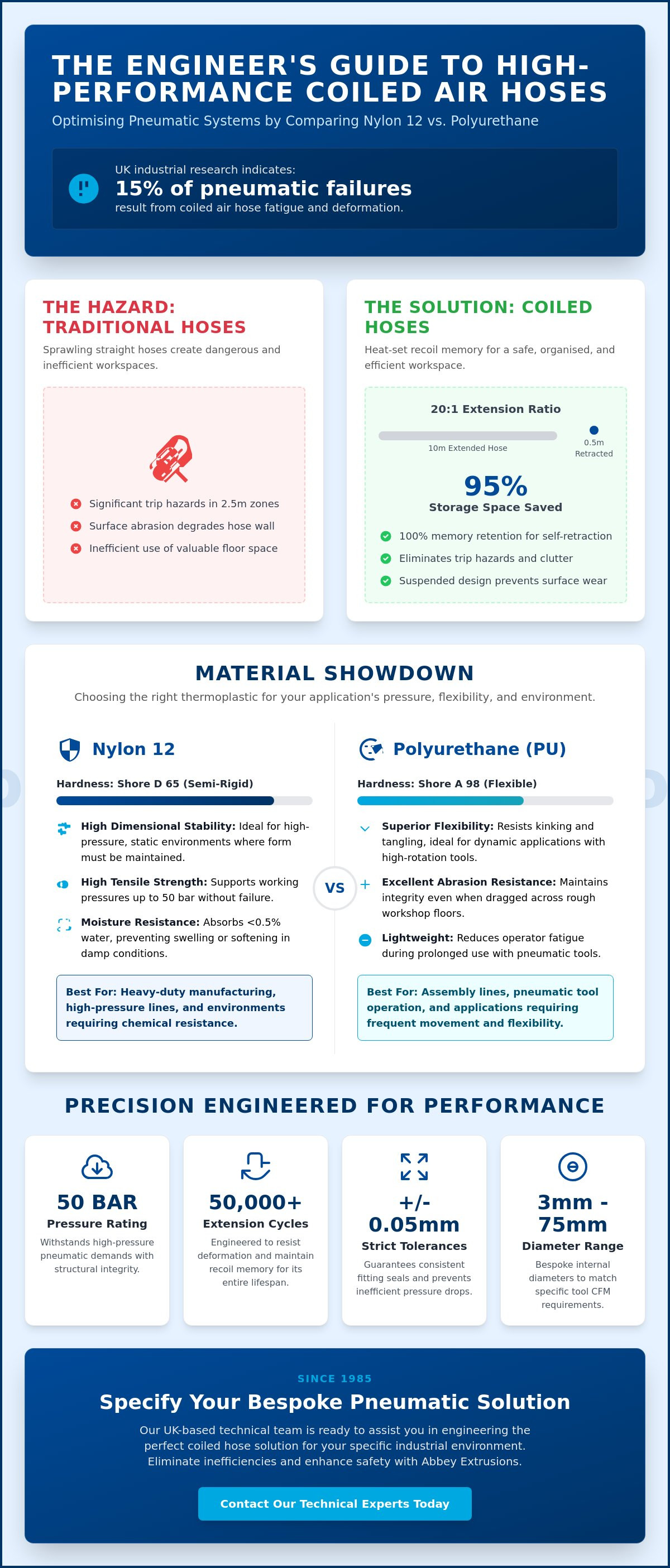
UK manufacturing environments reported 60,644 non-fatal workplace injuries according to 2022/23 HSE statistics. Industrial fluid systems require consistent pressure delivery while maintaining a clear and safe workspace for operators. Traditional straight hoses often sprawl across walkways, creating significant trip hazards and increasing the risk of material degradation. As UK extrusion specialists, we advocate for coiled air hoses that utilise heat-set memory to retract automatically. Abbey Extrusions has specialised in advanced tube forming since 1985 to produce consistent pneumatic lines. These self-retracting systems are manufactured by heat-setting high-performance thermoplastics like Nylon 12 or Polyurethane into a permanent helical shape. The Air line remains compact when not in use, which effectively eliminates the 2.5-metre trip hazard zones commonly found with loose hoses. By maintaining a tight helical structure, we ensure that pneumatic tools remain accessible without cluttering the assembly floor. In our view, the precision of the manufacturing process determines the longevity of the coil. We manufacture components with internal diameters ranging from 3mm to 75mm to suit diverse industrial applications. Our production facility maintains strict tolerances of +/- 0.05mm to ensure every hose meets rigorous safety standards. This technical precision ensures that the hose can withstand pressures up to 50 bar while maintaining its structural integrity.The Mechanics of Recoil Memory
Molecular orientation occurs during the extrusion process as the polymer chains are aligned under controlled thermal conditions. This internal tension allows the hose to achieve a 100 per cent retraction rate when the bend radius is kept within specified limits. A wall thickness of 1.5mm provides the necessary spring tension to support the weight of industrial couplings. We utilise high-grade Nylon 12 to ensure the material resists permanent deformation even after 50,000 extension cycles.Core Benefits of Retractable Systems
Our retractable systems offer a 20:1 extension ratio where a 10m hose efficiently retracts to a closed length of just 0.5m. This compact footprint saves 95 per cent of storage space compared to traditional straight-line reels. Keeping the hose suspended prevents surface abrasion that typically degrades external walls by 0.2mm per year on concrete floors. Integrating coiled air hosesComparative Analysis of Nylon and Polyurethane Materials
UK manufacturing statistics show that pneumatic systems power approximately 70 per cent of industrial automation processes. Choosing between different thermoplastics for recoil assemblies requires a deep understanding of polymer science. Many operators face premature failure because they select materials that don't withstand 50 bar pressure or chemical exposure. We offer a comprehensive analysis of Nylon 12 and Polyurethane to help you specify the correct hose for your facility.The primary distinction between these materials lies in their Shore A and Shore D hardness ratings. Polyurethane typically features a Shore A hardness of 98A, while Nylon 12 is a semi-rigid material with a Shore D rating of 65.
Since 1985, we've manufactured bespoke profiles with tolerances as tight as +/- 0.05mm. As UK extrusion specialists, we advocate for Nylon in high-pressure static environments where dimensional stability is a priority.
Our production lines generate high-quality Nylon tube for various industrial assemblies across the country. These components serve as the foundation for durable coiled air hoses used in heavy-duty manufacturing.
In our view, the choice between materials should always be dictated by the specific working environment and pressure requirements. We produce these tubes in internal diameters ranging from 3mm to 75mm to accommodate everything from small sensors to large power tools.
Nylon 12 Recoil Characteristics
Nylon 12 offers superior resistance to moisture because it absorbs less than 0.5 per cent of its weight when submerged. This stability prevents the material from swelling or softening when used in damp environments.
The high tensile strength of this polymer supports working pressures up to 50 bar at 20°C. Maintaining compliance with OSHA safety regulations is easier when utilizing materials with such high burst pressure margins.
Nylon 12 provides excellent chemical stability when exposed to industrial oils and greases. It doesn't degrade or crack when used in automotive or machine tool applications where lubricant contact is frequent.
Best practice dictates using Nylon 12 for overhead drops where the hose must retract fully to a height of 2 metres or more. Its memory is far superior to other thermoplastics, ensuring it doesn't sag over time.
Polyurethane PU Flexibility Factors
Polyurethane provides a rubbery feel that allows for a tighter bend radius of approximately 20mm. This flexibility prevents the hose from kinking when pulled around tight corners or through narrow machinery gaps.
We recommend PU for hand-held air tools because the lower resistance reduces user fatigue during 8-hour shifts. The material acts as a shock absorber, dampening vibrations from pneumatic impacts before they reach the operator's hand.
Excellent abrasion resistance ensures these coiled air hoses withstand being dragged across concrete workshop floors. This durability extends the service life of the assembly in high-traffic production zones where equipment is moved constantly.
While PU is more flexible, it's generally limited to lower working pressures compared to Nylon. Most PU recoil hoses are rated for 10 bar, making them ideal for standard workshop air lines.
If you require a specific balance of flexibility and strength, our polyurethane tube options can be tailored to your exact Shore hardness requirements.
Critical Engineering Specifications for High Pressure Air Lines
UK pneumatic systems often lose 30 per cent of their efficiency through avoidable air leaks.
Maintaining system pressure requires high-performance thermoplastic tubing that meets exact mechanical standards.
Standard hoses often fail when exposed to fluctuating factory temperatures or excessive mechanical strain.
We engineer our range of coiled air hoses to meet the rigorous demands of 24-hour manufacturing environments.
As UK extrusion specialists, we advocate for matching the internal diameter (ID) of the hose to the specific CFM requirements of the pneumatic tool. A 10mm ID hose provides the necessary volume for heavy-duty impact wrenches, whereas a 3mm ID is sufficient for precision air brushes.
Abbey Extrusions has been established since 1985, and we apply the Anchor Rule to specify tolerances of +/- 0.05mm for every batch. This precision ensures a consistent fitting seal that prevents pressure drops in systems operating at 10 bar.
Best practice dictates that working pressure ratings must be derated as ambient temperatures exceed 20°C. In our view, failing to account for this thermal expansion leads to premature hose failure in high-heat environments.
Engineers should reference the Nylon recoil air hose technical data for specific performance curves. These charts detail how Nylon 12 maintains its mechanical properties under varying stress loads and pressures up to 50 bar.
Pressure and Temperature Thresholds
A 10mm OD hose maintains its structural integrity at 15 bar when the environment is held at 20°C. If the temperature rises to 50°C, the safe working pressure must be adjusted to avoid bursting or permanent deformation.
There's a significant risk of failure if coiled air hoses are stretched beyond 80 per cent of their manufactured length. This over-extension compromises the recoil memory of the thermoplastic polymer.
Sub-zero temperatures as low as -40°C increase polymer brittleness in standard materials. We utilise specific Nylon grades to ensure flexibility remains constant in cold storage or outdoor applications.
Sizing for Pneumatic Efficiency
We provide a guide for ID sizes ranging from 3mm to 12mm for our standard coil range, though our capacity extends from 3mm to 75mm. Selecting the correct bore is essential for tools that require a high CFM to maintain torque.
Larger bores reduce friction loss over extended coiled lengths, ensuring 7 bar is delivered consistently to the tool head. This efficiency reduces the load on the air compressor and lowers energy costs.
The importance of tail length for stress relief at the connection point cannot be overstated. We recommend tails of at least 100mm to prevent kinking where the hose meets the rigid fitting.
Best Practice for Pneumatic Tool Integration
UK manufacturing data from 2023 indicates that compressed air accounts for 10% of total industrial electricity usage.
Engineers utilise coiled air hoses to deliver power to pneumatic tools while maintaining a clear and safe floor area.
Poorly specified couplings or a lack of abrasion protection can lead to dangerous pressure drops of 1 bar or more.
We provide the technical specifications required to integrate these components into 50 bar systems safely.
Fitting and Coupling Selection
In our view, correct fitting selection is vital for maintaining a precise tolerance of +/- 0.05mm at the tool interface. UK pneumatic systems typically utilise BSP threads, which must not be confused with NPT standards to avoid damaging the tool port.
We advocate for the use of swivel fittings to prevent hose twisting during tool rotation, protecting the coil memory of the material. These swivels allow for 360-degree movement, which is essential for operators using impact tools in confined spaces.
Heavy-duty applications require brass fittings due to their superior resistance to mechanical stress compared to plastic components. Pre-installed spring guards are recommended to prevent kinking at the tool, especially when the hose is at its maximum 4:1 stretch ratio.
Maintenance and Safety Protocols
Regular inspection for stress cracking near the couplings is essential for coiled air hoses operating at extreme temperatures of 80°C. As UK extrusion specialists established in 1985, we recommend the use of a Nylon spiral cut hose guard for high-wear entry points.
This guard prevents external abrasion that can compromise the wall thickness of small 3mm ID tubes. UV degradation in transparent Flexible PVC hoses appears as cloudiness, which signals that the material is becoming brittle and prone to failure.
A failed hose can 'whip' with enough force to cause injury if it ruptures under a dangerous 10 bar load. Safety blow guns should be integrated to ensure output pressure remains below the regulated 2 bar limit for operator safety.
View our full range of high-performance Nylon recoil air hoses for industrial applications.
Bespoke Extrusion for Custom Recoil Requirements
UK manufacturing data indicates that bespoke components account for over 60% of high-performance pneumatic assemblies in the automotive sector. Standard off-the-shelf solutions often fail to accommodate the tight spatial constraints found in modern robotic cells. Engineers frequently struggle to find coiled air hoses that offer both 50 bar burst pressure and specific chemical resistance. Abbey Extrusions provides custom-engineered profiles from our Leicestershire facility to solve these complex integration issues.
We have operated as a specialist UK manufacturer since 1985, refining our processes to support diverse industrial sectors. Our tube forming services enable the production of unique coil diameters tailored to the exact footprint of your machinery. We manufacture ID sizes ranging from 3mm up to 75mm to facilitate high-volume fluid and air transfer requirements. As UK extrusion specialists, we advocate for bespoke colours to ensure rapid air line identification and consistent branding across multi-channel systems.
Our production line maintains a precise +/- 0.05mm tolerance to guarantee total compatibility with industrial push-fit connectors. We specialise in processing high-grade thermoplastics including Nylon 12 and Polyurethane (PU) to meet the most demanding environmental challenges. These bespoke profiles are designed to withstand constant flexing without developing stress fractures or flow restrictions during operation.
Custom Lengths and Configurations
Best practice involves specifying exact working lengths to eliminate excess material and prevent snagging in automated assembly cells. We can integrate anti-static properties into our Polyurethane coils to safely dissipate electrical charges in volatile work environments. In our view, matching a specific 98 Shore A hardness is essential for maintaining recoil memory at 50 bar operating pressures. We also offer custom tail lengths to simplify the connection process within overcrowded pneumatic control cabinets.
These tailored configurations ensure your coiled air hoses provide a service life exceeding 10,000 extension cycles. We provide clear or braided Flexible PVC options for applications that require visual monitoring of fluid flow and purity.
UK Manufacturing and Quality Control
Sourcing directly from our Leicestershire production facility ensures a transparent supply chain and consistent material purity for every batch. We perform rigorous pressure testing at 23°C to verify that every extrusion meets our strict safety and performance standards. Our technical team provides expert support to assist engineers in the design of complex pneumatic systems and fluid transfer lines. We maintain detailed batch records to provide full traceability for all Flexible PVC, Nylon 6, and LDPE extrusions.
Every bespoke coil undergoes a memory retention assessment to ensure it returns to its original closed length after repeated use. Our long-standing presence in the industry allows us to provide competitive pricing without compromising on technical excellence or material quality. We utilise advanced tooling to ensure wall thickness remains uniform across the entire length of the coiled profile.
Optimising Industrial Pneumatic Performance
Selecting the correct material for coiled air hoses remains a critical decision for maintaining system pressure up to 50 bar. As UK extrusion specialists since 1985, we advocate for Nylon 12 or Polyurethane based on specific bend radius requirements and chemical resistance.
Precision engineering ensures our Leicestershire facility maintains tolerances of +/- 0.05mm across all bespoke profiles. This level of accuracy prevents fitting leaks and ensures consistent recoil memory throughout the hose's operational lifecycle.
Our bespoke tooling capabilities allow us to produce ID sizes from 3mm up to 75mm to meet your exact engineering specifications. We look forward to supporting your next pneumatic project with high-performance British manufacturing.
Frequently Asked Questions
Maximum working pressure for coiled air hoses
Our Nylon 12 coiled air hoses are engineered to withstand working pressures up to 24 bar at 20°C room temperature. We manufacture bespoke reinforced variants that handle up to 50 bar for high-pressure industrial applications.
Always ensure your fittings are rated to match the hose's maximum burst pressure to prevent system failure. In our view, matching component ratings is essential for maintaining site safety.
Nylon vs Polyurethane for pneumatic systems
Nylon 12 provides superior dimensional stability with 0.05mm tolerances for static lines or high-temperature environments. Polyurethane (PU) offers better flexibility with a 25mm bend radius for hand-held tools that require frequent movement.
As UK extrusion specialists, we advocate for PU when ergonomic tool use is a priority. We specialise in both materials to suit diverse industrial requirements.
Liquid and chemical transfer compatibility
While primarily designed for air, our LDPE and Nylon coiled air hoses are suitable for certain water and chemical transfer tasks. You must verify chemical compatibility using our technical charts to ensure the polymer doesn't degrade when exposed to diesel.
Our technical team provides compatibility data for liquids to ensure the 24 bar pressure rating is maintained. This prevents material leaching or structural softening during fluid transfer.
Maintaining hose recoil and memory retention
Loss of recoil usually occurs because the hose was stretched beyond its elastic limit or exposed to excessive heat. High-quality Abbey Extrusions hoses are heat-set at 80°C to ensure long-term helical memory.
Avoid leaving hoses fully extended for prolonged periods to maintain the original tension. This practice preserves the structural integrity of the coil over 5,000 extension cycles.
Available internal diameters for industrial coils
We specialise in manufacturing hoses with internal diameters ranging from 3mm to 75mm to suit all industrial scales. Standard pneumatic coils typically utilize 6mm, 8mm, or 10mm internal diameters for optimal flow rates.
Bespoke wall thicknesses can be extruded to meet your specific pressure or weight requirements. This precision allows for integration into complex machinery with limited space.
UV resistance and outdoor durability
Our standard black Nylon and PU hoses offer reliable UV resistance for most UK industrial environments. For extreme outdoor exposure, we include specific UV stabilisers tested for 1,000 hours of exposure to prevent material brittleness.
Transparent or brightly coloured hoses may degrade faster if left in direct sunlight without these additives. We recommend black polymers for any application involving consistent solar exposure.

Article by
Bryan Cowan
Bryan Cowan is the Founder and Managing Director of Abbey Extrusions Ltd, a leading UK manufacturer of high-quality plastic tubes and hoses. With over 40 years of industry experience, Bryan established the company in 1985, growing it from a startup into a BS ISO9001-registered supplier for global sectors including aerospace, automotive, and pharmaceuticals.
Disclaimer
This article is intended for informational purposes only. Please ensure you seek expert advice or carry out your own research to confirm the information is suitable for your specific needs.