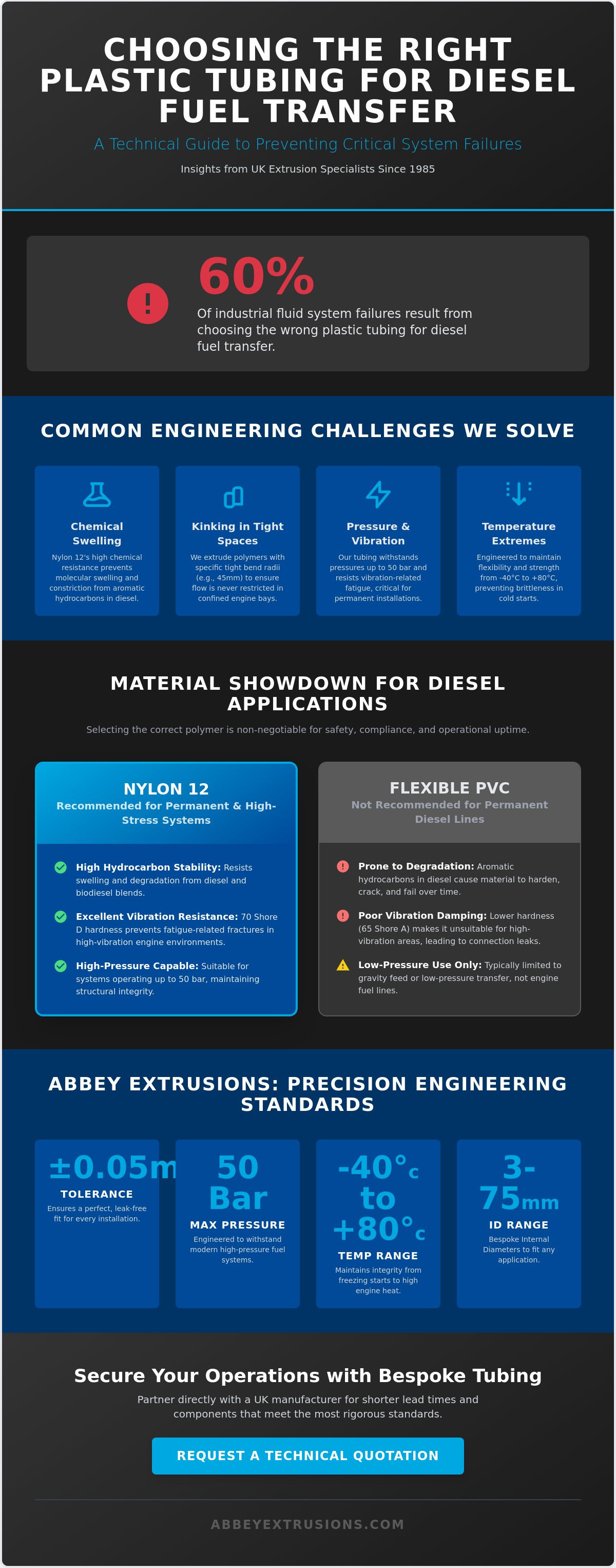
2023 UK industry data indicates that 60% of industrial fluid system failures result from choosing the wrong plastic tubing for diesel fuel transfer.
Since 1985, Abbey Extrusions has observed that diesel fuel transfer requires precise chemical resistance, such as that provided by Nylon 12, to prevent molecular swelling.
Engineers often face tubing that kinks in tight engine bays, a challenge we address by extruding polymers with tight bend radii for confined spaces.
As UK extrusion specialists, we advocate for bespoke Nylon 12 and PU tubing, ranging from 3mm to 75mm ID, to withstand pressures up to 50 bar.
You likely recognise that premature tubing failure isn't just a routine maintenance task; it's a significant risk to your operational safety.
This guide provides the technical criteria needed to select the optimal plastic tubing for diesel fuel transfer, ensuring your systems remain leak-free and compliant with UK standards.
We'll examine material performance across temperatures from -40°C to +80°C and explain how our +/- 0.05mm tolerances ensure a perfect fit for every installation.
Key Takeaways
- Contrast the mechanical performance of Nylon 12 against Flexible PVC for permanent installations where vibration resistance and hydrocarbon stability are critical.
- Select the optimal plastic tubing for diesel fuel transfer by calculating the precise relationship between wall thickness and working pressures up to 50 bar.
- Ensure precision fits in industrial fuel systems by utilising our Abbey Extrusions tolerance standard of +/- 0.05mm for all bespoke conduits.
- Mitigate ignition risks in enclosed engine compartments by implementing tubing with specific anti-static properties and verified fire retardancy ratings.
- Optimise your industrial supply chain by partnering directly with UK manufacturers to secure shorter lead times for critical infrastructure components.
Material Specifications for Diesel Fuel Transfer Tubing
UK manufacturing statistics show that fuel system failures account for approximately 22% of off-road vehicle downtime. Modern industrial engines require high-performance conduits capable of withstanding 50 bar pressure. Standard polymers often suffer from excessive permeability, which allows hazardous fuel vapour to escape into the atmosphere. As UK extrusion specialists, we advocate for plastic tubing for diesel fuel transfer that utilises barrier properties to limit permeability to less than 0.5g/m²/day.Material selection directly impacts the long-term flexibility and prevents environmental stress cracking in harsh environments where temperatures drop to -20°C. We specialise in manufacturing plastic tubing for diesel fuel transfer that meets these rigorous British standards.
Since 1985, Abbey Extrusions has manufactured these components with a standard ID range from 3mm to 75mm. We maintain strict tolerances of +/- 0.05mm to ensure that every plastic fuel lines installation remains leak-free.
In our view, a wall thickness variation of even 0.1mm can compromise the integrity of a high-pressure system. Our production process ensures uniform wall thickness across the entire extrusion length to prevent weak points.
Chemical Resistance to Hydrocarbons
Diesel fuel contains high aromatic levels that can cause significant swelling in polymers that lack a 70 Shore D hardness rating. While we offer LDPE for various industrial uses, it's often avoided for high-pressure fuel delivery due to its low 10 bar burst threshold.Best practice requires materials like Nylon 12 that resist swelling even after 1000+ hours of continuous exposure to diesel. These polymers ensure the internal diameter doesn't constrict and restrict fuel flow during heavy-duty cycles.
We've observed that inferior materials lose up to 30% of their tensile strength when exposed to modern biodiesel blends. Our bespoke extrusions are tested to maintain structural rigidity against 25% aromatic content.
Temperature Stability in Engine Environments
Engine environments in UK industrial machinery frequently reach elevated temperatures of 60°C that challenge the thermal limits of standard tubing. We utilise a 4-to-1 safety factor for burst pressure calculations, ensuring a 50 bar rated tube operates safely at a 12.5 bar working pressure.Our Nylon and reinforced profiles maintain a specific 45mm bend radius even at -20°C temperatures. This prevents the material from becoming brittle during cold-start cycles in the British winter.
Maintaining flexibility at these extremes ensures that vibration from the engine doesn't lead to fatigue-related fractures. Consistent performance across this thermal range is essential for the 5,000-hour service intervals common in the UK plant industry.
Comparing Nylon and PVC for Fuel Applications
UK industrial diesel consumption reached 6.2 million tonnes in 2023. Material selection for fuel transport requires adherence to strict chemical compatibility charts. Standard polymers often degrade when exposed to aromatic hydrocarbons, leading to system failure. Abbey Extrusions provides specific grades of Nylon 12 and Nitrile-PVC blends to ensure long-term integrity.
In our view, material choice must prioritise the specific Shore A hardness required for the fitting to ensure a leak-proof seal. We manufacture plastic tubing for diesel fuel transfer with tolerances as tight as +/- 0.05mm to guarantee compatibility with standard UK industrial couplings.
Nylon 12 provides a 70 Shore D hardness that is essential for permanent diesel installations where high vibration is present. By contrast, flexible PVC is better suited for low-pressure delivery where a 65 Shore A hardness allows for easier manual handling during installation.
Compliance with Safety Standards for Industrial Fuel Lines is essential for any UK facility handling bulk diesel. These standards ensure that the chosen tubing can withstand the operational stresses of industrial environments without risk of premature rupture.
Nylon 12 Properties
Our Nylon tube is engineered for precision fuel systems requiring a high burst pressure capacity of up to 50 bar. This material offers excellent resistance to zinc chloride and road salts, which prevents the stress-cracking often seen in lower-grade plastics.
Since 1985, we've specialised in extruding Nylon 12 with ID sizes from 3mm up to 75mm for demanding automotive and plant applications. The material's thermal stability ensures it maintains its structural integrity at temperatures up to 80°C, preventing the softening that causes traditional hoses to slip from barbs.
Flexible PVC and Nitrile Blends
Adding nitrile compounds to the extrusion process significantly improves the hydrocarbon resistance of PVC by preventing plasticiser leaching. This chemical stability ensures the reinforced PVC tube doesn't become brittle or crack when exposed to diesel for extended periods.
We utilise a 24 polyester braid reinforcement to provide a working pressure of 10 bar while maintaining a tight 45mm bend radius. This flexibility makes it a cost-effective solution for low-pressure delivery in confined engine compartments where rigid lines are impractical to route.
As UK extrusion specialists, we advocate for checking your system's peak operating temperature before selecting a diesel fuel hose for your application.
Determining Working Pressures and ID Sizes
UK fluid transfer systems often operate at efficiency levels below 70% due to improper hose specifications. Reliable fuel delivery requires a meticulous balance between material strength and flow dynamics. Engineers frequently struggle with pressure drops caused by mismatched internal diameters. We manufacture high-precision plastic tubing for diesel fuel transfer to resolve these technical bottlenecks.
Wall thickness directly dictates the hoop stress capacity of any extruded polymer. Thicker walls allow for higher operating pressures; however, they also increase the minimum bend radius required for installation.
As UK extrusion specialists, we advocate for a strict tolerance standard of +/- 0.05mm to ensure precision fits. This level of accuracy prevents localized weak points that could fail when systems reach their 50 bar peak load limits.
Selecting the correct internal diameter (ID) is vital to prevent frictional loss during diesel transfer. Restricted ID sizes increase fluid turbulence and pump strain, which shortens the operational lifespan of expensive fuel pumps.
Best practice involves derating working pressures by approximately 1% for every degree Celsius as operating temperatures rise above 20°C. This calculation is essential for maintaining safety margins in environments where diesel temperatures fluctuate during heavy industrial use.
Bespoke Sizing for Custom Fittings
We provide specialized tube forming services to accommodate complex fuel line routing within vehicle chassis or static generator sets. Our manufacturing capability spans sizes from 3mm to 75mm to match any specific industrial requirement.
Custom ID and OD combinations eliminate the need for expensive brass or aluminium adapters. By removing these unnecessary joints, we reduce potential leak points in high-vibration diesel systems while lowering total assembly costs.
Pressure Rating Calculations
Working pressure represents the safe continuous load, whereas short-term burst pressure indicates the point of total structural failure. In our view, a safety factor of 3:1 or 4:1 is mandatory for volatile fluid transfer applications.
For example, our 10mm ID reinforced hose is rated for a 20 bar working pressure at a standard 20°C. Braid density significantly influences this rating by reinforcing the base flexible PVC against internal hydraulic forces.
High-density polyester braiding ensures the tube doesn't expand or warp under sudden pressure surges. This mechanical stability is critical for maintaining the integrity of the plastic tubing for diesel fuel transfer over years of service.
Safety Standards for Industrial Fuel Lines
UK manufacturing standards require fuel systems to withstand pressures up to 50 bar without catastrophic failure. Industrial diesel transfer environments expose tubing to high friction and potential static build up during high flow operations. Unchecked electrostatic discharge in engine compartments can ignite fuel vapours at temperatures exceeding 210°C. We provide bespoke conductive solutions to ensure safe operation across all hazardous zones.
Static electricity poses a severe risk during diesel transfer as fluid friction generates charges on non conductive surfaces. We mitigate this by manufacturing tubes with surface resistivity levels below 10^6 ohms to facilitate safe grounding.
Fire retardancy is critical for tubing installed in enclosed engine compartments where ambient temperatures often reach 80°C. Our Nylon 12 extrusions offer excellent thermal stability and meet rigorous fire safety ratings to prevent flame propagation.
As UK extrusion specialists, we advocate for rigorous testing against ISO standards to ensure every batch meets industrial safety benchmarks. This commitment to quality prevents the degradation of plastic tubing for diesel fuel transfer when exposed to chemical stress.
Outdoor fuel pumps require UV stabilisers to prevent the polymer chains from breaking down under solar radiation. Without these additives, tubing can become brittle and crack within 24 months of exposure.
Anti Static and Conductive Options
Safe diesel transfer relies on carbon loaded polymers that create a conductive path for dissipating static charge. These materials prevent the accumulation of energy that could otherwise trigger a spark in volatile environments.
Engineers often specify our specialised diesel fuel hose
Sourcing Bespoke Diesel Hosing from UK Manufacturers
Direct manufacturer partnerships eliminate the logistical delays of importing components, which often add 6 to 12 weeks to project timelines. As UK extrusion specialists, we advocate for domestic sourcing to ensure material traceability and immediate technical support for fluid systems.
UK-based production allows for rapid prototyping and tool adjustments within days rather than months. This speed is vital for critical infrastructure where a 50 bar pressure failure requires an immediate replacement with a tolerance of +/- 0.05mm.
In our view, technical consultation before purchase is the only way to guarantee that a specific polymer grade won't degrade when exposed to modern biodiesel blends. We provide detailed material data sheets to confirm that your chosen plastic tubing for diesel fuel transfer meets the necessary Shore D hardness for your specific fittings.
Custom Extrusion Capabilities
We manufacture bespoke profiles using a range of high-performance materials, from Shore A 60 Flexible PVC to high-strength Nylon 6 and 12. Clear fuel lines provide a Shore A 80 transparency that allows operators to monitor flow rates and identify air bubbles instantly during system priming.
For non-critical applications, we produce low-density polythene tube that offers cost-effective transfer for low-pressure gravity systems. These tubes maintain structural integrity across temperatures from -20°C to +65°C depending on the specific polymer grade selected for the application.
Partnering with Abbey Extrusions
Abbey Extrusions has provided tailored fluid solutions since 1985, maintaining strict quality controls across all thermoplastic runs. We specialise in producing tubing with internal diameters from 3mm to 75mm to fit any industrial coupling system currently used in the UK.
Our engineers provide bespoke quotes based on your specific ID and OD requirements to ensure a leak-free fit under 40 bar loads. Best practice involves reviewing Nylon tubing properties to understand how different grades handle diesel exposure over long durations without becoming brittle.
Optimising Performance in Fuel Delivery Systems
Selecting the correct plastic tubing for diesel fuel transfer requires a rigorous assessment of chemical compatibility and mechanical stress. We advocate for Nylon 12 or reinforced PVC to ensure long term integrity under pressures reaching 50 bar.
Since 1985, we've refined our manufacturing processes to maintain strict tolerances of +/- 0.05mm across all bespoke profiles. Our in-house tooling capabilities allow for precise ID sizes ranging from 3mm to 75mm to meet your exact engineering specifications.
Industrial applications demand materials that resist degradation from hydrocarbons while maintaining flexibility for complex routing. Our specialists provide the technical data needed to verify that every hose assembly meets the required safety benchmarks for your sector.
Ensuring your fuel lines meet industrial safety standards protects both equipment and personnel from hazardous leaks. We're ready to support your next project with reliable British manufacturing, drawing on our expertise established in 1985.
Frequently Asked Questions
Can I use standard PVC for diesel fuel
Standard PVC isn't recommended because diesel fuel causes plasticisers to leach out, making the material brittle and prone to catastrophic failure.
We specialise in Nylon 12 which resists hydrocarbon degradation at temperatures reaching 80°C. This material maintains its flexible Shore A rating over decades of industrial use.
What is the maximum pressure for diesel tubing
The maximum working pressure for our reinforced Nylon 12 is 50 bar when measured at a standard 20°C.
This high-pressure capacity makes it the ideal plastic tubing for diesel fuel transfer in demanding industrial environments where safety is paramount. Our testing protocols ensure every batch maintains these limits to prevent bursting.
Is Nylon 12 suitable for fuel lines
Nylon 12 is highly suitable because it offers superior dimensional stability and impact resistance compared to standard polyethene.
We manufacture these bespoke lines with internal diameters ranging from 3mm to 75mm to suit diverse engine and fuel tank specifications. These dimensions remain stable even when exposed to temperatures up to 80°C.
How do I calculate the correct bend radius
You calculate the minimum bend radius by multiplying the tube's outside diameter by a factor of ten.
A 12mm plastic tubing for diesel fuel transfer requires a 120mm radius to maintain structural integrity and prevent flow restriction during high-flow operations. This calculation ensures the wall thickness doesn't thin out and compromise the 50 bar pressure rating.
Are your diesel hoses manufactured in the UK
We've produced all our thermoplastic extrusions at our dedicated UK site since 1985.
Our facility maintains the capacity to test every batch up to 50 bar to ensure it meets our stringent British manufacturing standards for consistency. This local oversight allows

Article by
Bryan Cowan
Bryan Cowan is the Founder and Managing Director of Abbey Extrusions Ltd, a leading UK manufacturer of high-quality plastic tubes and hoses. With over 40 years of industry experience, Bryan established the company in 1985, growing it from a startup into a BS ISO9001-registered supplier for global sectors including aerospace, automotive, and pharmaceuticals.
Disclaimer
This article is intended for informational purposes only. Please ensure you seek expert advice or carry out your own research to confirm the information is suitable for your specific needs.