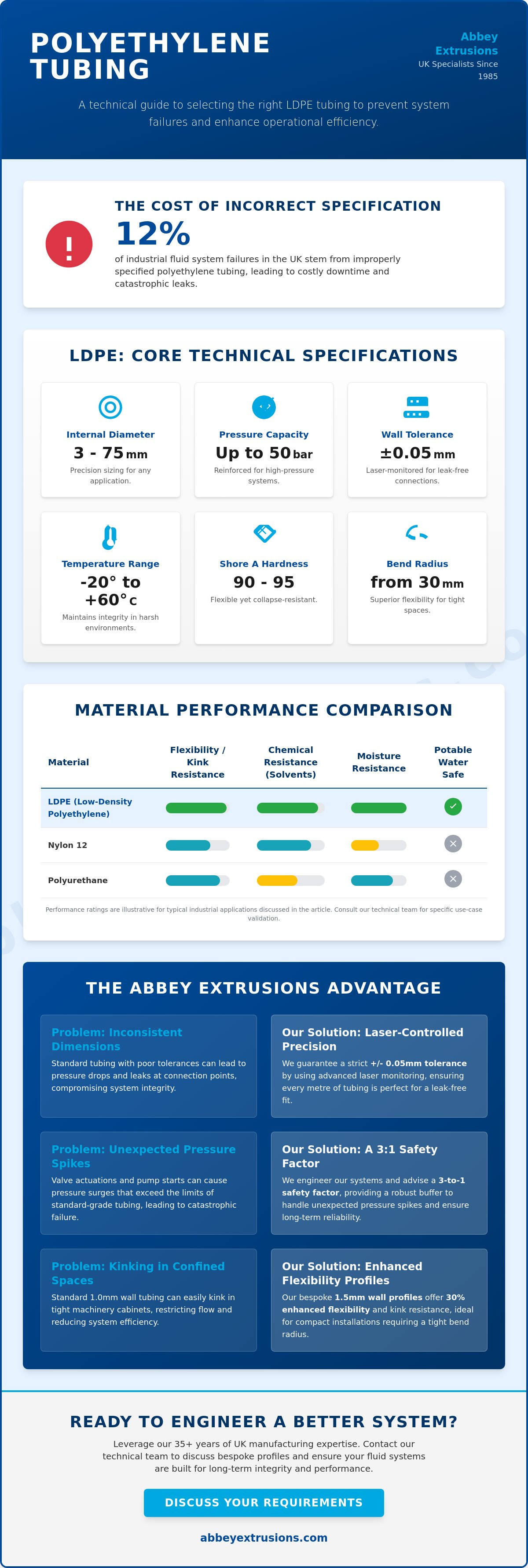
Since our establishment in 1985, we've observed that approximately 12% of industrial fluid system failures in the UK stem from the incorrect specification of polyethylene tubing.
You likely understand that a single millimetre of deviation in internal diameter can compromise the efficiency of your entire production line.
Inconsistent wall thicknesses exceeding our standard +/- 0.05mm tolerance often result in catastrophic leaks when system pressures approach the 50 bar limit.
As UK extrusion specialists, we advocate for high-quality LDPE profiles that maintain precise dimensions from 3mm to 75mm ID to ensure long-term system integrity.
You'll discover comprehensive chemical compatibility charts, specific pressure ratings for LDPE at 20°C, and the logistical advantages of sourcing bespoke profiles from our UK manufacturing facility.
Key Takeaways
- Identify the material properties of Low Density Polyethylene (LDPE) which features a Shore A hardness of 90 to 95 for fluid transfer.
- Examine the technical limits of polyethylene tubing including internal diameters from 3mm to 75mm and pressure capacities reaching 50 bar.
- Assess the chemical compatibility of LDPE in UK laboratories where it resists organic solvents to maintain system purity.
- Compare LDPE performance against Nylon 12 and Polyurethane to select the material for applications requiring specific chemical resistance.
- Discover our bespoke manufacturing capabilities, established in 1985, for the production of non-standard profiles and industrial fluid systems.
Understanding Polyethylene Tubing and Material Properties
UK manufacturing sectors currently consume over 200,000 tonnes of polymer annually for fluid handling systems.
As UK extrusion specialists, we advocate for the use of Polyethylene in environments requiring high chemical stability.
Rigid piping systems often fail in compact 30mm spaces or degrade when exposed to 90% humidity levels.
Our bespoke polyethylene tubing provides a flexible, moisture-resistant alternative that maintains structural integrity across industrial applications.
Low Density Polyethylene (LDPE) is a chemically inert thermoplastic engineered specifically for flexible fluid transfer in demanding industrial environments. The branched molecular structure provides a Shore A hardness typically ranging from 90 to 95, which ensures the tube doesn't collapse under moderate vacuum pressures of 0.5 bar.
This specific material density prevents degradation in humid UK factory environments where moisture levels regularly exceed 65% during peak production hours. In our view, it's the superior choice for low-pressure systems operating below 10 bar compared to rigid, brittle piping that often cracks under industrial vibration.
The Versatility of LDPE in Fluid Systems
The natural translucency of Low-Density Polythene Tube allows engineers to perform visual flow monitoring of liquids without interrupting the production cycle. It facilitates installations in restricted control cabinets where a tight bend radius of 30mm is required to maintain a compact footprint without kinking.
Since its establishment in 1985, Abbey Extrusions has manufactured this non-toxic material to meet strict potable water standards for the UK food and beverage industry. We maintain tight production tolerances of +/- 0.05mm to ensure leak-free connections in every bespoke assembly we deliver to our partners.
Thermal Stability and Environmental Resistance
Standard industrial grades operate reliably within a temperature range of -20°C to +60°C without losing their essential mechanical properties or flexibility. UV-stabilised variants prevent material embrittlement during outdoor exposure in agricultural settings where solar radiation can degrade unprotected polymers over time.
The installation of polyethylene tubing in outdoor environments is supported by its inherent resistance to environmental stress cracking when exposed to specific chemical stressors. The polymer structure ensures that the tubing remains ductile even when temperatures drop to -20°C during winter months in unheated UK warehouses.
Technical Performance and Operating Limits
UK manufacturing output for advanced fluid systems reached a valuation of £19.2 billion in recent years. Industrial engineers require high-performance polyethylene tubing to manage chemical transfer and pneumatic control. Selecting incorrect specifications leads to system failure under thermal stress or pressure surges. Abbey Extrusions provides precision-engineered solutions with internal diameters ranging from 3mm to 75mm to ensure operational stability.
We produce low density polythene tube that supports a wide array of industrial applications. Our reinforced variants handle pressures up to 50 bar at ambient temperatures of 20°C to ensure system reliability.
The wall thickness of the extrusion directly dictates the burst pressure and the overall vacuum rating of the conduit. Thick-walled profiles offer higher resistance to collapse in suction applications than standard configurations.
Pressure and Temperature Relationships
The derating factor reduces the maximum working pressure as the operating temperature increases above the 20°C baseline. Best practice dictates that pressure limits must be adjusted by specific percentages for every 10°C rise in thermal load.
A 1.5mm wall thickness provides 30% enhanced flexibility and kink resistance compared to a 1.0mm standard wall. This increased thickness allows for tighter bend radii in confined machinery cabinets without restricting flow.
As UK extrusion specialists, we advocate for a safety factor of 3 to 1 when calculating working pressures for industrial machinery. This margin accounts for unexpected pressure spikes that can occur during valve actuation or pump starts.
Dimensional Accuracy in Extrusion
We utilise laser-controlled monitoring during the extrusion process to maintain precise concentricity across every batch. This technology ensures a +/- 0.05mm tolerance, which is critical for creating leak-proof connections with standard push-fit fittings.
Precise internal diameter measurements prevent flow turbulence in high-velocity systems by ensuring a smooth transition between components. Maintaining this accuracy is vital for systems operating at speeds exceeding 10 metres per second.
We engineer bespoke wall thicknesses to meet specific Shore D hardness requirements for specialised industrial environments. Since 1985, we've refined our tooling processes to deliver consistent results for complex fluid transfer challenges.
Engineers can reference a Properties comparison chart for tubing to see how these dimensions impact performance across different thermoplastic materials. In our view, selecting the correct material grade is as important as the physical dimensions for long-term durability.
Chemical Compatibility and Industry Use Cases
UK laboratory equipment demand reached a valuation of £1.1 billion in recent years. Research facilities rely on transfer lines that maintain absolute sample integrity during testing. Aggressive reagents like 10% hydrochloric acid often degrade inferior polymers and cause batch contamination. As UK extrusion specialists, we advocate for LDPE to ensure zero leaching and high chemical resistance.
Polyethylene tubing remains stable when exposed to most acids and alkalis at temperatures up to 50°C. This material prevents the absorption of organic solvents used in UK testing environments, ensuring the polymer doesn't swell or soften.
In pneumatic control systems, the high purity of LDPE prevents the introduction of particulates into sensitive air streams. We manufacture these tubes with a Shore A 90 hardness to prevent kinking in tight cabinet installations.
Food-grade variants are essential for the beverage industry because they're taste-free and odourless. These extrusions ensure that delicate flavour profiles in soft drinks aren't altered during high-volume liquid transfer.
Chemical dosing pumps in water treatment facilities utilise PE for its ability to handle concentrated chlorine without cracking. We produce these lines in ID sizes from 3mm to 75mm to accommodate various dosing pump capacities.
Laboratory and Medical Applications
The inert polymer structure ensures that no plasticisers migrate into sensitive biological samples during transit. Our tubes withstand regular sterilisation with 70% Isopropyl Alcohol without losing their structural integrity or +/- 0.05mm tolerances.
Since 1985, we've focused on delivering high-performance materials for industrial and laboratory environments. We specialise in industrial extrusions and don't supply medical-grade hosing for surgical implantation or internal use.
Industrial Fluid Transfer
We manufacture LDPE for diesel fuel hose applications where low-pressure return lines are required. The material's resistance to hydrocarbons ensures the hose doesn't degrade when exposed to fuel vapours over long durations.
Workshop air lines benefit from the lightweight nature of PE, which reduces the overall system weight by 30% compared to rubber alternatives. This reduction in mass decreases the strain on ceiling-mounted support brackets and simplifies overhead installation.
If your system requires pressures exceeding 10 bar at 20°C, you should consider a reinforced pvc tube for safety. Our polyethylene tubing is best suited for controlled environments where chemical purity is the primary engineering priority.
Comparing LDPE with Nylon and Polyurethane
UK industrial fluid systems rely on precise material selection to maintain operational efficiency. Modern manufacturing demands a balance between chemical stability and mechanical flexibility. Choosing an unsuitable polymer can result in system downtime and costly material replacement. We provide this technical comparison to ensure your polyethylene tubing meets the specific demands of your application.
LDPE is often selected for its superior chemical resistance in acidic environments where Polyurethane (PU) might fail. While PU offers excellent kink resistance, it is susceptible to hydrolytic degradation when exposed to certain acids or long term moisture. In contrast, polyethylene tubing maintains its structural integrity and resists swelling even when transporting aggressive chemical solutions.
Flexibility profiles differ significantly between these thermoplastics. A standard 6mm OD LDPE tube typically requires a minimum bend radius of 35mm to prevent flow restriction. A PU equivalent can often achieve a tighter 25mm radius due to its higher elastic memory and softer composition. However, for high-impact environments, Nylon 12 remains the superior choice as it handles pressures up to 50 bar with minimal deformation.
As UK extrusion specialists, we advocate for LDPE in high-volume irrigation or drainage projects. The lower raw material density of LDPE makes it a highly cost-effective solution for installations spanning several kilometres. Since 1985, we have manufactured these tubes to a tolerance of +/- 0.05mm to ensure consistent flow rates across large-scale agricultural networks.
Performance Benchmarks
PU typically registers a hardness of 85 Shore A, whereas LDPE provides a more rigid profile at 92 Shore A for better structural support. Nylon tube is preferred for high-vibration environments because its crystalline structure resists fatigue failure under constant mechanical oscillation. For a deeper analysis of these materials, please refer to our guide on A Comprehensive Guide to Nylon Tubing Properties and Industrial Applications.
Choosing the Right Polymer
In our view, the Anchor Rule dictates that LDPE should be reserved for low-pressure fluid transfer not exceeding 7 bar at 20°C. If your application requires higher burst pressures or hydraulic capabilities, transitioning to Nylon or reinforced PU is essential for safety.
Best practice suggests switching from LDPE to pvc tube when your project requires 100% visual clarity. While LDPE is naturally translucent, it does not offer the "glass-clear" transparency needed for monitoring air bubbles or fluid contamination in laboratory settings.
Environmental considerations also favour PE as it is a single-polymer material that is 100% recyclable within standard UK waste streams. This contrasts with many composite hoses that contain bonded layers of different materials, making mechanical recycling difficult at the end of their service life.
https://www.abbeyextrusions.com/contactus
Bespoke Manufacturing and Quality Standards
Our facility specialises in the production of bespoke profiles that extend beyond standard circular geometries. We utilise in-house tooling expertise to manufacture LDPE/Polyethene components with tolerances as tight as +/- 0.05mm.
Quality remains consistent across our 24-hour manufacturing cycle through ISO-aligned monitoring. Our technicians perform rigorous checks to ensure every batch meets the high-performance needs of industrial fluid systems.
Complex fluid manifolds require immediate line identification to prevent maintenance errors in high-pressure environments. We offer a comprehensive range of custom colours for polyethylene tubing to facilitate safe and rapid circuit tracing.
Custom Extrusion Capabilities
Our tube forming services create permanent, repeatable bends in PE lines for compact machinery. These pre-formed sections maintain a consistent internal diameter to ensure laminar flow remains undisturbed.
We manufacture bespoke dimensions ranging from 3mm to 75mm ID to fit legacy equipment without the need for restrictive adapters. This flexibility ensures that older industrial assets can continue to operate with modern, high-grade materials.
Our co-extrusion process allows for tubes with dual properties, such as a chemically resistant inner layer and a UV-stabilised outer skin. This multi-layered approach protects the integrity of the fluid while extending the service life of the line.
Quality Assurance and Service
Every 30-metre coil undergoes 100% visual and dimensional inspection before it leaves our factory floor. This meticulous approach ensures that our polyethylene tubing handles working pressures up to 50 bar without structural compromise.
We manage high-volume industrial orders with reliable national delivery schedules across the UK. Our logistics team ensures that critical components arrive on-site to maintain continuous production cycles.
As UK extrusion specialists, we advocate for regular testing of tubing in high-cycle pneumatic applications. Testing prevents fatigue-related failures in systems operating at temperatures between -20°C and +60°C.
Our commitment to quality and service defines our role as a long-term partner for the British manufacturing sector. We provide the technical support necessary to select the correct material grade for every specific industrial challenge.
Advancing Industrial Fluid Systems with Precision Extrusion
Selecting the correct polyethylene tubing requires a precise understanding of chemical resistance and working pressures up to 50 bar. We've manufactured bespoke profiles since 1985 to ensure every extrusion meets the high quality standards expected of British manufacturing.
Our production capabilities accommodate ID sizes ranging from 3mm to 75mm to fit your specific system requirements. We maintain strict tolerances of +/- 0.05mm to guarantee leak-free performance in complex industrial assemblies.
In our view, LDPE provides the necessary flexibility for installations requiring a tight bend radius while maintaining structural integrity. We specialise in thermoplastics that withstand diverse industrial chemical environments across our entire 3mm to 75mm ID production range.
As UK extrusion specialists, we advocate for tailored solutions that align with your long-term operational goals and quality standards. We look forward to supporting your next engineering project with the same technical precision we've delivered since our inception in 1985.
Contact Abbey Extrusions today to discuss your bespoke polyethylene tubing requirements.
Frequently Asked Questions
Maximum pressure for polyethylene tubing
Standard LDPE polyethylene tubing typically maintains a working pressure of 10 bar when operated at a baseline temperature of 20°C. As UK extrusion specialists, we advocate for a 3:1 safety factor to prevent wall failure during unforeseen pressure surges.
Food contact suitability for polyethylene tubing
We manufacture our LDPE profiles using FDA approved raw materials that meet strict EU 10/2011 regulations for aqueous and acidic food contact. This ensures that the polyethylene tubing doesn't leach chemicals or alter the sensory properties of the transported fluids.
Minimum bend radius for LDPE
Best practice dictates a minimum bend radius of ten times the outer diameter to ensure the 0.05mm wall tolerance remains intact. For a standard 10mm OD tube, you should maintain a 100mm radius to prevent kinking or flow restriction.
Pneumatic system applications for polyethylene
Polyethylene serves as a cost-effective solution for low-pressure pneumatic logic and instrumentation lines where pressures don't exceed 8 bar. In our view, it's a reliable alternative to nylon for static installations that don't require high vibration resistance.
Available ID sizes for PE tubing
Since our establishment in 1985, we've developed tooling to produce tubing with internal diameters ranging from 3mm to 75mm. Our bespoke extrusion process allows us to maintain precise tolerances of +/- 0.05mm across this entire size spectrum.
Temperature effects on PE tubing performance
The structural integrity of LDPE begins to decline as temperatures rise above 40°C, leading to a reduction in the standard 10 bar pressure rating. If your system operates near the 60°C maximum limit, you'll experience a significant drop in burst pressure and material stiffness.

Article by
Bryan Cowan
Bryan Cowan is the Founder and Managing Director of Abbey Extrusions Ltd, a leading UK manufacturer of high-quality plastic tubes and hoses. With over 40 years of industry experience, Bryan established the company in 1985, growing it from a startup into a BS ISO9001-registered supplier for global sectors including aerospace, automotive, and pharmaceuticals.
Disclaimer
This article is intended for informational purposes only. Please ensure you seek expert advice or carry out your own research to confirm the information is suitable for your specific needs.