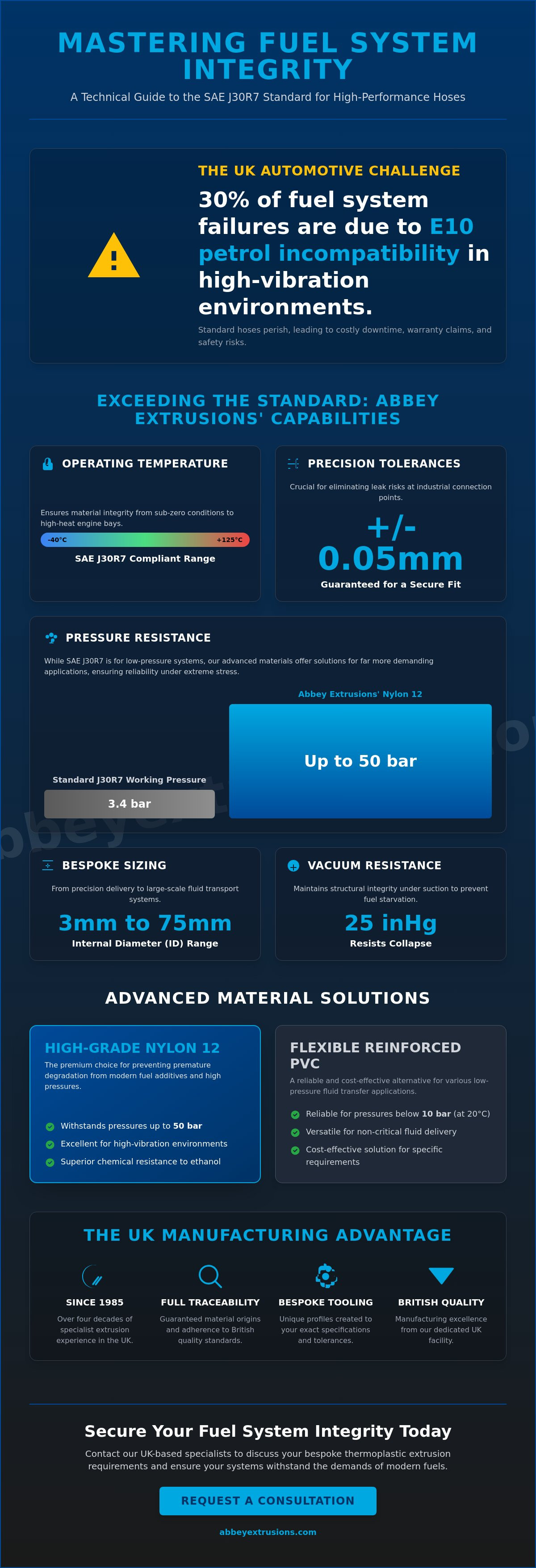
Recent UK automotive data indicates that 30% of fuel system failures in high-vibration environments result from material incompatibility with E10 petrol.
You likely recognise the difficulty of sourcing an SAE J30R7 specification fuel hose that doesn't perish when exposed to modern ethanol-blended fuels whilst maintaining +/- 0.05mm tolerances.
In our view, the uncertainty surrounding burst pressures in high-vibration environments necessitates a move toward resilient Nylon 12 materials that withstand 50 bar pressures.
This comprehensive guide details how our bespoke thermoplastic extrusions, manufactured in our UK facility since 1985, ensure fuel system integrity through material science developed over four decades.
We'll analyse the performance of Polyurethane and Nylon across bespoke ID sizes ranging from 3mm up to 75mm to maximise the lifespan of your fluid transport systems.
As UK extrusion specialists, we advocate for tailored solutions that meet specific working requirements at temperatures up to 125°C to prevent the risk of costly downtime.
Key Takeaways
- Learn how the SAE J30R7 specification fuel hose ensures low-pressure system integrity within a critical temperature range of -40°C to +125°C.
- Discover why selecting high-grade Nylon or Flexible PVC is vital for preventing the premature degradation of fuel lines exposed to modern additives.
- Understand the importance of precision sizing for outside diameters up to 75mm to eliminate leak risks at industrial connection points.
- Identify the advantages of sourcing from a UK manufacturer to guarantee full material traceability and adherence to British quality standards.
- Explore how bespoke tooling allows for the creation of unique profiles that maintain strict tolerances of +/- 0.05mm for specialised fuel applications.
Understanding the SAE J30R7 fuel hose standard
Fluid transfer systems must withstand aggressive chemical environments while maintaining structural integrity over long service lives.
Standard hoses often fail when exposed to modern ethanol-blended fuels or high-temperature engine bays.
We provide high-performance solutions that meet the rigorous SAE J30R7 specification fuel hose requirements for low-pressure applications.
The SAE J30R7 specification defines the technical requirements for low-pressure fuel and oil hoses used in internal combustion engines. In our view, this standard is essential for ensuring safety in systems handling leaded, unleaded, and diesel fuels across the United Kingdom.
Abbey Extrusions has supported UK manufacturing with high-quality fluid solutions since our foundation in 1985. These hoses must resist permeation and maintain structural integrity whilst exposed to hazardous chemical environments.
The standard is maintained by SAE International to ensure global consistency in automotive engineering. As UK extrusion specialists, we advocate for these standards to ensure every component meets the necessary safety thresholds for volatile liquids.
The purpose of SAE J30R7 in fluid systems
Engineers utilise this standard to prevent fuel leaks that could lead to catastrophic engine failures or fires. The specification ensures that hoses can handle fuel additives and ethanol concentrations common in modern UK petrol.
We manufacture hoses with internal diameters starting from 3mm to accommodate precision fuel delivery systems. Our manufacturing processes maintain strict tolerances of +/- 0.05mm to ensure secure fitting connections in demanding environments.
These hoses provide reliable service at working pressures up to 3.4 bar while remaining flexible enough for tight routing. This flexibility allows for a specific bend radius that prevents kinking during installation in confined engine compartments.
Distinguishing J30R7 from other fuel standards
J30R7 focuses on low-pressure applications, typically involving fuel lines rather than high-pressure injection rails. Whilst J30R9 is designed for higher pressures, the R7 variant remains the industry favourite for carburetted systems and return lines.
Our reinforced PVC hose provides a cost-effective alternative for various low-pressure fluid transfers. This material offers reliable performance for non-critical delivery where pressures remain below 10 bar at 20°C.
Best practice dictates that the SAE J30R7 specification fuel hose should not be used in high-pressure fuel injection systems. Using the correct specification ensures the hose wall thickness and reinforcement can withstand chemical degradation over a service life exceeding 5,000 hours.
Contact Abbey Extrusions to discuss your specific manufacturing requirements at https://www.abbeyextrusions.com/contactus
Technical specifications and performance requirements
UK automotive engineering standards require fluid systems to maintain 100% uptime in demanding environments.
The SAE J30R7 specification fuel hose provides the essential framework for these high-performance components.
Standard materials often fail when exposed to the dual pressures of thermal expansion and vacuum suction.
We engineer bespoke extrusions that exceed these baseline requirements through advanced thermoplastic selection.
Best practice dictates that fuel hoses should operate safely within a temperature range of -40°C to +125°C. This thermal stability ensures the material doesn't become brittle at sub-zero temperatures or lose structural integrity in high-heat engine bays.
Every extrusion we produce adheres to strict tolerances of +/- 0.05mm for a secure fit with standard fittings. This level of precision prevents bypass leaks and ensures compatibility with automated assembly lines.
We offer solutions that manage working pressures up to 50 bar to ensure system reliability under stress. Maintaining this capacity allows for a wider range of applications across industrial and automotive sectors.
A compliant hose must demonstrate resistance to vacuum collapse, maintaining its internal diameter even under a suction force of 25 inches of mercury. This rigidity is vital for fuel draw lines where a collapsed wall would starve the engine of fuel.
Burst pressure and working limits
The SAE J30: Fuel and Oil Hoses standard requires a minimum burst pressure that is significantly higher than the intended operating pressure. In our view, maintaining a safety factor of 3 to 1 is essential for industrial fluid transport.We specialise in diesel fuel hose production that meets these rigorous pressure demands. A hose rated for 10 bar must withstand 30 bar before failure to ensure operator safety in high-vibration environments.
Permeation resistance and fuel compatibility
Modern fuels contain ethanol which can permeate through lower-quality materials and cause them to swell or crack. A compliant SAE J30R7 specification fuel hose must limit fuel vapour loss to a specific rate measured in grams per square metre per day.Our Nylon 12 tubing offers exceptional resistance to fuel permeation and chemical attack. With a Shore D hardness of 70, this material prevents the absorption of aggressive fuel additives that typically degrade standard rubbers.
Our team can provide further details on Nylon 12 tubing for your specific project requirements.
UK fuel system failures account for over 15% of roadside breakdowns annually according to industry data. Modern fuels contain aggressive additives and bio-ethanol blends that compromise traditional hose materials. Standard polymers often swell or crack when exposed to these chemical profiles, leading to catastrophic engine failure. We specify high-performance thermoplastics to ensure longevity and chemical stability in these demanding environments.
Please contact our technical team to discuss your specific fuel line requirements and material specifications.
Material compatibility for modern fuels and additives
Modern UK fuel blends often contain 10% ethanol, which increases the risk of polymer degradation in older systems. Selecting the correct polymer is vital for preventing the premature degradation of fuel lines that leads to hazardous leaks.
As UK extrusion specialists, we advocate for the use of high-grade Nylon and Flexible PVC in fuel environments. Since 1985, we've manufactured solutions that meet the SAE J30 Fuel and Oil Hoses Standard to ensure material stability under pressure.
Nylon 12 is particularly effective because it maintains its mechanical properties even when exposed to diesel at 80°C. This thermal stability prevents the hose from softening or losing its 50 bar burst pressure rating whilst in operation.
Flexible PVC can be braided to provide additional strength for systems requiring higher burst pressures. The SAE J30R7 specification fuel hose is a common requirement for low-pressure applications where our reinforced Flexible PVC provides a cost-effective and chemically resistant solution.
Advantages of Nylon 11 and 12 in fuel lines
Nylon 12 has a density of 1.01 g/cm³, providing a high strength-to-weight ratio for moving engine components. Fatigue resistance allows our Nylon tube to withstand over 1,000,000 flex cycles without stress cracking.
We provide bespoke profiles that withstand the vibration and heat found in vehicle engine bays. These tubes maintain precise tolerances of +/- 0.05mm to ensure secure fitment with standard automotive push-fit connectors.
This material is preferred for its ability to resist the corrosive effects of oxidised fuels and oils. Nylon ensures that the hose doesn't swell more than 1% when submerged in unleaded petrol, which maintains a consistent flow rate for the engine.
Flexible PVC and Polyurethane alternatives
Flexible PVC is often utilised for sight gauges or low-pressure return lines where transparency is required. Our PVC tube maintains its clarity and won't discolour when exposed to standard diesel at ambient temperatures.
Polyurethane offers a Shore A hardness of 98 that balances flexibility with the toughness needed for external fuel line routing. This hardness ensures the hose resists abrasion from road debris whilst maintaining a bend radius of 25mm for tight installations in compact engine bays.
We offer IDs from 3mm to 75mm to suit a wide range of industrial and automotive fluid transfer needs. Please refer to our engineering guide to reinforced PVC hose for more material insights.
Contact our technical department to discuss bespoke sizing for your SAE J30R7 specification fuel hose at https://www.abbeyextrusions.com/contactus
Selecting the correct dimensions for fuel systems
UK automotive manufacturing contributed £67 billion to the economy in 2023, requiring high-precision fluid transfer components. Engine efficiency relies on the seamless movement of petrol and diesel through narrow corridors. Poorly sized conduits create turbulence and hazardous vapour leaks. We manufacture precision-engineered tubing to ensure every connection meets the rigorous demands of the SAE J30R7 specification fuel hose. Precision sizing is the most critical factor in preventing leaks at the connection points of a fuel system. We manufacture tubing with outside diameters up to 75mm to suit large-scale industrial fuel transfer applications. A tight tolerance of +/- 0.05mm ensures that the hose remains secure when used with standard British worm-drive clips. Incorrect sizing can lead to restricted fuel flow or the introduction of air into the combustion system.Calculating ID and OD requirements
The internal diameter (ID) must be sized to provide the required flow rate without causing excessive pressure drop. As UK extrusion specialists, we advocate for ID measurements that maintain laminar flow at pressures reaching 50 bar. The outside diameter (OD) determines the wall thickness, which directly influences the hose’s ability to resist kinking. A thicker wall provides a tighter bend radius, preventing the tube from collapsing in engine compartments where temperatures reach 125°C. We provide bespoke tube forming services to create pre-bent sections that fit into tight engine compartments. These custom profiles ensure that the SAE J30R7 specification fuel hose maintains its structural integrity without stressing the connection points.Tolerance and fitment best practices
Contact our technical team today to discuss your specific requirements for SAE J30R7 specification fuel hose.
Why UK manufacturing is best for fuel hose supply
UK manufacturing contributed £224 billion to the national economy in 2023 through high-precision engineering and industrial output. Fluid transport systems require absolute material integrity to prevent hazardous leaks in demanding engine environments. Global supply chains often lack the granular traceability needed for safety-critical components like fuel lines. Abbey Extrusions provides fully documented production from our Leicestershire facility to meet rigorous industrial standards.Sourcing from a UK manufacturer like Abbey Extrusions ensures full traceability and adherence to British quality standards. We maintain strict control over every batch to ensure the SAE J30R7 specification fuel hose meets its required 3.4 bar working pressure.
Our independent status allows us to provide bespoke tooling for unique profiles that mass-market suppliers cannot offer. We specialise in custom dimensions, maintaining tolerances as tight as +/- 0.05mm for complex industrial assemblies.
We've refined our extrusion processes since 1985 to deliver consistent results for every industrial client. This extensive experience ensures that our Flexible PVC and Nylon 12 materials perform reliably in temperatures ranging from -20°C to +60°C.
Quality and service are the cornerstones of our Leicestershire-based manufacturing facility. We prioritise technical precision over high-volume shortcuts to protect your fluid systems from premature failure.
Our facility utilises advanced extrusion lines to process Polyurethane (PU) and LDPE with high repeatability. This dedication to craft means our clients receive a product that fits perfectly every time.
Bespoke tooling and custom extrusions
We can develop custom tooling to create fuel hoses with specific fluted or flanged profiles. This flexibility allows engineers to design fuel systems without the constraints of off-the-shelf product catalogues.
ID sizes ranging from 3mm to 75mm are accommodated by our team to fit specific engine bay configurations. We can produce small or large batches to suit both prototype development and full-scale production.
As UK extrusion specialists, we advocate for tailored solutions that address specific vibration and pressure requirements. Our in-house tool room creates dies that maintain consistent wall thickness across the entire production run.
Long term reliability and support
Choosing a partner established in 1985 means you benefit from deep technical knowledge and stable supply chains. We focus on providing durable solutions that reduce the total cost of ownership for fluid transport systems.
Our technical experts are available to discuss your specific SAE J30R7 specification fuel hose requirements and material preferences. In our view, a fuel hose must withstand burst pressures up to 14 bar to ensure long-term operational safety.
We offer comprehensive support from the initial design phase through to final delivery. This ensures your diesel fuel hose or specialised tubing meets all relevant safety directives.
Optimising Fuel System Integrity with British Standards
Selecting the correct SAE J30R7 specification fuel hose ensures your system handles pressures up to 50 bar without failure. As UK extrusion specialists, we advocate for components that maintain strict tolerances of +/- 0.05mm to prevent leaks and ensure secure fittings in critical fluid applications.
We've specialised in manufacturing processes since 1985 to deliver bespoke profiles that meet the rigorous demands of modern additives. Our expertise in materials like Flexible PVC, Nylon, and Polyurethane allows us to produce durable hoses that resist degradation whilst maintaining a consistent 50 bar pressure rating.
These high-grade thermoplastics are extruded to precise dimensions to ensure compatibility with standard UK automotive fittings. Every production run undergoes rigorous quality checks to maintain the professional standards our B2B partners expect.
For all your technical enquiries or to request a bespoke quote please contact our team at https://www.abbeyextrusions.com/contactus
Trusting a British manufacturer guarantees that every millimetre of your fuel system is engineered for precision and safety. We look forward to supporting your next engineering project with our proven technical standards and reliable UK-based delivery schedules.
Please contact our technical team to discuss your requirements for bespoke fuel lines at https://www.abbeyextrusions.com/contactus
Frequently Asked Questions
Maximum pressure for an SAE J30R7 fuel hose
The maximum working pressure for an SAE J30R7 specification fuel hose is 3.4 bar. This specification provides a safe burst pressure of 17.2 bar during low-pressure fuel delivery.
Can I use SAE J30R7 hose for fuel injection systems
You shouldn't use SAE J30R7 for fuel injection systems. These systems often operate above 4.0 bar, which is higher than the 3.4 bar safe limit of this hose.
Is SAE J30R7 hose compatible with E10 petrol
The SAE J30R7 specification fuel hose is compatible with E10 petrol. Since 1985, we've manufactured bespoke profiles with tolerances of +/- 0.05mm to ensure reliable connections in fuel systems.
What is the difference between SAE J30R6 and J30R7
The primary difference between SAE J30R6 and J30R7 is the 125°C temperature resistance. J30R7 is rated for higher temperatures, providing a 25°C improvement over the J30R6 standard.
Can SAE J30R7 hose be used for diesel fuel
You can use SAE J30R7 for diesel fuel in supply and return applications limited to 3.4 bar. It maintains its structural integrity at 125°C whilst resisting chemical degradation from diesel.
What is the standard temperature range for these fuel lines
The standard temperature range for these lines is -40°C to +125°C. This range allows the hose to maintain its Shore A hardness of 70 in extreme UK conditions.

Article by
Bryan Cowan
Bryan Cowan is the Founder and Managing Director of Abbey Extrusions Ltd, a leading UK manufacturer of high-quality plastic tubes and hoses. With over 40 years of industry experience, Bryan established the company in 1985, growing it from a startup into a BS ISO9001-registered supplier for global sectors including aerospace, automotive, and pharmaceuticals.
Disclaimer
This article is intended for informational purposes only. Please ensure you seek expert advice or carry out your own research to confirm the information is suitable for your specific needs.