The initial cost savings of a standard PVC line often vanish the moment a robotic arm stalls or a pneumatic system loses pressure due to material fatigue. You likely rely on PVC for its versatility and economy, yet you've undoubtedly encountered the frustration of hoses kinking under repetitive motion or becoming brittle whilst operating in cold storage environments. When these failures become a recurring drain on your maintenance budget, upgrading from PVC to polyurethane hoses becomes a strategic necessity rather than a mere alternative. We recognise that in a high-cycle manufacturing environment, reliability is the only metric that truly dictates long-term value.
This article examines the technical transition from traditional vinyl to high-performance polyurethane tubing, focusing on the specific operational benefits for demanding industrial applications. You'll discover how the superior abrasion resistance and thermal stability of polyurethane can significantly reduce unplanned downtime and extend the service life of your components. We will also detail the critical compliance standards and material properties that make this upgrade a sound investment for maintaining mechanical integrity across your facility.
Key Takeaways
- Understand the physical limitations of standard PVC tubing, including its tendency to become brittle in cold storage or kink during repetitive robotic movements.
- Learn why upgrading from PVC to polyurethane hoses offers significantly better abrasion resistance and a longer service life in high-cycle pneumatic lines.
- Identify the technical differences between various polyurethane grades to ensure your chosen hose meets specific chemical and environmental requirements.
- Discover how transitioning to high-performance tubing reduces maintenance costs and prevents unplanned downtime in advanced manufacturing environments.
- Recognise the benefits of partnering with a specialist UK manufacturer for bespoke hose solutions tailored to your precise industrial specifications.
For bespoke advice regarding your specific industrial requirements, please visit our contact page.
Performance limitations of standard PVC tubing
Standard pvc tube remains a staple in the manufacturing sector due to its cost-efficiency and initial flexibility. However, it's essentially a rigid polymer made pliable through the addition of plasticisers. Whilst these additives provide elasticity, they aren't chemically bonded to the vinyl chain. Over time, environmental stressors such as UV exposure, heat, or contact with certain lubricants cause these plasticisers to leach out. This molecular migration leads to a gradual hardening of the hose, which eventually results in stress cracking and catastrophic system failure.
In pneumatic and fluid transfer systems, this degradation manifests as microscopic fractures that compromise pressure integrity. Whilst a reinforced pvc tube offers enhanced burst pressure through internal polyester braiding, it still shares the base polymer's inherent chemical limitations. When compared to the advanced properties of polyurethane, vinyl lacks the long-term elastomeric memory required for dynamic environments. Consequently, upgrading from PVC to polyurethane hoses is often the most viable route to ensuring operational stability in high-cycle automated machinery.
Brittleness at lower temperatures
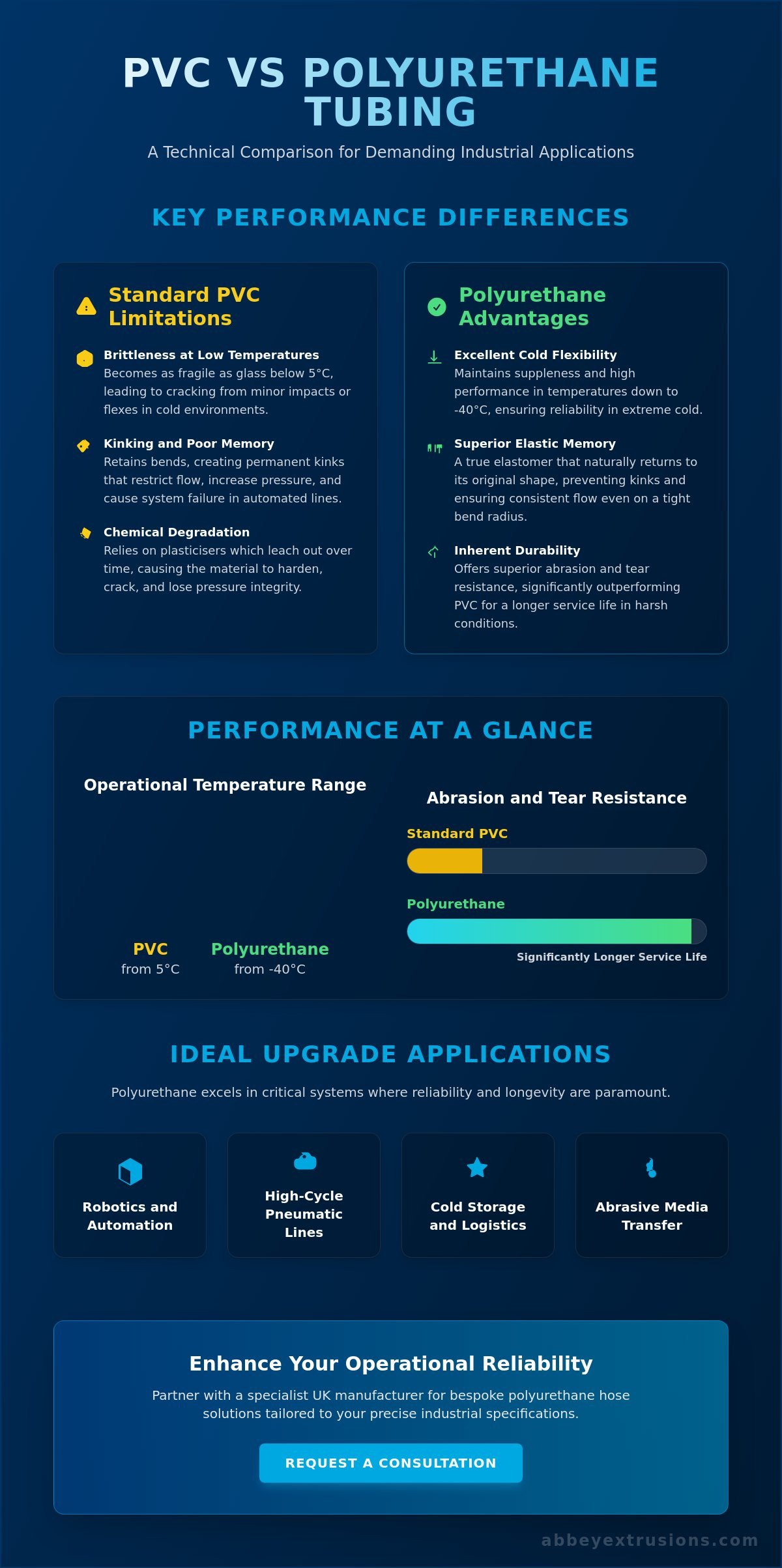
The glass transition temperature of PVC is a critical factor for UK-based facilities. As temperatures drop, standard vinyl tubing loses its ability to absorb impact and flex. Amongst refrigerated storage units or outdoor winter installations, PVC often reaches a point of physical transition where it becomes as fragile as glass. A single impact or a sharp bend in these conditions can lead to immediate cracking. Most standard PVC grades lose their structural integrity once temperatures dip below 5 degrees Celsius, making them unreliable for cold-chain logistics or unheated factory floors.
Kinking and memory issues in PVC
One of the primary frustrations in automated lines is the "kinking" behaviour of vinyl. PVC possesses a high level of material memory, meaning it tends to retain a permanent set if it's kept in a bent or coiled position for an extended period. This permanent deformation creates significant flow restrictions and internal pressure drops that force pumps and compressors to work harder. In applications involving constant movement, such as robotic arms, PVC's inability to spring back to its original shape leads to frequent obstructions. These kinks don't just slow down production; they create localised stress points that accelerate the eventual rupture of the line.
To discuss the technical specifications of polyurethane for your machinery, you can contact us via our website contact page.
Key technical advantages of polyurethane over PVC
Transitioning to a high-performance polyurethane tube represents a significant technical leap for industrial operators. Unlike vinyl, which relies on additive plasticisers to achieve its form, polyurethane is an elastomer by nature. This inherent material composition provides what engineers define as molecular memory. When the tubing is subjected to extreme bending or crushing forces, the polymer chains naturally return to their original orientation. This prevents the permanent deformation and flow restrictions that typically plague PVC lines in tight spaces.
The elastic properties of this material allow for exceptionally tight bend radii without the risk of wall collapse. This is vital in modern, compact machinery where installation space is at a premium. Whilst PVC becomes unworkable as temperatures drop, polyurethane maintains its supple characteristics at temperatures as low as -40 degrees Celsius. For facilities operating in extreme cold or those requiring consistent performance across fluctuating thermal cycles, upgrading from PVC to polyurethane hoses ensures the system remains responsive and leak-free.
Superior abrasion and tear resistance
In environments where hoses are dragged across concrete floors or used to transport granular media, abrasion is the primary cause of failure. When comparing Taber abrasion cycles, polyurethane consistently outperforms PVC by a significant margin. This durability makes it the favourite choice for transferring abrasive powders, pellets, or slurry. PU also possesses immense tear resistance. If a small nick or cut occurs, the material resists the propagation of that tear under pressure. This prevents the sudden, catastrophic bursts often seen in less resilient materials.
Flexibility and flexural fatigue resistance
Flexural fatigue occurs when a material weakens due to repeated bending and straightening. In automated systems where a hose might flex thousands of times per shift, this is the primary killer of industrial lines. Polyurethane molecular chains are designed to absorb and dissipate this mechanical stress rather than fracturing. Because the material does not work-harden or lose its plasticisers, it retains its original mechanical properties for millions of cycles. This exceptional longevity significantly reduces the frequency of maintenance intervals. It allows your team to focus on production rather than constant hose replacements. If you require a material that withstands these rigorous mechanical demands, our team can help you identify the correct specification for your specific equipment.
If you are unsure whether your application justifies an upgrade, our specialists are available through our contact form.
Primary industrial applications requiring a polyurethane upgrade
Many industrial sectors are finding that the initial cost benefit of reinforced pvc tube is quickly outweighed by the operational costs of frequent replacements. In facilities where high-speed production is the standard, the transition to polyurethane is driven by a need for a better return on investment. Upgrading from PVC to polyurethane hoses is particularly critical in chemical processing environments where vinyl would swell or degrade upon contact with specific hydrocarbons or industrial oils. By selecting a material with superior chemical resistance, engineers can ensure that fluid transfer lines remain secure and leak-free throughout their service life.
Pneumatic and robotic systems
Modern multi-axis robotic arms require tubing that can withstand constant, complex motions without fatigue. Polyurethane's lightweight profile is a distinct advantage for end-of-arm tooling, as it reduces the mechanical load on the robot's motors. In workshop environments, PU is also the preferred material for coiled air hoses. Unlike PVC, which often tangles or loses its "spring" over time, polyurethane coils retain their shape and provide consistent pneumatic power to assembly stations without obstructing the workspace.
Outdoor and cold storage environments
Standard PVC is notoriously susceptible to UV degradation and thermal shock. Amongst external machinery, polyurethane offers far greater UV stability, preventing the sun-bleaching and surface cracking that compromises vinyl. In food processing centres that operate at sub-zero temperatures, PU remains supple whilst PVC becomes brittle. This reliability extends to critical fuel delivery systems. Utilising a dedicated diesel fuel hose made from high-grade polyurethane ensures that external plant machinery remains operational during the harshest UK winter conditions.
High cycle manufacturing lines
In automated packaging and bottling plants, every minute of unplanned downtime carries a heavy financial penalty. PVC hoses often fail without warning due to the repetitive stress of high-speed cycles. By upgrading from PVC to polyurethane hoses, facilities can achieve millions of cycles without material failure. This consistent performance allows maintenance teams to move away from reactive repairs and towards a more predictable, scheduled maintenance strategy. Whilst PVC might require monthly replacement in a high-cycle line, a correctly specified polyurethane alternative can often last for years.
For guidance on chemical compatibility and material grades, please get in touch with our technical department.
Selecting the appropriate grade of polyurethane for your operations
Whilst upgrading from PVC to polyurethane hoses provides an immediate boost to durability, the success of the transition depends entirely on selecting the correct polymer chemistry. Polyurethane isn't a single material but a broad family of elastomers with varying resistances. Choosing an incompatible grade for your specific operating environment can lead to premature swelling, hardening, or even complete structural failure. Engineers must evaluate the medium being transported, the ambient humidity, and the presence of any chemical cleaners to ensure the new installation delivers the expected service life.
Within the industrial extrusion sector, we categorise polyurethane into two primary families: polyester-based and polyether-based. Each possesses distinct strengths and vulnerabilities that dictate its suitability for a given task. Beyond these base chemistries, specialised variants such as anti-static tubing for explosive environments or food-grade hoses for consumables are also available. We organise our production to meet these precise industrial requirements, ensuring that the material properties align with your operational needs.
Ester based polyurethane for oil and fuel resistance
Ester-based polyurethane is frequently selected for pneumatic power systems and lubrication lines. It offers the highest levels of tensile strength and is exceptionally resistant to oils, fuels, and many common solvents. This makes it a robust choice for automotive assembly or heavy machinery maintenance. However, it's vital to avoid using ester grades in applications involving water or high humidity. Moisture triggers a destructive chemical reaction known as hydrolysis. Hydrolysis is the process where water molecules penetrate the polymer and sever the ester bonds, eventually causing the hose to crumble into a waxy residue.
Ether based polyurethane for humid or aqueous environments
For applications involving water transfer or operation in humid UK manufacturing sites, ether-based polyurethane is the superior choice. This grade is immune to hydrolysis and resists microbial attack, which is a common issue in damp environments where fungi or bacteria can thrive on the hose surface. Whilst ether-based tubing offers slightly lower resistance to certain petroleum products compared to ester grades, its stability in aqueous conditions is unmatched. It remains flexible and structurally sound even when permanently submerged or exposed to constant steam. To ensure your system uses the most resilient polymer for your specific environment, you can speak with our technical team for a detailed compatibility assessment.
To request a quotation for custom extruded tubing, you can speak with our experts by visiting our contact page.
Sourcing bespoke polyurethane hoses from a UK manufacturer
Abbey Extrusions provides the engineering precision required for complex industrial upgrades. Unlike mass-produced imports, our plastic extrusion processes allow for exact control over wall thickness and internal diameters. This ensures that when you're upgrading from PVC to polyurethane hoses, the new components integrate seamlessly with your existing pneumatic fittings and connectors. We maintain strict compliance with British industrial standards, providing the material traceability that safety-critical sectors demand. For original equipment manufacturers (OEMs), we offer the ability to produce tubing in custom colours or with specific branding, which allows for clear line identification within complex mechanical assemblies.
When your facility is upgrading from PVC to polyurethane hoses, sourcing from a domestic partner ensures that every millimetre of the extrusion meets your exact engineering tolerances. We recognise that a standard off-the-shelf solution isn't always sufficient for specialised machinery. By working directly with a UK-based manufacturer, you gain access to technical expertise that can help refine your specifications for better long-term performance. This collaborative approach reduces the risk of material mismatch and ensures the chosen polymer grade is perfectly suited to your specific industrial environment.
Custom extrusion and tube forming capabilities
Our facility specialises in advanced tube forming, a process that creates permanent bends and specific shapes without compromising material integrity. This is particularly valuable for robotic applications where a specific hose geometry is needed to avoid mechanical interference or snagging. By organising multiple functions into a single extrusion profile, we help businesses simplify their assembly processes and reduce the number of individual components. UK businesses also benefit from our rapid prototyping capabilities. We can produce small batches for testing before moving to full-scale production, ensuring the design is optimised before you commit to a large-scale rollout.
Quality control and material traceability in the UK
Reliability in the manufacturing sector is built on consistent quality and methodical testing. Abbey Extrusions employs rigorous quality control procedures for every batch, verifying that the mechanical properties of our polyurethane meet the required industrial specifications. Knowing the exact polymer origin is essential for applications amongst the food processing and chemical sectors where contamination is a constant risk. By maintaining a national supply chain, we offer significantly reduced lead times and greater logistical flexibility compared to international suppliers. This proximity allows for direct technical consultation, ensuring that your transition to high-performance tubing is supported by decades of British manufacturing expertise.
To discuss your specific project requirements or to request further technical data, please visit our contact page.
Optimising industrial performance with advanced polymer solutions
Transitioning from standard vinyl to high-performance elastomers is a strategic investment in mechanical reliability. By addressing the inherent limitations of PVC, such as thermal brittleness and flexural fatigue, facilities can ensure their automated systems operate at peak efficiency. Upgrading from PVC to polyurethane hoses provides the molecular memory and abrasion resistance necessary to withstand millions of cycles in demanding environments. Every component should be selected based on its specific chemical and physical stressors to ensure a lasting return on investment.
Whether your application requires ether-based stability for aqueous environments or bespoke tube forming for complex robotic paths, selecting the correct material grade is essential for success. Abbey Extrusions has been a leading UK-based manufacturer since 1985, specialising in high-performance Nylon and Polyurethane extrusion. We provide bespoke profile services and rigorous quality control to meet your exact engineering tolerances. Contact Abbey Extrusions for a bespoke polyurethane hose quotation to discuss your technical requirements. We look forward to supporting your transition to more resilient industrial hosing solutions.
Frequently Asked Questions
What are the main benefits of switching from PVC to polyurethane hoses
Polyurethane provides significantly higher abrasion resistance and superior flexibility at low temperatures compared to vinyl. Whilst PVC serves well in static applications, polyurethane is engineered for high-cycle environments where kinking resistance is a priority. It features molecular memory, allowing the tube to return to its original shape after being crushed or bent. Upgrading from PVC to polyurethane hoses ensures better mechanical integrity in automated systems.
Is polyurethane more expensive than PVC for industrial use
Polyurethane tubing initially carries a higher unit cost due to more complex manufacturing processes and the price of raw materials. However, the total cost of ownership is often lower because the material lasts significantly longer in high-wear environments. This longevity reduces the frequency of hose replacements and the associated machinery downtime. By investing in PU, operators often see a reduction in long-term maintenance expenditure.
Can polyurethane hoses handle lower temperatures than PVC
Yes, polyurethane is far more resilient in cold environments than standard vinyl. PVC typically becomes brittle and prone to cracking as temperatures drop towards zero degrees Celsius. In contrast, many polyurethane hoses remain flexible and functional at temperatures as low as -40 degrees Celsius. This makes them the favourite choice for UK outdoor applications and industrial refrigeration units where structural integrity is a safety requirement.
What is the difference between ester based and ether based polyurethane
Ester-based polyurethane provides the best resistance to oils and fuels but can degrade when exposed to high humidity through a chemical reaction called hydrolysis. Ether-based polyurethane is slightly less resistant to petroleum products but is immune to hydrolysis and microbial attack. Selecting the correct chemistry is vital; ether grades are necessary for aqueous applications, whilst ester grades excel in lubrication and pneumatic systems.
Are polyurethane hoses suitable for food grade applications
Specific grades of polyurethane are manufactured to meet stringent food-grade standards for transferring consumables. These hoses are often ether-based to ensure they do not degrade when subjected to cleaning with water or steam. They provide a non-toxic, abrasion-resistant solution for transferring dry powders or liquids amongst food processing facilities. We recommend verifying the specific compliance certificates for any hose intended for food contact.
How does the abrasion resistance of polyurethane compare to PVC
Polyurethane is one of the most abrasion-resistant polymers available in the industrial market. It often outlasts PVC by a factor of three to one when conveying gritty or abrasive media. This durability makes it ideal for the pneumatic conveying of pellets or sand that would rapidly erode the inner wall of a standard PVC hose. Upgrading from PVC to polyurethane hoses is a proven method for extending component life in abrasive cycles.
Does polyurethane have a better kink resistance than PVC
Polyurethane possesses exceptional kink resistance due to its elastic nature and high molecular memory. It can be bent to a much tighter radius than PVC without the wall collapsing or flow being restricted. If a PU hose does kink under extreme stress, it's far more likely to recover its original shape without permanent damage. PVC often retains a weakened section at the point of the kink, which eventually leads to a structural failure.

Article by
Bryan Cowan
Bryan Cowan is the Founder and Managing Director of Abbey Extrusions Ltd, a leading UK manufacturer of high-quality plastic tubes and hoses. With over 40 years of industry experience, Bryan established the company in 1985, growing it from a startup into a BS ISO9001-registered supplier for global sectors including aerospace, automotive, and pharmaceuticals.
Disclaimer
This article is intended for informational purposes only. Please ensure you seek expert advice or carry out your own research to confirm the information is suitable for your specific needs.