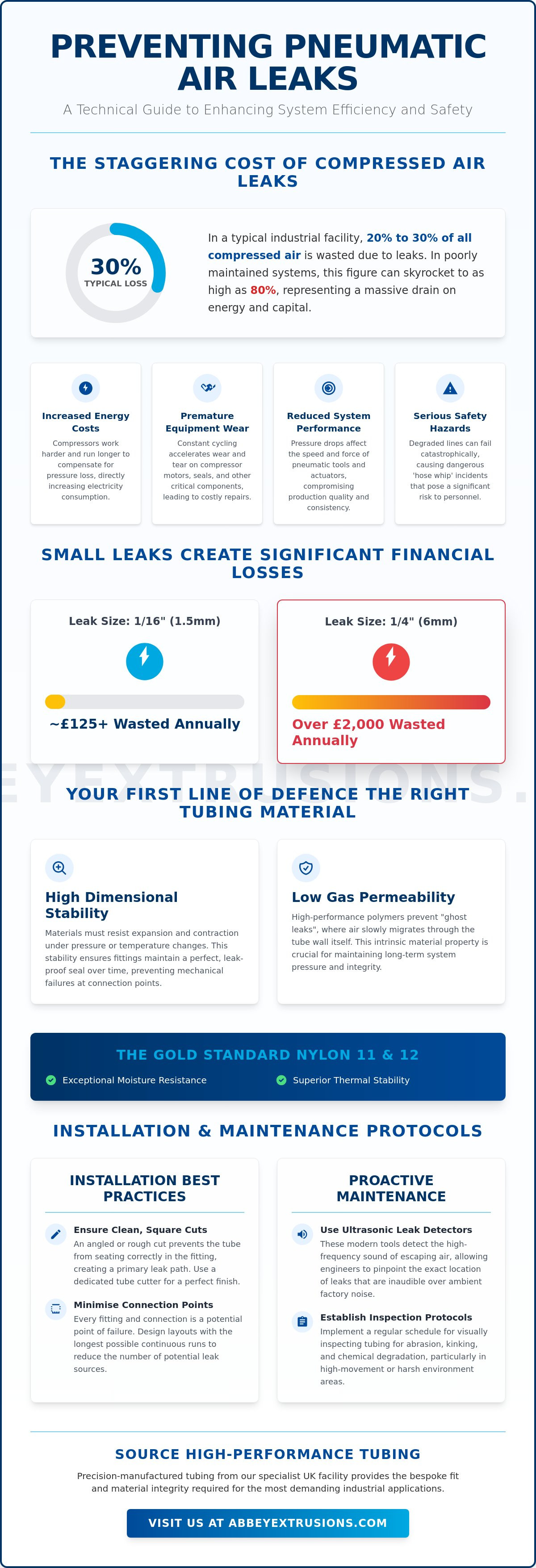
Did you know that the average industrial facility loses between 20% and 30% of its compressed air through leaks alone? For a plant operating at scale, the U.S. Department of Energy suggests these losses can even reach 80% in poorly maintained systems, representing a staggering waste of energy and capital. It's a frustrating reality for many engineers who find their compressors running constantly whilst system downtime increases due to unexpected hose failures. You likely recognise the difficulty of identifying small leaks within complex layouts, but these invisible losses directly impact your operational efficiency and bottom line.
We believe that preventing air leaks in pneumatic tubing starts long before a system is pressurised. By focusing on material science and precision extrusion rather than just reacting to failures after they occur, you can significantly reduce compressor load and extend the lifespan of your pneumatic components. This article provides the technical insights needed to stop costly air leaks by selecting high-performance materials and mastering professional installation techniques. We'll examine how the correct choice of tubing, such as Nylon 12 or Polyurethane, creates a safer and more reliable working environment for your entire team.
Key Takeaways
- Understand the economic impact of air leaks and how constant compressor cycling leads to premature component wear whilst increasing maintenance costs.
- Discover why selecting materials with high dimensional stability and low gas permeability is essential for preventing air leaks in pneumatic tubing.
- Learn professional installation techniques, including the necessity of clean, square cuts and the reduction of connection points to ensure system integrity.
- Establish robust maintenance protocols using modern tools like ultrasonic leak detectors to identify high-frequency leaks amongst ambient industrial noise.
- Explore how precision-manufactured tubing from a specialist UK facility provides the bespoke fit required for high-performance industrial applications.
If you require technical assistance with your current installation or wish to discuss bespoke tubing requirements, you can contact our specialist team for professional guidance.
The impact of air leaks on pneumatic system performance
Industrial efficiency relies heavily on the integrity of Pneumatic systems, yet air leakage remains one of the most overlooked sources of operational waste in UK manufacturing. Statistics indicate that air leaks represent a significant percentage of industrial energy waste, often accounting for 20% to 30% of a compressor's total output. This inefficiency isn't merely a matter of electricity consumption; it fundamentally alters the duty cycle of your equipment. Constant compressor cycling leads to premature wear of internal components and significantly increased maintenance costs over the system's lifecycle. At Abbey Extrusions, we recognise that a stable system is a profitable one.
Small leaks can cause subtle pressure drops that affect the precision of pneumatic actuators. When an actuator fails to reach its target pressure, the timing and force of the machine cycle are compromised, leading to rejects in high precision manufacturing environments. Beyond the financial burden, safety risks associated with high pressure leaks cannot be ignored. A sudden failure in a degraded line can lead to "hose whip", which presents a genuine danger to personnel. Prioritising preventing air leaks in pneumatic tubing is therefore not just an economic decision, but a vital part of maintaining a safe and stable workshop.
Quantifying energy waste in the pneumatic circuit
The scale of waste is often surprising to those who haven't performed a dedicated audit. For instance, data indicates that a single 1/4-inch leak at 100 PSI can waste over $2,500 annually in energy costs, whilst even a small 1/16-inch leak can cost roughly $150 annually. These figures escalate quickly in facilities with complex layouts. The relationship between system pressure and leak rate is direct; higher pressures accelerate the volume of air lost through any aperture. There is also the hidden cost of compressor carbon emissions. Running compressors inefficiently to compensate for losses increases a facility's environmental footprint, which is an increasingly critical metric in modern industrial standards.
Operational consequences of undiagnosed leakage
Undiagnosed leaks introduce pressure fluctuations that lead to inconsistent machine behaviour. In sensitive applications like food production or electronics assembly, these variations can compromise product quality or lead to total batch rejection. Some operators attempt to compensate by increasing system pressure, but this is a counterproductive strategy. Higher pressure increases the leak rate and puts unnecessary stress on every component, from Nylon tube lines to seals and fittings. By addressing the root cause rather than the symptoms, engineers can stabilise system pressure and ensure that every cubic foot of air produced contributes to productive work.
If you are evaluating material specifications for a new project or require custom profiles, our engineering team can provide a bespoke technical consultation to ensure the highest levels of system integrity.
Selecting the right tubing material for leak prevention
Whilst many maintenance strategies focus on tightening fittings, the foundational element of any leak-free system is the material itself. High-performance polymers offer a level of flexibility and durability that traditional rubber hoses simply cannot match. Preventing air leaks in pneumatic tubing begins with selecting materials that exhibit high dimensional stability and low gas permeability. If a material expands or contracts excessively under pressure or temperature shifts, the mechanical seal at the push-in fitting is inevitably compromised. Additionally, materials with low permeability prevent "ghost leaks" where air slowly migrates through the tube wall itself over time.
The technical advantages of Nylon 11 and 12
Nylon 11 and 12 are widely recognised as the gold standard for pneumatic integrity within the manufacturing sector. These materials possess exceptional moisture resistance and thermal stability, ensuring they don't become brittle or swell in humid industrial environments. A high-quality Nylon tube is manufactured with strict tolerances for wall thickness. This precision eliminates the thin weak spots that typically lead to pinhole leaks under high pressure. For workstations requiring mobility, a Nylon recoil air hose provides an organised solution that reduces the risk of mechanical damage from floor-level abrasion or snagging.
Polyurethane and Fluoropolymer alternatives
In applications where tight bend radii are unavoidable, a Polyurethane tube offers superior kink resistance compared to more rigid polymers. This flexibility is vital in preventing the micro-cracking that occurs when tubing is forced into restrictive machine enclosures. For environments involving extreme temperatures or aggressive chemical exposure, fluoropolymers like PTFE or FEP are necessary to prevent the material degradation that leads to catastrophic failure. Alternatively, Low-Density Polythene tube remains a cost-effective choice for low-pressure applications where chemical inertness is the primary concern. Choosing the correct material is a critical step in preventing air leaks in pneumatic tubing, ensuring long-term reliability and preventing the costly consequences of system-wide pressure loss.
For technical advice on optimising your facility's pneumatic layout or to request bespoke material samples, please get in touch with our engineering team.
Best practices for pneumatic tubing installation and layout
Precision in the installation phase is just as critical as the initial material selection. Even the highest specification polymers will underperform if the physical layout of the system is poorly executed. Preventing air leaks in pneumatic tubing requires a methodical approach that prioritises the reduction of potential failure points. Every joint, elbow, and tee-piece represents a site where thermal expansion or vibration could eventually compromise a seal. By designing circuits that minimise the total number of connections, engineers can significantly improve the long-term reliability of the entire compressed air network.
When preparing tubing for push-in fittings, the quality of the cut is paramount. A clean and square cut ensures that the tube end seats firmly against the internal stop of the fitting, allowing the O-ring to create a perfect circumferential seal. Using a dedicated tube cutter rather than standard blades prevents the deformation of the tube wall. Managing bend radii is also essential to prevent kinking and stress cracking. If a tube is forced into a tighter radius than its specification allows, the outer wall stretches and thins, whilst the inner wall compresses, creating a structural weakness that eventually leads to a fatigue-induced leak.
Optimising the pneumatic circuit layout
Efficient layouts keep tube runs as short as possible. This approach reduces pressure drop across the system and limits the total surface area vulnerable to environmental degradation. We recommend using proper support and mounting brackets to prevent sagging, which can put uneven tension on fittings. Isolating lines from excessive vibration ensures that mechanical seals remain secure over years of operation. It is also vital to avoid routing flexible lines near sharp metal edges or high-heat sources that could compromise the polymer's molecular structure and lead to premature failure.
Mechanical protection for flexible lines
Exposed lines in high-traffic or dynamic environments require additional layers of defence. Implementing a Nylon spiral cut hose guard is an effective way to prevent mechanical abrasion in applications with moving parts. For complex machinery where space is at a premium, we often suggest tube forming. This process creates bespoke, pre-shaped layouts that eliminate the need for unnecessary elbows and fittings, further reducing the leak profile of the installation. In areas where lines may be stepped on or subjected to external impacts, the structural integrity of a reinforced PVC tube provides the necessary durability to maintain system pressure under duress.
To ensure your facility meets the latest safety standards or to request a technical audit of your tubing specifications, please contact our specialist team for professional assistance.
Maintenance and inspection protocols for air systems
Professional maintenance is the final pillar of industrial efficiency. Even a system built with the highest grade Nylon tube requires a structured oversight strategy to remain at peak performance. Establishing a regular schedule for visual and audible leak inspections is a fundamental requirement for any modern factory. Whilst obvious failures are often easily heard, the most insidious losses occur at fitting interfaces and material transition points. Preventing air leaks in pneumatic tubing relies on catching these minor issues before they escalate into significant energy waste or safety hazards.
Ultrasonic leak detectors are the most effective tool for identifying high-frequency leaks amongst the ambient noise of a functioning factory. These devices translate the ultrasonic sound waves produced by escaping air into an audible frequency that an operator can easily track. This technology is particularly useful for inspecting complex manifolds or overhead lines where manual access is limited. With OSHA expected to increase enforcement and inspections throughout 2026, maintaining detailed documentation of these inspections is no longer just a best practice; it's a necessity for regulatory compliance. Fines for serious violations can reach $16,550 as of late 2025, making a proactive inspection regime a sound financial investment.
Implementing a leak detection programme
Conducting a "quiet facility test" during weekends or scheduled shutdowns allows maintenance teams to hear subtle air losses that are usually masked by heavy machinery. Training staff to recognise the specific behaviour of failing pneumatic lines, such as erratic actuator movement or unusual vibration, creates a culture of proactive reporting. We suggest documenting every identified leak on a facility map to reveal recurring issues in specific sections. This data often indicates that a more durable material, such as Polyurethane tube, is required to withstand the specific stresses of that environment.
Proactive component replacement
Identifying signs of UV degradation or chemical stress cracking is vital for preventing air leaks in pneumatic tubing before they reach a fatigue limit. If inspection findings reveal consistent material failure, it's often an indication that the current tubing is not suitable for the environmental conditions. When replacing lines, ensure the new tubing matches or exceeds the original technical specifications for pressure and temperature. Replacing components before they fail catastrophically avoids unplanned downtime and ensures a safer working environment for all personnel.
If your current maintenance findings suggest that a material upgrade is necessary to improve system reliability, speak to our technical experts about selecting the correct high-performance tubing for your facility.
To discuss your specific manufacturing requirements or to request a technical data sheet for our high-performance polymers, please contact our specialist team today.
Sourcing high performance tubing from Abbey Extrusions
At Abbey Extrusions, we understand that the long-term integrity of an industrial pneumatic system is determined by the quality of its smallest components. Whilst maintenance and installation techniques are vital, the precision of the initial extrusion process is the most significant variable in preventing air leaks in pneumatic tubing. Our commitment to engineering excellence ensures that every metre of tubing we produce meets the stringent demands of modern manufacturing environments. We believe that a reliable system begins with a reliable partner, and our decades of experience in the UK market reflect this dedication to quality.
The manufacturing process we employ focuses on achieving exceptional dimensional stability. This is a critical factor because even a minor deviation in the outer diameter of a tube can prevent a push-in fitting from seating correctly, leading to the persistent leaks that drain facility resources. By maintaining strict control over our production tolerances, we provide our partners with the confidence that their pneumatic circuits will remain airtight under constant pressure and varying thermal conditions.
UK manufacturing excellence and quality control
We operate from a specialist UK-based facility where we maintain total oversight of the production cycle. Our quality control protocols involve rigorous testing for wall thickness consistency and pressure ratings, ensuring that our Nylon tube and Polyurethane tube products perform reliably under heavy load. Sourcing directly from a specialist manufacturer provides our partners with a level of technical accountability that is often lost in global supply chains. Furthermore, we possess the unique ability to provide custom lengths and bespoke profiles. This flexibility allows engineers to design systems that require fewer joints and couplings, directly eliminating the most common failure points where air loss typically occurs.
Expert guidance for your pneumatic challenges
Our technical team possesses extensive knowledge in polymer science and its practical industrial applications. We assist our clients in selecting the ideal material for complex environments, whether they face chemical exposure, high temperatures, or the need for extreme flexibility. For specific heavy-duty requirements, we offer specialist products such as the Air 60 air hose, which is specifically engineered for maximum durability in demanding workshop conditions. By partnering with us, you gain access to bespoke solutions designed to eliminate air leaks and optimise your facility's energy efficiency. We invite you to leverage our expertise to create a safer, more reliable, and more cost-effective pneumatic network.
If you are ready to reduce energy waste and improve system safety, you can get in touch with our technical team for professional guidance on your next project.
Securing the future of your industrial pneumatic systems
Achieving long term efficiency in a compressed air network requires a transition from reactive maintenance to a strategy centred on material science and precision engineering. By selecting high performance polymers like Nylon 11 and 12, you ensure that your infrastructure maintains dimensional stability even under fluctuating industrial pressures. Professional installation and structured inspection protocols further solidify these gains, significantly reducing compressor load and preventing air leaks in pneumatic tubing whilst creating a safer environment for your personnel.
As a specialist UK manufacturer since 1985, Abbey Extrusions provides the deep technical expertise required to secure your pneumatic operations. We specialise in high performance Nylon 11 and 12 solutions, offering bespoke tube forming and extrusion capabilities tailored to your specific industrial challenges. Our team is ready to help. Contact our technical team for expert advice on leak-resistant tubing and ensure your facility operates at peak efficiency.
Frequently Asked Questions
How can I tell if my pneumatic tubing is leaking without tools
You can often identify leaks by listening for a distinct hissing sound during periods of machine inactivity. Observe the behaviour of your actuators; if they move erratically or fail to hold position, it suggests a pressure drop. Additionally, look for visible signs of degradation such as discolouration or "frosting" near fittings where air may be escaping at high velocity.
Does the colour of the pneumatic tubing affect its performance or leak resistance
Colour choice is often functional rather than purely aesthetic. Black tubing typically contains carbon black additives which provide superior resistance to ultraviolet radiation, making it less prone to the brittleness and cracking that lead to leaks in outdoor or high-light environments. Clear tubing allows for visual inspection of internal contamination, whilst other colours are used to organise complex circuits.
What is the most common cause of leaks in push-in fittings
The primary cause is an uneven or jagged cut on the tube end. If the cut is not perfectly square, the tube cannot seat correctly against the internal seal of the fitting. This creates a gap where air escapes. Debris or deep scratches on the outer surface of the tube can also damage the internal O-ring during insertion, leading to persistent leakage.
Can I repair a hole in pneumatic tubing or should I replace the whole section
You should never attempt to patch or tape a hole in a high-pressure line. The most reliable method for preventing air leaks in pneumatic tubing after damage is to cut out the affected section and replace it. If the run is long, you may use a high-quality union joiner to connect two clean-cut ends, provided the structural integrity of the remaining tube is still sound.
Is Nylon 12 better than Polyurethane for preventing air leaks
Nylon 12 is generally superior for leak prevention in static applications due to its higher dimensional stability and lower gas permeability. Whilst Polyurethane is more flexible and kink-resistant, it's more susceptible to moisture absorption and chemical degradation over time. Nylon 12 maintains its shape and seal within fittings more consistently, which is a vital factor in preventing air leaks in pneumatic tubing over several years.
How often should I inspect my pneumatic lines for potential leaks
We recommend a comprehensive inspection at least every quarter for standard industrial environments. However, systems subjected to high vibration, extreme temperatures, or constant movement should be checked monthly. Frequent inspections allow you to identify minor wear on the tube surface before it develops into a catastrophic failure that could halt your entire production line.
What environmental factors cause pneumatic tubing to degrade and leak
Ultraviolet light, ozone, and chemical vapours are the most common environmental catalysts for material failure. Exposure to industrial solvents or oils can cause certain polymers to swell or become brittle, leading to stress cracking. Temperature fluctuations also play a significant role, as constant expansion and contraction can eventually loosen the mechanical grip of push-in fittings.
Can improper storage of tubing before installation lead to future leaks
Yes, storing tubing in direct sunlight or in areas with high ozone levels will initiate the degradation process before the material is even installed. Tubing should be kept in its original packaging in a cool, dry environment. Avoid stacking heavy items on top of coils, as this can cause permanent deformation or "flat spots" that prevent a proper seal when the tube is eventually fitted.

Article by
Bryan Cowan
Bryan Cowan is the Founder and Managing Director of Abbey Extrusions Ltd, a leading UK manufacturer of high-quality plastic tubes and hoses. With over 40 years of industry experience, Bryan established the company in 1985, growing it from a startup into a BS ISO9001-registered supplier for global sectors including aerospace, automotive, and pharmaceuticals.
Disclaimer
This article is intended for informational purposes only. Please ensure you seek expert advice or carry out your own research to confirm the information is suitable for your specific needs.