The traditional reliance on heavy rubber hosing is rapidly becoming a liability for facilities that prioritise precision and long-term system stability. Whilst rubber was once the industry standard, its vulnerability to environmental cracking and chemical degradation often leads to costly, unplanned downtime. Identifying high-performance alternatives to rubber hoses for industrial use is no longer just an option for efficiency; it is a necessity for maintaining operational integrity in an increasingly regulated landscape.
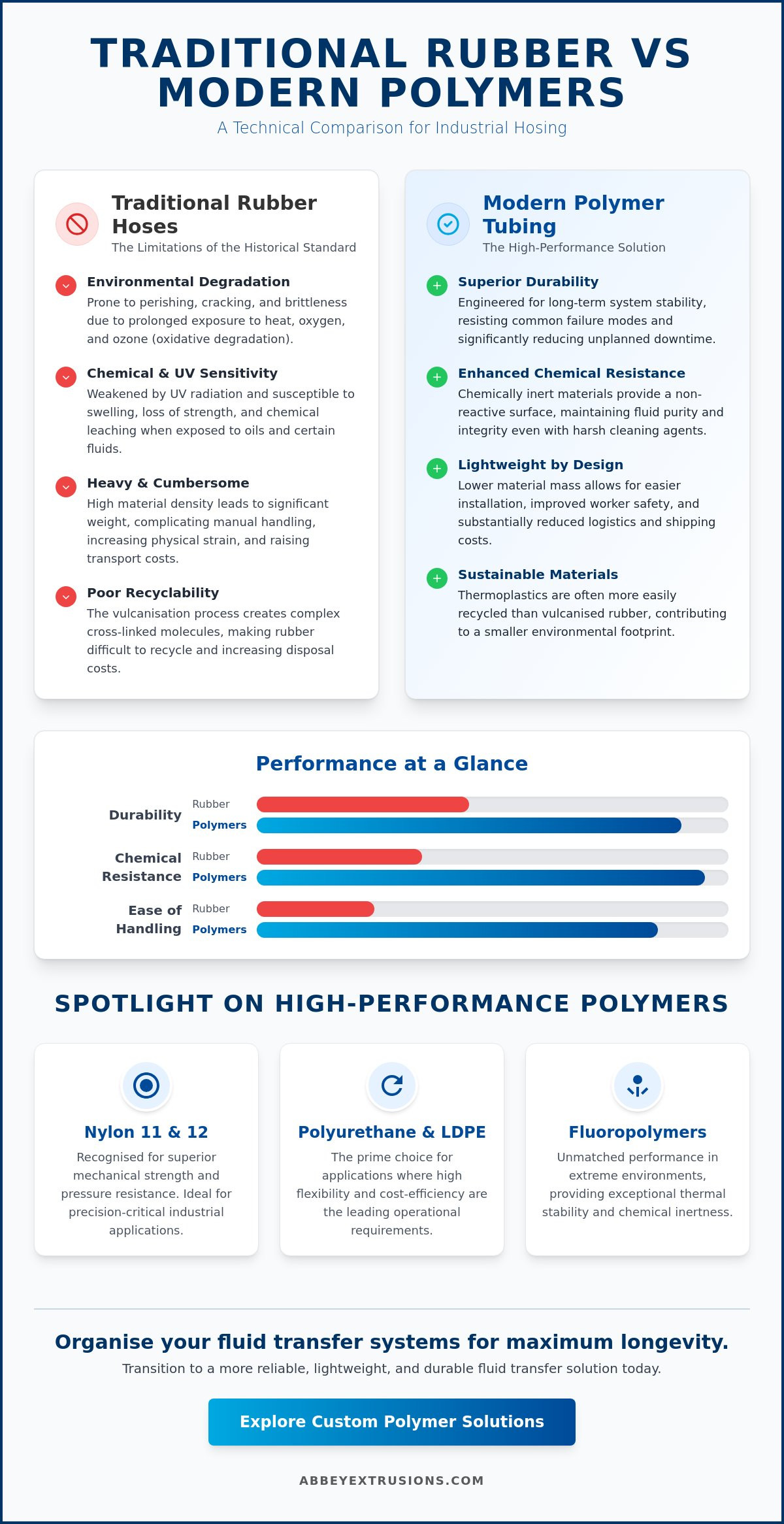
We recognise that engineers often tolerate the excessive weight and limited chemical compatibility of traditional elastomers because they believe no other material can match rubber's flexibility. However, modern material science has evolved. This article will demonstrate how advanced thermoplastics like Nylon and Fluoropolymers offer superior durability and chemical resistance compared to traditional rubber hoses. You will learn how to select a polymer that matches or exceeds rubber performance whilst significantly reducing maintenance requirements and system weight. We shall explore the technical parameters of Nylon 11 and 12, alongside the robust properties of Fluoropolymers, to help you transition to a more reliable fluid transfer solution.
Key Takeaways
- Identify the primary causes of elastomer degradation to prevent unplanned system downtime caused by perishing rubber components.
- Explore why high grade Nylon 11 and 12 serve as superior alternatives to rubber hoses for industrial use whilst offering enhanced pressure resistance.
- Evaluate the benefits of Polyurethane and LDPE for applications where flexibility and cost efficiency are the leading operational requirements.
- Determine the specific environments where Fluoropolymers provide the necessary thermal stability and chemical inertness that traditional materials lack.
- Master the selection process for custom polymer extrusions to ensure your fluid transfer systems are organised for maximum longevity.
If you require technical assistance regarding material selection or specific technical specifications, please get in touch with our engineering team.
Understanding the limitations of traditional rubber hoses in modern industry
The industrial sector has historically relied on vulcanised rubber as the primary medium for fluid transfer. However, as modern machinery demands higher precision and tighter tolerances, the inherent weaknesses of elastomers have become significant operational bottlenecks. Vulcanised rubber components are prone to perishing through oxidative degradation, a process where polymer chains break down under prolonged exposure to heat, atmospheric oxygen, or ozone. This results in the characteristic cracking and brittleness that leads to catastrophic system failure and costly maintenance cycles. Identifying viable high performance alternatives to rubber hoses for industrial use allows for the implementation of more durable, lightweight systems that resist these common failure modes.
Managing the lifecycle of traditional materials also presents substantial logistical hurdles. Unlike many thermoplastic fluid conveyance tubing options, used rubber hosing is difficult to recycle due to the complex cross-linking of molecules during the vulcanisation process. This often leads to increased disposal costs and a larger environmental footprint for manufacturing facilities. Consequently, many organisations are now seeking precision-engineered polymers to improve both their sustainability profiles and their operational uptime. Understanding these limitations is the first step in identifying the most suitable alternatives to rubber hoses for industrial use, ensuring that chosen materials align with modern engineering standards.
Chemical degradation and environmental stress
Traditional rubber structures, particularly EPDM and Nitrile variants, exhibit varying degrees of sensitivity to oils and ultraviolet radiation. Over time, UV exposure initiates a photochemical reaction that weakens the hose wall, whilst oil absorption can cause significant swelling and a loss of mechanical strength. In sensitive sectors, such as those requiring a brewery hose, the risk of chemical leaching from the elastomer into the fluid stream is a critical concern. These contaminants can alter the profile of the product, necessitating a move towards more inert materials that offer superior temperature stability and chemical resistance across a wider pH range. Modern thermoplastics provide a more stable, non-reactive surface that maintains integrity even amongst harsh cleaning chemicals.
The physical weight and handling challenges
The substantial density of thick walled rubber assemblies often creates unnecessary physical strain on personnel. When compared to lightweight polymer alternatives, rubber hoses can be significantly heavier, which directly impacts worker safety and ergonomic behaviour during manual handling tasks. Lighter hosing solutions, such as those found in our PVC tube or Nylon ranges, allow for easier installation in cramped machinery spaces. Beyond the factory floor, the reduced mass of polymer hosing lowers shipping and logistics costs, as manufacturers can transport higher volumes of material with less fuel consumption and lower freight charges. This transition to precision-engineered thermoplastics represents a logical step for businesses looking to optimise their supply chains and improve site safety through reduced component weight.
If you require technical assistance regarding material selection or specific pressure ratings for your system, please speak with our engineering department.
Nylon 11 and 12 tubing as a high performance alternative to rubber
Whilst rubber remains common in low pressure applications, technical engineers increasingly specify Nylon 11 and 12 as the primary alternatives to rubber hoses for industrial use when precision is paramount. These polyamides are recognised globally for their stability and mechanical strength. Unlike traditional elastomers, which can swell or soften when exposed to hydrocarbons, Nylon 11 and 12 maintain their structural integrity in the presence of oils, greases, and automotive solvents. This makes them the industry standard for pneumatic control lines and fuel delivery systems where failure is not an option.
The transition to Nylon is often driven by the need for a material with low moisture absorption. Traditional rubber can absorb environmental humidity, leading to dimensional changes and a loss of physical properties over time. In contrast, Nylon 11 and 12 exhibit excellent resistance to hydrolysis, ensuring that the tubing remains dimensionally stable throughout its service life. As of June 2026, regulatory standards such as ASTM F1973 for Polyamide 11 and 12 in fuel gas distribution systems have been updated to reflect the material's reliability, highlighting its role as a critical component in modern infrastructure. This stability is essential in automated manufacturing environments where precise tolerances are required for consistent performance.
Mechanical properties and pressure ratings
Nylon 12 offers significantly higher burst pressure thresholds compared to unreinforced rubber counterparts of similar wall thickness. This inherent strength is complemented by exceptional flexural fatigue resistance, which allows the tubing to withstand millions of cycles in dynamic applications without cracking. These properties make it the ideal choice for pneumatic systems and air brake applications where safety and longevity are non-negotiable. If you need to discuss specific pressure requirements for your machinery, we invite you to consult with our technical team.
Dimensional stability and precision fitments
A high quality Nylon tube maintains its outer diameter and wall thickness even under significant internal load, preventing the ballooning effect often observed in soft rubber hoses. This rigidity ensures full compatibility with modern push to connect fittings, which facilitates much faster assembly and reduces the likelihood of leaks in complex circuits. To assist with system organisation and maintenance, these tubes are available in a wide variety of colours, allowing for easy identification of different fluid or air lines at a glance. This level of precision and customisation simply cannot be achieved with traditional bulk rubber hosing.
If you require a bespoke material consultation for your specific fluid transfer requirements, please contact our technical sales department.
Polyurethane and LDPE for flexible and cost effective fluid transfer
Whilst Nylon 11 and 12 provide the structural rigidity required for high pressure pneumatic circuits, certain applications necessitate a higher degree of pliability. In these scenarios, Polyurethane (PU) and Low Density Polyethylene (LDPE) emerge as the leading alternatives to rubber hoses for industrial use. Polyurethane, in particular, challenges the traditional assumption that rubber is the only viable choice for high flexibility environments. It successfully combines the elastic behaviour of elastomers with the chemical stability of thermoplastics, offering a versatile solution for complex routing in modern machinery.
Industrial environments often involve tight installations where hosing must bend around intricate components without kinking. Unlike traditional soft rubber, which can collapse or develop permanent deformities under stress, these engineered polymers possess excellent memory properties. This ensures that the internal bore remains open even when the tube is subjected to repeated bending or tight radii. Maintaining a consistent flow rate is vital for system efficiency. By choosing these polymers, engineers can reduce the risk of flow restriction that often plagues aging rubber assemblies.
The transition to these materials is also driven by economic considerations. Managing large scale fluid systems requires a balance between performance and expenditure. Polymers like LDPE provide a lightweight, cost effective solution for low pressure systems, outperforming traditional elastomer assemblies in both longevity and ease of handling. This makes them a strategic choice for facilities looking to optimise their maintenance budgets whilst improving overall system reliability.
Polyurethane for abrasion resistance and flexibility
The use of a Polyurethane tube is essential in gritty or abrasive environments where standard rubber would quickly erode. PU exhibits extreme durability against mechanical wear, making it the preferred choice for conveying particulate matter or working in proximity to moving metal parts. In robotics and automated production lines, the material's ability to return to its original shape after stretching is a critical advantage. This resilience reduces the frequency of component replacement and ensures that the system remains organised and efficient over long operational cycles.
Low Density Polyethylene for economical chemical transport
An LDPE tube is characterised by its exceptional chemical inertness and resistance to environmental stress cracking. When compared to rubber for low pressure water systems or simple fluid transfer, LDPE offers significant cost advantages without compromising on performance. Its non-toxic nature and high purity make it particularly suitable for applications where fluid contamination must be avoided. For facilities managing large scale fluid transport, LDPE provides a reliable and economical solution that is far easier to install than heavy rubber alternatives.
If you require technical guidance on material qualification for regulated environments, please request a technical consultation with our material specialists.
Fluoropolymer solutions for extreme chemical and thermal environments
For the most demanding industrial environments, standard elastomers often fail to provide the necessary level of security. Fluoropolymers, specifically PTFE, FEP, and PFA, represent the ultimate alternatives to rubber hoses for industrial use when chemical aggression or thermal extremes are present. Whilst some manufacturers might suggest silicone for high heat applications, silicone lacks the broad chemical resistance that Fluoropolymers provide. Under the UK government PFAS Plan published in February 2026, businesses using these materials must justify their applications as controlled and responsible. Our commitment to technical competence ensures that we provide the necessary material traceability to meet these evolving regulatory standards whilst maintaining system integrity.
For businesses navigating complex regulatory landscapes, afnindustrialservices.co.uk offers expert consultancy in health, safety, and environmental compliance to ensure your operations remain fully aligned with current industrial standards.
The transition from rubber to Fluoropolymers is often a matter of operational necessity rather than simple preference. In environments where fluid contamination could result in the loss of an entire production batch, the non-reactive nature of these polymers is indispensable. They provide a level of safety that traditional vulcanised materials cannot match. By moving away from perishing rubber components, facilities can organise their maintenance schedules around predictable lifecycles rather than reactive repairs.
Unrivalled chemical inertness and purity
Fluoropolymers are virtually inert to almost all known industrial solvents and aggressive acids that would typically cause rubber to swell or degrade. This property is vital for pharmaceutical and laboratory use where fluid purity is a non-negotiable requirement. The smooth internal bores of these tubes prevent the clogging and build up of residues that often occur in porous rubber hoses. These materials also withstand rigorous steam cleaning and aggressive sterilisation cycles without losing their mechanical integrity. This ensures that hygiene standards remain high without compromising the lifespan of the fluid transfer system.
Operating in extreme temperature ranges
The thermal performance of PFA exceeds that of standard elastomers by a significant margin, as it maintains its strength at temperatures where rubber would simply char or melt. Similarly, PTFE provides exceptional cryogenic stability for specialised cooling systems, remaining flexible at temperatures that would cause other materials to shatter. These polymers also offer indefinite longevity in outdoor, high UV environments. They do not suffer from the oxidative cracking or perishing that affects traditional hosing after prolonged exposure to the elements. Enquire about our Fluoropolymer tubing specifications to find the correct grade for your thermal requirements.
If you require technical assistance with bespoke profile design or material qualification, please contact our specialist engineering team.
Selecting the correct polymer extrusion for your industrial application
Transitioning away from traditional elastomers requires a methodical approach to material science. When evaluating alternatives to rubber hoses for industrial use, engineers must consider the specific environmental stressors of their application. Whilst rubber is often chosen for its perceived ease of installation, modern thermoplastic extrusions offer a level of precision that bulk rubber cannot replicate. By selecting the correct polymer, you ensure that your fluid transfer system is optimised for both performance and longevity.
One common hurdle in the adoption of thermoplastics is the inherent rigidity of materials like Nylon or Fluoropolymers compared to soft rubber. However, this is easily overcome through advanced engineering techniques. Rather than forcing a straight tube into a tight radius, which risks kinking and flow restriction, we use technical processes to adapt the material to the machinery. This methodical approach ensures that the final assembly is exactly suited to its operational environment. It also reduces the stress on fittings, which is a frequent cause of leaks in traditional rubber systems.
Bespoke tube forming and custom profiles
The process of tube forming allows us to create permanent, heat-set bends in thermoplastic tubing. This technique ensures that the tube follows a specific path within a machine without the need for additional elbows or fittings, which often represent potential leak points. Bespoke profiles can be engineered to provide specific sealing or protective functions that standard off-the-shelf hoses cannot offer. For developers, the ability to produce small batches for prototype testing is an essential service that ensures the final production run meets all technical parameters before full scale implementation.
Transitioning from rubber to thermoplastic systems
To successfully integrate these alternatives to rubber hoses for industrial use, we recommend a comprehensive audit of your current fluid transfer components. This involves identifying the peak operating pressures, temperature fluctuations, and the specific chemical composition of the fluids being conveyed. Once these parameters are established, polymer specifications can be matched to existing fittings to ensure a secure, leak-free transition. Our technical team is available to guide you through this material selection process, ensuring that the chosen extrusion profile meets the rigorous demands of your specific industrial application. Choosing a UK based manufacturer provides the added security of stringent quality control and reliable logistics, which are fundamental to maintaining a stable supply chain.
If you are prepared to transition your facility to a high performance polymer system, please get in touch with our material specialists.
Modernising your fluid transfer infrastructure
The strategic transition to precision engineered polymers represents a significant advancement for facilities prioritising operational uptime and long term system integrity. We've demonstrated how identifying high performance alternatives to rubber hoses for industrial use allows engineers to overcome the persistent issues of material perishing and excessive assembly weight. From the pressure resistance of Nylon to the chemical inertness of Fluoropolymers, each material provides a distinct mechanical advantage over traditional elastomers.
As a specialist UK based manufacturer since 1985, Abbey Extrusions maintains a deep technical focus on Nylon 11 and 12 extrusion alongside bespoke tube forming services. This unique combination of manufacturing expertise and material knowledge ensures that your fluid transfer components are built for longevity and precision. We encourage you to contact our technical team to discuss your industrial tubing requirements and secure a more reliable future for your production environment. We look forward to supporting your next project with our decades of industry experience.
Frequently Asked Questions
What is the most durable alternative to rubber hoses for high pressure air
Nylon 11 and 12 represent the most durable alternatives to rubber hoses for industrial use in high pressure pneumatic circuits. These polyamides maintain higher burst pressure thresholds and superior dimensional stability compared to unreinforced elastomers. Their resistance to environmental stress cracking ensures a longer service life in demanding factory environments, particularly where precision and reliability are essential for automated processes.
Can plastic tubing be as flexible as a standard rubber hose
Polyurethane (PU) provides a level of flexibility that matches or exceeds many standard rubber hoses whilst offering significantly better abrasion resistance. Unlike rubber, PU possesses excellent memory properties, meaning it returns to its original shape after stretching or bending. This prevents the permanent deformation and kinking often seen in aging rubber assemblies, ensuring a consistent flow rate over time.
Which polymer provides the best chemical resistance for industrial use
Fluoropolymers such as PTFE, FEP, and PFA offer the highest level of chemical resistance for industrial applications. These materials are virtually inert and can withstand aggressive solvents, acids, and bases that would cause traditional rubber to swell or perish. They are essential for processes involving high-purity fluids or harsh cleaning cycles where material integrity is a non-negotiable requirement.
Is Nylon 12 better than rubber for diesel fuel lines
Nylon 12 is technically superior to rubber for diesel fuel lines due to its exceptional resistance to hydrocarbons and solvents. Rubber hoses often soften and swell when exposed to diesel, which leads to flow restrictions and eventual catastrophic failure. Nylon 12 remains dimensionally stable and resists the permeation of fuels, ensuring the long-term integrity of the fluid conveyance system.
How does the weight of Polyurethane tubing compare to rubber hosing
Polyurethane tubing is significantly lighter than traditional rubber hosing of an equivalent diameter and pressure rating. This reduction in mass improves ergonomic behaviour for personnel handling the equipment and reduces the total structural load on machinery. Lower weight also translates to reduced shipping costs and simplified logistics for manufacturers managing large-scale industrial installations.
Are there food grade alternatives to rubber hoses that do not leach
High-purity LDPE and Fluoropolymers are excellent food grade alternatives to rubber hoses that do not leach contaminants into the fluid stream. Traditional rubber is often porous and can harbour bacteria or leach chemical residues over time. These thermoplastic options provide a smooth, non-reactive internal bore that is easier to sanitise and maintains the necessary hygiene standards.
What are the benefits of using pre-formed plastic tubes over flexible rubber
Pre-formed plastic tubes provide permanent bends that eliminate the risk of kinking in tight installations where space is limited. Using custom formed tubes reduces the number of elbows and fittings required, which effectively removes multiple potential leak points from the system. This results in a more organised and reliable layout compared to the unpredictable routing of flexible rubber hosing.
Is it more cost effective to use LDPE instead of rubber for water transfer
LDPE is a more cost-effective solution for low pressure water transfer than traditional rubber, making it one of the most practical alternatives to rubber hoses for industrial use in simple fluid systems. The material costs for polyethylene are generally lower, and its resistance to environmental degradation means it requires less frequent replacement. For large-scale water transport, LDPE offers clear economic advantages whilst maintaining reliable performance.

Article by
Bryan Cowan
Bryan Cowan is the Founder and Managing Director of Abbey Extrusions Ltd, a leading UK manufacturer of high-quality plastic tubes and hoses. With over 40 years of industry experience, Bryan established the company in 1985, growing it from a startup into a BS ISO9001-registered supplier for global sectors including aerospace, automotive, and pharmaceuticals.
Disclaimer
This article is intended for informational purposes only. Please ensure you seek expert advice or carry out your own research to confirm the information is suitable for your specific needs.