Could a single undocumented batch of raw polymer jeopardise your entire production line and trigger a costly product recall? We understand the immense pressure you face when ensuring that every component meets rigorous safety standards, especially as new requirements like the EU Machinery Regulation begin to influence industry benchmarks. Most engineers recognise that quality is only as strong as its weakest link, yet managing the complexities of material traceability for industrial hoses remains a significant challenge for even the most established operations.
You will discover how a robust 'cradle to grave' tracking process ensures safety, regulatory compliance, and operational reliability for your industrial plastic tubing and hoses. We provide a clear overview of the essential certifications required for food-grade and chemical applications, whilst explaining how to identify a manufacturer with the technical competence to withstand strict quality audits. This guide details the importance of harmonised standards, such as the ISO updates released in May 2026, to help you maintain confidence in your supply chain and mitigate the risks associated with sub-standard material batches.
Key Takeaways
- Understand the fundamental importance of 'cradle to grave' visibility and how it ensures every component is trackable throughout the entire supply chain.
- Learn the technical process of assigning batch numbers to high-performance polymers like Nylon 12 to maintain material traceability for industrial hoses.
- Identify the essential regulatory standards and certifications, such as BS EN ISO 9001, that are required for specialised brewery hose and food-grade applications.
- Discover how robust internal systems facilitate rapid root cause analysis and significantly reduce liability for engineering and procurement teams.
- Gain confidence in the quality of British-manufactured products by understanding how rigorous internal controls are applied to low-density polythene tube and other extrusions.
To discuss your specific technical requirements or to request a certificate of conformity for your next project, please contact our engineering team for professional assistance.
Understanding the fundamentals of material traceability for industrial hoses
In the context of high-performance manufacturing, traceability represents the systematic ability to verify the history, location, or application of an item through documented recorded identification. For the engineering professional, this means having absolute clarity on the origin and journey of every component within the supply chain. We view this not as a bureaucratic exercise, but as a fundamental pillar of quality assurance that separates technical extrusions from generic, uncertified products. Maintaining material traceability for industrial hoses ensures that any potential vulnerability in a system can be isolated and addressed with surgical precision.
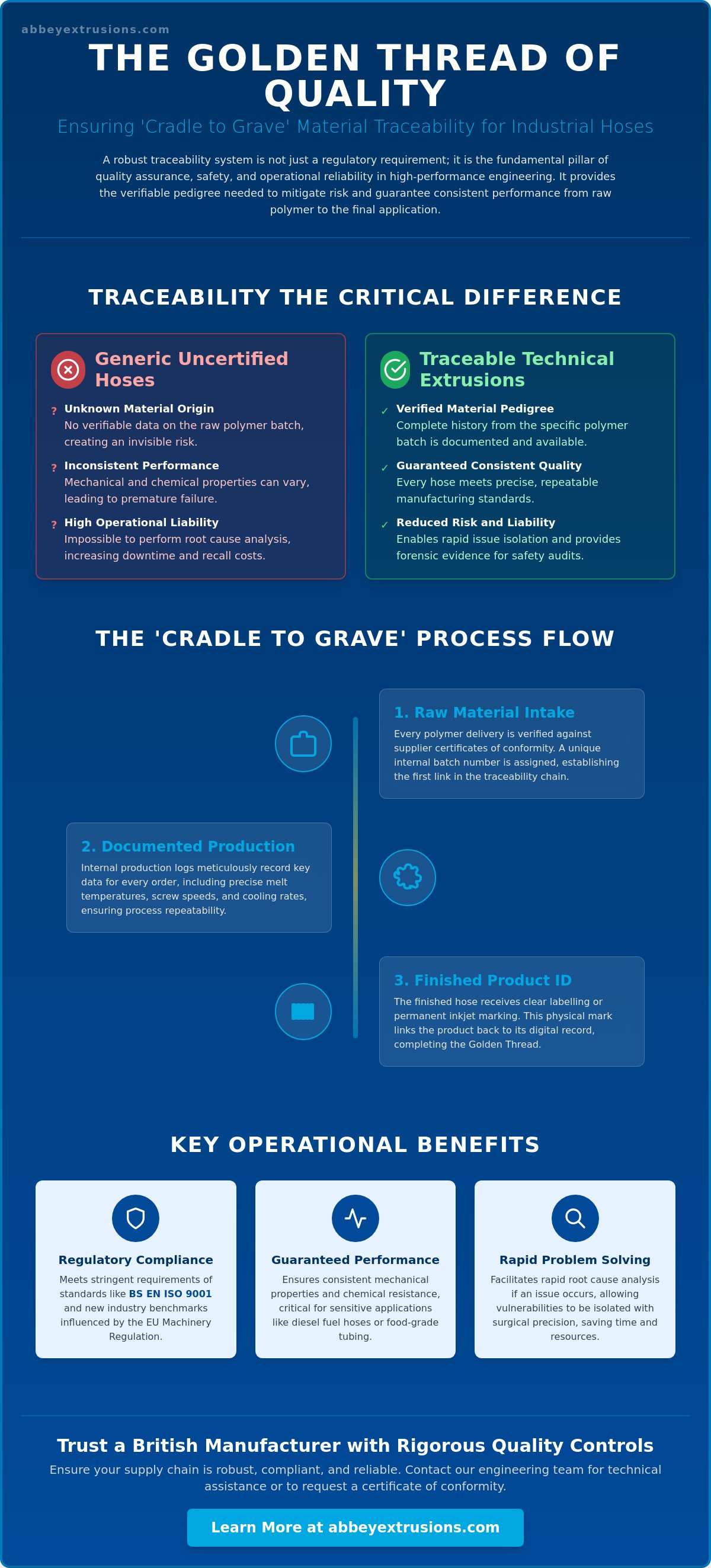
The concept of 'cradle to grave' visibility ensures that a product’s lifecycle is fully documented from the moment the raw resin enters the facility until the finished hose is decommissioned by the end user. This creates what is often referred to as the 'Golden Thread' of information. By maintaining this unbroken chain, we ensure that every length of tubing carries with it a verifiable pedigree of quality and compliance. Generic off-the-shelf tubing might appear identical to a high-performance extrusion on the surface, but the lack of documentation creates an invisible risk. If a batch of standard PVC fails under pressure, the procurement team has no way of knowing if the fault lay in the resin, the extrusion temperature, or a specific contaminant. Technical extrusions backed by rigorous tracking provide the data needed to isolate and resolve issues immediately.
The core components of a traceability system
A robust system relies on the precise integration of several data points throughout the production cycle. At the intake stage, raw material batch numbers and supplier certificates of conformity are recorded to ensure the polymer meets the required specification. Our internal production logs go beyond simple timestamps; they record the precise melt temperatures, screw speeds, and cooling rates used during the extrusion of every order. Finally, unique identification is applied through clear labelling or permanent inkjet marking. This physical mark allows the end user to link the hose back to its digital twin in our records, ensuring the information remains accessible for years after installation.
Why traceability is a critical engineering requirement
Engineers require material traceability for industrial hoses to guarantee that mechanical properties remain consistent across different production runs. When a project involves sensitive applications, such as a diesel fuel hose, validating chemical resistance is paramount. Without batch-level tracking, there is no way to prove that the material used will withstand the specific hydrocarbons it will encounter. Adhering to these rigorous standards is also the primary method for meeting the stringent requirements of UK health and safety legislation. Traceability provides the forensic evidence required during safety audits, proving that every component has been manufactured to a specific, repeatable standard that protects both the operator and the environment.
To ensure your supply chain remains compliant with the latest British manufacturing standards, you can speak with our technical specialists regarding your specific documentation needs.
The technical process of tracking polymers from raw resin to finished tube
The journey of a high-performance extrusion begins with the meticulous intake of raw polymers. For materials like Nylon 11 and Nylon 12, resin purity is the primary factor in determining the final performance characteristics of the hose. Upon delivery, every pallet of resin is cross-referenced against the manufacturer's batch data. This ensures that the material traceability for industrial hoses is established before the polymer even enters our drying systems. We assign a unique internal batch number to each delivery, which acts as the primary key for all subsequent data logging and quality checks throughout the manufacturing cycle.
Digital logging has transformed the modern extrusion facility from a purely mechanical environment into a data-driven operation. Every extrusion run is recorded in real-time, capturing a comprehensive profile of the production environment. This level of oversight is particularly critical when managing complex supply chains that might require EN 15343 certification for specific material content. By maintaining digital records, we provide our partners with the transparency needed to pass third-party audits without the delays associated with manual filing systems. It's a method that ensures precision and accountability at every stage.
Our commitment to engineering precision also involves the retention of physical material samples. We keep a representative sample from every significant production run for a defined period. This allows for retrospective testing if a customer reports an unexpected performance issue in the field. It's this level of foresight that builds long-term trust; it provides a tangible link back to the original material properties and production conditions. Such samples are vital for forensic analysis and serve as a final layer of security for the end user.
Managing raw material certifications
The Certificate of Analysis (CoA) provided by the polymer manufacturer is a non-negotiable requirement in our quality control process. We verify specific polymer grades against technical data sheets to ensure the material meets the exact mechanical and thermal requirements of the client's application. Our systems are organised to allow for the rapid retrieval of these documents, ensuring that even years after a project is completed, the original material pedigree can be verified within minutes. This organisation is essential for maintaining compliance with evolving UK and international standards.
Production monitoring and data capture
During the extrusion process, we monitor and record critical parameters including melt temperatures and head pressures for every batch. This data is linked directly to the production date and time, creating a comprehensive history for every metre of material produced. This rigorous monitoring ensures that every nylon tube we manufacture adheres to the precise tolerances required for pneumatic and hydraulic systems. If you require a specific documentation pack for your next project, our team can provide a detailed overview of our tracking capabilities and quality standards.
To discuss compliance documentation or to verify our current certification status, please contact our quality assurance department directly for professional assistance.
Regulatory standards and industry certifications for industrial tubing
Adhering to recognised regulatory frameworks is the only way to guarantee that technical components perform as intended in high-stakes environments. In the UK, the BS EN ISO 9001 quality management system provides the essential structure for our operations. This standard isn't merely a badge; it's a rigorous commitment to documented processes that ensure every length of tubing meets a repeatable level of excellence. Maintaining material traceability for industrial hoses is a core requirement of this framework, as it allows for the forensic reconstruction of any production event. When we issue a Certificate of Conformity (CoC), we're providing a formal guarantee that the product has been manufactured, tested, and inspected in full accordance with the relevant specifications.
The global landscape for chemical safety is governed by frameworks such as REACH and RoHS, which restrict the use of hazardous substances in plastic products. Compliance with these regulations requires a deep understanding of the chemical composition of raw resins. The implementation of comprehensive traceability systems for plastics is a global priority that ensures transparency across the supply chain. For our partners, this means they can confidently integrate our extrusions into their systems, knowing that every component is free from prohibited substances and fully compliant with environmental legislation. This transparency is vital for maintaining the integrity of the 'Golden Thread' in modern engineering.
Food and beverage grade requirements
In the food and beverage sector, the stakes for material safety are exceptionally high. Every brewery hose or dairy tube we produce must undergo migration testing to ensure that no harmful substances transfer into the product stream. Traceability is non-negotiable here; the Food Standards Agency (FSA) requires that manufacturers can identify the source of any material used in food contact applications. We maintain the detailed documentation needed to satisfy these audits, providing our clients with the peace of mind that their production lines remain safe and compliant with the latest health standards.
Technical standards for pneumatic and fuel systems
Pneumatic and fuel delivery systems require specific mechanical properties that can only be guaranteed through strict material control. For instance, an air 60 air hose must meet precise pressure ratings and safety factors to operate reliably in industrial workshops. Traceability supports the longevity of these components by ensuring that the anti-static or chemical-resistant properties of the polymer are consistent throughout the entire batch. By tracking the material pedigree, we help procurement teams reduce the risk of premature failure and ensure that fuel delivery systems remain robust against the corrosive effects of modern additives.
If you require technical documentation for an upcoming project or wish to discuss our quality control protocols, please get in touch with our specialist team for professional guidance.
Operational benefits of robust traceability for end users
Implementing material traceability for industrial hoses provides end users with a forensic toolset to manage operational risk effectively. When a component fails in a high pressure environment, the immediate priority is identifying the cause without disrupting the entire facility. A traceable system allows engineers to perform rapid root cause analysis by isolating the specific batch and production date of the failed part. This precision often prevents the need for total system replacements. Technicians can determine if the issue was a localised material defect or an environmental factor affecting only a specific run. It ensures precision. Data drives reliability.
For procurement and engineering teams, this transparency significantly reduces professional liability. By ensuring that every length of tubing is backed by a verifiable pedigree, you protect the organisation from the legal and financial fallout of undocumented material failures. Traceability also plays a central role in preventative maintenance schedules. By monitoring the performance of specific batches over time, maintenance managers can identify wear patterns and schedule replacements before a critical failure occurs. This proactive approach relies on the consistent data provided by a manufacturer committed to technical excellence and long term partnership.
Streamlining the audit and compliance process
A well organised tracking system reduces the time spent on manual documentation checks during internal or third party audits. It provides immediate evidence of material suitability to stakeholders, ensuring that production remains uninterrupted. We apply The Engineering Principles of Plastic Extrusion to build a more resilient supply chain for our partners. This methodology ensures that every technical parameter is recorded and accessible, allowing your compliance team to work with absolute confidence during rigorous safety inspections.
Enhancing long term system reliability
Using batch data allows engineers to predict the wear behaviour of hoses in specific environments with greater accuracy. It ensures that any replacement parts match the original specifications exactly, maintaining the integrity of the system design. This is particularly vital when components undergo secondary processes. For instance, achieving precise tube forming results requires consistent, traceable material properties to ensure the polymer behaves predictably during shaping. Without this level of detail, the risk of structural weakness increases significantly.
To integrate our documented quality standards into your operational framework, contact our technical department today to discuss your requirements.
To explore how our technical expertise can support your next project, please contact our specialist team for a detailed consultation.
Quality assurance and traceability at Abbey Extrusions
Abbey Extrusions has established a reputation over four decades for uncompromising quality in the field of technical plastic extrusions. Our commitment to British manufacturing standards is underpinned by a robust ISO 9001 quality management system that governs every aspect of our facility. This framework ensures that material traceability for industrial hoses is integrated into every workflow, from the initial resin drying stage to final inspection and dispatch. Whether we are producing a standard run of low-density polythene tube or a complex multi-material extrusion, the tracking process remains identical. We provide our partners with a level of security that only comes from a manufacturer with complete control over its production environment.
Our internal systems are designed to handle the complexities of modern industrial requirements. We maintain a digital archive of all production parameters, linking them directly to specific batch numbers and raw material certificates. This level of detail allows us to provide full documentation packs for technical projects, ensuring that your procurement and engineering teams have the evidence required to pass even the most stringent quality audits. It's a methodical approach that prioritises long term reliability over short term convenience.
Bespoke extrusion and technical support
Maintaining material traceability for industrial hoses becomes even more critical when dealing with custom profiles. For bespoke items like kedar cord or unique pelmet sections, we apply the same rigorous material selection and validation protocols used for our standard range. Our technical team works closely with clients to ensure that the chosen polymer grades meet the unique industrial challenges of their specific application. Being a UK-based manufacturer allows for transparent communication and rapid response times, ensuring that technical queries are resolved with professional precision. We don't just supply a product; we provide a fully documented engineering solution.
Securing your supply chain with Abbey Extrusions
Our 40 years of experience in the industry translates into a deeper understanding of quality control and risk mitigation. Every production run undergoes rigorous testing protocols to verify dimensional accuracy and mechanical performance. We understand that our components are often critical to the safety and efficiency of your operations, which is why we never compromise on material pedigree. To request specific certification or a certificate of conformity for your next project, you can simply reach out to our quality department. We're proud of our manufacturing heritage and remain committed to upholding the highest standards of British engineering excellence.
To discuss your quality control requirements or to learn more about our manufacturing processes, please contact our technical department for assistance.
Strengthening your supply chain with technical precision
Maintaining rigorous material traceability for industrial hoses is a fundamental requirement for modern engineering projects where failure is not an option. By implementing 'cradle to grave' tracking and adhering to BS EN ISO 9001 standards, you ensure every component in your system is backed by a verifiable pedigree of quality. This level of oversight reduces professional liability whilst providing the forensic data needed for rapid root cause analysis. Precision ensures reliability. As a specialist UK manufacturer since 1985, we've developed the internal systems required to manage these complexities with absolute precision.
Our expertise in high-performance polymers, including Nylon 11 and 12, allows us to provide full material certification on request for your specific applications. Whether you require standard tubing or bespoke profiles, our team is ready to support your project with the technical documentation needed to satisfy the most demanding audits. We invite you to contact Abbey Extrusions for technical guidance on your next project and discover the benefits of a partnership built on manufacturing excellence. We look forward to supporting your engineering goals.
Frequently Asked Questions
What is a Certificate of Conformity and why is it important for industrial hoses
A Certificate of Conformity is a formal document issued by a manufacturer stating that a specific batch of products meets the required technical specifications or industry standards. It provides the end user with documented proof that the material has been produced according to a specific quality management system. This document is essential for safety audits and ensures that the component is fit for its intended industrial application.
How long should traceability records be kept for industrial plastic tubing
The retention period for traceability records is typically governed by the ISO 9001 quality management framework or specific industry regulations. Most technical manufacturers maintain these records for at least seven to ten years to ensure that historical data is available for retrospective analysis. This long term approach to data management allows for the forensic review of production parameters long after the component has been installed.
Can I track a specific hose back to the raw polymer manufacturer
You can track a specific hose back to the raw resin supplier if the manufacturer maintains robust material traceability for industrial hoses. This is achieved by linking the unique batch number printed on the hose to the original Certificate of Analysis provided by the polymer producer. This unbroken chain of information ensures that the origin and purity of the raw material are never in doubt during the product lifecycle.
Does traceability apply to bespoke plastic profiles like Kedar cord
Traceability applies to all technical extrusions regardless of their shape or complexity. For bespoke profiles like Kedar cord, the same rigorous batch tracking and material validation protocols are applied as those used for standard tubing. This ensures that custom components meet the same high standards for mechanical performance and chemical resistance as any other technical part in our range.
What is the difference between a batch number and a serial number on a hose
A batch number identifies a specific production run of material produced under identical conditions, whilst a serial number identifies a single unique unit. In the context of industrial hoses, batch numbers are more common as they allow engineers to track groups of products manufactured from the same resin lot. This distinction is vital for isolating potential issues without affecting the entire inventory of a facility.
How does material traceability help in the event of an industrial hose failure
Material traceability for industrial hoses facilitates rapid root cause analysis by allowing engineers to isolate the specific production conditions and raw materials involved in a failure. Instead of replacing an entire system, technicians can determine if the fault was restricted to a single batch. This targeted approach significantly reduces operational downtime and helps prevent the recurrence of similar failures in the future.
Are there specific UK regulations governing traceability for plastic extrusions
The primary framework governing these processes in the UK is the BS EN ISO 9001 quality management standard. Whilst there are specific regulations for food contact materials and chemical handling, the ISO framework provides the overarching structure for documented traceability. Adhering to these standards ensures that manufacturers meet the legal requirements for safety and accountability in the British industrial sector.
Why is traceability more difficult with imported plastic tubing
Traceability is often more challenging with imported tubing due to the fragmented nature of global supply chains and the difficulty in accessing original manufacturer records directly. When products pass through multiple intermediaries, the documentation trail is frequently lost or obscured. Working with a UK based manufacturer ensures direct access to the technical team and the original production logs, providing greater security for your operations.

Article by
Bryan Cowan
Bryan Cowan is the Founder and Managing Director of Abbey Extrusions Ltd, a leading UK manufacturer of high-quality plastic tubes and hoses. With over 40 years of industry experience, Bryan established the company in 1985, growing it from a startup into a BS ISO9001-registered supplier for global sectors including aerospace, automotive, and pharmaceuticals.
Disclaimer
This article is intended for informational purposes only. Please ensure you seek expert advice or carry out your own research to confirm the information is suitable for your specific needs.