A single millimetre of deviation in your cut angle is often the hidden cause behind a high-performance pneumatic system failing to meet its pressure specifications. We recognise that even the most resilient Nylon 11 or Nylon 12 tubing cannot compensate for a crushed profile or a jagged edge that prevents a push-in fitting from seating correctly. You've likely experienced the frustration of an assembly that should be airtight but suffers from persistent leaks or debris-clogged valves, often tracing the issue back to a hurried or improper preparation stage. Mastering how to cut nylon tubing cleanly is not merely a matter of aesthetics; it is a critical engineering requirement for the mechanical integrity of every seal in your system.
By following established industrial practices, you can eliminate the risk of deformed tube ends and ensure a reliable, repeatable result across your entire production line. This article provides a technical overview of the professional techniques and specialised tools required to achieve a perfectly square, burr-free finish. We'll guide you through the selection of equipment that justifies the investment and the methodical approach necessary to guarantee zero leaks in your final industrial assemblies.
Key Takeaways
- Understand how a perfectly square cut prevents O-ring failure and ensures the mechanical integrity of pneumatic connections.
- Identify why dedicated radial tubing cutters are the superior choice over standard blades for professional industrial results.
- Master the exact steps of how to cut nylon tubing cleanly by utilising stable work surfaces and precise measurement techniques.
- Learn to recognise and avoid common errors such as tube crushing and angled cuts that lead to system leaks.
- Discover how proper storage and material awareness protect the cutting properties and longevity of your nylon lines.
If you require technical assistance with material selection or custom profiling, please reach out to our engineering team through our contact page.
The importance of a clean cut for nylon tubing performance
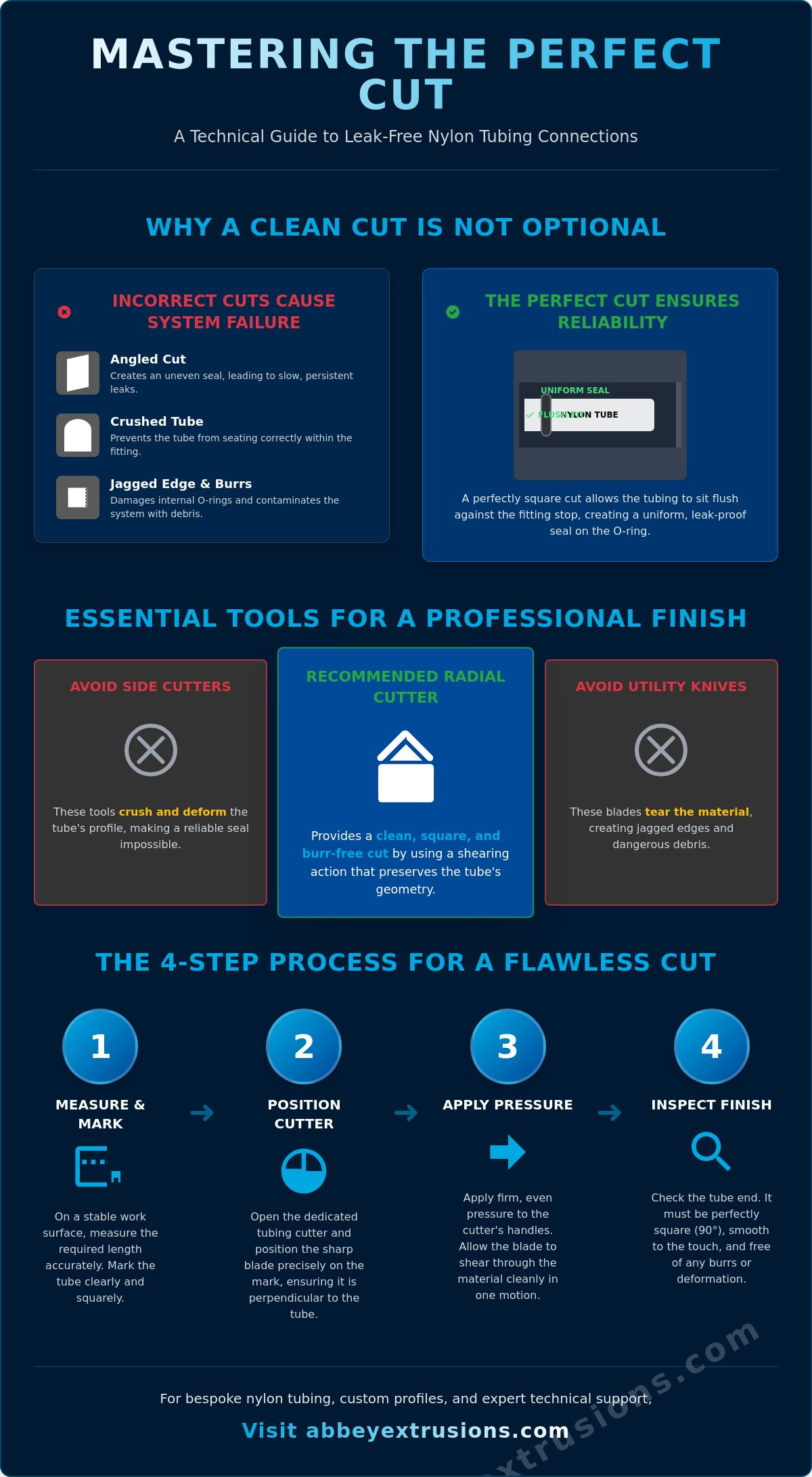
A clean cut is defined by three specific technical criteria: a perfectly square surface relative to the tube's longitudinal axis, a complete absence of burrs or swarf, and zero radial deformation. In professional industrial applications, achieving these standards is a prerequisite for system reliability. When a technician understands how to cut nylon tubing cleanly, they are effectively protecting the entire pneumatic circuit from premature failure. Most modern push-in fittings rely on an internal O-ring that creates a primary seal around the outer diameter of the tube. If the tube end is jagged or angled, the O-ring cannot maintain uniform contact, leading to immediate or latent pressure loss.
Plastic swarf and debris are silent killers in automated systems. When a tube is cut with an unsuitable tool, such as a standard utility knife or side cutters, small fragments of polymer can break away. These particles often migrate downstream, eventually clogging sensitive pneumatic valves or contaminating food-grade environments. A jagged cut doesn't just leak; it can physically score the delicate internal seals or damage the metal gripping teeth of the fitting during insertion, rendering the entire connection point compromised.
Why square cuts prevent pneumatic leaks
Visualise the internal architecture of a fitting where the tube end must sit flush against a stop. If the cut is not square, the pressure distribution across the seal becomes asymmetrical. This imbalance is the most common cause of the "slow leak" phenomenon, where a system loses pressure overnight despite appearing secure during initial testing. Mastering how to cut nylon tubing cleanly ensures that the contact point between the tube and the internal seal remains consistent. The properties of nylon tubing, specifically its high tensile strength and resistance to cold flow, mean that the material won't simply crush into place to compensate for a poor cut.
The role of nylon 11 and 12 in seal integrity
Industrial grade Nylon 11 and 12 flexible tubing possesses a distinct level of rigidity compared to softer alternatives like LDPE. Whilst this stiffness provides superior burst pressure ratings and chemical resistance, it also demands higher precision during preparation. These high-performance polymers don't yield easily to dull blades; instead, they tend to shatter or deform if the cutting force is not applied evenly. Understanding the technical properties of these specific materials is vital, as their dimensional stability ensures that once a clean, square cut is achieved, the seal remains airtight under fluctuating thermal and mechanical loads.
If you require bespoke lengths or specific tolerances for your project, please speak with our technical advisors for expert assistance.
Essential tools for professional results
Selecting the correct apparatus is the primary step in ensuring the mechanical integrity of your pneumatic assembly. Whilst general hardware stores often suggest multi-purpose blades, these are rarely sufficient for high-performance Nylon tube. Professional industrial applications demand specialised equipment designed to maintain the radial geometry of the extrusion throughout the shearing process. We recommend using dedicated radial tubing cutters as the standard for all installations involving diameters up to 25mm. For larger diameters or reinforced variants, heavy-duty guillotine-style cutters provide the necessary leverage to maintain a square face without compromising the material's structural wall.
The efficacy of any tool depends heavily on the condition of its cutting edge. A dull blade, regardless of the tool's cost, will cause the nylon to tear rather than shear. This results in microscopic fractures that can propagate under high-pressure cycles. Following OSHA safety standards regarding tool maintenance is not just a safety requirement; it is a quality control necessity. Technicians should establish a regular replacement interval for blades to ensure every cut meets the required precision. If you are unsure which tool suits your specific material grade, you can contact our team for guidance on equipment compatibility.
Dedicated radial tube cutters
Radial cutters are engineered with a V-shaped guide that centres the tube and prevents it from shifting during the cut. This mechanism is vital because it ensures the pressure is applied evenly around the circumference. By holding the tube steady, the tool allows the blade to penetrate the polymer at a precise 90-degree angle. This is the most reliable method for those learning how to cut nylon tubing cleanly, as the tool's geometry compensates for manual instability. Blade maintenance should be performed after every 500 to 1,000 cuts, depending on the wall thickness and the specific nylon grade being processed.
Why you should avoid hacksaws and standard scissors
Hacksaws are fundamentally unsuitable for precision polymer work. The serrated teeth of a saw blade create a jagged, irregular edge and generate a significant volume of internal plastic swarf. This debris is nearly impossible to remove entirely and will eventually migrate into your pneumatic valves. Standard workshop scissors are equally problematic; they rely on a bypass cutting action that exerts lateral pressure, inevitably crushing the hollow profile before the cut is complete. Using an unsecured utility knife is also discouraged, as the round profile of the tubing makes it prone to slipping, which presents a significant risk to the operator and often results in an unusable, angled end.
For professional guidance on high-volume processing or to discuss custom tube forming requirements, please consult with our technical department.
How to cut nylon tube square with precision
Precision in the workshop is a direct reflection of the final system's integrity. We've seen that even the highest quality Nylon tube can fail if the preparation is sloppy. Ensuring you know how to cut nylon tubing cleanly involves more than just a sharp blade; it requires a disciplined environment. A sturdy, level workbench is non-negotiable for preventing the extrusion from bowing or rolling during the measurement phase. Similarly, adequate task lighting is vital to ensure that your alignment marks are visible and that the blade is positioned exactly where intended.
Preparation and measurement techniques
When marking your cut line, we recommend using a fine-tip permanent marker in a contrasting colour. On black or dark blue nylon, a silver or white marker provides the necessary visibility for high-accuracy work. Measuring twice is a standard industrial practice that significantly reduces material waste, which is increasingly important given the rising costs of polymers. Whilst a dedicated radial cutter is the preferred choice, a precision mitre block can serve as a temporary guide to maintain a 90-degree angle if you are working with larger diameters. It's also wise to refer to a Tubing Regulatory Standards Guide to ensure your handling and tolerances align with industry-specific requirements, such as those found in automotive or food processing sectors.
Executing the perfect cut
The secret to a professional finish lies in the motion: rotate the tool around the circumference of the tube rather than applying excessive downward force. By rotating the cutter, the blade scores the surface evenly, allowing it to glide through the material without deforming the hollow profile. If you simply squeeze the handles, you risk flattening the tube, which leads to an ovalised end that will never seal properly in a push-in fitting. Once the cut is complete, perform a final inspection using this checklist:
- Place the tube end against a known flat surface to check for gaps that indicate an angled cut.
- Run a finger around the inner and outer diameters to detect any sharp burrs or raised edges.
- Ensure the tube remains perfectly circular with no signs of wall compression.
Mastering how to cut nylon tubing cleanly ensures that your final assembly meets the rigorous standards expected in modern manufacturing. By taking these methodical steps, you eliminate the primary cause of connection failure before the tube even reaches the fitting.
For technical support regarding material compatibility or to discuss your specific industrial requirements, please contact our engineering team.
Common mistakes that compromise your assembly
Identifying the most frequent errors in the workshop is the first step toward achieving a zero-leak assembly. The angled cut remains the primary cause of connection failure in pneumatic systems. When a technician fails to achieve a precise 90-degree face, the internal O-ring of the push-in fitting is forced to seal against an uneven surface. This creates a path for compressed air to escape, often resulting in intermittent pressure drops that are difficult to diagnose. We've observed that the specific grade of polymer significantly influences these outcomes. For instance, Nylon 12 offers superior dimensional stability due to its lower moisture absorption, making it less prone to deformation than other grades, yet it still requires a sharp blade to avoid brittle fracturing at the edge.
Another critical mistake is the attempt to soften Nylon tube using heat before cutting. Whilst it might seem logical to make the material more pliable, heat alters the polymer's crystalline structure and can cause the cut edge to melt and re-solidify into a jagged rim. This not only ruins the seal but can also make the tube end too brittle for the fitting's gripping teeth to hold securely. If you are encountering difficulties with material hardness, it's better to enquire about our flexible tubing options rather than attempting to modify the material properties on-site.
Recognising and fixing tube ovality
Ovality occurs when the radial force of a dull blade or an improper cutting motion crushes the tube into an elliptical shape. This structural deformation prevents the tube from entering the fitting's internal guide, often leading to technicians forcing the tube and damaging the internal seals. If you notice slight ovality after learning how to cut nylon tubing cleanly, you can sometimes restore the round profile by gently applying counter-pressure with a pair of smooth-jawed pliers. However, if the deformation is severe, the only professional solution is to discard the damaged end and re-cut using a sharper blade.
Dealing with swarf and internal debris
Even the most precise cut can produce microscopic polymer dust. This internal debris is a major risk factor for pneumatic valves and sensitive sensors downstream. We recommend a simple but effective protocol: after every cut, give the tube end a sharp tap against a clean surface to dislodge any loose particles. For high-purity or critical industrial lines, flushing the assembly with clean compressed air before final connection is a mandatory step. This ensures that no swarf remains to migrate into the system and cause mechanical blockages or seal erosion over time.
For expert advice on maintaining your pneumatic infrastructure or to discuss large-scale material requirements, please reach out to our technical team.
Ensuring long term performance of your nylon lines
Professional maintenance begins with material preservation. Knowing how to cut nylon tubing cleanly is a vital skill for any technician, but the longevity of the final system depends heavily on the material's environmental history and storage conditions. Even the most precise cut cannot compensate for a tube that has already suffered structural degradation. Nylon is a resilient polymer, yet its mechanical properties are not static. It reacts to its surroundings, and these reactions can complicate the cutting process or lead to premature failure in the field. High-quality extrusions are designed for stability, but they still require disciplined handling to ensure ease of maintenance over many years of service.
Storage and environmental factors
Nylon is naturally hygroscopic, meaning it absorbs moisture from the atmosphere. Whilst Nylon 12 is significantly more resistant to water than other grades, prolonged exposure to high humidity can soften the polymer. This change in shore hardness makes it more difficult to achieve a crisp, square face, as the material may tear rather than shear under the blade. UV exposure is another critical factor. Constant sunlight or high-intensity industrial lighting can make nylon brittle. Brittle tubing is prone to shattering during the cutting process, creating dangerous shards and internal debris. We recommend storing coils in their original packaging, away from direct light and extreme temperature fluctuations. In environments where physical abrasion or external impact is a risk, the use of a Nylon spiral cut hose guard provides an essential layer of protection for your pneumatic lines.
When to opt for bespoke tube forming
There are instances where manual cutting and bending are insufficient for the technical requirements of a project. Complex geometries or tight radii often lead to kinking when handled on-site, which permanently restricts flow rates and compromises the tube's burst pressure. In these scenarios, factory-formed components are the superior choice. Abbey Extrusions provides custom tube forming services that ensure every bend is perfectly executed and every end is pre-cut to exacting tolerances. Factory forming eliminates the variability of manual labour and guarantees that the tube maintains its circular profile throughout its entire length. This level of precision is especially beneficial in high-volume production environments where repeatable accuracy is a prerequisite for system certification. By opting for pre-formed solutions, you ensure that the mechanical integrity of your assembly is built-in from the point of manufacture.
To discuss your specific project requirements or to request a quotation for our industrial products, please visit our contact page to speak with a specialist.
Achieving precision in your pneumatic installations
Maintaining the integrity of an industrial system requires a disciplined approach to every component preparation. Mastering how to cut nylon tubing cleanly is a fundamental skill that directly impacts the reliability of your seals and the longevity of your pneumatic valves. By prioritising the use of dedicated radial cutters and adhering to methodical measurement practices, you'll eliminate the primary risks of pressure loss and system contamination. We've found that the synergy between a precise cut and a high-quality extrusion profile is the only way to ensure zero leaks in high-pressure environments.
As a UK based specialist manufacturer since 1985, we provide more than just materials. We offer expert technical support for bespoke extrusion profiles and supply a comprehensive range of Nylon 11 and 12 flexible tubing to meet the most demanding industrial specifications. Whether you require standard coils or advanced tube forming, our team's ready to assist with your technical requirements. Contact Abbey Extrusions today to discuss your industrial nylon tubing requirements and ensure your next project benefits from engineering excellence.
Frequently Asked Questions
Can I use a standard utility knife to cut nylon tubing
You should avoid using a standard utility knife for professional industrial applications as it is extremely difficult to maintain a precise 90 degree angle on a round profile. The blade often slips or creates an angled face that prevents the internal O-ring of a push-in fitting from seating correctly. This leads to persistent leaks and presents a significant safety risk to the operator if the knife slips during the cut.
Why does my nylon tube leak even though the cut looks straight
Microscopic deviations from a perfectly square face are the most common cause of leaks in systems that appear correctly assembled. Even if a cut looks straight to the naked eye, a deviation of just one or two degrees prevents uniform pressure distribution against the fitting's seal. Additionally, a dull blade can cause micro-fractures in the polymer wall that allow air to bypass the O-ring under high pressure.
Is it necessary to deburr the inside of a nylon tube after cutting
Removing internal swarf and debris is essential to protect the mechanical integrity of your pneumatic valves and sensors. Small fragments of nylon can migrate downstream and cause blockages or damage delicate internal components. After learning how to cut nylon tubing cleanly, you should always inspect the tube end and give it a sharp tap or a blast of compressed air to ensure no loose particles remain.
How do I prevent the nylon tube from flattening whilst I am cutting it
You can prevent tube crushing by using a dedicated radial cutter and rotating the tool around the circumference of the tube rather than applying direct downward force. Tools that rely on a simple squeezing action, such as standard workshop scissors, exert lateral pressure that inevitably deforms the hollow profile. Rotating the blade allows it to score and shear the material without compromising the tube's radial geometry.
What is the best way to ensure a 90 degree square cut every time
The most reliable method for how to cut nylon tubing cleanly is to use a professional radial tubing cutter equipped with a V-shaped guide. This guide centres the tube and holds it perpendicular to the blade throughout the entire cutting motion. Using a stable work surface and ensuring you have adequate task lighting will also help you align your marks and maintain the necessary precision for a square finish.
Does the grade of nylon affect how easy it is to cut cleanly
The specific polymer grade significantly influences the cutting behaviour of the extrusion. Nylon 12 is generally easier to cut with precision because its lower moisture absorption results in superior dimensional stability and a crisper shear. Softer grades or those that have been stored in high-humidity environments can become more pliable, which often leads to the material tearing or deforming under the pressure of the blade.
Can I use heat to make cutting thick walled nylon tubing easier
You must never use heat to soften nylon tubing before cutting as it permanently alters the crystalline structure of the polymer. Applying heat can cause the material to melt and re-solidify into a jagged, uneven rim that is impossible to seal. It also makes the tube end brittle, which may lead to the material cracking when it is gripped by the metal teeth of a push-in fitting.

Article by
Bryan Cowan
Bryan Cowan is the Founder and Managing Director of Abbey Extrusions Ltd, a leading UK manufacturer of high-quality plastic tubes and hoses. With over 40 years of industry experience, Bryan established the company in 1985, growing it from a startup into a BS ISO9001-registered supplier for global sectors including aerospace, automotive, and pharmaceuticals.
Disclaimer
This article is intended for informational purposes only. Please ensure you seek expert advice or carry out your own research to confirm the information is suitable for your specific needs.