The traditional reliance on rigid metal piping for industrial pneumatic circuits is increasingly being challenged by high performance polymers that offer superior long term efficiency. Whilst steel or copper might seem like the standard choice, the hidden costs of internal corrosion and the resulting contamination of sensitive downstream valves often outweigh the initial familiarity. We recognise the technical frustration caused by significant pressure drops and the energy waste that stems from rough internal bores in ageing metal lines.
This technical engineering comparison is designed to assist you in specifying the best plastic tubing for compressed air systems to ensure a clean and dry air supply for your facility. By moving away from labour intensive rigid systems, you can significantly reduce installation complexity in tight machine frames whilst protecting your equipment from harmful particulates. Within this analysis, we examine the mechanical properties and flow characteristics of materials like Nylon 11 and Polyurethane against traditional metallic alternatives. This guide will provide the data necessary to specify the most efficient and safe tubing for your specific industrial pneumatic applications in 2026.
Key Takeaways
- Understand how the choice of distribution material directly influences air quality and system pressure stability in demanding industrial environments.
- Analyse the long term risks associated with galvanised steel, specifically internal corrosion that can contaminate downstream pneumatic components.
- Discover why high performance polymers such as Nylon 11 and Nylon 12 are considered the best plastic tubing for compressed air systems due to their smooth internal bores.
- Utilise a structured engineering framework to select the appropriate tubing material based on specific system pressures and environmental constraints.
- Learn how specialist UK manufactured solutions can reduce installation complexity whilst ensuring a reliable and clean air supply for machine level circuits.
If you require technical assistance with material specifications for your pneumatic circuits, please reach out to our engineering team via our contact page.
Understanding the Importance of Pipe Material for Compressed Air Systems
A compressed air line serves as the vital artery of any industrial facility, where the choice of material dictates the efficiency of the entire pneumatic network. Whilst many engineers focus on compressor output, the distribution system often accounts for the most significant energy losses. Selecting the best plastic tubing for compressed air systems involves balancing pressure ratings with flow characteristics. In 2026, the shift from rigid galvanised pipes to high performance flexible tubing reflects a need for modularity and reduced maintenance. We understand that a well designed circuit must maintain air quality whilst delivering consistent pressure to the point of use.
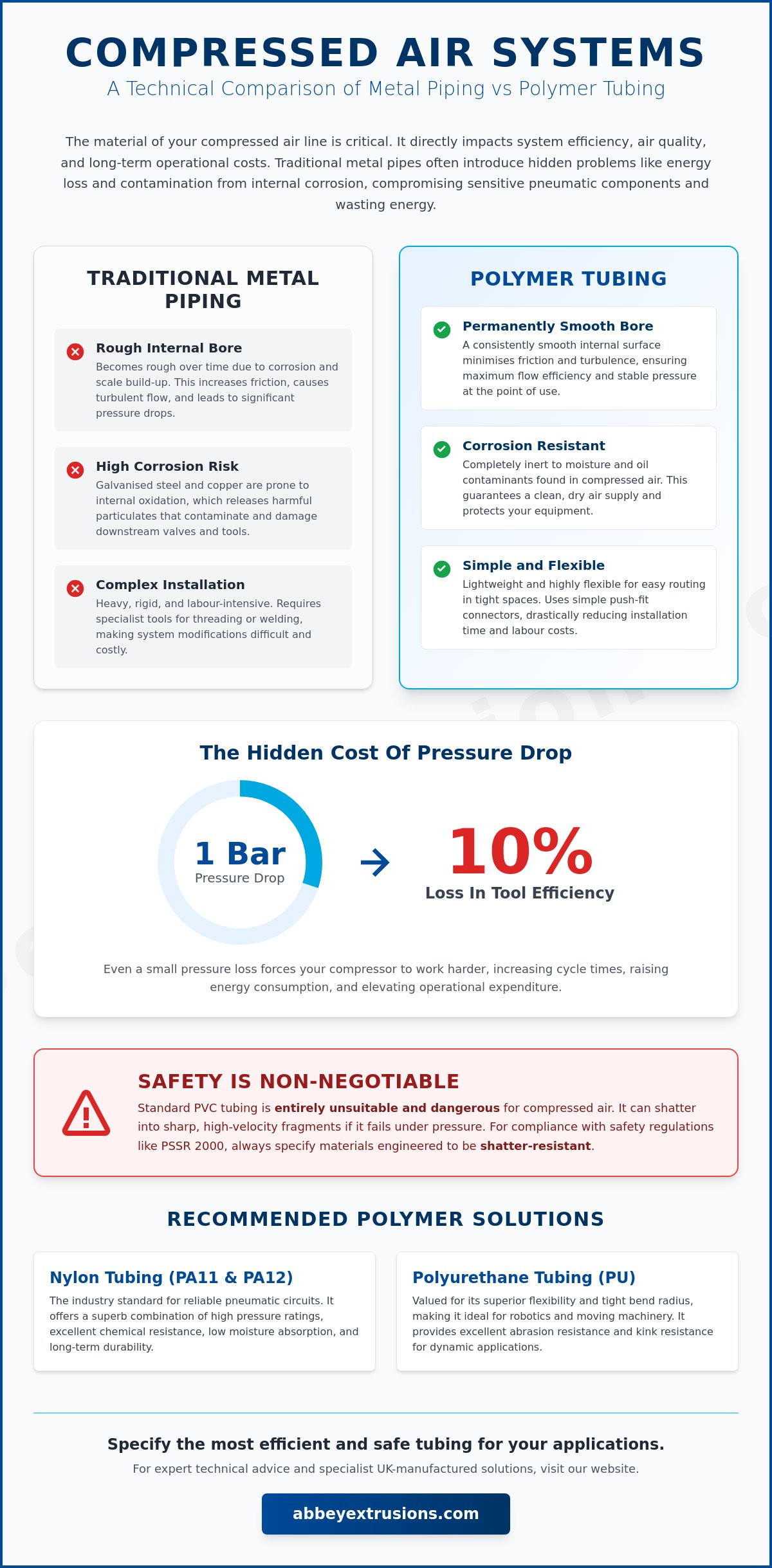
Material choice affects the bottom line through two primary mechanisms, friction and leakage. Traditional metal systems often suffer from scale build up and internal oxidation, which increases surface roughness over time. This leads to turbulent flow and higher energy consumption to maintain terminal pressure. In contrast, modern polymers offer a consistently smooth bore that minimises resistance. Leakage is also a critical factor; threaded metal joints are prone to weeping, whereas push-fit or compression systems used with Nylon tube provide a more secure, airtight seal. UK industrial regulations, including the Pressure Systems Safety Regulations 2000, mandate that all components must be suitable for the intended pressure and temperature amongst other environmental factors. Failure to comply can lead to costly downtime and legal liabilities.
The Impact of Internal Surface Roughness on Pressure Drop
Smooth internal bores are essential for reducing turbulence and energy loss. Whilst new copper or aluminium pipes have low friction coefficients, they can degrade as moisture and oil contaminants cause pitting. Technical polymers maintain their smooth finish throughout their service life, preventing the build up of scale that plagues metallic alternatives. A pressure drop at the point of use directly affects tool performance through several channels:
- Increased cycle times due to reduced actuator speed
- Higher compressor duty cycles to compensate for line loss
- Fluctuating pressure levels that compromise precision in automated assembly
A drop of just 1 bar at the tool can result in a 10% loss in efficiency. This forces the compressor to work harder and increases electricity costs, making the choice of the best plastic tubing for compressed air systems a matter of fiscal responsibility as much as engineering precision. These efficiency gains are vital for facilities looking to reduce their carbon footprint and operational expenditure.
Safety Standards and Shatter Resistance in Compressed Air Lines
Safety is paramount in any manufacturing environment. Standard PVC is entirely unsuitable for compressed air because it can shatter into sharp fragments if it fails under pressure. Compressed gas stores significantly more potential energy than liquids; a rupture is an explosion, not just a leak. Materials such as Polyurethane tube or specific grades of Nylon are engineered to be shatter resistant. These materials are designed to split or tear safely rather than fragmenting. Choosing materials that fail safely under pressure is a non negotiable requirement for modern industrial safety standards, ensuring that your workforce and equipment remain protected from high velocity debris.
If you require specific technical data regarding pressure ratings or chemical resistance for your facility, please consult our engineering team through our contact page.
The Performance Characteristics of Metal Piping in Industrial Settings
Traditional manufacturing environments have historically relied upon galvanised steel or copper for their primary distribution networks. These materials offer high structural rigidity and can withstand extreme ambient temperatures, yet they introduce significant operational challenges during both installation and long term maintenance. Installing a rigid metal system requires a substantial investment in labour; technicians must use specialised threading machines, heavy duty benders, and specific sealants to ensure a pressure tight fit. This process is inherently slow and lacks the modularity required for modern, evolving production lines. Whilst metal remains a viable choice for large diameter main headers, many engineers are finding that identifying the best plastic tubing for compressed air systems is more effective for machine level distribution.
Stainless steel represents a premium alternative for environments requiring high purity or resistance to external chemical attack, such as in food processing or pharmaceutical manufacturing. Aluminium has also gained popularity as a lightweight, modular alternative to traditional steel, offering easier overhead installation. However, even these advanced metallic options struggle with the vibration and constant movement inherent in automated machinery. Rigid lines lack the dampening qualities of polymers, which can lead to fatigue at connection points. When designing a safe circuit, engineers must also consider HSE guidance on pressure systems safety which highlights the critical nature of material suitability and the risks associated with improper piping choices in pressurised environments.
Traditional Steel and the Problem of Internal Corrosion
Internal corrosion remains the primary failure mode for galvanised steel lines. Despite the use of sophisticated dryers, moisture inevitably enters the distribution network, reacting with the iron to form oxide scale. This rust does not stay stationary; it detaches from the pipe walls and travels downstream at high velocities. These abrasive particles are notorious for scoring the precision bores of pneumatic cylinders and clogging delicate solenoid valves. Amongst older systems, the maintenance burden of constantly replacing clogged filter elements and repairing damaged actuators often exceeds the cost of a complete system overhaul. Transitioning to a non corrosive polymer ensures that the air quality remains consistent from the compressor room to the final actuator.
Aluminium and Copper as Rigid Alternatives
Aluminium piping offers a significant weight advantage over steel, reducing the load on factory roof structures and simplifying the installation of long overhead runs. Copper is sometimes specified for its thermal conductivity in applications where heat dissipation is a priority, yet its high material cost and the need for soldering or brazing make it less attractive for large scale projects. The most significant limitation of any rigid metal pipe is its inability to navigate the tight radii and moving frames of modern industrial equipment. For these specific applications, we recommend tube forming services to create custom polymer profiles that provide the stability of a rigid line with the chemical and corrosion benefits of advanced plastics. If you are currently struggling with the limitations of rigid piping, our specialists can help you select a more versatile solution through our contact page.
For expert guidance on selecting the correct polymer for your industrial circuit, please visit our contact page.
Evaluating Plastic Tubing Options for Pneumatic Applications
Whilst traditional metal piping provides a rigid backbone for factory ring mains, identifying the best plastic tubing for compressed air systems is essential for machine level distribution and automated circuits. Modern polymers have replaced metallic alternatives in these applications because they offer superior vibration damping and chemical resistance. In high speed manufacturing environments, the constant oscillation of actuators can cause rigid metal connections to fatigue and fail. Flexible tubing absorbs these micro vibrations, significantly extending the service life of the entire pneumatic assembly. Using high grade plastics also prevents the turbulent flow and pressure drops associated with the internal scaling found in aged steel lines.
Plastic tubing is naturally resistant to the moisture and compressor oils that inevitably migrate through an air system. This inherent corrosion resistance ensures that the air quality remains high, protecting sensitive downstream sensors and valves from particulate contamination. The ease of routing flexible tubing through complex machine frames cannot be overstated; it allows engineers to navigate tight radii without the need for multiple elbows or specialised threading tools. This modularity reduces both initial assembly time and the duration of future maintenance interventions.
The Technical Superiority of Nylon 11 and 12 Flexible Tubing
Nylon 11 and Nylon 12 represent the industry standard for high performance pneumatic applications. Nylon 11 is particularly valued for its exceptional temperature stability and high pressure ratings, making it suitable for demanding industrial environments where thermal fluctuations are common. Nylon 12 is often favoured for its low moisture absorption, which ensures dimensional stability and prevents the tubing from becoming brittle over time. You may refer to our technical specification page for Nylon tube to view specific pressure and temperature ratings. For a deeper analysis of polymer chemistry, we invite you to read our guide on Nylon tubing properties and applications.
Polyurethane and Polyethylene Tubing for Secondary Lines
For applications requiring extreme flexibility and kink resistance, Polyurethane tube is the preferred choice. Its elastic properties allow it to be used in tight bends where Nylon might struggle, making it ideal for robotic arms and compact valve manifolds. Conversely, low density polythene tube provides a cost effective solution for secondary lines where pressures are lower and chemical inertness is a priority. LDPE is particularly prevalent in fluid transfer and low pressure pneumatic control circuits. By selecting the specific polymer that matches the operational environment, engineers can ensure maximum system efficiency whilst minimising material costs.
If you require a detailed chemical compatibility chart for your specific compressor lubricant, please reach out to our team through our contact page.
Critical Factors for Selecting Between Metal and Plastic Tubing
Specifying the optimal distribution material requires a structured evaluation of the operating environment. Whilst pressure rating is the primary metric, engineers must also account for ambient temperature fluctuations and UV exposure. In 2026, the best plastic tubing for compressed air systems is often selected based on its ability to maintain integrity under varied thermal loads. As temperature increases, the maximum working pressure of thermoplastic tubing decreases; a factor that must be calculated during the design phase to prevent premature failure. Total cost of ownership also plays a decisive role. Whilst metal pipes may have a lower initial material cost, the labour required for threading and the inevitable downtime for corrosion related repairs often make flexible polymers the more economical long term investment.
Environmental conditions at the installation site dictate the necessary material properties. For outdoor installations, tubing must be UV stabilised to prevent the polymer chains from breaking down under sunlight. In high temperature environments, such as near industrial ovens or heavy machinery, the thermal stability of the material becomes the limiting factor. We recognise that specifying the correct material is a balance of performance and safety. By considering the lifecycle costs rather than just the initial purchase price, facility managers can specify a distribution system that remains efficient for decades.
Chemical Compatibility with Compressor Oils and Lubricants
Synthetic lubricants used in modern screw compressors can be aggressive towards certain polymers. Whilst Nylon tube exhibits excellent resistance to a wide range of industrial oils, other materials like standard polyethylene may swell or soften when exposed to specific esters. It's essential to verify that the tubing material is compatible with the oil mist present in the air stream. We recommend reviewing technical data sheets for all components in an oil mist system to ensure chemical stability. If you are unsure about the interactions between your lubricants and distribution lines, contact our specialists for a technical review.
Vibration Resistance and Mechanical Fatigue
Industrial machinery creates constant mechanical harmonics that can be detrimental to rigid distribution systems. Metal lines are susceptible to work hardening, where repeated vibration causes the material to become brittle, eventually leading to stress cracks at joints and fittings. Flexible Polyurethane tube provides natural damping that isolates these vibrations, protecting the integrity of the entire circuit. This mechanical resilience is a primary reason why flexible connections are considered vital for the longevity of automated systems. By utilising the best plastic tubing for compressed air systems at connection points, you can eliminate the joint failures that frequently plague rigid metallic installations.
To discuss your specific project requirements or to request a technical consultation with our engineering team, please visit our contact page.
Specialist Flexible Tubing Solutions from Abbey Extrusions
Abbey Extrusions stands as a premier UK manufacturer, leveraging decades of technical expertise to deliver high performance solutions for the most demanding industrial environments. Whilst standard off the shelf products may suffice for basic setups, complex machinery often requires a more precise approach to pneumatic distribution. We provide a comprehensive range of polymers that are widely recognised as the best plastic tubing for compressed air systems due to their reliability and precision engineering. Our commitment to quality control ensures that each length of tubing meets rigorous industrial standards, providing peace of mind for specifyers and maintenance engineers alike.
For neat and efficient machinery layouts, our tube forming service is indispensable. Pre-shaped profiles allow for a clean installation that follows the contours of the machine chassis, eliminating the risk of "spaghetti" layouts that complicate maintenance. When workstation flexibility is a priority, a Nylon recoil air hose offers the necessary reach whilst retracting neatly to keep the work area clear. This combination of bespoke shaping and functional design reduces the physical footprint of the pneumatic circuit whilst improving overall system accessibility. As a British manufacturer, we offer direct technical support and rapid lead times that overseas suppliers simply cannot match.
Custom Extrusion and Bespoke Tubing Profiles
The ability to manufacture colour coded tubing is a significant advantage for facilities managing complex pneumatic systems. By assigning specific colours to different pressure zones or functions, engineers can drastically reduce the time required for fault finding and routine inspections. We specialise in bespoke profiles that address unique pneumatic challenges, ensuring that every component is perfectly suited to its application. Our expertise in sourcing custom plastic extrusions allows us to meet specific mechanical needs that standard tubing cannot satisfy. This tailored approach is what defines our role as a partner in your manufacturing success.
Selecting the Right Hose for Specialised Industrial Environments
Certain applications demand enhanced durability beyond standard polymer tubing. The Air 60 air hose is specifically engineered for heavy duty pneumatic applications where abrasion and external wear are constant factors. In environments where lines are exposed to mechanical friction or sharp edges, a Nylon spiral cut hose guard provides an essential layer of protection, extending the service life of the best plastic tubing for compressed air systems. We encourage engineers to consult with our manufacturing experts to develop tailored solutions that account for every environmental variable. Selecting the correct protection and material grade is the most effective way to ensure long term operational stability and safety.
If you require further technical information or wish to discuss a bespoke requirement, please reach out to us via our contact page.
Optimising Industrial Pneumatic Performance for the Future
Specifying the distribution material for your pneumatic circuits is a decision that impacts the long term efficiency and safety of your entire facility. Whilst traditional metal piping remains a staple for main distribution, high performance polymers have proven to be the superior choice for machine level applications. By selecting the best plastic tubing for compressed air systems, you can eliminate the risks of internal corrosion and particulate contamination that frequently compromise sensitive downstream components. Modern engineering demands a balance of mechanical resilience and installation flexibility, qualities that are inherent in advanced Nylon 11 and 12 extrusions.
As a specialist UK manufacturer with decades of expertise, we provide bespoke tube forming and profiling services to solve unique engineering challenges. Our commitment to technical competence ensures that your pneumatic systems remain reliable and efficient amongst evolving industrial requirements. We invite you to contact our technical team for expert advice on industrial tubing to discuss your specific material requirements. Investing in precision engineered polymers today will ensure a stable and high quality air supply for your operations for years to come.
Frequently Asked Questions
Is plastic tubing safe for high pressure compressed air
Plastic tubing is extremely safe for high pressure compressed air when high performance polymers like Nylon 11 and 12 are specified. These materials are engineered specifically for pneumatic circuits and remain safe when used within their rated pressure and temperature ranges. Unlike PVC, which can shatter, these polymers are designed to fail safely by splitting. It's vital to ensure the tubing is rated for the maximum pressure of your compressor and that all fittings are compatible. In 2026, UK safety standards continue to favour these materials for machine level connections due to their mechanical reliability.
What is the best plastic for compressed air lines
Nylon 12 is considered the gold standard for most industrial pneumatic systems. Identifying the best plastic tubing for compressed air systems often involves balancing high pressure resistance, low moisture absorption, and chemical resistance to compressor oils. Whilst Polyurethane is more flexible and ideal for tight bends, Nylon 12 provides better long term stability in high pressure environments. Abbey Extrusions specialises in both materials to ensure you have the correct polymer for your specific application requirements.
Why is PVC not recommended for compressed air
Standard PVC tubing is not recommended for compressed air because it can become brittle over time. This degradation is accelerated when the material is exposed to compressor oils or UV light. If a PVC pipe fails under pressure, it can shatter into sharp fragments, posing a serious safety risk to personnel. Whilst reinforced PVC has its specific uses, it's generally unsuitable for the high energy storage inherent in compressed air. Professional systems should always use shatter resistant materials like Nylon or aluminium.
How does temperature affect plastic versus metal air lines
Temperature has a more significant impact on plastic tubing than on metal piping. As temperatures rise, the pressure rating of plastic tubing decreases. Conversely, in very cold environments, some plastics can become less flexible. Metal piping is far more stable across extreme temperature ranges but is more prone to thermal expansion and contraction. It's essential to consult the technical data sheets for your specific tubing to ensure it maintains safety margins at your operating temperature.
Can I mix metal piping and plastic tubing in the same system
Mixing materials is actually the most efficient way to design a modern compressed air system. Many engineers use rigid aluminium or stainless steel for the main distribution ring main to minimise pressure drop over long distances. They then switch to flexible plastic tubing for the final connection to machinery and tools. This hybrid approach combines the structural integrity of metal with the vibration resistance and ease of routing provided by flexible polymers. This method ensures maximum efficiency across the entire network.
Does plastic tubing cause more pressure drop than metal
Plastic tubing actually has a lower friction coefficient than traditional galvanised steel, which can lead to less pressure drop when new. Because plastic does not rust or scale, it maintains this smooth internal bore throughout its lifespan. Metal pipes, particularly steel, can become rough internally as they age due to corrosion. This leads to increased turbulence and significant energy loss. Choosing a smooth bore polymer ensures consistent efficiency for your pneumatic equipment and reduces overall energy costs.

Article by
Bryan Cowan
Bryan Cowan is the Founder and Managing Director of Abbey Extrusions Ltd, a leading UK manufacturer of high-quality plastic tubes and hoses. With over 40 years of industry experience, Bryan established the company in 1985, growing it from a startup into a BS ISO9001-registered supplier for global sectors including aerospace, automotive, and pharmaceuticals.
Disclaimer
This article is intended for informational purposes only. Please ensure you seek expert advice or carry out your own research to confirm the information is suitable for your specific needs.