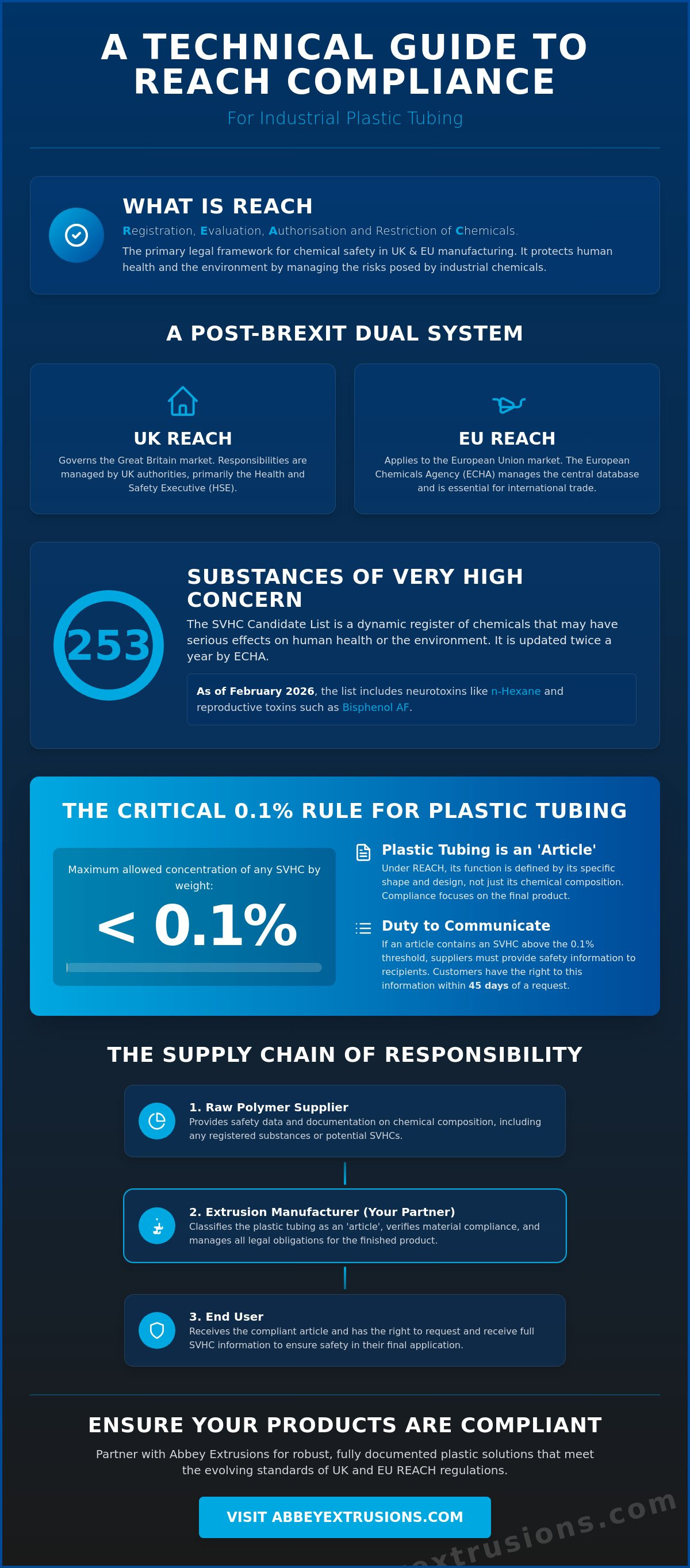
Did you know that as of February 2026, the REACH SVHC Candidate List has expanded to include 253 restricted substances? With the recent addition of compounds like n-Hexane and Bisphenol AF, maintaining REACH compliance for plastic tubing has become a complex requirement for many industrial manufacturers. We understand that the divergence between UK REACH and EU REACH post-Brexit has created a landscape of technical uncertainty. It's a significant challenge to ensure every component in your supply chain meets these rigorous standards without sacrificing the mechanical properties of your extrusions.
We recognise that obtaining accurate compliance documentation and vetting suppliers often feels like an administrative burden that distracts from your core production goals. This guide provides a definitive technical framework for navigating these chemical safety regulations whilst ensuring your industrial applications remain high performing. We'll examine your specific legal obligations, the impact of the upcoming 2026 REACH Recast, and how to establish a robust evaluation process for your material partners.
Key Takeaways
- Understand the fundamental requirements of REACH regulations and how they safeguard human health and environmental standards within the polymer extrusion sector.
- Learn how to identify and monitor Substances of Very High Concern to maintain REACH compliance for plastic tubing whilst ensuring material stability.
- Identify the critical documentation and communication protocols required to verify chemical safety standards across the entire manufacturing supply chain.
- Discover how to select compliant materials that meet rigorous safety standards without sacrificing technical performance or durability.
- Develop a professional framework for supplier evaluation to ensure your industrial components remain fully documented and compliant with evolving UK and EU laws.
To discuss your specific material requirements and ensure your supply chain meets current regulatory standards, please get in touch with our team via our contact page.
Understanding REACH Regulations for Industrial Plastic Tubing
The Registration, Evaluation, Authorisation and Restriction of Chemicals (REACH) represents the most comprehensive piece of chemical legislation in industrial history. It serves as the primary framework for chemical safety in UK manufacturing, ensuring that every substance used in the production process is documented and assessed for risk. For manufacturers and procurement leads, achieving REACH compliance for plastic tubing is no longer just a legal box to tick. It's a fundamental requirement for protecting human health and the environment from the potential hazards posed by industrial chemicals.
The regulatory landscape has become more complex following the UK's departure from the European Union. Whilst the core principles of the original 2007 legislation remain intact, we now operate under two distinct systems: UK REACH and EU REACH. For domestic supply chains, this means businesses must adhere to the UK statutory instruments whilst often maintaining EU alignment to facilitate international trade. With the anticipated REACH Recast in late 2026 likely to introduce a 10 year validity period for registrations and the recent Commission Regulation (EU) 2026/1168 amending microplastics restrictions, staying informed on these nuances is critical for long term operational stability.
The Role of the European Chemicals Agency and UK Authorities
The European Chemicals Agency (ECHA) maintains the central database for all chemical registrations across the EU, acting as the primary gatekeeper for industrial safety. It's a rigorous system where the ECHA performs compliance checks on approximately 5% of all registration dossiers to ensure data accuracy. In the United Kingdom, these responsibilities have transitioned to national regulatory bodies, including the Health and Safety Executive (HSE). Any company that manufactures or imports chemical substances in quantities exceeding one metric tonne annually must register them. This registration process ensures that the technical properties and safety profiles of polymers used in extrusions are fully understood before they enter the market.
Plastic Tubing as an Article under REACH
Under these regulations, plastic tubing is classified as an "article" because its specific shape, surface, and design are more important to its function than its chemical composition alone. This classification changes the nature of REACH compliance for plastic tubing. Instead of registering the tube itself, manufacturers must ensure that no restricted substances or Substances of Very High Concern (SVHC) are present in the material at concentrations above 0.1% by weight. This obligation flows through the entire supply chain, requiring precise communication from the raw polymer supplier down to the end user of the finished extrusion. If an SVHC is present above this threshold, manufacturers are legally obliged to provide sufficient information to customers within 45 days of a request.
To ensure your specific polymer requirements align with the latest chemical safety standards, please reach out to our technical team for a detailed consultation.
Identifying SVHCs in Common Polymer Extrusions
Within the polymer industry, identifying Substances of Very High Concern (SVHCs) is a continuous process that requires constant vigilance. The European Chemicals Agency manages the Candidate List, which is updated twice a year to include new substances that may pose risks to human health or the environment. As of February 2026, this list includes 253 entries, including neurotoxic agents like n-Hexane and reproductive toxins like Bisphenol AF. Achieving REACH compliance for plastic tubing depends on monitoring common additives such as catalysts, solvents, and antioxidants that may be added to the polymer matrix during processing. Any SVHC presence over 0.1 percent weight by weight triggers notification duties that must be fulfilled to maintain legal market access. For a broader perspective on these obligations, the ECHA provides a guide on Understanding REACH for businesses.
Phthalates and Plasticisers in PVC Tubing
Historically, phthalates were the primary additives used to increase flexibility in pvc tube. However, current restrictions on specific plasticisers are strictly enforced, especially amongst industrial and food grade variants where migration risks are high. Substances such as DEHP, BBP, DBP, and DIBP are restricted in plasticised materials at concentrations of 0.1% or above. Modern manufacturing processes have evolved to eliminate these restricted substances, replacing them with high molecular weight plasticisers that offer superior performance without the health risks. This ensures that even in demanding environments, the tubing remains safe and compliant with both UK and EU standards.
Additives in Nylon and Polyurethane
For technical polymers, the challenge lies in maintaining specific physical properties whilst adhering to chemical restrictions. High performance extrusions such as nylon tube often require flame retardants and UV stabilisers to meet industrial specifications. We must evaluate these additives carefully to ensure they don't contain restricted brominated compounds or other SVHCs. Similarly, pigments used for colour coding must be free from restricted heavy metals like lead or cadmium. These regulations have a direct impact on polyurethane tube formulations, where chemical stability and compliance are paramount. Consistent REACH compliance for plastic tubing requires a deep understanding of these chemical interactions. If you are unsure about the chemical composition of your current components, our experts can provide technical guidance on material safety.
To verify the specific chemical status of your current supply or to request technical documentation for a new project, please visit our contact page.
Supplier Documentation and the Chain of Responsibility
In the industrial sector, the chain of responsibility is the foundation of chemical safety. Manufacturers of extruded products have a legal duty to communicate essential safety information down the supply chain to ensure every stakeholder understands the material composition. For those seeking REACH compliance for plastic tubing, this process begins with rigorous supplier vetting. Following the UK REACH regulations, downstream users must be able to verify that their components do not contain restricted substances above the 0.1% threshold. A Declaration of Conformity is the primary proof of compliance for buyers and should be requested for every unique polymer batch.
Maintaining a comprehensive audit trail is essential for long term compliance. This involves tracking every raw material batch back to its original polymer source. If a substance is added to the SVHC list, an organised record allows a manufacturer to quickly identify which products are affected. This methodical approach to data management prevents the accidental use of materials containing restricted substances and provides peace of mind for procurement teams. It ensures that every component used in your assembly is backed by verifiable technical data.
Safety Data Sheets and Declarations of Conformity
A Safety Data Sheet (SDS) provides a broad overview of chemical hazards, but it's often insufficient on its own for verifying specific REACH status. Buyers must distinguish between a general REACH statement and a product specific declaration. A general statement might claim a company is REACH compliant, but a product specific Declaration of Conformity confirms that a particular extrusion, such as a batch of reinforced PVC tube, meets the latest regulatory updates. Organising these documents by product line simplifies your own compliance audits and ensures you're prepared for regulatory inspections.
Communication Obligations for Downstream Users
Transparency amongst partners is vital in the industrial supply chain. Downstream users have a duty to inform their suppliers about the specific uses of the tubing. This ensures the manufacturer can confirm the material is safe for that application. Companies must also respond to consumer inquiries about harmful substances within 45 days. Establishing clear communication channels allows you to handle these requests with confidence whilst maintaining REACH compliance for plastic tubing. If you require assistance in interpreting complex material data, our technical team is available to provide support.
If you require technical assistance in selecting the most appropriate materials for your application, you can consult our technical department for material specifications.
Material Selection and Compliance Standards for UK Manufacturing
Material selection is the foundation of long term operational safety. When engineers specify components, they must balance mechanical performance with chemical purity to ensure the longevity of their systems. Choosing inherently stable polymers, such as low density polythene tube, significantly reduces the risk of non-compliance. These materials often lack the complex additives that trigger regulatory scrutiny under current legislation. This approach aligns with the engineering principles of plastic extrusion, where material integrity dictates the final product's performance. Maintaining REACH compliance for plastic tubing ensures that even in harsh industrial environments, the material remains resistant to degradation without leaching harmful substances. Evaluating the chemical resistance of compliant tubing is a prerequisite for industrial reliability, ensuring that products do not become brittle or fail prematurely when exposed to acids or oils.
Comparing Nylon 11 and 12 Compliance
Nylon 11 and 12 are widely regarded as the gold standard for high performance applications. Their favour amongst engineers stems from their exceptional chemical resistance and thermal stability in demanding environments. These polymers are often produced with high purity levels, making them naturally compliant with the latest SVHC lists. For critical systems like diesel fuel hose production, these materials provide the necessary durability whilst meeting all UK REACH requirements. We ensure that our Nylon extrusions maintain their mechanical properties across wide temperature ranges without the use of restricted flame retardants or stabilisers.
Transitioning to REACH Compliant Alternatives
Replacing restricted materials requires a methodical engineering approach to avoid compromising system performance. Businesses must identify alternative polymers that mirror the tensile strength and flexibility of the original material. Custom tube forming plays a vital role here, allowing for the creation of complex geometries with compliant materials that might otherwise be difficult to manipulate. Ensuring REACH compliance for plastic tubing may involve moving to higher grade polymers, which brings substantial long term benefits by avoiding regulatory fines and supply chain disruptions. We assist our partners in navigating these transitions by providing detailed technical data and material samples for testing.
To explore our range of compliant polymer solutions, please contact our team for a technical overview.
To discuss your specific compliance requirements or to request a technical data sheet for your next project, please visit our contact page.
Partnering with Abbey Extrusions for Compliant Plastic Solutions
Abbey Extrusions represents a legacy of precision and technical competence in the UK manufacturing sector. With over forty years of experience, we've developed a deep understanding of how chemical safety regulations intersect with high performance engineering. Our commitment to REACH compliance for plastic tubing is reflected in our rigorous material testing protocols and our transparent approach to chemical safety. We provide UK manufacturers with fully documented solutions that ensure long term reliability and market access. We invite engineers and procurement specialists to discuss their specific compliance needs with our technical team to ensure every extrusion meets the required standards.
Quality Control and Material Traceability
Maintaining a transparent supply chain is a cornerstone of our operations. For every batch of nylon tube we produce, we implement strict quality control measures to ensure material traceability. As a British manufacturer, we have direct oversight of our production processes, which allows us to provide a level of accountability that is often missing in global supply chains. We proactively monitor the SVHC list, which reached 253 substances in February 2026, to ensure that our materials remain ahead of regulatory changes. This foresight protects our clients from sudden supply disruptions and ensures that their products remain compliant throughout their lifecycle.
Bespoke Extrusions and Technical Support
Our expertise extends beyond standard tubing to include complex bespoke profiles. We provide REACH compliant solutions for specialised applications such as kedar cord and custom vehicle profiles where material durability is non negotiable. For sectors with even stricter requirements, such as food and beverage production, we offer technical guidance on material compatibility for brewery hose applications. Our proactive approach to chemical safety and environmental responsibility means that we don't just react to legislation; we integrate these standards into our fundamental design process. By combining engineering precision with a thorough understanding of REACH compliance for plastic tubing, we help our partners maintain a competitive edge in an increasingly regulated global market.
Securing Your Supply Chain for 2026 and Beyond
Maintaining REACH compliance for plastic tubing requires a proactive approach to chemical safety and a deep understanding of evolving polymer science. As regulatory bodies continue to expand the list of restricted substances, businesses must prioritise material traceability and clear supplier documentation to ensure uninterrupted market access. It's essential to maintain a rigorous audit trail to mitigate long term technical and legal risks whilst ensuring your industrial systems remain high performing.
As a specialist UK manufacturer since 1985, we provide the technical expertise and full material traceability necessary for demanding applications. We specialise in Nylon 11 and 12 polymers, ensuring every extrusion is backed by the comprehensive compliance documentation your auditors require. If you require technical assistance with your specific material requirements, please contact us at Abbey Extrusions for expert guidance. We look forward to supporting your next industrial project with precision and safety.
Frequently Asked Questions
What is the difference between EU REACH and UK REACH for plastic tubing
UK REACH is the independent regulatory framework for Great Britain, whilst EU REACH continues to apply across the European Economic Area. Although both systems share the same fundamental principles of chemical safety, they require separate registrations and reporting through different databases. Manufacturers must ensure their technical documentation aligns with the specific requirements of the Health and Safety Executive in the UK and the European Chemicals Agency for exports to the continent.
Does plastic tubing require registration under REACH
Plastic tubing is classified as an article and does not require registration itself. The legal obligation for registration applies to the chemical substances used to manufacture the polymer, such as monomers and additives, if they are produced or imported in quantities exceeding one tonne per year. As a downstream user, your primary responsibility is to ensure that the substances within the finished extrusion are used according to the registered safety conditions.
How can I check if my nylon tubing contains SVHCs
The most reliable method is to request a product specific Declaration of Conformity from your supplier. This document should explicitly state whether any Substances of Very High Concern from the current Candidate List are present in the material at concentrations exceeding 0.1% weight by weight. Relying on a general company statement is often insufficient for technical audits, as it may not reflect the specific chemical composition of a particular polymer batch.
Is REACH compliance mandatory for food grade plastic hoses
REACH compliance is a universal requirement that applies to all chemical substances regardless of the final application. Food grade hoses must adhere to these standards in addition to specific food contact regulations, such as EU 10/2011. This dual layer of regulation ensures that the materials are not only safe for contact with consumables but also free from restricted industrial chemicals that could pose broader environmental or health risks.
What documentation should I request from my plastic extrusion supplier
You should request a formal REACH Declaration of Conformity and an up to date Safety Data Sheet for every material grade you purchase. These documents serve as the primary evidence of REACH compliance for plastic tubing and must reference the most recent update to the SVHC Candidate List. Ensuring these records are current is vital for maintaining your own compliance during internal audits or regulatory inspections.
Are there specific REACH restrictions for PVC tubing
PVC manufacturing often involves the use of plasticisers and stabilisers that are subject to specific restrictions under Annex XVII of the regulations. Phthalates such as DEHP, DBP, and BBP are strictly limited to concentrations below 0.1% in plasticised materials. Manufacturers of high quality PVC extrusions now utilise alternative, high molecular weight plasticisers to ensure their products remain fully compliant whilst maintaining the necessary flexibility and durability for industrial use.
What happens if a substance in my tubing is added to the Candidate List
If a substance used in your tubing is newly added to the Candidate List and exceeds the 0.1% threshold, the manufacturer is legally obliged to inform you within 45 days. This notification triggers a duty for you to pass this information down the supply chain to your own customers. In such cases, it's often necessary to work with your supplier to identify a compliant alternative polymer to ensure REACH compliance for plastic tubing remains intact.
Can I use non compliant tubing if it is for industrial use only
REACH regulations do not provide exemptions for industrial use regarding the presence of restricted substances or unauthorised SVHCs. Every professional application must meet the same rigorous chemical safety standards to protect workers and the environment. Using non-compliant materials exposes your business to significant legal penalties, potential product recalls, and long term liability for any health or environmental damages caused by the restricted chemicals.

Article by
Bryan Cowan
Bryan Cowan is the Founder and Managing Director of Abbey Extrusions Ltd, a leading UK manufacturer of high-quality plastic tubes and hoses. With over 40 years of industry experience, Bryan established the company in 1985, growing it from a startup into a BS ISO9001-registered supplier for global sectors including aerospace, automotive, and pharmaceuticals.
Disclaimer
This article is intended for informational purposes only. Please ensure you seek expert advice or carry out your own research to confirm the information is suitable for your specific needs.