Relying on outdated EU documentation for your production lines is no longer a viable strategy for UK based engineers. Understanding the specific food contact materials regulation UK tubing must meet is essential to prevent costly contamination risks and ensure your facility remains fully compliant. We recognise that the divergence between Great Britain and the European Union has created a complex landscape of assimilated laws and Food Standards Agency requirements that can be difficult to manage whilst maintaining high production volumes. This regulatory shift places a significant burden on procurement teams to secure precise Declaration of Compliance paperwork and verify polymer additives for every component.
This guide provides a rigorous technical overview of the current legal framework to help you navigate these requirements with the confidence that only decades of manufacturing experience can provide. We will examine how specific polymers such as Nylon, LDPE, and reinforced PVC perform under these standards and what the upcoming 2027 Sanitary and Phytosanitary Agreement means for your long term procurement strategy. By the end of this article, you will have a clear understanding of how to select the correct material for specific food types whilst ensuring your supply chain is robust, safe, and legally sound.
Key Takeaways
- Gain a definitive understanding of how the Food Standards Agency governs the domestic market through assimilated legislation and specific GB requirements.
- Identify the authorised monomers and additives allowed under Regulation (EU) No 10/2011 to ensure your plastic tubing is chemically safe for its intended use.
- Evaluate the technical performance and food grade suitability of Nylon 11 and Nylon 12 against standard PVC for high pressure processing environments.
- Learn how to verify a Declaration of Compliance to meet the strict requirements of the food contact materials regulation UK tubing framework and satisfy health inspectors.
- Discover how specialist manufacturing and bespoke tube forming can solve complex engineering challenges whilst maintaining rigorous safety standards.
For technical guidance on material specifications or to request a Declaration of Compliance for your facility, please speak with our technical team.
Understanding Food Contact Materials Regulation in the UK Tubing Market
In industrial processing, Food Contact Materials (FCM) encompass every component that comes into direct contact with food during production, transport, or dispensing. For engineers, this includes essential transfer lines such as nylon tube or low density polythene tube. Understanding Food Contact Materials is fundamental to ensuring that polymer additives don't migrate into the food stream. The food contact materials regulation UK tubing manufacturers must adhere to ensures that these materials are sufficiently inert. They must not transfer their constituents to food in quantities that could endanger human health or bring about an unacceptable change in the composition of the product.
The Legal Framework for UK Food Safety
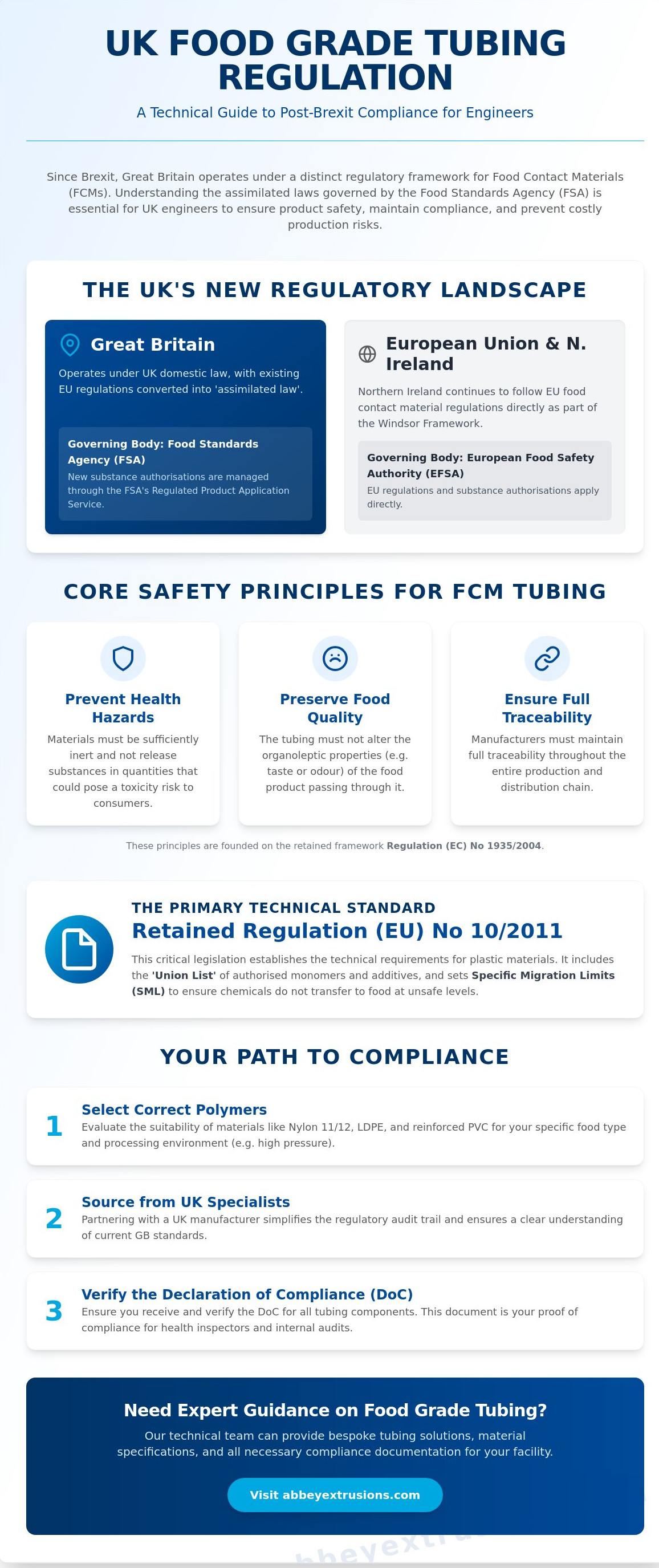
The foundation of this safety regime is the General Food Law Regulation, which sets out the overarching principles for food safety. This is supported by the framework Regulation (EC) No 1935/2004, which has been retained in UK domestic law as assimilated law. These regulations apply directly to the manufacture of tubing, requiring that every production batch is created according to Good Manufacturing Practice (GMP). Under this framework, plastic tubing must meet several critical safety criteria:
- Materials must not release substances that pose a toxicity risk to consumers.
- The tubing must not alter the organoleptic properties, such as the taste or odour, of the food passing through it.
- Manufacturers must ensure full traceability throughout the production and distribution chain.
It's essential that engineers verify these properties, as using non-compliant polymer grades can lead to chemical migration that compromises the entire production batch.
Navigating Brexit and Regulatory Divergence
The Brexit transition on 1 January 2021 introduced a split in the regulatory landscape. Northern Ireland continues to follow EU rules directly, but Great Britain operates under a system of assimilated law governed by the Food Standards Agency (FSA). This means that new substance authorisations are now processed through the FSA's Regulated Product Application Service rather than the European Food Safety Authority (EFSA). Sourcing components from a specialist UK manufacturer like Abbey Extrusions simplifies the regulatory audit trail. We maintain a precise understanding of these shifting standards, ensuring that your paperwork remains accurate despite the divergence between UK and EU policies. This proximity allows for better transparency in the supply chain and more reliable compliance with the food contact materials regulation UK tubing standards currently in force.
If you require technical documentation or a consultation regarding material compliance for your specific application, please contact our specialist engineers.
The Impact of Retained EU Regulations on Plastic Tubing Safety
Whilst Great Britain has departed from the EU, the technical requirements for plastic materials remain deeply rooted in Regulation (EU) No 10/2011. This retained legislation serves as the primary technical standard within the food contact materials regulation UK tubing regime. It establishes the Union List, which is a comprehensive inventory of monomers, additives, and polymer production aids that are permitted for use in food grade components. For a substance to be included, it must undergo a rigorous risk assessment to ensure it doesn't pose a health risk. Any new additions to this list for use in Great Britain now follow the UK authorisation process for FCMs managed by the Food Standards Agency.
Specific Migration Limits for Polymer Additives
Specific Migration Limits (SML) are a critical component of these safety standards. Migration limits are defined as the maximum amount of a substance that can transfer from tubing into food. These limits ensure that even if chemical transfer occurs, it remains at a level that doesn't compromise consumer safety. Testing is conducted using food simulants that mimic the behaviour of fatty, acidic, or aqueous foods. For instance, a hose used for dairy transport requires different migration verification than one used for dry grains. This specificity prevents the leaching of polymer additives that could otherwise contaminate the production line.
Good Manufacturing Practice in Plastic Extrusion
Safety isn't solely dependent on the raw polymer; it's also a product of the manufacturing environment. Regulation (EC) No 2023/2006 mandates Good Manufacturing Practice (GMP) for all food contact materials. At Abbey Extrusions, we maintain stringent quality control systems to ensure that every batch of tubing is produced under controlled conditions. This prevents cross contamination amongst batches and ensures that the material integrity is never compromised. Our adherence to fundamental plastic extrusion principles allows us to maintain precise thermal and mechanical control during production.
This level of oversight provides full traceability from the initial resin intake to the finished hose. It's this methodical approach that guarantees the safety of the final product. We ensure that every stage of the process, from melt temperature to cooling rates, is monitored to prevent polymer degradation. If you need to verify the compliance of your current components or discuss a bespoke requirement, our technical consultants are available to assist.
For expert advice on selecting the most appropriate polymer for your production facility, please enquire with our engineering team.
Evaluating Polymer Suitability for Specific Food Contact Applications
Selecting the correct polymer is a critical engineering decision that balances mechanical performance with strict safety compliance. Whilst the previous sections outlined the legal framework and migration limits, this section focuses on the practical application of different materials within the food contact materials regulation UK tubing landscape. Every polymer behaves differently when exposed to various food types. Selecting an incompatible material can lead to chemical migration or physical degradation that compromises your entire production line. We ensure that every material we extrude is matched to the specific demands of the food or beverage it will transport.
Nylon 11 and 12 in Food Processing
Nylon is a high performance polymer often chosen for its exceptional durability and resistance to environmental stress cracking. When considering Nylon tube, engineers benefit from a material that is highly resistant to fatty foods and oils, which can cause other plastics to swell or degrade. Under the Retained EU regulations, Nylon 11 and 12 are recognised for their low permeability and high thermal stability. These grades are particularly suitable for high pressure lines where material integrity must be maintained at elevated temperatures. For a deeper analysis of the material science involved, you may consult our technical guide to nylon tubing. We specify these polymers when the application demands a robust, long lasting solution that won't leach constituents into the food stream.
Flexible PVC and LDPE for General Food Use
For applications requiring visibility and flexibility, Reinforced PVC Tube is a frequent choice amongst plant managers. However, the use of PVC in food contact requires careful monitoring of plasticisers to ensure they appear on the authorised substance list. We ensure all our PVC formulations meet these rigorous standards. In contrast, Low Density Polythene Tube (LDPE) is naturally chemically inert and does not typically require these additives. This makes it a favourite for low cost, high purity, aqueous food contact applications where chemical neutrality is paramount.
In beverage production, preventing taint is the primary concern. A specialist Brewery hose must be constructed from materials that don't impart any flavour or odour to the liquid. This is especially important in the craft ale and spirits sectors, where the organoleptic profile of the product is its most valuable asset. Our manufacturing process ensures that these hoses are produced to the exact specifications required by the domestic market, providing you with total confidence in your supply chain.
For technical support in verifying the compliance of your existing tubing batches or to request detailed material specifications, please contact our specialist team.
Ensuring Compliance Through Proper Documentation and Migration Testing
Compliance in a high precision manufacturing environment is not merely about material selection; it involves the rigorous verification of that material through every stage of the supply chain. Under the food contact materials regulation UK tubing standards, every batch of food grade tubing must be accompanied by a written Declaration of Compliance (DoC). This document serves as the legal evidence that the material has been assessed and meets the necessary safety criteria. Without this paperwork, plant managers risk failing audits or being forced to halt production by local health inspectors. We recognise that maintaining this level of documentation is a significant administrative task, which is why we prioritise transparency and accuracy in all our technical filings.
Checklist for a Valid Declaration of Compliance
A professional DoC is a technical document that provides essential transparency regarding the chemical composition and intended use of the tubing. To satisfy UK health inspectors, the documentation must include the identity and address of the manufacturer or the importer responsible for the material. It must also provide a clear identification of the materials or articles, such as a specific batch of low density polythene tube or nylon tube. Crucially, it must contain an explicit confirmation that the plastic material complies with the requirements of Regulation (EU) No 10/2011 as retained in UK law. Finally, it should detail the conditions of use, including specific food types and the maximum temperature limits the material can safely endure whilst in operation.
Understanding Migration Testing Simulants
To verify the safety claims made in the DoC, independent laboratories conduct migration testing using food simulants. These substances are designed to mimic the chemical behaviour of different food categories without the complexity of testing with actual food products. For example, 3% acetic acid is used to simulate acidic foods, whilst various concentrations of ethanol are used for alcoholic beverages. For fatty foods, vegetable oils are employed to test the limits of polymer stability. These tests are essential because they account for the time and temperature variables found in industrial food processing. By testing under 'worst-case' conditions, we ensure that the material remains safe even when the production line is operating at its maximum thermal or mechanical limits.
Reliable compliance requires a partner who understands the intricacies of the UK authorisation process and the technical demands of the extrusion process. We ensure that every product we supply is backed by the necessary technical data to satisfy the most stringent health and safety audits. If you require a review of your current documentation or need to source compliant tubing for a new project, request a technical consultation with our compliance experts.
To discuss your specific technical requirements or to request a quote for bespoke components, please contact our engineering department.
Technical Expertise in UK Food Grade Tubing Manufacture
Abbey Extrusions has spent over 40 years establishing a reputation for technical excellence within the specialist UK manufacturing sector. Our deep understanding of the food contact materials regulation UK tubing market allows us to provide more than just standard components; we offer an engineering partnership built on decades of material science. We recognise that food safety is a non-negotiable standard, and our manufacturing processes are designed to reflect this commitment. By maintaining our production entirely within the United Kingdom, we provide our partners with a level of oversight and quality assurance that international suppliers often struggle to match.
Bespoke Solutions for the Food and Beverage Industry
We provide custom extrusion profiles tailored to the precise requirements of complex food machinery. Our ability to offer bespoke tube forming is a critical service for equipment manufacturers who require precision curved components that maintain their structural integrity under pressure. We organise our production schedules and cleaning protocols with meticulous care to ensure zero cross-contamination amongst different polymer batches. This methodical approach is vital when switching between different food grade materials, ensuring that no residue from a previous run compromises the safety of the current batch. Choosing a manufacturer that understands the nuances of domestic legislation ensures that even the most complex custom profiles remain fully compliant with all safety standards.
Reliability and Traceability in National Supply
Operating from our facility in Leicestershire, we provide a robust national supply chain that significantly reduces lead times compared to international sourcing. This proximity ensures a higher degree of documentation accuracy, as our technical team is directly involved in every production run and can provide immediate support for regulatory queries. We follow rigorous testing and quality assurance protocols that exceed basic requirements, ensuring that every metre of tubing meets our internal standards for excellence. For applications involving potable water, we offer specialised products such as the Triflex 2000 Water Hose, which is specifically engineered for high purity water transfer.
Technical competence is the ultimate foundation of food safety in any processing environment. Our experience allows us to guide engineers through the complexities of polymer selection, ensuring that the chosen material is perfectly suited to its intended application. We don't just sell tubing; we provide the technical security that comes from knowing your components are manufactured to the highest possible standards. This commitment to precision and reliability is why we remain a trusted partner for the UK's most demanding food and beverage producers. If you're looking to secure your supply chain with compliant, high performance components, our engineers are ready to provide the necessary technical guidance.
For expert guidance on compliance or to request a technical audit of your current tubing specifications, please speak with our engineering consultants.
Securing Your Food Grade Production Lines
Navigating the food contact materials regulation UK tubing framework requires a partner that prioritises technical precision over convenience. Ensuring your facility maintains full compliance involves more than just selecting a high grade polymer; it requires rigorous migration testing and the maintenance of accurate Declaration of Compliance paperwork. By understanding the technical differences between materials like Nylon, LDPE, and Reinforced PVC, engineers can prevent contamination risks whilst maintaining the mechanical performance of their transfer lines.
Abbey Extrusions has been a specialist UK manufacturer since 1985, providing the industrial extrusion expertise necessary to navigate these evolving standards with confidence. We provide full traceability and comprehensive compliance documentation for every batch, ensuring your production facility remains audit ready at all times. Our Leicestershire facility is equipped to handle bespoke requirements with the same level of technical competence that has defined our business for decades. This commitment to precision and reliability ensures your food processing environment remains safe and efficient.
Contact our technical team today to discuss your food-grade tubing requirements and secure a reliable partner for your future manufacturing needs. We look forward to supporting your engineering projects with our specialist knowledge and manufacturing capacity.
Frequently Asked Questions
What are the main UK regulations for food contact tubing
The primary framework is established by the assimilated Regulation (EC) No 1935/2004 and the specific plastic standards in Regulation (EU) No 10/2011. These laws form the core of the food contact materials regulation UK tubing market, ensuring all components are inert and safe for industrial food processing. The Food Standards Agency remains the competent authority for enforcing these standards across Great Britain.
Does my tubing need a Declaration of Compliance in the UK
Yes, a written Declaration of Compliance (DoC) is a mandatory legal requirement for all plastic tubing used in food contact applications. This document provides the necessary technical evidence that the material has been tested against relevant migration limits. It must also include specific instructions regarding safe operating temperatures and the types of food the tubing is authorised to transport.
Is Nylon 12 tubing safe for contact with fatty foods
Nylon 12 is exceptionally well suited for contact with fatty foods and oils due to its superior chemical resistance and low permeability. Unlike many standard polymers that may swell or suffer mechanical failure when exposed to lipids, Nylon 12 maintains its structural integrity. It is frequently specified for high pressure dairy or oil processing lines where material purity is essential.
How does Brexit affect food contact material standards for British manufacturers
Brexit created a dual regime where Great Britain follows assimilated law whilst Northern Ireland adheres to EU rules directly. The food contact materials regulation UK tubing manufacturers follow is currently aligned with retained EU standards, but new substance authorisations must be processed through the Food Standards Agency. Sourcing from a UK manufacturer ensures your documentation reflects these specific domestic requirements accurately.
What is the difference between global and specific migration limits
Global migration limits measure the total quantity of all non-volatile substances that transfer from the tubing into a food simulant. In contrast, specific migration limits apply to individual authorised substances, such as certain monomers or additives. These specific limits are based on toxicological data to ensure that consumption of a particular chemical remains well within safe health thresholds.
Can I use standard industrial PVC hose for food applications
No, standard industrial PVC hoses often contain plasticisers or stabilisers that are not authorised for food contact. Using non-compliant hoses can lead to the migration of harmful chemicals into the food stream. You must only use reinforced PVC hose that is explicitly manufactured using substances found on the authorised Union List and backed by a valid Declaration of Compliance.
What information should I look for on a food-grade tubing technical data sheet
A comprehensive data sheet should explicitly reference Regulation (EU) No 10/2011 and confirm the material's suitability for specific food simulants. You should also verify the maximum operating temperatures and pressure ratings to ensure the material can withstand your specific processing conditions. Reliability is further guaranteed if the manufacturer confirms adherence to Good Manufacturing Practice standards during the extrusion process.
How often should food contact tubing be replaced for safety compliance
Replacement intervals depend on the intensity of the production cycle and the aggressiveness of the cleaning chemicals used. Whilst there is no fixed legal expiry date, tubing should be replaced immediately if it shows signs of surface pitting, permanent discolouration, or loss of flexibility. Maintaining a regular replacement schedule prevents the harbouring of bacteria and ensures continued compliance with safety standards.

Article by
Bryan Cowan
Bryan Cowan is the Founder and Managing Director of Abbey Extrusions Ltd, a leading UK manufacturer of high-quality plastic tubes and hoses. With over 40 years of industry experience, Bryan established the company in 1985, growing it from a startup into a BS ISO9001-registered supplier for global sectors including aerospace, automotive, and pharmaceuticals.
Disclaimer
This article is intended for informational purposes only. Please ensure you seek expert advice or carry out your own research to confirm the information is suitable for your specific needs.