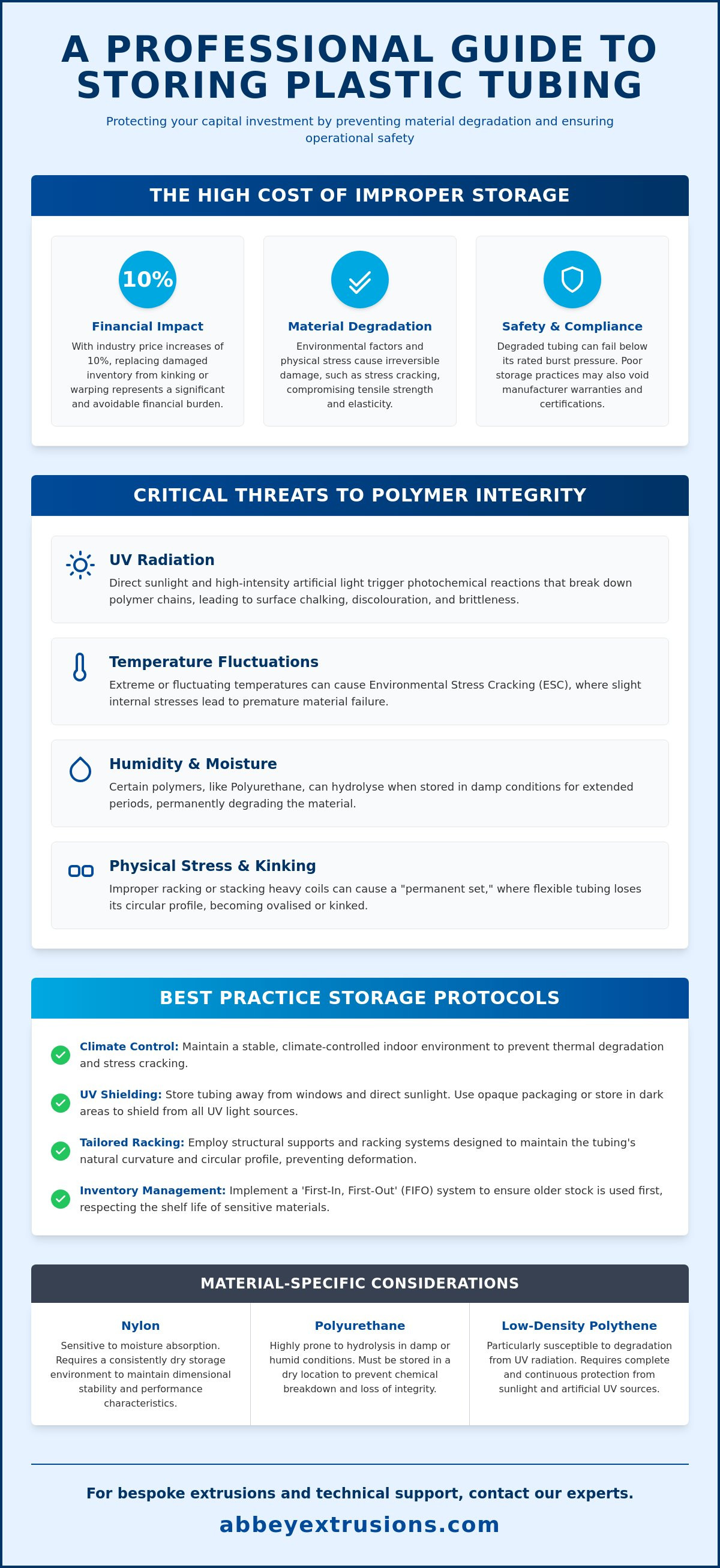
With leading manufacturers such as Charlotte Pipe and IPEX announcing price increases of 10% in early 2026, the financial burden of replacing damaged inventory has reached a critical level. You likely recognise that even the most resilient industrial polymers remain susceptible to environmental stress cracking and physical kinking when they are stored without technical precision. Adopting robust plastic tubing storage best practices is therefore no longer a secondary concern; it is a fundamental requirement for protecting your capital investment and maintaining the structural integrity of your materials.
We understand that preserving the performance characteristics of specialised materials like Nylon 11 or Polyurethane requires a methodical approach to environmental control and structural support. This article outlines a professional framework for organising an industrial warehouse to prevent both chemical and physical degradation over time. By following these protocols, you will gain the material-specific knowledge necessary to manage complex inventories whilst significantly improving the safety and efficiency of your storage facility.
Key Takeaways
- Implement essential plastic tubing storage best practices to maintain the molecular stability and tensile strength of technical extrusions during long-term warehousing.
- Identify the critical environmental controls required to shield sensitive polymers from UV radiation and temperature fluctuations that lead to stress cracking.
- Evaluate the structural benefits of tailored racking systems to prevent permanent kinking or deformation in flexible materials like Polyurethane and Nylon.
- Develop material-specific handling protocols that ensure the performance characteristics of industrial hoses remain intact from delivery to installation.
- Optimise your inventory management to reduce the risk of material loss and improve overall operational safety within the storage facility.
To discuss your specific technical requirements or to request a quotation for high-performance extrusions, please reach out to our team via the contact page.
Factors that Influence Plastic Tubing Longevity and Performance
Industrial procurement often focuses on manufacturing specifications and the final application, yet the period between delivery and installation is where many technical extrusions suffer irreversible damage. Storage is a critical phase in the product lifecycle of a plastic extrusion, rather than a passive interval of inactivity. During this time, the material remains a dynamic chemical structure. Without adhering to established plastic tubing storage best practices, the polymer can undergo subtle but destructive changes that compromise its intended function.
One of the primary concerns is Polymer degradation, a process where environmental factors trigger chemical reactions that break down long-chain molecules. This molecular breakdown directly compromises the material's tensile strength and elasticity. Whilst rigid piping possesses a degree of structural resistance, flexible tubing is significantly more susceptible to physical deformation. Under its own weight or improper racking, flexible polymers can experience "permanent set," where the tubing loses its circular profile and becomes ovalised or kinked. These physical changes are often permanent and render the product useless for precision fittings.
Environmental Degradation and Polymer Stability
Technical materials, such as a high-quality Nylon tube, are particularly sensitive to their surroundings. Ambient conditions like humidity and temperature fluctuations can lead to Environmental Stress Cracking (ESC). This phenomenon occurs when the plastic is under even slight internal stress and is exposed to specific environmental triggers. Some polymers are far more sensitive to shelf life than others. For instance, certain polyurethanes can hydrolyse if they're stored in damp conditions for extended periods. Understanding these material-specific sensitivities is the first step in implementing effective plastic tubing storage best practices.
The Hidden Costs of Poor Storage Practices
Improper handling leads to substantial financial impacts that go beyond the initial purchase price. Inventory loss from warping or kinking forces companies to absorb the cost of wasted material, which is particularly painful given the recent 10% price increases across the industry. Safety is the ultimate priority. Using degraded tubing in high-pressure applications introduces severe risks, as a pipe that has suffered molecular degradation may fail well below its rated burst pressure. Additionally, failing to follow manufacturer recommendations often voids warranties and certifications, leaving your operation vulnerable to both technical failure and legal liability.
To receive technical data sheets or to discuss bespoke extrusion profiles, you may contact our engineering department.
Environmental Controls to Prevent Polymer Degradation
Maintaining a climate-controlled warehouse is essential for preserving the technical specifications of high-performance extrusions. Without rigorous environmental oversight, even the highest grade polymers will undergo physical and chemical changes that compromise their operational safety. Adhering to plastic tubing storage best practices ensures that the material properties engineered during the extrusion process remain unchanged throughout the product's shelf life. The molecular stability of an industrial extrusion is inherently linked to its storage environment, requiring a proactive approach to facility management.
Direct sunlight represents the most significant threat to polymer integrity. Ultraviolet (UV) radiation triggers a photochemical reaction that cleaves the molecular bonds within the plastic, leading to surface chalking, discolouration, and eventual brittleness. This process is often irreversible and can significantly reduce the burst pressure rating of the tubing before it's even deployed. Shielding materials from both natural and high-intensity artificial light is a fundamental requirement for any professional storage strategy.
Shielding from Ultraviolet Light and Oxidisation
Materials such as low-density polythene tube are particularly prone to UV-induced chain scission if they aren't adequately protected. We recommend utilising black or opaque polythene wrapping for any materials intended for long term storage. Keeping tubing in its original manufacturer packaging until the moment of installation provides a secondary layer of protection against both UV exposure and atmospheric oxidisation. This practice also prevents the accumulation of dust and surface contaminants that could interfere with future fitting or welding processes.
Managing Temperature and Humidity in the Warehouse
Temperature control is equally vital for maintaining material performance. For a Polyurethane tube, excessive heat can lead to premature softening and permanent deformation, especially if the coils are stacked. Ideally, storage facilities should maintain a temperature range between 10°C and 25°C. Humidity levels must also be monitored, as certain plastics are moisture-sensitive. High humidity can trigger hydrolysis, a chemical breakdown caused by water absorption that is especially prevalent in specific polyurethane formulations. Following the PIPA guidelines for PE pipe storage provides a robust framework for managing these environmental variables effectively.
You should never store tubing near localised heat sources like heaters, boilers, or steam pipes. These hot spots can cause localised thinning of the tube wall. Proper ventilation is also necessary to prevent the accumulation of volatile organic compounds (VOCs) or ozone, both of which can accelerate the ageing process of certain synthetic rubbers and plastics. If you're unsure about the environmental tolerances of your current inventory, you can request a material compatibility consultation with our specialists to ensure your facility meets the necessary standards.
If you require assistance with warehouse layout planning or specific material handling advice, please visit our enquiry page to speak with a technical advisor.
Structural Storage Methods for Flexible and Rigid Extrusions
The physical arrangement of a storage facility plays a decisive role in preventing material fatigue and permanent deformation. Whilst previous sections addressed the chemical stability of polymers, the structural geometry of the tube must be preserved through correct racking and support. Adhering to plastic tubing storage best practices requires a nuanced understanding of how different profiles react to gravity and mechanical pressure over time. Improper support leads to "permanent set," a condition where the material loses its intended shape and cannot be returned to its original tolerances.
Horizontal storage remains the preferred method for the majority of industrial extrusions. This approach provides the most consistent support across the entire length of the product, which is vital for maintaining straightness. Custom profile extrusions, such as curtainsider pelmet sections, are particularly vulnerable to twisting or crushing. These complex shapes require dedicated shelving or bins that mirror their specific dimensions to prevent the weight of the material from compromising the profile's integrity. For smaller coiled products, using reinforced bins or industrial shelving ensures that coils remain contained and protected from external impacts.
Horizontal Racking and Cantilever Systems
Cantilever racks offer an efficient solution for long lengths, but they must be configured correctly to support flexible materials like PVC tube. A common error in warehouse management is placing support arms too far apart, which causes the tubing to sag between contact points. This sagging creates "waves" in the material that can affect fluid flow and make installation difficult. We recommend using closely spaced support arms, typically no more than 1 metre apart for flexible hoses. Additionally, installing wooden or plastic liners on metal rack arms prevents abrasion and "pressure marks" that can weaken the tube wall.
Vertical Storage and Coil Management
Vertical storage is generally reserved for very rigid, short profiles where the risk of bowing is minimal. For most industrial applications, however, vertical orientation should be avoided as it places excessive stress on the base of the extrusion. When managing coils, such as a Nylon recoil air hose, the primary objective is to prevent ovalisation. Coils should always be stored flat on a clean, level surface rather than on their edge. Storing a coil on its edge concentrates the entire weight of the material on a single point, which inevitably leads to a flattened or ovalised cross section that can interfere with pneumatic fittings. Stacking height should also be limited to prevent the bottom coils from being crushed by the weight of those above.
To request specific material compatibility data or to discuss your storage requirements with a technical specialist, please visit our contact page.
Material Specific Storage Guidelines for Technical Polymers
A uniform approach to warehousing is rarely sufficient when managing a diverse inventory of industrial extrusions. Each polymer possesses a unique chemical profile that dictates its reaction to the storage environment. Whilst standard Low Density Polyethylene (LDPE) is relatively forgiving, technical polymers require a much more disciplined approach to preserve their engineered properties. Adhering to material-specific plastic tubing storage best practices is the only way to guarantee that a Nylon tube or a fluoropolymer hose performs as intended once it's integrated into a high-pressure system. Proximity to industrial solvents or cleaning agents must be strictly avoided, as even the fumes from these chemicals can cause surface micro-cracking in sensitive materials.
Storing Nylon 11 and 12 for Optimal Performance
Nylon 11 and 12 are widely respected for their toughness and chemical resistance, yet they are inherently hygroscopic. This means they naturally absorb moisture from the surrounding atmosphere. If a Nylon extrusion is left exposed in a humid warehouse, it'll gradually absorb water, which directly affects its dimensional stability. This absorption can cause the outer diameter and wall thickness to swell, potentially leading to fitment issues with precision pneumatic couplings. To maintain consistent tolerances, we recommend keeping Nylon products in sealed polythene bags. These bags act as a vapour barrier, ensuring the material remains in its "as-manufactured" state until it's ready for deployment.
Special Considerations for Polyurethane and Fluoropolymers
A Polyurethane tube requires specific oversight to prevent microbial growth, especially when stored in warm, damp areas. Certain formulations of PU can serve as a substrate for fungi or bacteria if the surface remains moist for extended periods. This biological activity doesn't just look unsightly; it can eventually lead to surface pitting and material failure. In contrast, fluoropolymers like PTFE, FEP, and PFA offer exceptional chemical stability and are virtually immune to environmental degradation. However, these materials are physically "soft" and highly susceptible to permanent indentation. Even light pressure from a zip-tie or a sharp edge on a rack can leave a lasting mark that creates a point of turbulence in the fluid stream.
Cleanliness is another vital factor, particularly for anti-static tubing. If the surface of an anti-static hose becomes contaminated with dust or oils during storage, its ability to dissipate electrical charges may be compromised. Maintaining a clean, dust-free environment is essential for these safety-critical components. If you're managing a diverse inventory of technical polymers and require precise handling specifications, you can enquire about our material-specific storage protocols to ensure your stock remains in peak condition.
To discuss your specific logistics requirements or to enquire about our bulk handling procedures, please visit our contact page.
Professional Handling and Inventory Management Protocols
The final stage in maintaining material integrity involves the rigorous application of handling and inventory protocols. Even if a facility adheres to the environmental and structural plastic tubing storage best practices discussed previously, reckless handling during retrieval or dispatch can cause immediate and irreversible damage. Professional inventory management ensures that every product reaching the end user retains the exact performance characteristics established during the extrusion process. This requires a combination of technical awareness amongst warehouse staff and a structured approach to batch documentation.
Clear labelling and meticulous documentation are fundamental for batch traceability. In industrial applications where material failure can lead to significant downtime, knowing the precise manufacture date and resin batch is vital for quality assurance. Before any product is cleared for dispatch, it should undergo a visual inspection for surface degradation, chalking, or physical deformation. During transport, the use of protective accessories like a Nylon spiral cut hose guard provides an essential layer of defence against abrasion and external impacts, ensuring the tubing arrives in peak condition.
Safe Handling Procedures to Avoid Kinking
Staff must be trained to respect the minimum bend radius of every material in stock. Exceeding this radius during manual handling or storage can lead to kinking, which creates a permanent weak point in the tube wall. Mechanical handling also requires specialised care. You should never allow forklift tines to come into direct contact with unprotected tubing, as the sharp metal edges can easily gouge or crush the polymer. We recommend using padded slings or dedicated pallets for all movement. When unrolling a coil, it's essential to rotate the coil itself rather than pulling the material from the side, which introduces internal twists and unnecessary stress into the molecular structure.
Implementing a First In First Out Inventory System
The First In First Out (FIFO) principle is a cornerstone of professional warehouse management for technical polymers. Whilst high-quality plastics are durable, they do possess a finite shelf life, and the FIFO system ensures that the oldest stock is always utilised first. Effective labelling systems should clearly display manufacture dates, material types, and batch numbers to facilitate this process. Regular inventory rotation prevents the accumulation of "dead stock," which is material that has sat at the back of a rack for years and may have suffered from invisible ageing. By maintaining a disciplined rotation programme, you ensure that every extrusion in your facility remains within its optimal performance window.
To discuss your specific technical requirements or to request a quotation for high-performance extrusions, please reach out to our team via the contact page.
Securing Material Performance Through Professional Standards
Maintaining the structural integrity of industrial polymers requires a disciplined approach to warehouse management. By integrating rigorous environmental oversight with material-specific handling protocols, you effectively safeguard the technical specifications of your extrusions. Adhering to plastic tubing storage best practices isn't merely a logistical requirement; it's a fundamental strategy for protecting your capital investment and ensuring operational safety across your facility.
Abbey Extrusions brings over 35 years of UK manufacturing expertise to every project, specialising in bespoke tube forming and high-performance polymers. We provide a comprehensive range of Nylon, PVC, and Polyurethane solutions designed to meet the most demanding industrial standards. Contact our technical team for expert advice on plastic tubing specifications to ensure your inventory management meets the highest professional criteria. With the right protocols in place, you can remain confident in the long term reliability and performance of your technical materials.
Frequently Asked Questions
How should I store Nylon tubing to prevent it from becoming brittle
You should store Nylon tubing in sealed polythene bags to maintain its engineered moisture content. Nylon is a hygroscopic material that naturally absorbs and desorbs moisture based on its environment. If stored in very dry conditions without protection, the polymer loses its internal moisture, which leads to increased brittleness and reduced impact resistance. Keeping the material in its original packaging is a vital part of plastic tubing storage best practices for maintaining long term flexibility.
Can plastic tubing be stored outside if it is covered by a tarpaulin
We don't recommend storing technical plastic tubing outside, even if it's covered by a tarpaulin. Tarpaulins often fail to provide a complete ultraviolet barrier and can trap heat and moisture underneath, creating a micro-climate that accelerates polymer degradation. Technical extrusions require the stable, climate-controlled environment of an indoor facility to ensure their burst pressure ratings and safety certifications remain intact for industrial use.
What is the best way to prevent kinking in flexible PVC hoses during storage
The best way to prevent kinking in flexible PVC hoses is to utilise horizontal racking with closely spaced support arms. You should ensure that support points are positioned no more than one metre apart to prevent the material from sagging under its own weight. It's also essential to avoid stacking coils too high, as the cumulative weight can crush the bottom layers and cause permanent physical deformation.
How does ultraviolet light affect the performance of LDPE tubing over time
Ultraviolet light triggers a chemical process called chain scission in LDPE tubing, where high-energy radiation breaks the molecular bonds of the polymer. Over time, this results in surface chalking, discolouration, and a significant loss of tensile strength. Even relatively short exposure to direct sunlight can initiate these changes, making the use of opaque storage covers or black polythene wrapping essential for protecting your inventory.
How long can technical plastic tubing be stored before it is considered unsafe
Most technical plastic tubing can be stored for two to five years, provided that the facility adheres to professional plastic tubing storage best practices. However, you must always consult the specific manufacturer data sheets, as certain high-performance polymers or anti-static materials may have shorter shelf lives. Implementing a disciplined First In First Out system ensures that no stock exceeds its safe operational window before dispatch.
What is the ideal temperature range for a plastic tubing storage facility
The ideal temperature range for a plastic tubing storage facility is between 10°C and 25°C. Maintaining this consistent range prevents the premature softening of materials like Polyurethane and reduces the risk of thermal expansion cycles. You should always position your racking systems away from localised heat sources such as industrial heaters, boilers, or steam pipes to avoid localised thinning of the tube walls.
Should I store tubing coils horizontally or vertically to maintain their shape
You should store tubing coils horizontally and flat on a level surface to maintain their circular profile and prevent ovalisation. Vertical storage is generally unsuitable for flexible extrusions because it causes the material to bow or slump under the force of gravity. Storing a coil on its edge concentrates the entire weight on a single contact point, which inevitably leads to permanent kinking or structural weakness.
Does Polyurethane tubing have a specific shelf life in humid environments
Polyurethane tubing is highly susceptible to hydrolysis in humid environments, where moisture absorption causes a chemical breakdown of the polymer chains. This process is often accelerated in temperatures above 25°C and can lead to a total loss of mechanical properties over several months. In damp conditions, certain formulations may also support microbial growth, which results in surface pitting and eventual material failure if not monitored.

Article by
Bryan Cowan
Bryan Cowan is the Founder and Managing Director of Abbey Extrusions Ltd, a leading UK manufacturer of high-quality plastic tubes and hoses. With over 40 years of industry experience, Bryan established the company in 1985, growing it from a startup into a BS ISO9001-registered supplier for global sectors including aerospace, automotive, and pharmaceuticals.
Disclaimer
This article is intended for informational purposes only. Please ensure you seek expert advice or carry out your own research to confirm the information is suitable for your specific needs.