The integrity of an entire industrial air system often rests on a component measuring just a few millimetres in diameter. When a production line halts unexpectedly, the culprit is rarely the heavy machinery itself but rather a failure at the connection point. Choosing the correct flexible tubing for pneumatic fittings is the most effective way to prevent costly downtime caused by leaks or kinking in tight radiuses. We recognise that for engineers and maintenance managers, a secure seal is not merely a preference; it is a fundamental requirement for operational safety and efficiency.
This technical guide offers a comprehensive overview of polymer selection to help you identify the ideal material for your specific environment. We will compare the mechanical properties of Nylon, Polyurethane, and Polyethylene, whilst providing insights into ensuring technical traceability and long term reliability. By understanding how different materials behave under pressure and within harsh chemical conditions, you can secure a leak free system that meets the rigorous demands of modern manufacturing.
Key Takeaways
- Understand the distinct mechanical advantages of Nylon, Polyurethane, and Polyethylene to match your tubing to the specific demands of your pneumatic system.
- Learn how to select the correct flexible tubing for pneumatic fittings to prevent system failure, ensuring a secure and leak-free connection under constant industrial pressure.
- Master the relationship between wall thickness and burst pressure, including the standard safety factors required to maintain operational integrity whilst in use.
- Identify the appropriate polymer for harsh environments, including considerations for chemical resistance and visual flow monitoring through material transparency.
- Discover the benefits of technical traceability and consistent quality control that come from sourcing directly from a specialist UK manufacturer.
To ensure your industrial air systems operate at peak efficiency with the correct material specifications, you can speak with our technical team for bespoke advice and support.
Flexible Tubing for Pneumatic Fittings and Industrial Systems
In the field of industrial automation, flexible tubing for pneumatic fittings serves as the critical conduit that delivers compressed air to actuators, valves, and tools. Whilst the main distribution headers of an air system often consist of rigid piping, the final connection points require a high degree of versatility. These lines must maintain their structural integrity whilst under constant pressure, often reaching 10 bar or higher in standard workshop applications. A failure in the tubing wall or a breach at the fitting interface can lead to immediate system depressurisation, resulting in safety hazards and expensive downtime.
Precision is the hallmark of a reliable installation. With the global Pneumatics tool market valued at USD 9.61 billion in 2025, the scale of industrial reliance on these systems is immense. One often overlooked factor in system failure is the precise outer diameter (OD) measurement of the tube. Modern push-in fittings rely on an airtight seal against the outer surface, meaning even a minor deviation in manufacturing tolerances can lead to persistent leaks. Whether using standard 4mm or 12mm lines, maintaining rigorous dimensional control is essential. Different polymers, such as Nylon tube or Polyurethane tube, offer varying levels of flexibility and chemical resistance, making the initial material selection a vital engineering decision.
The Role of Flexible Tubing in Pneumatic Circuits
The transition from rigid distribution piping to flexible lines is essential for any system involving motion. In applications such as robotic arms or reciprocating actuators, the tubing must bend and flex thousands of times per shift. Standard rigid pipes would simply crack under these conditions. Choosing a material that does not suffer from stress cracking or fatigue under repetitive motion is paramount. This flexibility allows for compact machine designs where space is limited, enabling air to be routed through tight radiuses without restricting flow or causing performance drops.
How Tubing Interacts with Modern Pneumatic Fittings
The mechanics of a secure connection depend heavily on the type of fitting used. Push-in fittings are the industry standard for speed and ease of use, employing an internal grab ring that bites into the tube surface. Selecting the right flexible tubing for pneumatic fittings is not just about size, but also about the compatibility between the polymer and the fitting mechanism. For this connection to be secure, the tubing must possess the correct surface hardness. If the material is too soft, the ring may tear the outer jacket; if it is too hard, the fitting cannot gain sufficient purchase. In high-vibration environments, compression fittings are often preferred as they provide a mechanical lock. In both cases, the consistency of the tubing wall ensures that the fitting remains leak-free throughout its service life.
For detailed technical specifications or to request material samples for your specific application, you may contact our specialist engineering team for expert guidance.
Key Materials for Pneumatic Tubing and Their Properties
The performance of any pneumatic circuit is fundamentally dictated by the polymer selection of its conduits. Selecting the correct Key Materials for Pneumatic Tubing involves balancing pressure requirements, environmental exposure, and the mechanical demands of the application. Material purity remains a critical factor for consistent performance across long production runs; impurities in the resin can lead to weak spots in the tube wall, resulting in premature failure under pressure. Beyond the base resin, specific additives are often used to enhance UV resistance for outdoor use or to provide anti-static properties in sensitive electronic assembly environments.
Nylon 11 and 12 Tubing for High Pressure Stability
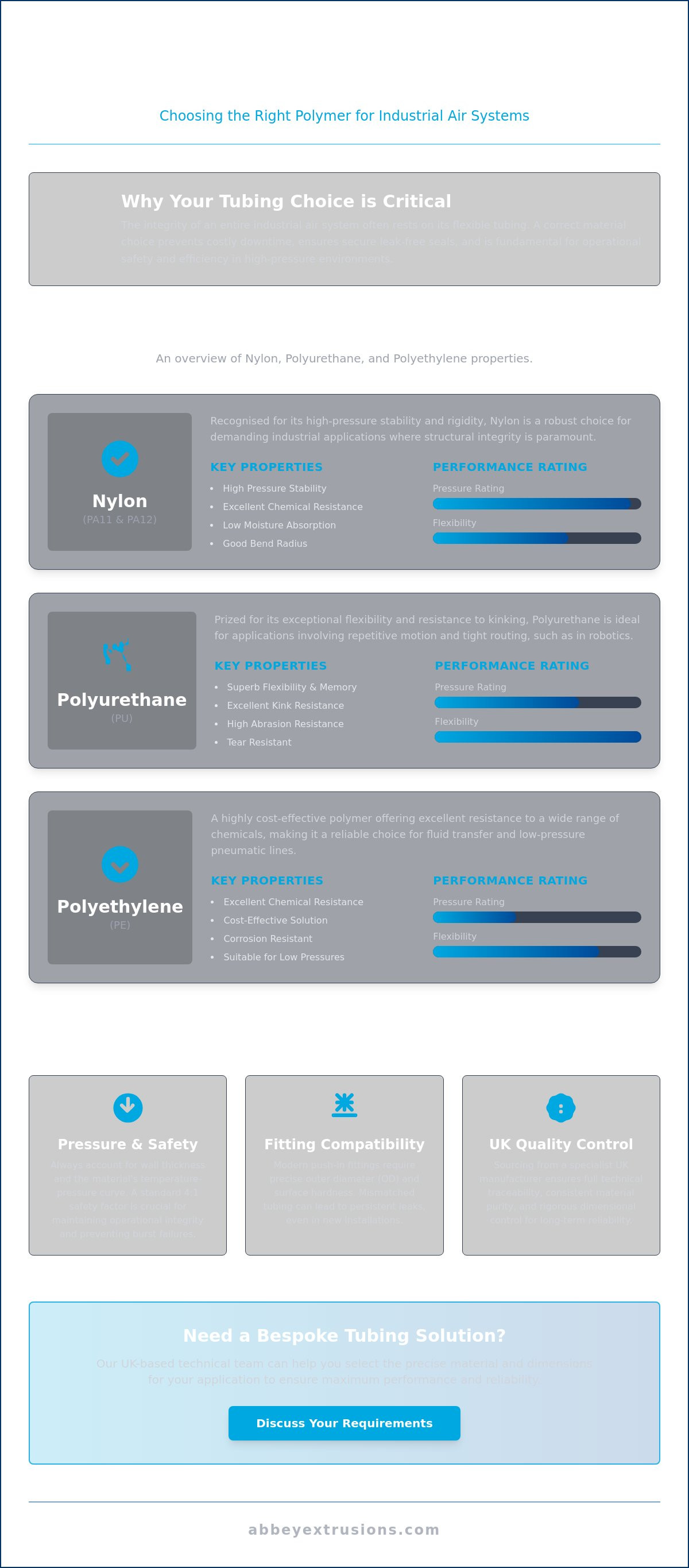
Nylon tube is recognised as the industry standard for high-pressure pneumatic systems due to its excellent dimensional stability and tensile strength. Whilst both Nylon 11 and Nylon 12 provide high performance, Nylon 12 is often preferred for its lower moisture absorption, which ensures the tubing maintains its precise outer diameter in humid conditions. This stability is vital for maintaining a secure seal when using flexible tubing for pneumatic fittings. For those requiring deeper technical data on stress-strain curves and chemical compatibility, our nylon tubing properties guide provides a comprehensive breakdown.
Polyurethane Tubing for Flexibility and Kink Resistance
Where tight routing is required, Polyurethane tube offers superior flexibility compared to semi-rigid nylons. PU is the favourite choice for pneumatic tools and moving machinery because it resists kinking even when bent around small radiuses. Its excellent abrasion resistance makes it ideal for environments where the tubing may rub against machine frames or floor surfaces whilst under mechanical stress. This resilience ensures that the flexible tubing for pneumatic fittings remains intact despite constant movement and external friction.
Low Density Polyethylene Options for Cost Effective Air Lines
For applications where cost-efficiency is a priority without sacrificing performance, Low-Density Polythene Tube serves as a versatile and economical solution. LDPE is prized for its chemical inertness, making it suitable for low-pressure pneumatic logic circuits or environments where exposure to corrosive agents is a concern. It provides a balanced middle ground between flexibility and rigidity amongst other polymers, ensuring ease of installation in static air lines. If you're unsure which material fits your budget and technical needs, you can reach out for a consultation with our technical staff.
To ensure your pneumatic system meets the highest safety and performance standards, you can speak with our technical consultants for specific pressure rating advice.
Pressure Ratings and Temperature Performance for Pneumatic Lines
Selecting the correct flexible tubing for pneumatic fittings requires a deep understanding of how physical dimensions influence pressure thresholds. The relationship between wall thickness, outer diameter, and burst pressure is a fundamental engineering principle. A tube with a thicker wall relative to its diameter will naturally withstand higher internal forces. However, as the outer diameter increases, the surface area exposed to internal pressure also grows, which necessitates a proportional increase in wall thickness to maintain the same rating. We calculate these performance metrics at a controlled standard temperature of 20 degrees Celsius, but engineers must account for real-world fluctuations that deviate from this baseline.
The safety of your workforce and the reliability of your machinery depend on these calculations. It's a common mistake to assume that a tube's ambient pressure rating applies across all environments. In reality, the physical properties of polymers change significantly when exposed to thermal stress. A failure to account for these changes is a primary cause of unexpected system failure. By applying rigorous safety margins and understanding material limits, you can prevent the costly consequences of a line failure whilst maintaining peak operational efficiency.
Understanding Working Pressures and Safety Factors
Working pressure is the maximum force a tube can safely handle during continuous operation, whilst burst pressure represents the point of catastrophic failure. In the UK manufacturing sector, we typically apply a safety factor of 3 to 1 or 4 to 1 to account for pressure spikes and material fatigue. For instance, if your compressor delivers 8 bar, your tubing should ideally be rated for a burst pressure of at least 32 bar. This margin of safety is critical for compliance with OSHA standards for compressed air and other international safety protocols. Choosing a tube that comfortably exceeds your system's maximum pressure ensures longevity and prevents the risk of sudden depressurisation.
The Impact of Temperature on Pneumatic Tubing Integrity
Ambient heat drastically alters the mechanical behaviour of polymer conduits. As temperatures rise above the 20 degree Celsius mark, the tensile strength of the material begins to decline. This softening of the polymer can lead to tube expansion, which compromises the grip of the fitting and may result in a blow-out. Whilst Nylon tube retains its structural rigidity at higher temperatures better than many alternatives, Polyurethane tube is more susceptible to softening. In extreme heat zones, such as those near industrial ovens or heavy engines, the use of heat shields or specialist fluoropolymer materials is essential. Conversely, extreme cold can make some polymers brittle, increasing the risk of cracking under vibration. Understanding these thermal limits is vital for maintaining a secure connection with your flexible tubing for pneumatic fittings amongst the varied conditions of a modern factory floor.
If your operations require specific material certifications or technical advice on chemical compatibility, please enquire with our engineering team for a tailored solution.
Selecting Specialist Tubing for Demanding Industrial Environments
Standard pneumatic applications are well-served by Nylon or PU, but specialist sectors face unique challenges that demand more resilient solutions. Environmental factors such as oil mist, ozone exposure, or aggressive cleaning agents can degrade standard polymers over time, leading to embrittlement or swelling. Material transparency is often a fundamental requirement in these settings, as it allows maintenance teams to monitor for internal condensation or contaminants without dismantling the system. When organising a pneumatic installation, selecting the correct flexible tubing for pneumatic fittings involves assessing the chemical landscape of the entire facility to ensure long-term reliability.
Protective measures are equally vital for the longevity of an air system. In environments where lines are exposed to sharp edges or heavy foot traffic, simple conduits may not suffice. Introducing protective sleeving or bundling multiple lines together can significantly reduce the risk of puncture. This approach not only protects the individual tubes but also keeps the workspace organised and reduces the likelihood of trip hazards. By considering these environmental variables during the design phase, you can prevent many of the common failure points associated with industrial air transport.
Chemical Resistance and Fluoropolymer Solutions
For systems exposed to aggressive solvents or corrosive vapours, standard Nylon or PU conduits will quickly lose their structural integrity. Fluoropolymers such as PTFE and FEP are the necessary choice for these demanding environments. These materials possess near-total chemical inertness, ensuring they don't react with the fluids or gases they transport. Before selecting a tube, engineers should consult chemical compatibility charts to verify that the polymer can withstand the specific acids or alkalis present in the workspace. Using the wrong material often results in pinhole leaks or catastrophic wall failure, which can be avoided through precise material specification.
Anti Static and Food Grade Requirements for Specialized Sectors
In explosive atmospheres or electronics assembly lines, the buildup of static electricity presents a significant risk. Anti-static tubing is engineered to dissipate these charges safely, preventing sparks that could ignite volatile vapours or damage sensitive components. Similarly, the food and beverage industry requires materials that meet stringent hygiene standards. A brewery hose, for example, is designed to transport fluids without imparting taste or odour whilst resisting the hot water used in cleaning cycles. To protect these specialized lines from external mechanical damage, we recommend using a Nylon spiral cut hose guard. This allows multiple pneumatic lines to be bundled together, providing a layer of protection against abrasion whilst maintaining the flexibility required for routing flexible tubing for pneumatic fittings through complex machinery.
To ensure your specialist installation meets all regulatory and safety requirements, reach out to us today for a technical consultation.
To discuss your specific manufacturing requirements or to request a technical quote, please get in touch with our specialist team.
Sourcing High Performance Pneumatic Tubing from UK Manufacturers
The decision to source flexible tubing for pneumatic fittings from a domestic manufacturer offers significant advantages in terms of technical accountability and supply chain security. Whilst global distributors focus on high volume standardisation, a specialist UK manufacturer like Abbey Extrusions provides the agility required for bespoke industrial projects. We maintain rigorous control over the entire production cycle, from raw resin selection to the final extrusion profile. This level of oversight ensures that every metre of tubing meets the precise tolerances required for high stakes automation, where even a fraction of a millimetre in diameter variation can compromise a push-in fitting.
Direct collaboration with a manufacturer also allows for the customisation of colours and sizes to suit specific machinery and branding requirements. This is particularly useful for complex systems where colour coding is used to identify different air pressures or logic circuits. Our collective expertise is available to help solve complex routing challenges, ensuring that the selected polymer and profile are perfectly matched to the operational environment.
Bespoke Extrusion and Tube Forming Services
Beyond standard reels, our tube forming services represent a sophisticated solution for complex pneumatic layouts. By creating permanent, heat-set bends in the tubing, we allow engineers to route air lines through tight spaces without the risk of kinking. This technique significantly reduces the number of elbow fittings required within a circuit. Fewer fittings mean fewer potential leak points. This directly translates to improved system reliability and reduced maintenance costs. We can also develop bespoke extrusions that combine multiple pneumatic channels into a single profile, simplifying the installation process for intricate machinery amongst varied industrial sectors.
Quality Assurance and Material Traceability in the UK
Adhering to British Standards and maintaining full material traceability is a hallmark of our manufacturing process. In high performance pneumatic systems, consistency is the primary safeguard against failure. Variations in wall thickness or surface finish, often found in lower quality imports, are the leading causes of fitting blow-outs and pressure drops. By organising our production around strict quality management protocols, we ensure that our flexible tubing for pneumatic fittings performs reliably under constant mechanical stress. We encourage our partners to consult with our technical experts during the design phase to identify the most efficient material and profile for their specific automation projects, ensuring a solution that is both technically sound and commercially viable.
To request a technical consultation regarding your system requirements, please speak with our manufacturing specialists for professional support.
Optimising Your Pneumatic System Performance
Selecting the right flexible tubing for pneumatic fittings is a technical decision that directly impacts the safety and efficiency of your production environment. Throughout this guide, we have explored how the mechanical properties of Nylon, PU, and LDPE dictate their performance under various pressures and temperatures. It's clear that maintaining a leak free connection requires a precise match between the polymer choice and the specific demands of your machinery. By prioritising technical traceability and manufacturing precision, you can significantly reduce the risk of unexpected system failure and costly industrial downtime.
As a specialist UK manufacturer since 1985, we provide a comprehensive range of Nylon 11 and 12, PU, and LDPE tubing designed for rigorous use. Our capabilities extend to bespoke tube forming and custom extrusion services, allowing us to solve even the most complex routing challenges with engineering precision. To discuss your specific technical requirements for pneumatic tubing, please contact our expert manufacturing team for professional advice. We look forward to supporting your next automation project with reliable, high quality components.
Frequently Asked Questions
Can I use any flexible tubing with push-in pneumatic fittings
No, you cannot use any material. Push-in fittings rely on precise outer diameter (OD) tolerances to create an airtight seal. If the tubing is too soft, the internal grab ring may damage the surface; if it is too hard, the fitting cannot gain a secure grip. Selecting high quality flexible tubing for pneumatic fittings ensures that the dimensions remain consistent, preventing leaks and unexpected blow-outs.
What is the difference between Nylon 11 and Nylon 12 for pneumatic use
Nylon 12 is generally preferred for its superior dimensional stability and lower moisture absorption compared to Nylon 11. Whilst Nylon 11 is sourced from renewable materials and offers slightly better impact resistance, Nylon 12 maintains its shape and size more effectively in humid environments. This stability makes it more reliable for maintaining a consistent seal within pneumatic circuits over long periods of operation.
How do I calculate the correct tube size for my pneumatic fittings
You must always match the outer diameter (OD) of the tube to the size of the fitting. For instance, a 6mm push-in fitting requires a tube with an exact 6mm OD. Whilst the internal diameter (ID) is important for calculating air flow and pressure drop, it does not affect the security of the fitting connection. Always verify the manufacturer's tolerances to ensure a leak-free interface.
Is Polyurethane tubing better than Nylon for moving parts
Polyurethane is the superior choice for applications involving constant movement or tight routing. Its high flexibility and excellent kink resistance allow it to bend around small radiuses without restricting airflow. Whilst Nylon is better for high-pressure static lines, PU is the favourite for pneumatic tools and robotic actuators where the tubing is subject to repetitive mechanical stress and vibration.
What happens to pneumatic tubing if the temperature exceeds 60 degrees
Standard polymer tubing begins to soften significantly as temperatures rise, which leads to a dramatic reduction in its pressure handling capacity. If the temperature exceeds 60 degrees Celsius, the material may expand, causing it to slip out of the fitting or even burst under standard operating pressures. In these environments, it's essential to use specialist fluoropolymers or apply appropriate heat shielding to protect the lines.
Why is my pneumatic tubing kinking and how can I prevent it
Kinking occurs when the tubing is forced into a bend radius that is smaller than its mechanical limit. To prevent this, you should select a more flexible material like Polyurethane or increase the bend radius of your routing. Alternatively, professional tube forming can create permanent, heat-set bends that allow for tight turns without compromising the structural integrity of the flexible tubing for pneumatic fittings.
Do I need anti-static tubing for my pneumatic system
Anti-static tubing is required if your system operates amongst volatile vapours or sensitive electronic components. Standard plastic tubing can generate significant static charges as air flows through it, which may lead to sparks in explosive atmospheres or damage to microchips. Using conductive or dissipative materials ensures these charges are safely earthed, maintaining a secure and compliant work environment.
How does tube forming help in pneumatic system design
Tube forming allows for the creation of permanent, pre-set bends in your pneumatic lines, which simplifies the assembly of complex machinery. By using pre-formed sections, you can eliminate the need for numerous elbow fittings. This reduces the number of potential leak points in your system and ensures a cleaner, more organised layout whilst maintaining consistent pressure throughout the pneumatic circuit.

Article by
Bryan Cowan
Bryan Cowan is the Founder and Managing Director of Abbey Extrusions Ltd, a leading UK manufacturer of high-quality plastic tubes and hoses. With over 40 years of industry experience, Bryan established the company in 1985, growing it from a startup into a BS ISO9001-registered supplier for global sectors including aerospace, automotive, and pharmaceuticals.
Disclaimer
This article is intended for informational purposes only. Please ensure you seek expert advice or carry out your own research to confirm the information is suitable for your specific needs.