With the global price of rubber rising by more than 40% between 2025 and 2026, the financial impact of premature component failure has never been more severe, making extending the service life of industrial hoses a critical priority for facility managers. We recognise that frequent production downtime caused by hose leaks and the high costs of replacing specialist tubing represent a constant challenge for modern manufacturing operations. Uncertainty regarding chemical compatibility often compounds these issues, leading to avoidable safety risks and budgetary strain.
This article provides professional strategies to maximise the durability and performance of your hosing through meticulous material selection and the implementation of clear maintenance protocols. We'll demonstrate how aligning technical specifications with specific environmental demands can reduce operational costs and improve safety standards across your facility. This guide offers a structured approach to ensuring your industrial components withstand the rigours of daily service whilst maintaining peak performance.
Key Takeaways
- Understand how selecting high performance polymers like Nylon 11 or 12 provides a technical foundation for extending the service life of industrial hoses in demanding environments.
- Identify the primary environmental catalysts, including UV radiation and ozone concentration, that lead to polymer degradation and premature component failure.
- Discover how to implement a formalised inspection and documentation schedule to transition from reactive repairs to proactive, predictive maintenance.
- Learn the importance of secondary protection layers and correct routing techniques to shield hosing from external mechanical damage and unnecessary tension.
- Recognise how precision extrusion and material purity ensure consistent wall thickness and pressure ratings to prevent the development of operational weak points.
If you require technical assistance in selecting the most durable components for your specific facility requirements, please reach out to our engineering team for a detailed consultation.
Factors affecting the service life of industrial hoses
In a professional manufacturing context, we define the service life of an industrial hose as the specific duration during which the component retains its full structural integrity and safety margins whilst operating within its designed parameters. Extending the service life of industrial hoses requires a deep understanding of the various stressors that degrade polymer chains over time. When a hose is pushed beyond its technical limits, the result is often a catastrophic failure that compromises facility safety and production schedules.
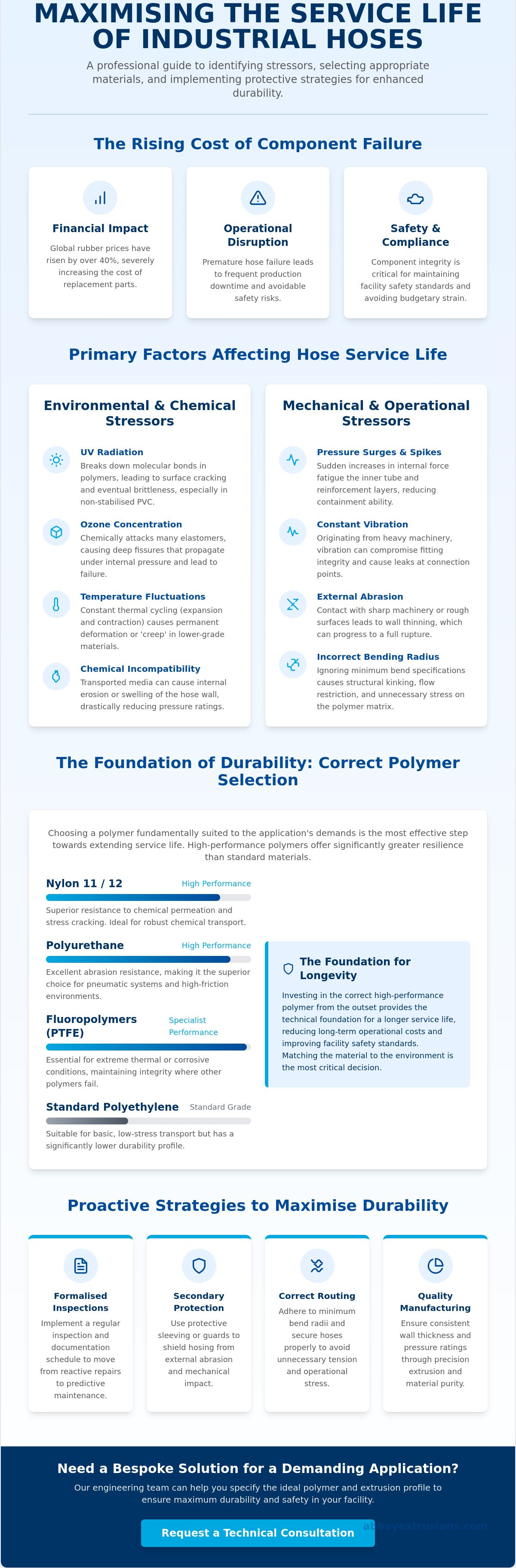
Primary environmental catalysts such as UV exposure and ozone concentration act as silent degraders of plastic and rubber materials. UV radiation provides the energy required to break down molecular bonds, leading to surface cracking and eventual brittleness. Similarly, ozone attacks the chemical structure of many elastomers, causing deep fissures that propagate under pressure. Temperature fluctuations also play a significant role in longevity. Constant thermal cycling forces the molecular structure of flexible tubing to expand and contract, which can lead to permanent deformation or "creep" in lower grade materials. Pressure surges and spikes are particularly damaging. These sudden increases in internal force fatigue the inner tube and reinforcement layers, eventually causing the hose to lose its ability to contain the medium safely. A thorough understanding of Hose construction and materials is essential for extending the service life of industrial hoses and anticipating these failure modes before they occur.
Environmental and chemical stressors
UV radiation causes significant brittleness in standard PVC tube if it lacks the necessary stabilisers, whereas high grade polymers are engineered to resist such degradation. Chemical compatibility is equally vital. If the transported medium is incompatible with the hose lining, it can lead to internal erosion or swelling of the hose wall, which drastically reduces pressure ratings. Additionally, ambient moisture and humidity can affect certain polyurethane tube variants through a process called hydrolysis, which weakens the material's physical properties over time.
Mechanical wear and operational dynamics
Mechanical factors often accelerate the end of a hose's useful life. Constant vibration from heavy machinery can compromise fitting integrity and lead to leaks at the connection points. External abrasion is another common issue, where contact with sharp machinery surfaces leads to wall thinning and eventual rupture. We also emphasise the importance of adhering to minimum bend radii. Ignoring these specifications causes structural kinking and flow restriction, which puts unnecessary stress on the polymer matrix and the reinforcement layers. Proper routing is the only way to avoid these mechanical pitfalls.
To ensure your facility meets the highest safety standards, you can speak with our technical consultants about bespoke material specifications.
Selecting the correct polymer for application longevity
The process of extending the service life of industrial hoses begins long before installation. It starts at the material specification stage. Selecting a polymer that is fundamentally suited to the chemical, thermal, and mechanical demands of the application ensures that the system maintains its performance over a longer duration. Whilst standard polyethylene is often used for basic transport, its durability profile is significantly lower than that of advanced engineering plastics. By choosing the correct material for the task, you are taking the most effective step toward extending the service life of industrial hoses in your facility.
When we compare Nylon 11 and 12 against standard polyethylene for chemical transport, the differences in resilience are clear. Nylon provides a much higher level of resistance to stress cracking and chemical permeation. Similarly, the abrasion resistance of polyurethane tubing makes it the superior choice in pneumatic or high-friction settings where standard rubber would quickly degrade. For those operating in extreme thermal or corrosive conditions, fluoropolymers like PTFE are essential. These materials maintain their structural integrity at temperatures that would cause other plastics to melt or become brittle.
Nylon 11 and 12 for chemical and thermal stability
The Nylon tube is recognised for its superior dimensional stability across varied industrial climates. This characteristic is vital for maintaining tight tolerances in precision systems. Nylon 12, specifically, is prized for its exceptionally low moisture absorption rates. This property prevents hydrolytic degradation, which is a common cause of failure in environments with high humidity. In applications such as engine bays, we often incorporate heat stabilisers into the polymer matrix. These additives prevent the molecular breakdown that occurs when tubing is exposed to constant radiant heat. Adhering to these high material standards helps facilities remain compliant with OSHA inspection and maintenance standards by reducing the frequency of component failure.
Polyurethane and PVC for flexibility and resistance
For applications requiring extreme flexibility and high tear strength, polyurethane tube offers a distinct advantage over standard rubber. It withstands repetitive flexing without developing fatigue cracks. In contrast, reinforced PVC tube provides a cost-effective yet durable solution for general water and air transport. The reinforcement layer allows for higher pressure ratings whilst the PVC remains lightweight. Clear PVC variants are particularly useful because they allow for the visual inspection of fluid flow. This visibility enables operators to detect contamination or air bubbles early, preventing downstream damage to sensitive equipment. If you are uncertain which polymer best suits your operational parameters, our team can provide a technical assessment to help you make an informed decision.
If you require a technical audit of your current hosing systems, please speak with our engineering team.
Implementing a rigorous inspection and maintenance schedule
A proactive approach to maintenance is the most effective method for extending the service life of industrial hoses. We recommend that facilities move away from reactive repairs and instead establish a formalised schedule for visual and physical assessments. This structured oversight ensures that potential failure points are identified before they lead to costly downtime. Precise records are vital. Accurate documentation of hose age and the exact installation date is critical for this process. Without these records, predictive maintenance remains impossible, as operators cannot accurately track the fatigue life of their components.
Maintenance teams must pay close attention to fitting torque and connection security, especially amongst moving machinery parts where vibration is constant. Loose fittings allow for microscopic movements that eventually erode the sealing surfaces. It is also vital to understand that the outer cover doesn't always tell the whole story. Internal degradation, such as tube swelling or reinforcement separation, may not be immediately visible. Adhering to federal regulations for hose assemblies provides a robust baseline for safety, ensuring that pressure ratings and burst pressures are monitored according to professional standards.
A step by step inspection protocol
We suggest following a methodical four step protocol during every scheduled check to maintain operational integrity.
- Step 1 Conduct a thorough visual check for surface abrasions, cracks, or discolouration, which often indicate UV damage or ozone attack.
- Step 2 Inspect all fittings for signs of leakage, corrosion, or movement whilst the system is under operational pressure.
- Step 3 Evaluate the routing to identify kinks or areas where the minimum bend radius has been exceeded, as this causes structural fatigue.
- Step 4 Perform a tactile check by running a gloved hand along the length to feel for soft spots or localised hardening of the polymer wall.
Establishing replacement intervals based on duty cycles
Not all hosing requires the same frequency of replacement. We advise categorising components into high risk and low risk zones based on their operating pressure and temperature. High pressure lines or those carrying corrosive chemicals require more frequent intervention than a standard low density polythene tube used for basic pneumatic transport. By analysing historical failure data, facilities can refine their replacement windows to match the actual duty cycle of the equipment. Implementing a "replace before failure" policy for critical production lines is an essential business norm that prevents catastrophic losses and maintains high safety standards.
For professional guidance on selecting the right protective accessories for your facility, contact our technical team today.
Physical protection and proper storage techniques
Physical protection is a critical yet often overlooked component of industrial maintenance. Whilst material selection provides the technical foundation, physical barriers preserve that integrity against the harsh realities of the factory floor. Secondary protection layers shield hoses from external mechanical damage such as dragging, impact, or constant friction against sharp edges. Proper routing is equally essential. By using professional clamps and supports, you prevent unnecessary tension and twisting that can lead to internal layer separation. We also advise maintaining a safe distance from heat sources and electrical equipment whilst hoses are in use. Radiant heat significantly accelerates polymer oxidation, leading to premature failure and safety risks.
Extending the service life of industrial hoses requires a holistic view of the component's environment. Vibration isolation is another factor to consider, as constant movement can fatigue both the hose and its connections. By organising the layout of your hosing systems, you reduce the likelihood of accidental damage from passing machinery or foot traffic. These simple mechanical adjustments often yield the most significant returns on durability and operational uptime.
Using spiral cut hose guards to prevent abrasion
A Nylon spiral cut hose guard serves as a sacrificial wear layer. It absorbs the friction and impact that would otherwise thin the hose wall and compromise its pressure rating. These guards are particularly efficient because they allow for retrofitting to existing assemblies without the need to disconnect fittings or shut down systems. They also facilitate the bundling of multiple tubes within a single guard. This organises routing and significantly reduces the risk of individual lines snagging on moving machinery parts.
Storage conditions to prevent polymer degradation
Spare inventory must be managed with precision to ensure that hoses are ready for service when needed. Extending the service life of industrial hoses includes protecting them before they ever enter the production line. We recommend storing tubing in cool, dry, and dark environments to maintain original material properties. For instance, low density polythene tube is susceptible to UV degradation and should be kept away from direct sunlight and fluorescent lighting. When coiling hoses for storage, ensure the diameter is large enough to avoid a "permanent set" or internal stress on the reinforcement layers. Proper shelving prevents the weight of stacked hoses from crushing those at the bottom.
You can order custom lengths of protective guards to match your existing hose assemblies and enhance your facility's safety standards.
To discuss how our manufacturing processes can support your facility's operational goals, please consult our technical department regarding your specific requirements.
The role of high quality manufacturing in hose durability
Manufacturing excellence is the foundation upon which all maintenance and protection strategies are built. Without a high quality product as the starting point, even the most rigorous inspection protocols will fail to prevent premature degradation. Precision extrusion is the technical process that ensures consistent wall thickness and pressure ratings across the entire length of the component. This uniformity is essential for extending the service life of industrial hoses, as any deviation in wall thickness creates a localised weak point where stress concentrates and failures occur.
Material purity is another pillar of durability. We ensure that only high grade resins are used in our production lines to prevent the inclusions that lead to bursting under pressure. Sourcing from a UK manufacturer provides significant advantages in terms of material traceability and direct technical support. This relationship allows engineers to verify that the tubing meets the exact specifications required for their application. Bespoke profiles can also be engineered to meet the unique stressors of a specific facility, providing a level of performance that mass produced alternatives cannot match.
Precision extrusion and material integrity
The technical process of maintaining tight tolerances during the extrusion of high performance polymers requires sophisticated equipment and decades of experience. We maintain rigorous production standards to ensure that every batch of tubing meets its designed parameters. This consistency is vital for systems where flow rates and pressure stability are critical. The external surface finish of the tubing is also a key factor in its wear characteristics. A superior finish reduces friction against machinery parts, whilst a precise molecular structure prevents the hardening that leads to cracks. By focusing on these technical details, we provide a product that's inherently more resilient to the operational environment.
Bespoke tube forming for stress reduction
One of the most effective ways to reduce mechanical fatigue is through professional tube forming. This process creates pre-shaped bends that eliminate the installation tension often found in standard assemblies. When a straight hose is forced into a tight radius, the outer wall is under constant stress whilst the inner wall is compressed. Pre-formed tubes sit naturally within the machinery, which eliminates this internal tension and prevents kinking. This is particularly beneficial in repetitive motion applications where the tubing must flex thousands of times per day. Using custom profiles tailored to specific spatial constraints ensures that the hose remains within its safe operating limits, significantly extending the service life of industrial hoses in complex environments.
If you're looking for a technical partner to assist with your material specifications, please contact our specialist team.
Optimising your facility's long term operational efficiency
Achieving longevity in industrial systems requires a disciplined approach that integrates superior material selection with rigorous maintenance and mechanical protection. By prioritising high performance polymers like Nylon 11 and 12 and implementing structured inspection protocols, you've taken the primary steps toward extending the service life of industrial hoses within your facility. These strategies don't just prevent failure. They provide the technical stability needed for consistent production and improved safety standards.
As a specialist UK manufacturer since 1985, we provide the engineering expertise required to solve complex hosing challenges. We specialise in high performance Nylon 11 and 12, offering custom tube forming and precision extrusion services tailored to your unique stressors. If you require expert advice on selecting the most durable tubing for your facility, please reach out via our contact page. We look forward to helping you build a safer and more efficient production environment.
Frequently Asked Questions
How long do industrial hoses typically last
Industrial hose longevity is highly dependent on the operational environment and the specific media being transported. Whilst some low pressure air lines can last up to ten years, high pressure hydraulic or chemical hoses may require replacement every one to two years to maintain safety margins. We recommend consulting the manufacturer's specific fatigue life data and adhering to established industry standards for your particular application.
What are the most common causes of industrial hose failure
The primary causes of failure include external abrasion, internal chemical erosion, and exceeding the minimum bend radius. Mechanical stress from improper routing often leads to kinking, which fatigues the reinforcement layers. Environmental factors like UV exposure and ozone concentration also play a significant role in degrading the polymer structure over time, leading to brittleness and eventual rupture.
How can I tell if a hose needs replacing before it leaks
You can identify a failing hose by checking for surface discolouration, fine cracks in the outer cover, or localised soft spots. Hardening of the polymer wall often indicates that the plasticisers have leached out, making the hose brittle and prone to bursting under pressure. Regular tactile inspections are the most effective way of extending the service life of industrial hoses by catching these issues early.
Does temperature really affect the life of plastic tubing
Temperature has a direct impact on the molecular stability and flexibility of plastic tubing. Operating at the upper limit of a material's thermal range will soften the polymer and reduce its pressure rating, whilst extreme cold can make it susceptible to impact damage. Constant thermal cycling leads to material fatigue and can cause permanent deformation or "creep" in the tubing wall.
What is the best way to store spare industrial hoses
The best way to store spare hosing is in a cool, dry, and dark environment away from direct sunlight and ozone sources like electric motors. Hoses should be stored in large coils to prevent internal stress and kept on flat shelves rather than being hung from hooks. Proper storage prevents the shelf life degradation that occurs when polymers are exposed to UV radiation or fluctuating temperatures.
Should I use a hose guard for all my pneumatic lines
Whilst not essential for every application, we recommend using hose guards for any pneumatic lines located in high friction areas or amongst moving machinery. A sacrificial wear layer protects the primary tube from external abrasion and impact. This is a cost effective method for extending the service life of industrial hoses in harsh manufacturing environments where mechanical damage is a frequent risk.
How does chemical compatibility impact the service life of Nylon tubing
Chemical compatibility is a decisive factor in the durability of Nylon tubing. Exposure to incompatible acids or bases can cause the polymer to swell, soften, or become brittle through the leaching of essential additives. Always cross reference your specific chemical media with a compatibility chart to ensure the Nylon grade, such as 11 or 12, is technically suited for the task.
Can I extend the life of a hose that is already showing signs of wear
It's not possible to safely extend the life of a hose that already shows signs of structural wear like deep cracks or reinforcement exposure. Once the integrity of the polymer or reinforcement is compromised, the risk of a catastrophic burst becomes too high for continued operation. In these instances, immediate replacement is the only professional course of action to maintain facility safety standards.

Article by
Bryan Cowan
Bryan Cowan is the Founder and Managing Director of Abbey Extrusions Ltd, a leading UK manufacturer of high-quality plastic tubes and hoses. With over 40 years of industry experience, Bryan established the company in 1985, growing it from a startup into a BS ISO9001-registered supplier for global sectors including aerospace, automotive, and pharmaceuticals.
Disclaimer
This article is intended for informational purposes only. Please ensure you seek expert advice or carry out your own research to confirm the information is suitable for your specific needs.