UK manufacturing reports indicate that approximately 15% of industrial downtime is caused by component failures resulting from substandard material specifications.
As UK extrusion specialists since 1985, we've seen how relying on stock components leads to inconsistent tolerances that exceed the critical +/- 0.05mm threshold.
Inconsistent dimensions in extruded plastic profiles often result in assembly rejection rates that can increase project costs by over 20%.
We provide the technical expertise to ensure your bespoke profiles maintain integrity at pressures up to 50 bar and temperatures specific to your environment.
In our view, you shouldn't have to settle for a generic solution when your system demands a specific Shore A hardness or a precise 3mm to 75mm ID. You're likely aware that even a minor mismatch in chemical compatibility can lead to catastrophic material degradation in the field.
This guide will help you master the technical requirements for specifying bespoke plastic profiles that meet rigorous UK industrial standards. We'll detail how to optimise material selection across Nylon 6, Polyurethane, and LDPE to ensure your components deliver long term reliability.
Key Takeaways
-
Understand how thermoplastic forced-die processes produce continuous cross-sections with precision tolerances of +/- 0.05mm for industrial seals.
-
Master the technical selection of extruded plastic profiles using materials like Nylon 12 to ensure performance in temperatures ranging from -40°C to +80°C.
-
Discover how bespoke tooling allows for the integration of multiple functions into a single profile, suitable for complex systems operating at pressures up to 50 bar.
-
Identify specific requirements for industrial applications, including Kedar cord for tensioned fabrics and pelmet sections designed for the UK transport sector.
-
Leverage over 40 years of UK manufacturing expertise to secure supply chain stability and bespoke components with ID sizes ranging from 3mm to 75mm.
Table of Contents
https://www.abbeyextrusions.com/contactus
Understanding the Mechanics of Extruded Plastic Profiles
UK manufacturing output in the plastics sector reaches approximately £27 billion annually. Industrial systems rely on extruded plastic profiles for airtight seals and mechanical tracks. Standard components often fail to meet the +/- 0.05mm tolerance required for precision fluid assemblies. We provide bespoke profiles with ID sizes from 3mm to 75mm to ensure exact fitment.
Extruded plastic profiles are defined as continuous cross-sectional shapes produced through a thermoplastic forced-die process. These industrial components serve as critical seals, tracks, or structural elements within UK fluid and transport systems.
As UK extrusion specialists, we advocate for precision engineering to maintain internal diameter (ID) sizes ranging from 3mm to 75mm. Maintaining a strict tolerance of +/- 0.05mm is essential for ensuring component fitment in complex industrial assemblies.
The Extrusion Process for Bespoke Shapes
The plastic extrusion process begins by melting raw polymer granules before forcing them through a custom-designed steel die. This method ensures the profile maintains a consistent geometry across its entire length.
During the cooling and calibration phase, the material reaches its final Shore A hardness to meet specific application requirements. Since our establishment in 1985, we have maintained in-house tooling facilities to protect the integrity of every bespoke profile.
Rigid vs Flexible Profile Applications
Material selection depends on the mechanical role, such as using rigid PVC for structural tracks or flexible polyurethane-tube for dynamic seals. Rigid profiles provide high impact resistance, while flexible variants are specified by a minimum bend radius to allow for coiled supply.
Profiles intended for outdoor UK weather conditions require the addition of UV stabilisers to prevent degradation at temperatures exceeding 30°C. We supply pvc-tube and custom profiles in both straight lengths and coils to suit various installation environments.
In our view, selecting the correct polymer is the most vital step in the design phase. We specialise in processing materials like LDPE and Nylon 12 to meet pressures up to 50 bar in technical environments.
UK plastic manufacturing contributes approximately £27 billion to the national economy annually. Material integrity dictates the operational success of extruded plastic profiles within complex fluid systems. Engineers often struggle to balance cost against the harsh thermal and chemical demands of industrial environments. We provide technical guidance on polymer selection to ensure every profile meets rigorous performance standards.
Material Selection for High Performance Profiles
In our view, the performance of extruded plastic profiles depends entirely on the molecular structure of the chosen thermoplastic. The selection process begins with identifying the thermal threshold of the polymer, such as Flexible PVC which maintains stability between -20°C and +60°C.
As UK extrusion specialists, we advocate for Nylon 6 where high mechanical strength is required to resist impact in heavy-duty applications. Shore A hardness serves as a critical metric for determining the functional flexibility and tactile response of the finished profile.
A Shore A rating of 60 provides the necessary compression for industrial seals, while 98A offers the rigidity required for high-pressure pneumatic lines. Nylon 12 remains the industry standard for profiles requiring superior dimensional stability under pressures reaching 50 bar.
Its low moisture absorption rate of 0.2% ensures that the profile doesn't swell or lose tolerances of +/- 0.05mm in humid conditions. We specialise in creating bespoke PVC profiles tailored to your exact industrial specifications.
Nylon and Polyurethane for Dynamic Environments
We utilise Nylon 11 and 12 for fuel lines and pneumatic profiles because these materials withstand vibration and pressures up to 50 bar. For technical specifications regarding these high-performance polymers, you may view our Nylon tube data.
Polyurethane (PU) profiles are the preferred choice for grit-heavy industrial settings due to their exceptional abrasion resistance. The material's inherent elasticity allows for a tight bend radius without kinking, which is essential for dynamic machinery.
PVC and LDPE for Cost Effective Solutions
Flexible PVC is the primary material for brewery and food-grade applications because it provides clear visibility for fluid monitoring at temperatures up to 60°C. The material's resistance to dilute acids makes it a reliable choice for standard liquid transfer tasks.
For low-pressure chemical transfer where flexibility is paramount, LDPE offers a lightweight solution with excellent resistance to corrosive alkalis. When evaluating materials and manufacturers, engineers must consider the chemical compatibility of the polymer with the transported media.
Detailed technical data sheets for these materials are available on our page for low density polythene tube. Since 1985, Abbey Extrusions has refined the processing of these thermoplastics to deliver bespoke profiles with ID sizes ranging from 3mm to 75mm.
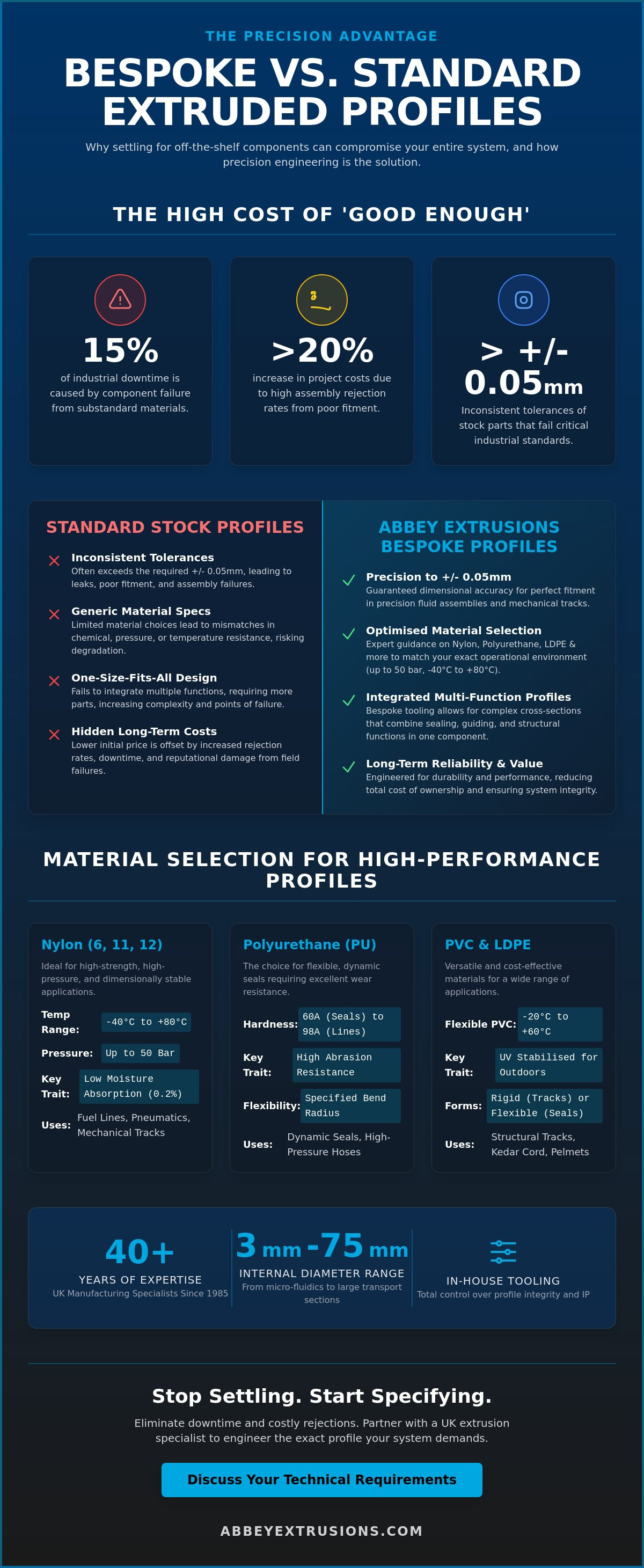
Bespoke Tooling vs Standard Stock Profiles
British manufacturing contributed £224 billion to the economy in 2023, requiring high-precision components to maintain global competitiveness.
Engineers often select off-the-shelf plastic trims to bypass the initial investment of custom die creation.
These standard profiles frequently result in a 15% increase in material waste because they don't meet exact mounting specifications.
Abbey Extrusions develops bespoke tooling that integrates multiple functions into a single profile with +/- 0.05mm tolerances.
Since 1985, Abbey Extrusions has provided tailored requirements for industrial clients who require more than a "close enough" fit. While stock profiles offer immediate availability, they lack the multi-functional capability of a profile designed specifically for your assembly.
Custom tooling allows us to integrate multiple functions, such as snap-fit joints and sealing lips, into a single 50mm profile. This integration reduces the component count in your bill of materials and eliminates 10-minute secondary machining tasks.
Our bespoke profiles arrive ready for installation, removing the need for on-site modifications that can compromise structural integrity. We produce these parts using materials like Nylon 12 or Polyurethane to ensure they remain durable at temperatures up to 80°C.
The Engineering Value of Custom Dies
Investing in bespoke dies provides a measurable ROI within 12 months by increasing assembly speeds by 30% compared to standard trims. As detailed in the Practical Guide to Plastic Extrusion, the die design is critical for managing internal material stress and ensuring a smooth surface finish with a Ra 1.6 rating.
We specialise in creating complex geometries with 4 or more intersecting planes that stockists cannot provide. These extruded plastic profiles perform reliably under pressures up to 50 bar when manufactured from reinforced PVC.
Achieving Tight Tolerances in UK Manufacturing
In our view, a tolerance of +/- 0.05mm is the essential benchmark for high-quality industrial extruded plastic profiles. We achieve this precision by meticulously controlling the cooling cycle to account for thermal expansion rates of 2% in LDPE components.
This level of control ensures that every profile, from 3mm to 75mm ID, fits perfectly without the need for secondary machining. You can find more information in our guide on custom extrusion for industrial applications.
Specifying Profiles for Industrial Applications
UK road freight accounts for 77% of all domestic goods moved, placing immense pressure on vehicle component durability. Industrial sectors require bespoke extruded plastic profiles that can withstand rigorous mechanical stress and environmental exposure. Standard components often fail when subjected to high-velocity wind or extreme thermal fluctuations during long-haul transport. Since 1985, we've solved these challenges by engineering profiles with specific Shore A hardness ratings and UV-stabilised polymers.
Transport and Logistics Profiles
As UK extrusion specialists, we advocate for the use of high-grade flexible PVC in curtainsider pelmet sections for heavy goods vehicles. These profiles are engineered to endure constant mechanical friction and wind speeds exceeding 60 mph without losing structural integrity.
We utilise bespoke polymer blends to ensure the pelmet remains flexible at temperatures as low as -20°C. This thermal stability prevents the material from becoming brittle and cracking, ensuring a consistent seal throughout the winter months.
Our tooling capabilities allow us to produce these sections in various widths to accommodate different track specifications. We also provide vehicle seals that compress efficiently to prevent water ingress during high-pressure cleaning cycles.
Specialist Industrial Cord and Seals
The marquee and tensioned fabric industry relies on Kedar cord for secure and reliable track fitment. We maintain a strict tolerance of +/- 0.05mm across all diameters, typically ranging from 3mm to 15mm, to ensure seamless installation into aluminium extrusions.
In our view, anti-static properties are essential for profiles used in sensitive electronic manufacturing environments. We integrate specialized additives into our polymer blends to prevent static discharge that could damage hardware or interfere with delicate sensors.
We also specialise in the production of fluted water hose for use within complex drainage and irrigation profiles. The fluted external ribs provide enhanced crush resistance and prevent kinking when the hose is installed at a tight bend radius.
This design ensures a consistent flow rate even in applications where space is limited and sharp turns are necessary. Our fluted profiles are available in LDPE and flexible PVC to suit specific chemical resistance requirements.
Brewery and food-grade profiles must comply with specific UK hygiene standards to ensure consumer safety and product purity. We manufacture these components from materials that resist bacterial growth and handle working pressures up to 50 bar.
Our production processes ensure that every profile, from 3mm to 75mm ID, meets the exacting cleanliness required for fluid transfer. Best practice dictates the use of clear or reinforced PVC to allow for visual inspection of the fluid during processing.
This transparency helps operators identify blockages or contamination early in the production cycle. By using high-purity polymers, we ensure that no leaching occurs, maintaining the integrity of the transported liquids.
Partnering with a UK Extrusion Specialist
UK manufacturing contributes £183 billion to the national economy through high-precision engineering. Industrial fluid systems rely on consistent extruded plastic profiles to maintain 50 bar pressure ratings. Global supply chains often introduce lead time volatility and variable material traceability. We provide domestic production from our UK facility to ensure 100% control over every batch.
Since 1985, we've focused on the "quality and service" philosophy that defines our domestic manufacturing. This long-term approach ensures our partners receive components that meet exact industrial specifications without the risks of international shipping.
We specialise in producing extruded plastic profiles with ID sizes ranging from 3mm up to 75mm. Our facility handles materials including LDPE, Polyurethane, and Nylon 12 to suit diverse chemical environments and temperature ranges.
In our view, early-stage collaboration is essential for optimising production efficiency and reducing waste. We invite engineers to submit technical drawings for a detailed review of manufacturability and cost-effectiveness before tooling begins.
This technical support covers everything from initial material selection to final high-volume production runs. We maintain strict tolerances of +/- 0.05mm to ensure every profile fits perfectly into your machine assembly or fluid system.
Our UK-based production line allows for rapid prototyping and shorter lead times than overseas competitors. This proximity gives you direct access to our engineering team for real-time adjustments and quality audits.
Quality Assurance and Technical Standards
Our testing protocols subject components to hydrostatic pressures up to 50 bar at 20°C to verify performance limits. This rigorous approach ensures that every batch of Flexible PVC or Nylon tube maintains its rated burst pressure under industrial stress.
We provide comprehensive batch documentation for all food-grade and chemical-resistant profiles to satisfy regulatory audits. As UK extrusion specialists, we advocate for material traceability to maintain the highest safety standards across all industrial contracts.
Our quality management system monitors dimensions throughout the extrusion process to prevent deviations. This focus on precision is why we've remained a trusted partner for UK engineers for over four decades.
Custom Tube Forming and Post Extrusion Services
Secondary processes like tube forming add significant value by shaping profiles for specific machine footprints. This custom shaping prevents kinking in tight spaces and maintains consistent flow rates for pneumatic or hydraulic fluids.
We also manufacture bespoke spiral cut guards and coiled air hoses designed for heavy-duty workshop environments using Nylon 6. These post-extrusion services allow us to deliver ready-to-use components that simplify your internal assembly processes.
Our facility is equipped to handle high-volume orders of coiled products while maintaining consistent Shore A hardness levels. Please note that we focus exclusively on the manufacturing phase and don't provide on-site installation services.
Optimising Industrial Performance through Precision Engineering
Achieving peak performance in industrial systems depends on the precise specification of extruded plastic profiles. We maintain tolerances of +/- 0.05mm to ensure every component integrates seamlessly into your assembly.
Since 1985, we've specialised in converting complex requirements into high performance solutions. We use materials like Nylon 12 and Polyurethane to provide the chemical resistance required for rigorous UK manufacturing environments.
Selecting bespoke tooling over standard stock avoids the compromises of "near-fit" components. Our UK-based manufacturing facility focuses on delivering exact geometries that withstand pressures up to 50 bar.
We work with ID sizes from 3mm to 75mm to meet diverse fluid handling needs across the British industrial sector. This versatility ensures your specific application benefits from the exact bend radius and wall thickness required for long term durability.
We specialise in Flexible PVC and LDPE to ensure your profiles maintain structural integrity under demanding conditions. We look forward to supporting your next engineering project with the reliability that only decades of British manufacturing experience can provide.
Frequently Asked Questions
Maximum pressure ratings for extruded plastic profiles
In our view, the maximum pressure for extruded plastic profiles depends entirely on the polymer and wall thickness specified during the design phase. For Nylon 12 profiles, we achieve working pressures of up to 50 bar at 20°C.
Higher temperatures will significantly reduce this burst pressure rating, necessitating a thicker wall section to maintain structural integrity.
Food grade suitability for brewery and catering applications
We specialise in the manufacture of clear Flexible PVC profiles that meet stringent food-grade standards for the UK brewery and catering industries. These extrusions maintain clarity and flexibility at temperatures ranging from -5°C to +60°C.
Every batch is produced to ensure no leaching occurs during fluid transfer, protecting the purity of the end product.
Standard tolerances for high precision industrial profiles
Best practice in UK manufacturing dictates a standard tolerance of +/- 0.05mm for high-precision industrial profiles. This level of accuracy ensures that bespoke profiles fit perfectly into existing aluminium tracks or vehicle housings.
Achieving these limits requires advanced calibration and consistent cooling during the extrusion cycle to prevent warping.
Bespoke tooling process for custom plastic extrusions
We provide a comprehensive bespoke tooling service for all custom plastic extrusion profiles from our UK facility. This process involves designing a specific steel die that matches your technical drawing to within microns.
Our team has managed bespoke tooling projects since 1985, ensuring reliable production for complex geometries and tight tolerances.
Minimum and maximum internal diameter specifications
Our manufacturing capacity allows for the production of plastic tubing and profiles with an internal diameter as small as 3mm. These micro-bore extrusions are typically produced in Nylon or PU for pneumatic control systems.
We can scale these extruded plastic profiles up to a maximum ID of 75mm for larger fluid transfer applications.
Material longevity for long term outdoor applications
For long-term outdoor use in the UK, we advocate for Nylon or UV-stabilised PVC to prevent embrittlement and discolouration. Nylon 12 offers excellent resistance to environmental stress cracking and maintains its Shore A hardness over years of exposure.
PVC profiles require specific additives to reach a similar level of UV durability against the British climate.

Article by
Bryan Cowan
Bryan Cowan is the Founder and Managing Director of Abbey Extrusions Ltd, a leading UK manufacturer of high-quality plastic tubes and hoses. With over 40 years of industry experience, Bryan established the company in 1985, growing it from a startup into a BS ISO9001-registered supplier for global sectors including aerospace, automotive, and pharmaceuticals.
Disclaimer
This article is intended for informational purposes only. Please ensure you seek expert advice or carry out your own research to confirm the information is suitable for your specific needs.