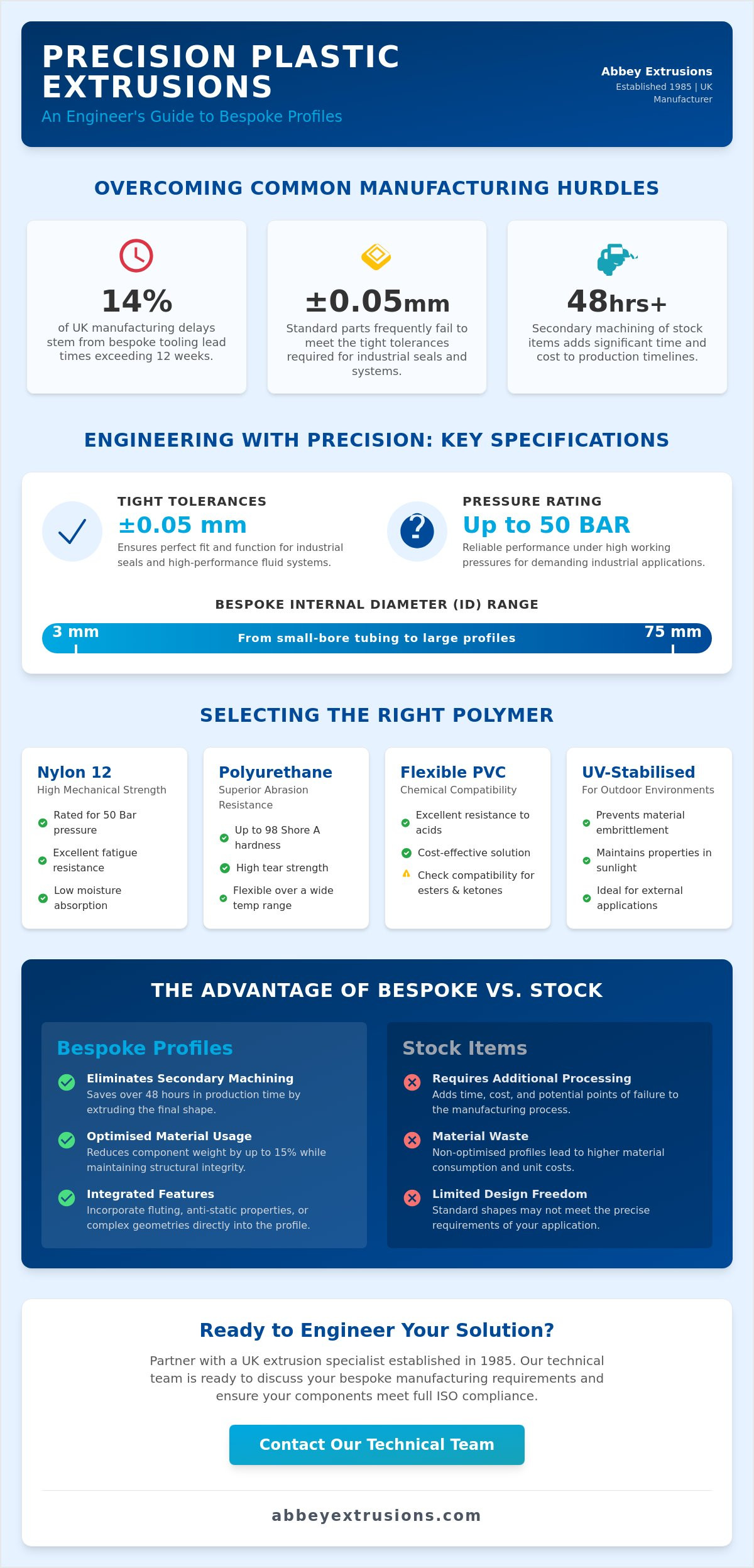
Recent UK industry reports indicate that 14% of manufacturing delays stem from bespoke tooling lead times for custom plastic extrusions that exceed the 12-week mark.
Since 1985, we've observed that the success of these profiles relies entirely on matching polymer properties to specific environmental pressures and chemical exposures.
You've likely faced the challenge of sourcing components that fail to maintain tolerances of +/- 0.05mm or arrive without the necessary technical guidance for high-temperature applications.
This article provides a technical framework for engineers to specify precision profiles with internal diameters from 3mm to 75mm and working pressures reaching 50 bar.
We'll examine the mechanical benefits of Nylon 12 and Polyurethane, including 98 Shore A hardness for superior abrasion resistance, whilst outlining a reliable procurement path for the 2026 industrial landscape.
Key Takeaways
- Understand how maintaining tight tolerances of +/- 0.05mm ensures the integrity of industrial seals and fluid systems.
- Evaluate the chemical compatibility of Flexible PVC and the 50 bar pressure rating of Nylon 12 for high-performance applications.
- Learn how to specify custom plastic extrusions with bespoke profiles ranging from 3mm to 75mm to meet exact engineering requirements.
- Determine necessary working pressures at 20°C and select UV-stabilised polymers to prevent material embrittlement in outdoor environments.
- Discover the quality control benefits of sourcing from a UK manufacturer established in 1985 to ensure full ISO compliance.
Understanding the precision of custom plastic extrusions
UK manufacturing output reached £224 billion in 2023, requiring higher precision for complex components with ID sizes from 3mm to 75mm.
Abbey Extrusions has operated since 1985 to provide bespoke manufacturing for unique shapes tailored to Shore A hardness specifications.
Standard items produced in batches under 1,000 metres often fail to meet the tight tolerances of +/- 0.05mm required for industrial seals.
We provide custom plastic extrusions that ensure repeatable dimensions across production runs exceeding 1,000 metres.
In our view, the transition from standard tubing to bespoke profiles is a critical step for systems operating at 50 bar. By specifying the exact Shore A hardness and wall thickness, engineers can ensure that components perform reliably under pressures up to 50 bar.
Custom plastic extrusions allow for the creation of intricate geometries within +/- 0.05mm tolerances that are impossible to achieve with off-the-shelf products. Our technical team utilises technical tooling to maintain these specifications throughout the entire manufacturing cycle.
Specialised applications like curtainsider pelmet sections require precise geometries of +/- 0.05mm to ensure weatherproofing on heavy-duty vehicles. Our facility handles ID sizes from 3mm to 75mm to accommodate diverse industrial requirements.
The extrusion process for industrial components
The production cycle begins when raw polymer granules, such as Nylon 12 or LDPE, are melted and forced through a custom-designed steel die. Understanding the plastic extrusion process is vital for engineers who require profiles that maintain a consistent Shore A hardness throughout the cooling and calibration phase.
Profiles then pass through a vacuum tank to ensure the external dimensions remain stable during the transition from a molten state. We also provide post-extrusion services including bespoke tube forming for complex assemblies that require a 90 degree bend radius for easier installation.
The cooling and calibration phase is where the profile achieves its final dimensional stability and physical properties. During this stage, we monitor the material flow to prevent internal stresses that could compromise the 20 bar burst pressure rating.
Benefits of bespoke plastic profiles over stock items
Bespoke profiles eliminate the need for secondary machining that adds 48 hours to production timelines by extruding the exact final shape required for the assembly. This approach reduces waste and lowers the unit cost for production runs that must withstand a 20 bar burst pressure.
Material usage is optimised to reduce weight by up to 15% whilst maintaining the necessary wall thickness for 20 bar fluid transfer. We can integrate specific features like internal fluting or anti-static properties directly into the profile during the initial run.
As UK extrusion specialists, we advocate for technical tooling that maintains structural integrity for 20 bar systems across every 1,000mm of the profile. This ensures that materials like Flexible PVC or Nylon 6 meet the rigorous demands of 2026 industrial standards.
Selecting materials for high performance fluid systems
UK manufacturing output reached £224 billion in 2023, requiring high-specification fluid transfer components.
Modern industrial systems demand custom plastic extrusions that withstand aggressive chemical exposure and high mechanical stress.
Engineers often struggle to balance material cost against the risk of catastrophic pressure failure or chemical degradation.
As UK extrusion specialists, we advocate for a data-driven approach to material selection based on specific operating parameters.
Abbey Extrusions has been established since 1985, producing bespoke profiles with ID sizes from 3mm to 75mm. We maintain strict tolerances of +/- 0.05mm to ensure that every component integrates perfectly with standard industrial couplings.
Analysing the chemical compatibility of Flexible PVC is essential before installation in environments containing industrial solvents. Whilst it offers excellent resistance to many acids, it reacts poorly to esters and ketones, which can lead to material hardening.
Nylon 12 is the preferred choice for air brake systems due to its 50 bar pressure rating and superior burst strength. This material remains stable under mechanical vibration and satisfies the safety requirements of the UK transport sector.
Polyurethane (PU) provides the necessary flexibility for applications requiring a tight bend radius of 25mm without restricted flow. In our view, this prevents the kinking often seen in less resilient materials used in compact pneumatic assemblies.
Low Density Polyethylene (LDPE) provides a cost-effective solution for chemical transfer in non-pressurised systems. Its inert properties make it suitable for laboratory use where maintaining fluid purity is a primary concern.
Technical properties of Nylon and PU
We specialise in comparing the thermal stability of nylon tube which maintains its structural integrity at temperatures up to 80°C. This heat resistance is vital for preventing tube failure in high-temperature engine bays or industrial processing plants.
The abrasion resistance of polyurethane tube ensures a long service life in demanding pneumatic environments. We offer Shore A hardness variations from flexible 60 to rigid 98 to meet specific mechanical handling requirements.
Flexible PVC and LDPE applications
Using pvc tube for food-grade applications and brewery lines ensures compliance with hygiene standards whilst providing clear fluid visibility. These profiles are designed to resist the growth of bacteria and withstand regular sanitisation cycles.
The moisture resistance of low density polythene tube makes it an ideal selection for sensitive laboratory environments. According to leading industry organizations, the molecular structure of LDPE prevents fluid contamination during low-pressure transfer.
Best practice involves referencing standard industrial dimensions for custom plastic extrusions to ensure seamless integration. This precision reduces the risk of leaks and ensures compatibility with existing UK manufacturing infrastructure.
Engineering bespoke profiles with technical tolerances
UK manufacturing output reached £224 billion in 2023, demanding higher precision in fluid and structural components. Engineering departments require profiles that integrate seamlessly into complex assemblies without the risk of mechanical failure. Standard off-the-shelf tubing often fails to meet the +/- 0.05mm tolerance required for secure pneumatic seals in high-pressure environments. We provide custom plastic extrusions with internal diameters starting at 3mm to ensure absolute mechanical reliability for every client.Established in 1985, Abbey Extrusions specialises in maintaining a strict +/- 0.05mm tolerance for push-fit pneumatic connections. This level of precision is vital to prevent pressure drops in systems operating at 10 bar or higher.
Our production capabilities cover a wide range of dimensions, with clear ID and OD parameters from 3mm up to 75mm. This versatility allows us to support diverse applications from medical-grade Nylon 12 tubing to heavy-duty LDPE industrial conduits.
In our view, designing for structural integrity is paramount when developing rigid profiles for vehicle trims. These components must withstand constant vibrations and temperature fluctuations whilst maintaining their 80 Shore D hardness profile.
We often incorporate co-extrusion techniques to combine rigid and flexible materials into a single, unified part. This process allows a rigid PVC base to provide structural support whilst a flexible 65 Shore A lip creates a watertight seal.
Tooling and die design for custom shapes
The initial investment in bespoke steel dies is a critical step for producing unique industrial profiles that standard tools cannot achieve. We utilise high-grade tool steel to ensure the die maintains its geometry over production runs exceeding 50,000 metres.
Best practice involves calculating die swell based on the specific 2.5% shrinkage rate of the chosen thermoplastic. Our engineers compensate for this polymer behaviour during the design phase to ensure the final cooled part matches the client's CAD drawing exactly.
We ensure consistent wall thickness between 1.5mm and 5mm across complex geometries to prevent structural weak points. Maintaining this uniformity is essential for profiles that must endure 50 bar burst pressures without deforming.
Quality control benchmarks in UK manufacturing
In-line laser measurement provides real-time monitoring of every millimetre of the extrusion to catch deviations before they exceed our +/- 0.05mm limit. This automated system ensures that every batch of Polyurethane or Flexible PVC meets the rigorous standards of British industry.
As UK extrusion specialists, we advocate for batch testing for tensile strength and elongation at break for every production run. We verify that our flexible PVC tube achieves the 250% elongation required for high-flexibility applications in factory automation.
Our manufacturing process ensures all bespoke outputs maintain strict adherence to plastic pipe sizes for compatibility with standard UK industrial fittings. This alignment simplifies the integration of custom profiles into existing pneumatic or fluid transport systems across the UK.
Specifying custom tubing for industrial applications
UK manufacturing output reached £224 billion in 2023, requiring high-precision fluid transfer components for critical infrastructure. Industrial systems rely on precise tubing specifications to maintain operational safety and fluid integrity. Specifying the wrong polymer or pressure rating leads to a 40% reduction in service life and potential system failure. We provide technical guidance to ensure your bespoke profiles meet exact engineering tolerances of +/- 0.05mm.
Working pressure must be determined at a reference temperature of 20°C to ensure safety margins remain intact. As UK extrusion specialists, we advocate for a 3 to 1 safety factor where a 10 bar working pressure requires a 30 bar burst rating.
Outdoor profiles require UV-stabilised polymers to prevent embrittlement caused by ultraviolet radiation. Unprotected PVC can lose 25% of its impact strength within 12 months of direct sun exposure without these additives.
Brand consistency is maintained by specifying bespoke colours using the RAL colour matching system. We achieve precise pigment dispersion to ensure your custom plastic extrusions match existing hardware within a Delta E tolerance of less than 1.0.
Reinforced braided hoses are essential for applications where internal pressures exceed 30 bar. Our reinforced PVC tube incorporates high-tensile polyester yarn to handle pressures up to 50 bar without compromising the 3mm to 75mm ID range.
Environmental and chemical considerations
Flexible polymer chains in standard PVC degrade quickly when they come into contact with aggressive oils or diesel fuels. Best practice involves selecting Nylon 12 for these environments because it maintains dimensional stability even when submerged in hydrocarbons.
Operating temperatures vary significantly between materials, ranging from -40°C for Nylon 11 up to 60°C for standard Flexible PVC. In explosive atmospheres, we specify anti-static properties with a surface resistivity of less than 10^9 ohms to prevent spark discharge.
Logistics and delivery for custom orders
Standard inventory is typically held in 30m or 100m coil lengths to suit common industrial layouts. We also provide bespoke cut-to-length services for custom plastic extrusions where tolerances are held to within +/- 0.05mm for automated assembly lines.
Packaging protocols are designed to prevent kinking or ovality that might occur during palletised transit. Lead times for bespoke tooling usually range from three to four weeks, followed by a first-article sampling process for client approval.
Sourcing reliable plastic extrusions from UK manufacturers
UK manufacturing contributed over £217 billion to the national economy in the last fiscal year.
Procuring bespoke profiles requires a deep understanding of polymer behaviour under variable thermal loads.
Inaccurate material selection often results in profile failure when temperatures exceed 60°C or pressures surpass 10 bar.
Abbey Extrusions provides the technical depth needed to ensure every custom plastic extrusion meets precise industrial standards.
Operating since 1985, we've developed the specialised knowledge required to manage complex cooling rates for LDPE and Nylon 12. UK-based production allows for rigorous oversight of material quality and strict ISO 9001 compliance throughout every stage of the manufacturing cycle.
In our view, a direct technical contact is essential when developing components that must withstand 50 bar of pressure. We ensure that every bespoke profile is evaluated for its specific application, whether it requires the structural rigidity of LDPE or the 18mm bend radius of flexible PU.
Why technical experience matters in extrusion
Experienced technicians prevent common defects such as surging or shark-skinning by precisely controlling melt temperatures within 1°C. We manage a diverse range of polymers to ensure that rigid profiles maintain structural integrity whilst flexible PVC achieves a specific Shore A hardness of 70.
As UK extrusion specialists, we advocate for early-stage design collaboration to identify potential tooling issues before production begins. This proactive approach ensures that tolerances of +/- 0.05mm are consistently achieved across every batch of custom plastic extrusions.
Transitioning from design to full production
Best practice involves a meticulous review of sample extrusions against the original technical drawing to verify ID sizes from 3mm to 75mm. We scale production seamlessly from small test batches to high-volume runs whilst maintaining a consistent density of 0.92 g/cm³ for LDPE profiles.
Maintaining long-term consistency is vital for industrial applications where working pressures reach up to 50 bar. Direct technical contact ensures that any adjustments to the bespoke profile design are implemented immediately by the engineering team to avoid project downtime.
Securing Precision for Future Industrial Applications
Since 1985, we've prioritised manufacturing accuracy to support the specific needs of the UK industrial sector. Our production processes consistently achieve tolerances of +/- 0.05mm to guarantee the dimensional reliability required for leak-free seals in bespoke profiles.
Specifying the appropriate material, such as Nylon 12 or flexible Polyurethane for easier routing in tight enclosures, is vital for components that must withstand pressures reaching 50 bar. We provide a versatile range of ID sizes from 3mm to 75mm to accommodate the exact requirements of modern fluid systems and industrial machinery.
Utilising custom plastic extrusions ensures that your technical specifications are met without the compromises found in standard components. This precision-led approach provides the stability required for engineering projects across the British Isles.
We look forward to supporting your next project with the technical expertise and manufacturing excellence that defines our industry.
Frequently Asked Questions
Maximum diameter for custom plastic extrusions
We manufacture custom plastic extrusions with internal diameters starting at 3mm and extending to a maximum of 75mm. This capacity allows our team to produce bespoke profiles that maintain their structural integrity whilst operating at pressures up to 50 bar at 20°C.
Our facility specialises in Nylon 12 and Flexible PVC to ensure these dimensions remain precise to +/- 0.05mm across varied industrial environments.
Extruding custom profiles in different colours
Abbey Extrusions produces bespoke profiles in a vast array of colours including clear, translucent, and solid opaque shades to suit your branding. We ensure long-term colour stability in our Flexible PVC materials which typically range from 65 to 90 Shore A hardness.
This customisation is available for all Polyurethane (PU) and LDPE extrusions to ensure your components are easily identifiable during complex installations.
Tolerances achieved in bespoke plastic extrusion
Our production processes consistently achieve tight tolerances of +/- 0.05mm for critical industrial components. This precision is vital for Nylon 6 and Nylon 12 tubes that must interface perfectly with pneumatic fittings at 23°C.
We utilise advanced monitoring equipment to ensure every millimetre of the extrusion meets these high-specification requirements.
Bespoke tooling for new plastic profiles
We've designed and maintained bespoke tooling for specialised industrial applications since our establishment in 1985. Our in-house expertise ensures that LDPE and Polyurethane profiles meet the exact geometry required for your specific installation.
This dedicated tooling service allows us to create complex shapes that maintain a 50 bar pressure rating in demanding environments.
Minimum order quantity for custom extrusions
Minimum order quantities are determined by the specific material and the complexity of the custom plastic extrusions requested. We generally require a 500-metre production run for bespoke profiles to ensure manufacturing efficiency and maintain competitive UK pricing.
Small-batch production is also considered for high-performance materials like Nylon 12 where technical precision at 50 bar is the primary requirement.
Custom plastic extrusions manufactured in the UK
Every custom plastic extrusion we supply is manufactured at our dedicated facility within the United Kingdom to ensure total oversight. This British-based manufacturing guarantees that every batch meets our strict quality standards for components rated up to 50 bar at 20°C.
We've operated from our UK base since 1985 to provide the engineering reliability that modern fluid systems demand.

Article by
Bryan Cowan
Bryan Cowan is the Founder and Managing Director of Abbey Extrusions Ltd, a leading UK manufacturer of high-quality plastic tubes and hoses. With over 40 years of industry experience, Bryan established the company in 1985, growing it from a startup into a BS ISO9001-registered supplier for global sectors including aerospace, automotive, and pharmaceuticals.
Disclaimer
This article is intended for informational purposes only. Please ensure you seek expert advice or carry out your own research to confirm the information is suitable for your specific needs.