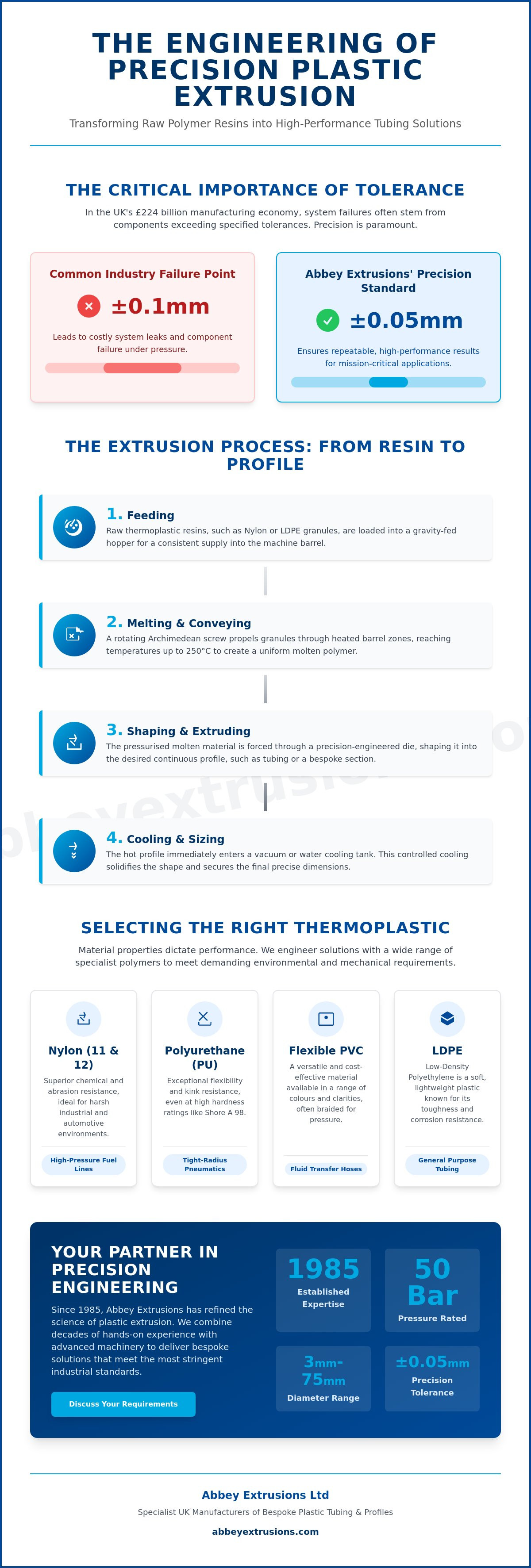
The UK manufacturing sector contributed £224 billion to the economy in 2023, yet many precision fluid systems fail because component tolerances exceed +/- 0.1mm.
Our manufacturing range spans from 3mm to 75mm, serving critical roles within the UK automotive and brewery sectors. Sourcing from a long-standing UK manufacturer provides the reliability needed for high-volume industrial supply chains, much like how global suppliers such as Buffalo Divine International ensure the availability of industrial metals and minerals for large-scale manufacturing.
Achieving repeatable +/- 0.05mm results requires a deep understanding of how an extrusion machine processes thermoplastic resins like Nylon 12 under controlled thermal conditions up to 250°C.
You likely find that navigating the differences between rigid Nylon 6 and flexible Polyurethane with a Shore A 98 rating for tight-radius routing is difficult when your application demands a specific 50 bar pressure rating.
We've refined our bespoke engineering since 1985.
We agree that selecting the wrong polymer leads to costly system leaks during 50 bar pressure tests, especially when tolerances aren't held to +/- 0.05mm.
This engineering overview explains how we transform raw resins into high-performance tubing with ID sizes ranging from 3mm to 75mm.
You'll master material constraints for LDPE and braided PVC.
Key Takeaways
- Learn how the extrusion machine converts thermoplastic resins like Nylon 11 into continuous lengths of high-performance tubing through precise thermal control.
- Understand the mechanical influence of screw configurations and speeds on the output volume of bespoke profiles including reinforced PVC tube.
- Identify the critical variables such as ambient temperature and cooling rates required to maintain rigorous engineering tolerances of +/- 0.05mm for polyurethane tube.
- Discover how Abbey Extrusions leverages manufacturing experience established in 1985 to deliver specialist solutions in materials such as PU and Flexible PVC.
You can discuss your specific technical requirements with our engineering team at https://www.abbeyextrusions.com/contactus.
Defining the Plastic Extrusion Machine
The extrusion machine operates as a high-volume manufacturing system designed specifically for thermoplastics like Nylon 11. It functions by forcing molten material through a precision-cut die to create continuous lengths of a specific profile.
This method allows us to produce tubing with internal diameters ranging from 3mm up to 75mm. As UK extrusion specialists, we advocate for precision-engineered systems to ensure every millimetre meets industrial standards.
Understanding What is Plastic Extrusion? provides the necessary context for how mechanical screws drive material through heated zones. Our facility utilises these systems to maintain a strict +/- 0.05mm tolerance on all standard production runs.
The machinery must be robust enough to handle the constant pressure required for 24-hour manufacturing cycles. We've refined our processes since 1985 to ensure that the output remains consistent from the first metre to the last.
The Role of Thermoplastics in Extrusion
Materials such as Flexible PVC and Polyurethane (PU) behave differently under the intense heat of the machine barrel. Shore A hardness, often ranging from 60 to 95 for flexible grades, determines the specific torque and screw speed settings required.
Material melting points must align with the thermal stability of the 200°C heated zones within the machine barrel. If the temperature fluctuates by even a few degrees, the viscosity changes and ruins the profile's structural integrity.
Effective cooling then secures the dimensions of the profile as it exits the die and enters the vacuum tank. We monitor these thermal gradients closely to prevent internal stresses that could lead to tube failure in the field.
Choosing the right thermoplastic depends on the environmental factors the finished product will face. For example, Nylon 12 is selected for its superior chemical resistance in automotive fuel lines.
Industrial Purpose and Application
The process begins with raw resin beads which the machine transforms into high-performance nylon tube solutions. Maintaining consistent wall thickness is vital for components that must withstand 50 bar working pressures.
Whilst standard tubing covers most needs, we also manufacture bespoke profiles for specialised hardware. These custom sections provide the exact geometry needed for industrial vehicle components and heavy-duty seals.
In our view, the versatility of the extrusion machine is what makes it indispensable for modern British industry. It allows for the rapid production of LDPE and Polyethene products that meet stringent safety regulations.
Every profile we create is tested to ensure it meets the specific Shore A hardness and pressure ratings requested by the client. This dedication to technical accuracy is why we've remained a trusted partner for nearly four decades.
Contact our technical team to discuss your specific manufacturing requirements for bespoke plastic profiles
The Step by Step Extrusion Process
UK manufacturing contributes approximately £183 billion to the national economy and demands exceptional precision in polymer processing. The industrial extrusion machine functions as a continuous thermal reactor that converts solid granules into complex profiles. Inadequate heat regulation during this transition causes polymer degradation, which reduces the structural integrity of the finished part. We utilise advanced thermal monitoring to maintain tolerances of +/- 0.05mm throughout the entire production cycle.
The journey from the hopper to the final cooling tank requires absolute synchronisation of mechanical and thermal systems. Our process relies on a heavy duty breaker plate to maintain back pressure, ensuring the melt is uniform before it reaches the tooling.
As UK extrusion specialists, we advocate for a linear production flow that prevents material stagnation. This methodical approach ensures that every millimetre of the finished profile meets the technical specifications required for high pressure applications up to 50 bar.
Feeding and Melting the Resin
Raw LDPE and Nylon resins enter the system through a gravity-fed hopper that ensures a consistent volume of material enters the screw. Frictional heat within the barrel provides the thermal energy needed to reach specific melting points, such as 190°C for low density polyethylene.
A clean resin supply is essential to prevent defects that would otherwise exceed our strict +/- 0.05mm tolerance limits. In our view, maintaining a sterile feeding environment is the only way to guarantee the clarity and strength of our clear flexible PVC profiles.
The rotating screw pushes the granules forward whilst internal heaters maintain a stable temperature profile across the barrel zones. This controlled environment prevents the chemical breakdown of polymer chains, which is vital for maintaining a consistent Shore A hardness of 60 to 95.
Shaping and Cooling the Profile
The molten polymer is forced through a breaker plate to generate back pressure and then through a bespoke die head. This die head is precision engineered to create the specific geometry of the pvc tube or custom profile being manufactured.
A vacuum sizing process stabilises the external diameter of the tube to ensure it fits standard industrial couplings with a 3mm to 75mm internal diameter. Water cooling troughs reduce the temperature rapidly to set the final dimensions and lock in the physical properties of the thermoplastic.
The puller unit dictates the final dimensions by maintaining a constant haul-off tension that prevents wall thickness variations. This unit operates in perfect synchronisation with the extrusion machine speed to ensure the finished product remains dimensionally stable over long production runs.
Contact our technical sales team to discuss your bespoke manufacturing requirements at https://www.abbeyextrusions.com/contactus
Mechanical Variations in Extruder Design
The screw configuration determines the mechanical efficiency of the melting process within the barrel. When we manufacture reinforced pvc tube, the screw speed is adjusted to manage shear heat effectively.
Rotating the screw at specific RPMs ensures the polymer doesn't exceed 190°C during the transition phase. Exceeding this thermal limit would cause degradation and compromise the 50 bar pressure rating required for industrial use.
Moisture-sensitive materials like Nylon 12 require vented barrels to eliminate volatiles that cause structural pitting. This vacuum extraction process is critical for maintaining the structural integrity of hoses used in pneumatic systems.
In our view, machine maintenance is the anchor of quality for every bespoke profile we produce. Since 1985, we've maintained our machinery to ensure that every flexible PVC extrusion meets a 40mm bend radius requirement without kinking.
Single Screw vs Twin Screw Systems
Single screw machines are the reliable standard for producing simple low density polythene tube. These systems provide the uniform melt pressure needed to keep tolerances within +/- 0.05mm for standard fluid lines.
Twin-screw systems offer high-shear mixing capabilities for complex compounds that involve UV stabilisers or flame retardants. We link machine selection to the required bend radius of the finished product to ensure performance at temperatures down to -20°C.
As UK extrusion specialists, we advocate for twin-screw processing when blending different Shore A hardness materials together. This ensures a homogenous melt that prevents delamination in multi-layered industrial hoses.
Downstream Equipment and Tooling
Achieving the correct geometry for unique shapes like kedar cord requires bespoke tooling. Our tool room produces dies that account for the 15% die swell common in flexible thermoplastics.
The haul-off speed must be synchronised with the extrusion machine output to prevent dimensional drifting. If the puller speed exceeds the melt flow, the wall thickness will drop below the specified +/- 0.05mm limit.
We use precision cutting and coiling stages to ensure industrial hoses are delivered in exact 30-metre or 100-metre lengths. This rigorous control at the end of the line guarantees that every product meets the high standards we've upheld since 1985.
Please contact our technical department to discuss your specific requirements for bespoke industrial extrusions.
Critical Factors in Precision Extrusion Quality
UK manufacturing output reached £224 billion in 2023, with fluid systems requiring absolute dimensional accuracy.
Abbey Extrusions has provided high-specification profiles since 1985 with tolerances of +/- 0.05mm.
Ambient variables and material moisture can disrupt these tolerances during the manufacturing cycle.
We utilise advanced thermal controls to ensure every extrusion machine maintains consistent output quality.
Precision remains the primary benchmark for industrial components with internal diameters ranging from 3mm to 75mm. Deviations from our +/- 0.05mm standard occur if the melt temperature fluctuates by as little as 2°C.
Ambient workshop temperatures significantly impact the cooling rate of polyurethane tube, which requires a stable 20°C environment to prevent dimensional shrinkage. In Nylon 6 production, moisture levels exceeding 0.2% cause steam bubbles that create visible surface pits and structural weaknesses.
Engineers should consult A Technical Comparison of Tube Extrusion Materials and Industrial Specifications for specific polymer behaviour data. As UK extrusion specialists, we advocate for rigorous material testing to prevent these common defects.
Managing Pressure and Flow
Internal pressures reaching 50 bar are precisely regulated during the melt phase to prevent surging and wall thickness variations. The screen pack also assists in creating necessary back-pressure, which improves the homogenisation of the melt at 50 bar.
We utilise a multi-layered screen pack to filter out particulate impurities from recycled polymers before they reach the die. Maintaining a constant RPM on the extrusion machine is essential for producing uniform lengths of LDPE or Flexible PVC.
Fluctuations in the flow rate directly alter the wall thickness of flexible tubing, which can compromise the 50 bar burst pressure rating. This precision ensures that the final product, whether it's a clear PVC tube or a braided hose, possesses a consistent molecular density.
Ensuring Material Compatibility
Best practice dictates a thorough review of chemical compatibility before we begin any production run of bespoke profiles. Different Shore A ratings, such as a soft 70A versus a rigid 90A, require specific cooling durations to set the polymer structure correctly.
Cooling tanks must be calibrated to the specific thermal conductivity of the material, as a 90A Shore A Polyurethane dissipates heat differently than a 70A variant. This precision prevents internal stresses that might cause the tube to coil or warp after it leaves the production line.
We incorporate anti-static additives for sensitive industrial environments where spark prevention is a safety requirement for Nylon 12 systems. Our team ensures that every material, from Flexible PVC to Polyurethane, meets the exact mechanical demands of the final application.
https://www.abbeyextrusions.com/contactus
Specialist Manufacturing Services at Abbey Extrusions
UK manufacturing output reached £224 billion in 2023.
High-performance fluid systems rely on the consistent output of a precision extrusion machine to maintain operational safety.
Engineers frequently struggle to source components that maintain a strict +/- 0.05mm tolerance under high-pressure conditions.
We deliver tailored thermoplastic solutions from our Leicestershire-based facility to meet these exact industrial specifications.
Since 1985, Abbey Extrusions has operated as a specialist manufacturer providing bespoke components to diverse British industries. Our Leicestershire facility utilises advanced technology to process materials including Nylon 11, Polyurethane (PU), and Flexible PVC.
In our view, the versatility of our tube forming service adds value by creating permanent bends for compact engine bays. We maintain competitive pricing for production runs whilst ensuring every batch meets the tailored requirements of our long-standing partners.
Our core material specialisms include Nylon 12 for chemical resistance and Polyurethane for high-abrasion environments. We also specialise in Flexible PVC, which provides the necessary bend radius for complex pneumatic installations.
By managing the entire process in-house, we control every variable from raw polymer selection to final quality inspection. Our team provides technical support to ensure the selected material handles temperatures from -20°C to +80°C effectively.
Bespoke Profiles and Custom Solutions
We manufacture curtainsider pelmet sections designed to withstand the mechanical stresses of the UK haulage sector. Our engineering team designs custom dies to ensure the extrusion machine produces unique profiles that standard tooling cannot achieve.
As UK extrusion specialists, we advocate for early-stage consultation to define your specific ID and OD requirements. This precision ensures that flexible PVC components maintain a Shore A hardness of 70 for optimal sealing properties.
We create bespoke profiles that integrate seamlessly into existing aluminium tracks or steel frames. Clients are invited to discuss their specific dimensional needs to ensure perfect alignment with their industrial applications.
Quality Assurance and British Standards
Rigorous testing protocols ensure our tubing handles working pressures up to 50 bar without compromising structural integrity. We verify dimensional accuracy using precision gauges to maintain our standard +/- 0.05mm tolerance levels across all production runs.
Our manufacturing range spans from 3mm to 75mm, serving critical roles within the UK automotive and brewery sectors. Sourcing from a long-standing UK manufacturer provides the reliability needed for high-volume industrial supply chains.
Best practice dictates that brewery hoses must remain taste-free and odourless to protect the quality of the beverage. We provide certificates of conformity to confirm that materials meet the required British Standards for safety and performance.
Our commitment to quality ensures that every metre of tubing produced in our facility meets the rigorous demands of modern engineering. We continue to invest in our Leicestershire plant to maintain our position as a leader in the UK thermoplastic extrusion market.
For professional advice on your next project, please contact us at Abbey Extrusions
Advancing Your Industrial Production Standards
Selecting a high-specification extrusion machine remains the foundational step in achieving the rigorous +/- 0.05mm tolerances required for critical industrial applications. Our technical team has refined these bespoke manufacturing processes in our UK facility since 1985 to ensure every profile meets exact engineering benchmarks.
We specialise in processing high-performance materials such as Flexible PVC and Nylon 12 to create components with internal diameters ranging from 3mm to 75mm. This commitment to precision engineering ensures that your bespoke UK-based tooling requirements translate into consistent, high-quality output across every production cycle.
Our methodology prioritises technical stability, ensuring it's possible to handle working pressures up to 50 bar without compromising material integrity. We maintain a strict focus on professional standards to deliver the reliability your fluid systems and industrial projects demand.
We look forward to supporting your next manufacturing phase with our proven technical capabilities.
Please contact our technical team to discuss your specific manufacturing requirements and bespoke profile designs.
Frequently Asked Questions
Maximum pressure ratings for extruded nylon tubing
Our extruded Nylon 12 tubing maintains a working pressure of up to 50 bar when operated at a constant temperature of 20°C for industrial fluid transfer. We ensure these high-pressure capabilities by controlling the wall thickness to within +/- 0.05mm during the extrusion machine process to prevent burst failures in critical pneumatic systems whilst maintaining a 45mm minimum bend radius.
Shore A hardness variations in extrusion production
The equipment processes various grades of flexible PVC to achieve specific Shore A hardness levels ranging from 60 to 95 for diverse industrial applications. We precisely calibrate the melt temperature between 160°C and 190°C to ensure the material retains its intended flexibility and 25mm bend radius for use in complex sealing environments and gasket configurations.
Standard tolerances for industrial plastic profiles
Since 1985, our standard manufacturing protocol has maintained a high-precision tolerance of +/- 0.05mm for all industrial profiles produced in our British facility. This level of accuracy is essential for components with internal diameters between 3mm and 75mm to ensure a secure absolute fit in fluid systems that operate under high-vibration conditions or extreme thermal cycles.
Processing moisture sensitive polymers in an extrusion machine
We process moisture-sensitive polymers like Nylon 6 by utilising desiccant dryers to reduce water content to below 0.02% before the material enters the extrusion machine. Preventing hydrolytic degradation ensures the finished profile achieves a tensile strength of 60 MPa without structural voids or surface defects that could compromise the integrity of the 50 bar pressure rating in demanding environments.
Distinguishing between flexible and rigid extrusion processes
Flexible extrusion typically utilises plasticised PVC with a Shore A rating of 75 to allow for a tight 30mm bend radius in complex industrial installations. In contrast, rigid profiles are designed for structural stability and don't deform under a 10 bar load whilst maintaining a constant 75mm outer diameter for structural framing and cable management applications.
Lead times for bespoke extrusion die development
Creating a bespoke extrusion die for custom profiles typically requires a lead time of 14 to 21 days for design and precision spark erosion. This timeframe allows us to guarantee that the final tooling produces components within our +/- 0.05mm tolerance limit for all 3mm to 75mm ID products manufactured in our UK facility to meet specific client requirements.

Article by
Bryan Cowan
Bryan Cowan is the Founder and Managing Director of Abbey Extrusions Ltd, a leading UK manufacturer of high-quality plastic tubes and hoses. With over 40 years of industry experience, Bryan established the company in 1985, growing it from a startup into a BS ISO9001-registered supplier for global sectors including aerospace, automotive, and pharmaceuticals.
Disclaimer
This article is intended for informational purposes only. Please ensure you seek expert advice or carry out your own research to confirm the information is suitable for your specific needs.