A single hour of unplanned machinery downtime in a high-volume British manufacturing facility can cost thousands of pounds in lost productivity. The most common point of failure is often the external surface of your hydraulic assemblies, which is why selecting a high-quality nylon spiral cut hose guard is a critical technical decision for any maintenance strategy. You likely recognise the frustration of frequent hose failures caused by constant abrasion against metal edges or the gradual degradation of standard plastic coverings when exposed to industrial oils.
This guide demonstrates how the implementation of a high-specification Nylon 12 guard provides the robust chemical resistance and mechanical durability required to safeguard your investments. By choosing a material engineered for the rigours of the modern factory floor, you can significantly extend equipment service life whilst reducing the need for tedious maintenance cycles.
We shall examine the technical advantages of Nylon 12 over conventional materials and discuss the efficiency of retrofitting these guards without the need for system disassembly. Our analysis also outlines how bespoke extrusion solutions are tailored to meet the exacting standards of your specific industrial applications, ensuring your operations remain both safe and profitable.
Key Takeaways
- Learn why Nylon 12 provides superior tensile strength and enhanced chemical resistance compared to standard HDPE alternatives in demanding oily environments.
- Discover how the unique profile of a nylon spiral cut hose guard maintains full protective coverage whilst allowing for the necessary flexibility in hydraulic systems.
- Understand the technical methodology for calculating precise wrap lengths to ensure efficient installation and minimal material waste during assembly.
- Identify the advantages of sourcing bespoke lengths and colours directly from a specialist UK manufacturer to meet high volume industrial requirements.
- Gain insights into reducing equipment downtime by implementing protection solutions that can be retrofitted without the need for dismantling existing machinery.
To discuss your specific requirements for industrial hose protection, please contact our Leicestershire technical team for expert assistance.
Understanding the function of nylon spiral cut hose guards
A nylon spiral cut hose guard is a high-strength protective sleeve engineered to shield hydraulic and pneumatic lines from the harsh realities of industrial environments. Unlike solid sleeves, the spiral profile provides a unique balance between comprehensive surface coverage and the inherent flexibility required for dynamic machinery. This design ensures that as a hose flexes or bends during operation, the guard remains securely in place whilst allowing for the necessary range of motion without creating stress points.
Primary functions include the prevention of mechanical impact damage and surface abrasion, which are the most frequent catalysts for premature hose failure. Beyond protection, these guards play a vital role in the tidy organisation of multiple hose or cable bundles. By applying standard cable management principles, engineers can prevent tangling and ensure that complex systems remain accessible for inspection and maintenance.
The importance of hose protection in modern hydraulics
In modern manufacturing, the financial implications of hydraulic failure extend far beyond the price of a replacement hose, and it's a cost that compounds quickly. Equipment downtime can result in significant losses, often reaching hundreds of pounds per hour in high-output environments. External wear, typically caused by hoses rubbing against vibrating metal frames or other abrasive surfaces, is the leading cause of these replacements.
Implementing a nylon spiral cut hose guard also provides critical safety benefits. In the event of a pinhole leak or a more significant hose burst, the guard acts as a secondary containment layer. It helps to diffuse the energy of escaping high-pressure fluid, reducing the risk of injury to nearby operators and preventing the atomisation of oils that could lead to fire hazards.
Key features of the spiral cut geometry
The geometry of the spiral wrap offers distinct logistical advantages. One of the most significant is the ability to retrofit the guard onto existing systems without disconnecting fittings or draining hydraulic fluid. This eliminates the need for system bleeding and reduces installation time from hours to minutes, which is vital for maintenance efficiency.
The expandable nature of the spiral design allows a single guard size to accommodate a wide range of hose diameters or bundle thicknesses. This versatility simplifies inventory management for maintenance departments. From a technical standpoint, the gaps between the spiral wraps facilitate essential ventilation. This prevents the build-up of moisture and heat amongst bundles, which can otherwise accelerate the degradation of the hose's outer rubber carcass.
To discuss the technical specifications of our Nylon 12 guards, please contact our technical sales team for a custom quote.
Comparing Nylon 12 properties with standard HDPE alternatives
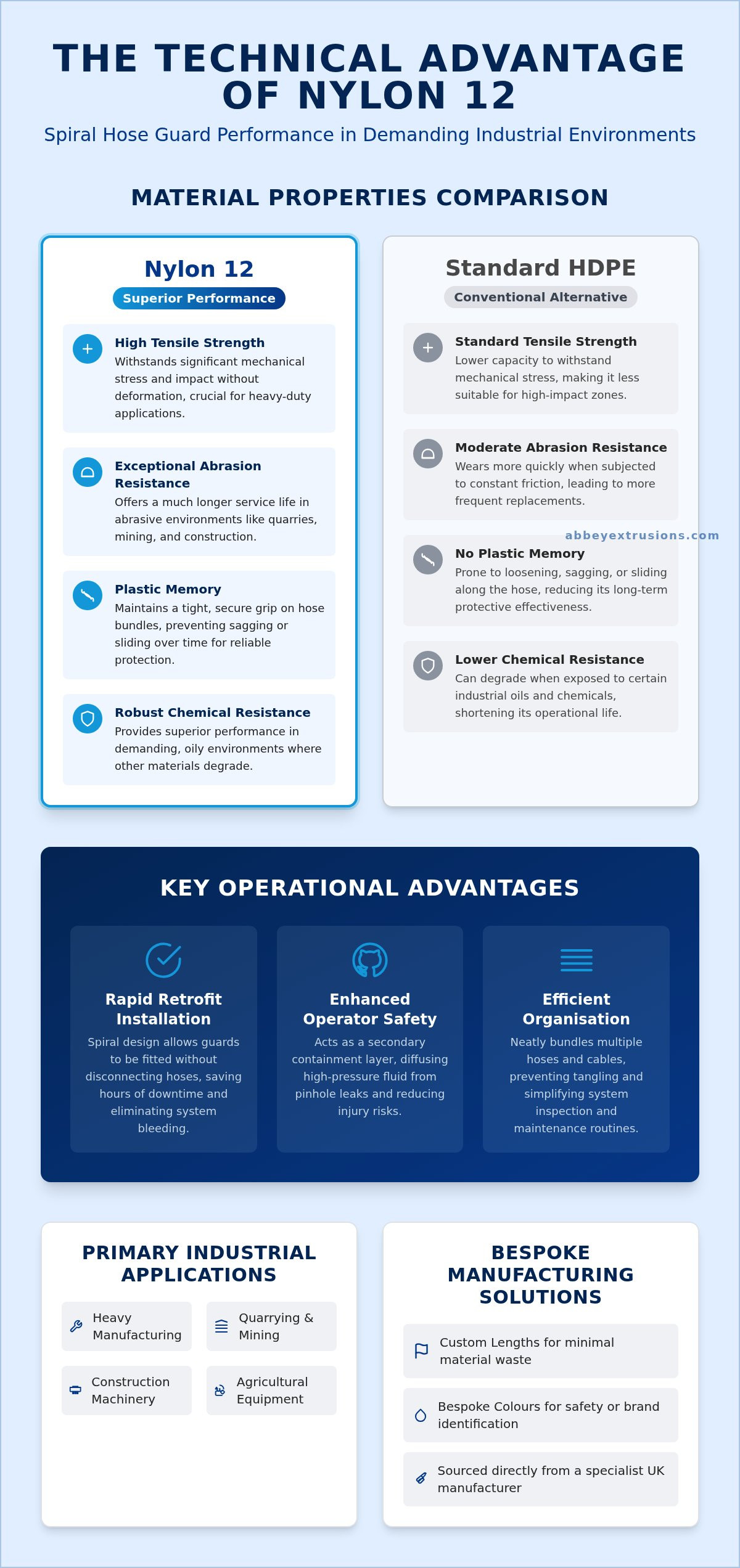
While High-Density Polyethylene (HDPE) is frequently utilised as a cost-effective material for basic hose wrapping, high-performance industrial environments require the superior technical attributes of a nylon spiral cut hose guard. Nylon 12 exhibits significantly higher tensile strength compared to standard polyethylene, which allows it to withstand much greater mechanical stress without deforming. This structural integrity is vital for protecting high-pressure lines in heavy-duty applications where the risk of impact is constant.
The abrasion resistance ratings for Nylon 12 are markedly superior to those of HDPE, providing a longer service life in abrasive conditions like quarrying or mining. One of the most important technical features of Nylon 12 is its "plastic memory." This property ensures that once the guard is wrapped around a bundle, it maintains a tight, secure grip on the hose assembly. This prevents the guard from sliding or sagging over time, which is a common failure point in cheaper plastic alternatives. For outdoor construction and agricultural machinery, our guards are UV-stabilised to prevent the material from becoming brittle or cracking when exposed to prolonged sunlight. This level of protection supports compliance with broader safety protocols, including OSHA safety standards for pneumatic hoses, which emphasise the necessity of maintaining secure and intact hose assemblies.
Temperature and environmental resistance
The thermal performance of Nylon 12 is a primary differentiator in industrial material selection. While HDPE may soften or lose its structural integrity as temperatures rise, Nylon 12 maintains its mechanical properties across a much broader operating range. Crucially, in extreme cold, Nylon 12 retains its flexibility whilst standard plastics often become brittle and shatter upon impact. Its anti-crushing attributes provide a robust shield for internal tubing, ensuring that fluid flow remains consistent even when subjected to external pressure or heavy loads.
Chemical compatibility in industrial settings
Industrial environments often expose equipment to aggressive substances that can rapidly degrade standard plastic guards. Nylon 12 offers excellent resistance to hydraulic oils, greases, petrol, and dilute acids, making it the preferred choice for the chemical processing and oil and gas sectors. We ensure that every nylon spiral cut hose guard we manufacture is fully REACH and RoHS compliant. This ensures your operations meet the strict regulatory standards required for modern UK manufacturing. If you require guidance on material selection for a specific environment, you can consult with our specialists.
For guidance on selecting the correct protection for your industry, reach out to our facility for assistance.
Primary industrial applications for spiral cut protection
The versatility of the nylon spiral cut hose guard makes it an essential component across a diverse range of demanding sectors. In the heavy construction industry, hydraulic excavators and loaders operate in environments where falling debris and constant friction against concrete or steel are daily occurrences. By installing these guards, operators ensure that their high-pressure lines have a sacrificial wear layer that absorbs mechanical energy before it can compromise the hose wall. This is particularly vital for equipment used in demolition or site clearance where the risk of puncture is highest.
Agricultural machinery presents a different set of challenges, as hoses on harvesters and tractors must frequently move through dense vegetation, thorny brush, and abrasive crops. A nylon spiral cut hose guard prevents the outer rubber carcass from being shredded by natural elements. Similarly, in marine environments, the primary concern is the aggressive nature of saltwater. Unlike metal-based protection, Nylon 12 is entirely immune to corrosion, ensuring long-term reliability on offshore platforms and vessels. In mining and quarrying operations, where grit and rock dust create an environment of constant, high-intensity abrasion, the superior hardness of nylon provides a level of protection that standard plastic wraps cannot match.
Automotive and transport sectors
Commercial vehicle operators utilise spiral guards to protect critical brake lines and fuel systems from road debris and stone chips. These guards are often paired with a nylon recoil air hose in trailer coupling systems, where the combination of flexibility and impact resistance is paramount for safe operation. Beyond fluid lines, they are frequently used to bundle and protect intricate electrical looms within engine bays, shielding sensitive wiring from both mechanical vibration and the heat generated by large-capacity engines.
Manufacturing and chemical processing
Within factory automation, pneumatic lines must be precisely routed to avoid interference with moving robotic arms. Spiral guards help organise these lines into manageable bundles whilst preventing wear against the machine frame. In chemical processing plants, the resistance of Nylon 12 to various solvents, oils, and greases is a critical requirement. This durability extends to food and beverage production lines, where the guards must withstand frequent high-pressure wash-down procedures with industrial cleaning agents without becoming brittle or losing their protective properties.
To ensure you order the correct length for your installation project, get in touch with our extrusion experts.
Technical methods for efficient hose guard installation
While many maintenance professionals find the manual application of a nylon spiral cut hose guard to be a time-consuming task, employing the correct technical approach can significantly reduce labour hours. There are two primary methods for installation. Threading involves sliding the hose through the guard before the fittings are crimped, which is ideal for new assemblies. However, the most significant advantage of the spiral design is the ability to wrap the guard around an existing hose. This method requires a systematic rotation of the guard, feeding it onto the hose in a continuous motion. To prevent the guard from slipping or migrating during high-vibration operation, the ends should be secured using industrial-grade cable ties or by ensuring the "memory" of the Nylon 12 material provides a sufficiently tight grip on the hose fittings.
Retrofitting guards to existing assemblies
The ability to install a nylon spiral cut hose guard without disconnecting hydraulic lines is a major benefit for reducing unplanned downtime. User forums often highlight the "patience" required for this task, but the process can be expedited by using basic tools like a simple plastic mounting tool or even a modified PVC pipe to help spread the spiral as you feed it. By starting at one end and maintaining a consistent angle, you can achieve a professional finish without the risk of introducing air into the hydraulic system, which would occur if lines were disconnected. This makes it an ideal solution for upgrading protection on machinery already in the field.
Sizing and pitch selection
Selecting the correct length and pitch is essential for both protection and performance. To estimate the required length of a spiral wrap, you can use the following formula: (Outside Diameter of Hose / Inside Diameter of Guard) x Length of Hose. This calculation accounts for the expansion of the spiral as it opens to accommodate the hose. The pitch, or the distance between the spiral cuts, dictates the balance between flexibility and coverage. A tighter pitch increases the overlap between the wraps, providing maximum protection in high-abrasion environments, but it also reduces the flexibility of the assembly. For applications requiring tight bends, a wider pitch is preferable. Ensuring a slight overlap is recommended for most industrial settings to prevent the hose surface from being exposed during extreme flexing. For large-scale projects requiring specific dimensions, you can request a technical consultation to determine the optimal specifications for your equipment.
To request a bespoke length or specific colour for your project, submit an enquiry through our contact page.
Ordering bespoke hose guards for large volume industrial projects
Sourcing directly from a UK manufacturer offers distinct logistical and quality advantages for large scale industrial projects. When you procure a nylon spiral cut hose guard from Abbey Extrusions, you gain access to a supply chain that prioritises traceability and technical precision. Off the shelf solutions often lead to significant material waste because standard lengths rarely align perfectly with complex hydraulic layouts. By specifying bespoke lengths, we help your facility reduce on site trimming time and minimise the environmental impact of discarded scraps. Our commitment to high volume B2B orders ensures that your production lines remain consistent and your maintenance schedules are fully supported by a reliable, domestic partner.
Customisation and safety identification
Safety is a paramount concern in modern manufacturing environments. We provide custom colours to assist with high visibility safety requirements, such as using bright yellow guards for hoses located in high traffic pedestrian areas. Beyond safety, colour coding is an efficient method for fluid line identification; technicians can instantly distinguish between hydraulic, pneumatic, or coolant lines based on the guard colour. This reduces the risk of cross contamination or maintenance errors in complex systems. Our capabilities also extend to custom tube forming, allowing us to create bespoke profiles that accommodate unique equipment geometries that standard wraps cannot serve.
The Abbey Extrusions manufacturing standard
With over 40 years of industry experience, our manufacturing processes are grounded in deep technical expertise. We operate under strict quality management systems, and as the industry prepares for the publication of the revised ISO 9001:2026 standard in September 2026, we are already aligning our protocols to meet these updated ethical and quality benchmarks. Our specialisation in high performance polymers, specifically nylon tube and spiral guards, allows us to provide solutions that standard plastic suppliers cannot match. We understand the engineering principles of plastic extrusion for industrial applications, ensuring that every batch of Nylon 12 we produce meets the rigorous REACH and RoHS compliance standards required for modern UK manufacturing. This dedication to excellence ensures that your industrial assemblies are protected by the most durable materials available on the market today.
To discuss your requirements for large volume industrial orders, please contact our technical sales team for a custom quote.
Securing long term equipment reliability through technical protection
Selecting a high specification nylon spiral cut hose guard is a strategic investment in the longevity and safety of your industrial assemblies. We've explored how the superior mechanical properties of Nylon 12 outperform standard HDPE alternatives, particularly in environments where chemical exposure and extreme temperature fluctuations are constant factors. By adopting professional installation techniques and prioritising the organisation of hose bundles, you can significantly reduce unplanned maintenance costs and improve operational safety.
As a specialist UK manufacturer since 1985, Abbey Extrusions remains dedicated to providing bespoke industrial solutions for large volume orders. Our Leicestershire facility combines decades of technical expertise with high performance materials to ensure every project meets the most rigorous engineering standards. Whether you require custom colours for safety identification or specific lengths to eliminate on site waste, we're here to support your manufacturing goals. Please contact our technical sales team for a custom quote to discuss your specific requirements. We look forward to partnering with you to enhance your equipment's service life.

Article by
Bryan Cowan
Bryan Cowan is the Founder and Managing Director of Abbey Extrusions Ltd, a leading UK manufacturer of high-quality plastic tubes and hoses. With over 40 years of industry experience, Bryan established the company in 1985, growing it from a startup into a BS ISO9001-registered supplier for global sectors including aerospace, automotive, and pharmaceuticals.
Disclaimer
This article is intended for informational purposes only. Please ensure you seek expert advice or carry out your own research to confirm the information is suitable for your specific needs.