The assumption that higher density always translates to superior industrial performance often leads to costly installation errors in confined environments. Whilst HDPE offers impressive tensile strength, the perceived stronger option can become a liability when your system requires a tight bend radius. Choosing between polyethylene variants is rarely a matter of finding a single superior material, but rather identifying the specific molecular structure that aligns with your spatial constraints. This guide examines the critical nuances of LDPE vs HDPE tubing flexibility to help you avoid the common pitfalls of material fatigue and kinking.
We recognise that selecting a material that proves too rigid for easy installation often results in increased labour costs and compromised structural integrity. Through this engineering comparison, we provide a data-driven overview of how these polymers behave under stress. You will gain a clear understanding of bend radius differences and application suitability, allowing you to plan your projects with precision. By the end of this guide, you will be equipped to make a selection that ensures long-term reliability whilst significantly reducing installation time.
Key Takeaways
- Learn how molecular branching determines the bend radius and why LDPE is the preferred choice for systems requiring high pliability.
- Understand the critical differences in LDPE vs HDPE tubing flexibility to ensure your material selection matches your specific routing path.
- Discover how to balance structural integrity with thermal stability whilst avoiding common issues like material fatigue and kinking.
- Identify the essential pressure ratings and installation parameters needed to select the correct polyethylene grade for your industrial environment.
- Explore how bespoke manufacturing solutions can optimise your fluid transfer systems through precise material engineering.
To ensure your fluid transfer systems are specified with the correct polymer grade for your specific industrial environment, please contact our technical specialists for professional guidance.
Understanding Polyethylene Tubing in Industrial Applications
Polyethylene serves as a primary thermoplastic in the production of high performance industrial tubing. Its chemical stability and cost effectiveness make it a standard choice across various sectors, from food processing to pneumatic control. However, the performance of any fluid system depends heavily on selecting the correct grade of polymer. The decision between different grades relies on a precise balance of flexibility and tensile strength required for the specific installation environment. At Abbey Extrusions, we ensure that our manufacturing processes maintain strict tolerances to provide consistent mechanical properties across every batch.
In modern extrusion, LDPE and HDPE represent the two most common variants encountered by engineers. Whilst they are chemically similar, their mechanical behaviours are distinct. A failure to specify the correct material can lead to severe operational issues, such as tube kinking in confined spaces or premature structural failure when the tube is subjected to pressures beyond its design limit. A thorough analysis of LDPE vs HDPE tubing flexibility is necessary to ensure long term system reliability and to reduce the frequency of maintenance interventions.
The Role of Low Density Polyethylene in Flexible Systems
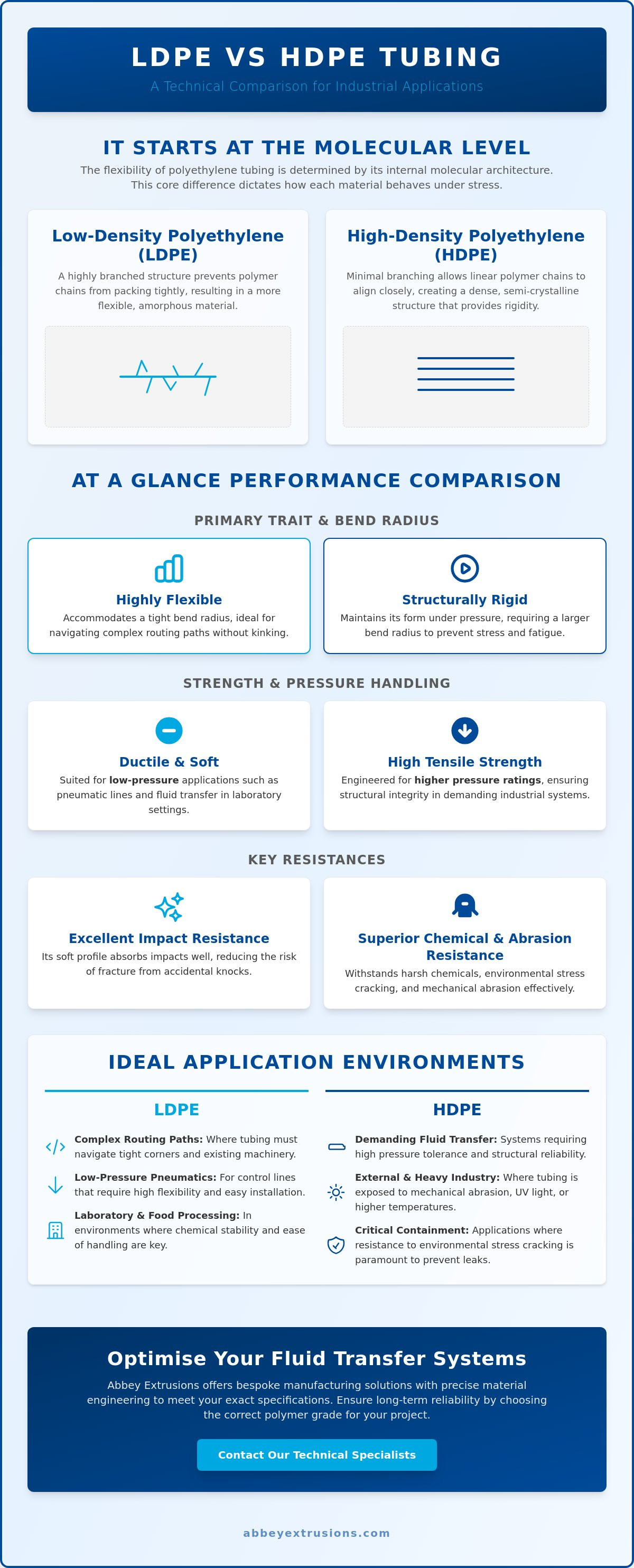
Low Density Polyethylene is favoured for its high degree of ductility and ease of handling during the installation process. Its molecular arrangement allows the material to bend without significant resistance, which is why it is often chosen for laboratory settings and low pressure pneumatic lines. Beyond its pliability, low density polythene tube provides excellent impact resistance whilst maintaining a soft profile. This makes it particularly useful in systems where the tubing must navigate around existing machinery or tight corners without the risk of permanent deformation or flow restriction.
Why High Density Polyethylene Offers Greater Rigidity
High Density Polyethylene is characterised by its high strength to density ratio. This material is engineered for applications that require greater structural integrity and higher pressure ratings than standard flexible tubes can provide. Because the molecular chains are more tightly packed, HDPE offers superior resistance to environmental stress cracking compared to lower density variants. It is the preferred choice for external installations or heavy industrial environments where the tubing may be exposed to mechanical abrasion or higher temperatures. Whilst it lacks the extreme pliability of LDPE, its durability ensures it remains a staple in demanding fluid transfer systems where structural collapse is not an option.
To ensure your industrial assembly utilises the most appropriate polymer for its specific routing requirements, please speak with our engineering team for technical assistance.
Comparing LDPE and HDPE Tubing Flexibility and Material Structure
The mechanical performance of polyethylene tubing is not a matter of chance but a direct consequence of its internal molecular architecture. When evaluating LDPE vs HDPE tubing flexibility, we must look at how the polymer chains are arranged during the extrusion process. It's these structural differences that dictate how a tube will respond when bent, twisted, or subjected to external pressure within an industrial assembly. Understanding the relationship between molecular density and pliability is essential for any engineer tasked with system design.
Molecular Branching and Its Impact on Tube Behaviour
The primary differentiator between these two polymers is the degree of molecular branching. Low Density Polyethylene (LDPE) features a highly branched structure where both long and short side chains prevent the molecules from packing together in a dense, orderly fashion. This results in a more amorphous material that retains a high degree of pliability, allowing it to flex easily under manual or mechanical force without compromising its structural integrity.
In contrast, High Density Polyethylene (HDPE) possesses minimal branching, which allows the linear polymer chains to align closely together. This tight packing creates a semi-crystalline structure that provides significant resistance to deformation and external stress. The degree of molecular branching inversely correlates with the Shore hardness of the final product, meaning that LDPE typically offers a softer, more compliant profile whilst HDPE provides the rigid, hard surface required for high-load applications.
Calculating Bend Radius for Industrial Routing
In practical industrial scenarios, these structural characteristics translate directly into the minimum bend radius of the tube. LDPE is the favourite choice for complex routing within confined spaces, such as compact machine manifolds or laboratory equipment. It allows for a significantly tighter bend radius without restricted flow or the risk of permanent kinking. This flexibility simplifies the installation process and reduces the need for additional fittings or elbows, which can often be a source of potential leaks.
HDPE requires much larger radius turns to maintain its structural integrity. If forced into a tight bend, the semi-crystalline chains can experience internal stress, leading to whitening, kinking, or eventual structural failure. Whilst HDPE is ideal for long, straight runs where rigidity is an advantage, it is less suited for intricate layouts. Engineers often require precise technical data to organise complex manifolds, and our team can provide the necessary guidance for your project. To ensure your system design incorporates the most efficient material for your routing requirements, you may wish to consult with our technical advisors for a detailed specification review.
For detailed technical specifications or to discuss how specific environmental factors might impact your system, contact our engineering department for professional advice.
Performance Characteristics Beyond Material Bend Radius
Whilst physical bend radius remains a primary consideration, industrial performance is rarely defined by a single mechanical metric. Engineers must balance LDPE vs HDPE tubing flexibility against the chemical environment and thermal fluctuations the system will encounter. Environmental factors can significantly alter the behaviour of a tube over its lifespan, leading to unexpected rigidity or structural degradation if the material is incorrectly specified. A comprehensive understanding of these secondary characteristics is essential to ensure that the chosen polymer remains fit for purpose throughout its operational life.
Chemical Resistance and Environmental Stress Cracking
High Density Polyethylene is typically the preferred choice for the transport of aggressive chemicals and solvents. Its dense, linear molecular structure provides a more robust barrier against solvent migration and chemical attack amongst the various polyethylene grades. Conversely, Low Density Polyethylene may be more susceptible to environmental stress cracking when exposed to certain oils, detergents, or surfactants. This phenomenon occurs when the material is under mechanical stress whilst in contact with a sensitising agent, leading to brittle failure. For a thorough assessment of chemical suitability, engineers should refer to our polyethylene tubing technical guides which contain detailed compatibility charts.
Temperature Stability and Flexibility Retention
Temperature fluctuations exert a direct influence on the stiffness and mechanical reliability of polyethylene. HDPE maintains its structural properties and tensile strength at higher temperatures than LDPE, making it suitable for applications where thermal exposure is a constant factor. However, LDPE offers a distinct advantage in sub-zero conditions. Whilst many industrial plastics become brittle and prone to shattering in cold environments, LDPE remains ductile and retains its essential pliability. This ability to absorb impact and resist cracking at low temperatures makes it an ideal material for refrigeration systems or outdoor installations in colder climates. Balancing these thermal requirements against the need for pliability ensures that the LDPE vs HDPE tubing flexibility remains consistent with the system's operational demands.
To discuss your specific project requirements and ensure the correct material specification for your fluid transfer system, please get in touch with our technical team for professional guidance.
Practical Selection Criteria for Industrial Fluid Transfer
Selecting the appropriate material for an industrial system requires a methodical assessment of the operational parameters. It's not enough to simply choose the most pliable option; the choice must be validated against the mechanical stresses and spatial constraints of the application. The primary trade-off in LDPE vs HDPE tubing flexibility involves balancing the ease of routing against the structural requirements of the fluid being transported. A precise specification at the design stage prevents costly retrofitting and ensures the longevity of the installation.
Evaluating Pressure Ratings Against Flexibility Needs
Higher density materials naturally support higher burst pressures due to their tightly packed molecular structure. HDPE is the superior choice for systems operating under significant pressure, whereas LDPE is generally restricted to low pressure or gravity fed systems where the risk of structural expansion is minimal. If your application demands the high pressure resistance typically associated with more rigid polymers whilst requiring the pliability of a flexible hose, a reinforced PVC tube may serve as a viable alternative to standard polyethylene. We always recommend identifying the maximum operating pressure, including potential surges, before finalised material selection.
Installation Considerations for Complex Manifolds
The ease of installation directly impacts project costs and labour time. LDPE allows for quicker manual routing through tight apertures, which is essential when assembling complex manifolds in restricted spaces. Its high ductility means it can be manipulated into position without the need for specialised tools or excessive force. HDPE, being more rigid, may require heat forming or the use of specific elbow fittings to navigate corners without kinking or inducing internal stress.
When the installation environment involves external exposure, factors like UV radiation and ambient temperature ranges must be considered. Whilst standard polyethylene provides a degree of resistance, prolonged UV exposure can lead to embrittlement, particularly in higher density grades. For systems requiring precise, repeatable geometries to navigate around fixed machinery, tube forming provides a permanent solution that maintains flow efficiency without the risk of kinking over time. If your system requires a custom geometry to navigate limited space, contact us to discuss our bespoke tube forming capabilities.
To ensure your project benefits from the highest standards of polymer engineering and technical support, please contact our specialist team today.
Sourcing High Performance Polyethylene Tubing from Abbey Extrusions
Abbey Extrusions provides expert manufacturing of both LDPE and HDPE tubing, drawing on decades of specialist experience within the plastic extrusion industry. We recognise that the decision between polymer grades is a critical engineering choice that impacts the entire lifecycle of a fluid transfer system. Our technical team is equipped to advise on the specific nuances of LDPE vs HDPE tubing flexibility, ensuring that the material specified for your project offers the optimal balance of pliability and structural integrity. By manufacturing all products at our dedicated UK facility, we maintain absolute control over the quality and consistency of every production run.
We pride ourselves on our ability to provide technical solutions that go beyond off the shelf products. Our collective expertise allows us to support clients from the initial design phase through to final logistics, ensuring that every technical parameter is met with precision. Whether you require standard dimensions or a bespoke solution for a complex industrial assembly, we provide the stability and reliability that only a traditional manufacturer can offer.
Bespoke Extrusion and Tube Forming Capabilities
Our facility offers customised profiles and tube forming services designed to solve unique engineering challenges. When standard flexible tubing cannot meet the spatial constraints of a compact machine manifold, our post extrusion forming processes ensure a permanent, kink free geometry. We have the capability to produce specialised variants, including anti static and food grade options, to suit the rigorous demands of the pharmaceutical and beverage sectors. Our material portfolio is extensive, featuring high performance polymers such as nylon tube and fluoropolymers, alongside our standard low density polythene tube tailored to your exact specifications.
UK Manufacturing Excellence and Quality Standards
Decades of experience in plastic extrusion have allowed us to refine our processes for diverse industrial sectors, from automotive to chemical processing. We remain committed to providing reliable and durable solutions for our national clients, focusing on the technical precision that modern engineering demands. Our manufacturing standards ensure that every batch of tubing adheres to strict tolerances, reducing the risk of system failure and ensuring compatibility with standard fittings. We don't just sell products; we provide the technical competence and long term trust required for successful industrial partnerships. Our focus on quality and customer service excellence remains a fundamental business norm, ensuring that your fluid transfer components perform as specified in even the most demanding environments.
To ensure your industrial assembly utilises the most appropriate polymer for its specific routing requirements, please speak with our technical team for engineering assistance.
Optimising Fluid Transfer Systems through Precise Material Specification
Selecting the correct polymer grade is a fundamental requirement for the long term efficiency of any industrial fluid system. The nuances of LDPE vs HDPE tubing flexibility are rooted in molecular branching, which directly influences bend radius and installation ease. Whilst LDPE offers superior pliability for intricate manifolds, HDPE provides the structural rigidity necessary for high pressure environments. Correct material specification prevents premature failure and reduces maintenance costs. Balancing these mechanical properties against thermal stability and chemical resistance ensures your system remains reliable under operational stress.
As a UK-based specialist manufacturer since 1985, Abbey Extrusions provides a comprehensive range of high-performance polymers tailored to meet unique engineering challenges. Our facility offers bespoke tube forming and extrusion services to deliver precise geometries that off the shelf components cannot achieve. If you require technical assistance with material selection for your project, please contact our engineering team to discuss your requirements. We look forward to supporting your next project with our decades of manufacturing expertise.
Frequently Asked Questions
Is LDPE tubing more flexible than HDPE
Yes, LDPE is significantly more flexible than HDPE due to its highly branched molecular structure which prevents a dense crystalline arrangement. This fundamental structural difference is the primary factor in LDPE vs HDPE tubing flexibility, allowing the material to bend easily without kinking. Whilst HDPE offers greater rigidity for straight runs, LDPE remains the preferred choice for applications requiring a tight bend radius and ease of manual routing through compact industrial assemblies.
Can HDPE tubing be used for high pressure applications
HDPE is better suited for higher pressure applications than LDPE due to its superior tensile strength and linear chain arrangement. Its high strength to density ratio allows the material to withstand greater internal pressures without significant expansion or structural failure. However, it's essential to consult specific burst pressure ratings for the tube's wall thickness and diameter before finalising your system design to ensure it meets safety standards for your specific fluid transfer requirements.
What is the typical bend radius for LDPE tubing
The typical bend radius for LDPE tubing is generally between three to five times its outside diameter, though this varies based on wall thickness and ambient temperature. This tight radius allows for efficient routing in confined spaces without the risk of flow restriction. Because of its ductile nature, LDPE can maintain this flexed position over long periods without experiencing the material fatigue or whitening often seen in more rigid polyethylene grades.
Does temperature affect the flexibility of polyethylene tubing
Temperature fluctuations have a direct impact on the mechanical behaviour of all polyethylene grades. Increased heat generally softens the polymer, whilst sub zero temperatures cause the material to become more rigid. LDPE is particularly valued for its ability to remain ductile in cold environments where other plastics might become brittle. Conversely, HDPE maintains its structural integrity at higher temperatures, providing better resistance to thermal softening in heavy industrial settings.
Which material is better for chemical resistance LDPE or HDPE
HDPE offers superior chemical resistance amongst the polyethylene grades because its dense molecular structure provides a more effective barrier against solvent migration. It is the preferred choice for transporting aggressive chemicals and solvents that might cause environmental stress cracking in lower density variants. Whilst LDPE is suitable for many aqueous solutions, it remains more susceptible to absorption and structural degradation when in contact with certain oils or surfactants over long periods.
Are LDPE and HDPE tubing suitable for food grade applications
Both LDPE and HDPE can be manufactured to meet food grade standards, provided they are produced from virgin resins that comply with relevant safety regulations. These materials are inherently non toxic and resistant to bacterial growth, making them ideal for beverage distribution and food processing. At Abbey Extrusions, we ensure that our food grade tubing maintains the necessary purity and chemical stability required for safe contact with consumables in commercial environments.
How do I prevent my polyethylene tubing from kinking
Preventing kinking requires a precise match between the material's minimum bend radius and the system's routing path. If a tight turn is unavoidable, selecting LDPE or a reinforced variant is often the most effective solution. Additionally, using proper support brackets and avoiding mechanical tension during installation will reduce the risk of structural collapse. For permanent, complex geometries, professional tube forming services can provide a pre shaped solution that eliminates the risk of kinking entirely.
Can HDPE tubing be formed into specific shapes
Yes, HDPE can be formed into specific, permanent shapes through professional tube forming processes. Whilst it is more rigid than LDPE at room temperature, it is a thermoplastic that can be shaped using controlled heat and specialised tooling. This allows for the creation of complex, repeatable geometries that maintain their structural integrity and flow efficiency. Pre formed HDPE components are particularly useful in automotive and industrial machinery where space for traditional fittings is limited.

Article by
Bryan Cowan
Bryan Cowan is the Founder and Managing Director of Abbey Extrusions Ltd, a leading UK manufacturer of high-quality plastic tubes and hoses. With over 40 years of industry experience, Bryan established the company in 1985, growing it from a startup into a BS ISO9001-registered supplier for global sectors including aerospace, automotive, and pharmaceuticals.
Disclaimer
This article is intended for informational purposes only. Please ensure you seek expert advice or carry out your own research to confirm the information is suitable for your specific needs.