Selecting the wrong pneumatic tubing isn't just a minor oversight; it's a calculated risk that often leads to catastrophic system failure and expensive downtime. You likely understand that whilst flexibility is often a priority in tight spaces, the structural integrity of your air lines determines the overall reliability and safety of your industrial operations. Identifying the correct material is essential to prevent split lines and ensure your facility remains compliant with evolving safety standards.
This comprehensive engineering guide provides a rigorous comparison of nylon vs polyurethane tubing for pneumatics to help you organise a system that achieves maximum efficiency and long-term durability. We recognise that maintenance frequency and material degradation are significant concerns for any plant manager or engineer. Therefore, we will examine the technical differences between these polymers, including their performance under pressure and their resistance to chemicals like n-hexane, which was added to the REACH SVHC Candidate List in February 2026.
By the end of this analysis, you will be able to identify the most cost-effective material for your specific environment whilst ensuring compliance with the updated ISO 2507:2026 standards. We shall guide you through the mechanical properties and environmental factors that dictate whether Nylon 11 and 12 or flexible polyurethane is the superior choice for your pneumatic circuit.
Key Takeaways
- Understand the fundamental mechanical differences between semi-rigid thermoplastics and flexible elastomers to select the most stable material for your unique pneumatic circuit.
- Evaluate the structural stability and burst pressure ratings when comparing nylon vs polyurethane tubing for pneumatics to ensure your system operates safely under high-pressure loads.
- Determine the ideal minimum bend radius for your installation to eliminate the risk of kinking and air flow restriction in compact or dynamic machinery.
- Assess environmental resilience by reviewing the chemical compatibility and temperature performance of each polymer against industrial solvents and oils.
- Identify the specific industrial scenarios where Nylon 11 and 12 offer superior durability compared to the high-flexibility benefits of Polyurethane.
Understanding the Fundamental Material Differences for Pneumatic Systems
The efficiency of a pneumatic system is fundamentally dictated by the chemical composition of its air lines. When evaluating nylon vs polyurethane tubing for pneumatics, engineers must distinguish between the structural rigidity of thermoplastics and the elastic nature of elastomers. These material classifications determine how a tube reacts to pressure spikes, environmental heat, and mechanical stress. Central to this behaviour is the Shore hardness rating, which measures a material's resistance to indentation. Whilst a higher Shore D rating indicates a stiffer tube capable of maintaining its profile, a lower Shore A rating suggests the pliable, rubber like characteristics necessary for dynamic movement.
Material selection serves as the primary factor in determining long term system reliability. Choosing a tube that lacks the necessary hardness for a high pressure fitting or the required flexibility for a robotic arm lead to premature failure. This technical guide examines the mechanical properties that define performance, focusing on how molecular structures influence real world application.
Defining Nylon 11 and 12 Properties
Nylon, or polyamide, is a semi rigid thermoplastic polymer known for its exceptional toughness and dimensional stability. By Understanding Polyamide (Nylon) at a molecular level, it becomes clear why these materials are the industry standard for high pressure circuits. Unlike standard Nylon 6, high grade Nylon tube variants such as Nylon 11 and 12 are engineered for exceptionally low moisture absorption. This property is vital because it prevents the tubing from swelling or becoming brittle in humid environments, ensuring the internal diameter remains consistent for precise airflow. This structural integrity allows the tubing to withstand continuous vibration and mechanical abrasion without compromising the seal of push-in fittings.
Defining Polyurethane Elastomer Characteristics
In contrast, Polyurethane (PU) functions as a highly flexible elastomer that bridges the gap between plastics and rubber. This material's defining feature is its memory, which allows it to return to its original shape after significant stretching or bending. When selecting a Polyurethane tube, engineers must choose between ether based and ester based formulations. Ether based PU offers superior resistance to moisture and fungus, making it ideal for humid climates, whilst ester based variants provide better oil and fuel resistance. Because of this extreme flexibility and kink resistance, PU is the primary choice for robotics and automated machinery where constant, rapid motion would cause semi rigid materials to fatigue and fail.
If you require technical assistance to determine the correct pressure ratings for your system, please consult our engineering team for a detailed material specification.Pressure Performance and Structural Stability in Air Lines
The mechanical behaviour of air lines under load is a critical safety consideration for any pneumatic installation. When comparing nylon vs polyurethane tubing for pneumatics, the primary distinction lies in their burst pressure thresholds and their ability to maintain dimensional stability. Nylon 11 and 12 typically exhibit significantly higher working pressures than their polyurethane counterparts. Whilst a standard PU tube might be rated for 10 bar, a similarly sized nylon tube can often handle 20 bar or more, depending on the wall thickness and the specific grade of the polymer.
Industrial safety standards usually require a 3:1 or 4:1 safety ratio between the working pressure and the ultimate burst pressure. Softer materials like polyurethane are susceptible to "ballooning," a phenomenon where the tube diameter expands under pressure or heat. This expansion reduces the effective wall thickness and increases the risk of a catastrophic split. Nylon's semi rigid molecular structure resists this deformation, maintaining a constant internal diameter even during peak pressure surges. This stability is essential for ensuring consistent airflow and preventing the pressure drops that lead to system inefficiency.
Performance Under High Pressure Loads
For fixed pneumatic installations and long distance air distribution, Nylon 11 & 12 Flexible Tubing remains the industry benchmark. Its high tensile strength ensures that the tube does not stretch or fatigue over time. Temperature plays a decisive role in pressure retention; as ambient heat increases, the maximum working pressure of all polymers decreases. However, nylon retains its structural integrity at higher thermal levels far better than PU. This thermal stability extends the service life of the entire pneumatic circuit and reduces the frequency of line replacements in demanding environments.
Dimensional Stability and Kink Resistance
Dimensional precision is essential for effective sealing and connector reliability. The rigidity of nylon ensures it interfaces perfectly with push-in fittings without the risk of the tube wall collapsing under the pressure of the internal claws. This is a key factor in how tubing material affects pneumatic quick couplers, as a firmer tube provides a more secure grip and a more reliable airtight seal. Whilst nylon resists kinking in long, straight runs, it lacks the elastic memory of polyurethane. If a nylon tube is bent beyond its minimum radius, it may permanently deform, whereas PU will typically spring back to its original shape. If you're unsure which pressure rating suits your environment, we recommend you speak with our technical department for a precise recommendation.
To discuss the mechanical requirements of your specific machinery or to request samples for durability testing, please contact our technical specialists for professional guidance.Flexibility and Mechanical Durability Comparison
In dynamic industrial environments, the ability of an air line to withstand repeated motion and physical impact is just as vital as its pressure rating. Whilst the previous sections established the structural superiority of nylon for high pressure loads, the debate of nylon vs polyurethane tubing for pneumatics often shifts in favour of polyurethane when mechanical flexibility is the primary requirement. Polyurethane possesses a lower flexural modulus. This means it requires less force to bend and is far less likely to suffer from stress cracking during continuous cycles of movement. This property is particularly advantageous in automated systems where lines must follow the complex path of a multi-axis robotic arm without fatiguing.
Mechanical durability also encompasses the material's reaction to external forces. If a tube is accidentally crushed or stepped on, nylon may retain a permanent crease that restricts air flow. Polyurethane, however, demonstrates excellent impact recovery. It typically returns to its original circular profile once the external pressure is removed. This resilience makes it the preferred choice for floor-level installations or areas with high foot traffic where accidental compression is a daily occurrence. We often see systems where the ability to absorb vibration also reduces the noise and wear on associated fittings.
Bend Radius and Routing in Tight Spaces
Technical specifications for any pneumatic circuit must include the minimum bend radius. This is defined as the radius of the smallest circle a tube can be bent into without kinking or compromising the internal cross-sectional area. Using Polyurethane Tube allows for much tighter routing within compact manifolds and control cabinets compared to semi-rigid materials. When routing lines, engineers should always aim for a radius larger than the manufacturer's minimum. This ensures laminar flow and prevents unnecessary turbulence. If a line is forced into too tight a corner, the resulting kink can cause a significant pressure drop, leading to sluggish actuator performance and increased energy costs.
Resistance to Abrasion and Repeated Flexing
In automated robotics, air lines are frequently housed within "drag chains" where they are subjected to constant sliding and rubbing against other cables or the machine frame. Polyurethane is naturally more resistant to this type of surface abrasion than nylon. Its elastic surface tends to deflect abrasive forces rather than being scored by them. However, in environments where nylon must be used for its pressure benefits but is exposed to external wear, the application of a Nylon Spiral Cut Hose Guard provides an essential protective layer. This sacrificial sleeve organises multiple lines whilst preventing direct contact between the tubing and abrasive surfaces. It's a simple yet effective way to prevent the small surface nicks that eventually lead to catastrophic air line failure.
To ensure your pneumatic system is specified for its exact operating environment, please request a chemical compatibility chart from our technical team.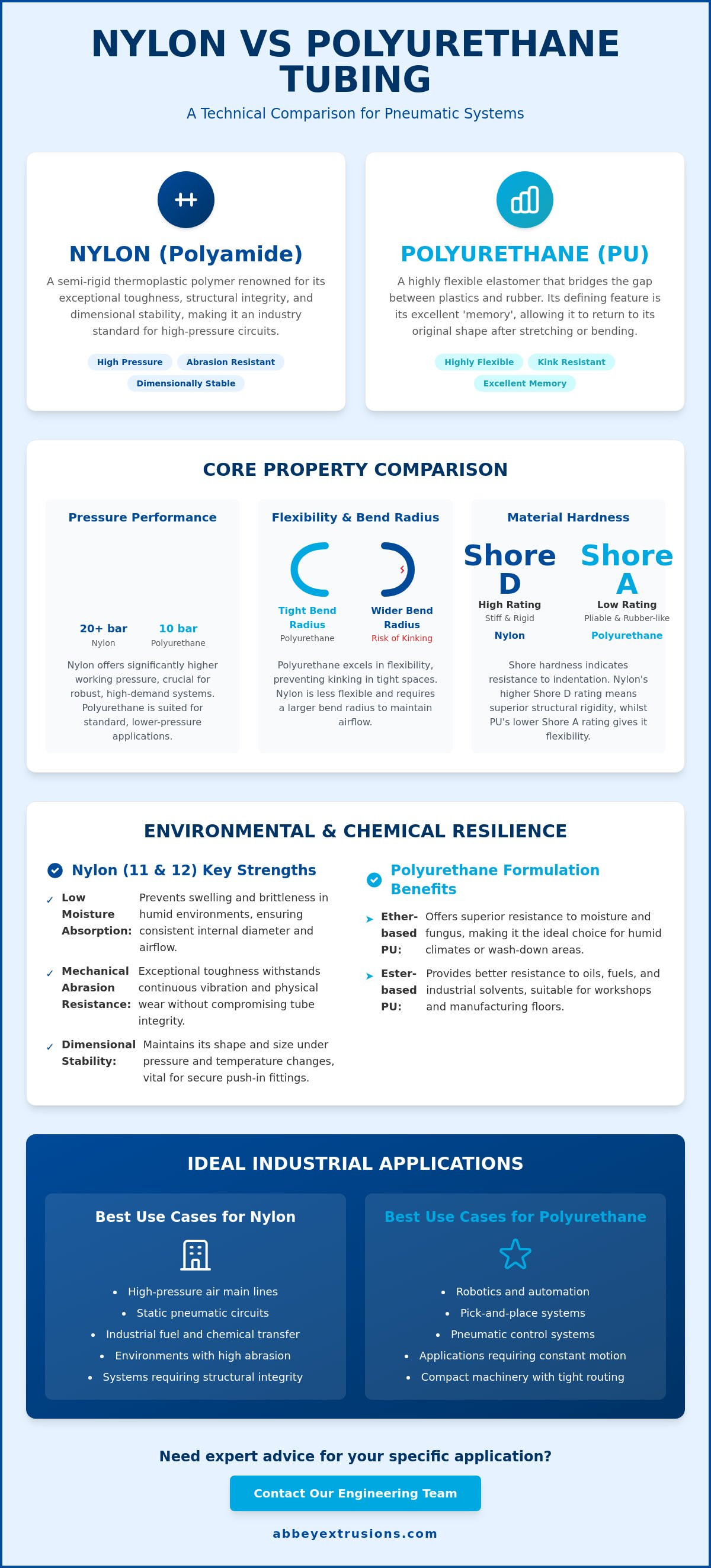
Environmental Resilience and Chemical Compatibility Considerations
Environmental stressors are the silent killers of pneumatic efficiency. Whilst mechanical properties are vital, the chemical and thermal context of the application determines the long term behaviour of the material. When evaluating nylon vs polyurethane tubing for pneumatics, engineers must account for the presence of industrial solvents, UV radiation, and moisture levels. A material that performs perfectly in a temperature controlled laboratory may fail rapidly when exposed to the harsh realities of a factory floor or an outdoor installation.
Degradation often manifests as a loss of flexibility, surface cracking, or a reduction in burst pressure capacity. These issues are frequently accelerated by the presence of substances recently added to the REACH SVHC Candidate List, such as n-hexane. Understanding how these polymers interact with their surroundings is essential for reducing maintenance frequency and ensuring the long term safety of your pneumatic circuit.
Temperature Performance Ranges
Nylon 11 and 12 maintain a superior thermal ceiling compared to standard polyurethane. In high temperature environments, PU can soften significantly, which drastically lowers its maximum working pressure and increases the risk of the "ballooning" effect. However, nylon can become increasingly brittle in extreme sub-zero conditions. Conversely, polyurethane retains its elastic properties in the cold, making it the preferred choice for outdoor pneumatic systems in winter climates where semi-rigid lines might snap under vibration or impact. Engineers must always de-rate the working pressure of both materials as the ambient temperature rises above 20 degrees Celsius.
Chemical Resistance and External Exposure
Nylon 12 is widely regarded as the superior choice for industrial applications involving direct contact with fuels, greases, and oils. It resists the swelling and softening that can occur in lesser polymers. Polyurethane selection requires more nuance, specifically the choice between polyether and polyester formulations. Polyester based PU is highly vulnerable to hydrolysis, a process where moisture causes the polymer chains to break down, resulting in the material crumbling. For humid environments or wash-down areas, polyether based Polyurethane Tube is essential to prevent premature failure.
UV exposure is another critical factor often overlooked in system design. Prolonged sunlight causes surface micro cracking and "chalking" in unprotected tubes. For outdoor installations, we recommend specifying UV stabilised variants of Nylon tube to prevent environmental stress cracking. If you are operating in a harsh chemical environment, please contact us for a technical consultation to ensure your material choice is compliant with the latest industrial safety standards.
If you are ready to discuss your specific project requirements or need advice on custom extrusion profiles, please contact our technical sales team to find the ideal solution.Practical Application Guide for Industrial Tubing Selection
The final decision regarding nylon vs polyurethane tubing for pneumatics depends entirely on the mechanical and environmental demands of your specific application. Whilst previous sections highlighted individual material strengths, industrial reality often requires a hybrid approach. For instance, a main factory ring main benefits from the high pressure stability of nylon, whilst the final connection to a moving actuator might require the extreme flexibility of polyurethane. Identifying these nuances early in the design phase prevents costly retrofits and ensures the system operates within its intended safety margins.
Selecting the correct polymer is the first step in building a resilient pneumatic circuit. Engineers must balance the need for structural rigidity with the requirement for elastic recovery, particularly in automated environments. By understanding the technical limitations of each material, you can organise a system that minimises air leaks and maximises component longevity.
Application Specific Recommendations
Static factory air lines and fixed distribution manifolds are best served by Nylon 11 or 12. Its semi-rigid nature allows for long, straight runs that maintain their profile without sagging. For workshop environments where pneumatic tools are used frequently, a Nylon Recoil Air Hose offers the perfect balance of durability and storage convenience. These hoses are engineered to retract into a compact coil when not in use, preventing trip hazards and protecting the line from floor-level damage.
In contrast, high-speed automation and robotic pick and place systems demand the superior flexural fatigue resistance of polyurethane. If your system involves constant, rapid directional changes, PU is the only material that can withstand millions of cycles without stress cracking. For particularly complex or crowded machinery layouts, Tube Forming allows for the creation of pre-shaped lines. This technique organises the layout, reduces the risk of incorrect connections during maintenance, and ensures that every tube follows a precise, space-saving path.
Sourcing UK Manufactured Tubing Solutions
Choosing a specialist UK manufacturer ensures that your pneumatic tubing meets rigorous quality control standards and remains compliant with updated safety directives. We understand that standard off-the-shelf sizes don't always meet the requirements of custom engineering projects. Therefore, we offer bespoke extrusion profiles and custom colours to help you organise complex pneumatic circuits effectively. Working with a domestic partner also provides the advantage of shorter lead times and direct access to technical expertise for material testing and validation.
Reliability in the manufacturing sector is built on precise engineering and consistent material quality. When weighing the benefits of nylon vs polyurethane tubing for pneumatics, you must consider the long-term impact on maintenance and energy efficiency. Whether you require a standard Nylon tube for a high-pressure installation or a flexible Polyurethane tube for a dynamic robotic cell, the correct material choice will significantly reduce your operational downtime. Our production processes are designed to deliver the stability and precision that modern industrial systems demand.
If you require any further technical specifications or wish to discuss a bespoke project with our experts, please contact our engineering team for professional support.
Optimising Your Pneumatic System for Long Term Reliability
The technical evaluation of nylon vs polyurethane tubing for pneumatics is a critical engineering decision that directly impacts the efficiency and safety of your industrial operations. Whilst nylon provides the structural rigidity and high pressure ratings necessary for stable air distribution, polyurethane delivers the flexible performance and memory required for dynamic machinery and robotics. Accounting for environmental factors such as temperature extremes and chemical exposure is essential to prevent premature failure and reduce maintenance frequency.
As a dedicated UK manufacturer since 1985, we specialise in high quality Nylon 11 and 12 extrusions designed for the most demanding environments. Our capabilities include bespoke tube forming and profile services to help you organise complex layouts with engineering precision. Selecting the correct material is a vital investment in the long term stability of your facility and its compliance with safety standards.
Contact Abbey Extrusions today for expert advice on pneumatic tubing selection to ensure your system achieves maximum performance. We look forward to supporting your engineering requirements with our decades of manufacturing expertise.
Frequently Asked Questions
Is nylon or polyurethane tubing better for high pressure air
Nylon 11 and 12 are significantly better for high pressure air applications due to their higher tensile strength and superior burst pressure ratings. Whilst polyurethane is typically rated for lower pressures, nylon maintains its structural integrity under constant high loads without the risk of ballooning. This makes nylon the preferred choice for fixed factory installations where pressure stability and safety are the primary engineering requirements.
Does polyurethane tubing kink more easily than nylon
No, polyurethane tubing is far more resistant to kinking than nylon because it is an elastomer with excellent elastic memory. Nylon is a semi rigid thermoplastic that can permanently deform or kink if it is bent too sharply during installation. When evaluating nylon vs polyurethane tubing for pneumatics, PU is the superior choice for dynamic applications where the air line must flex repeatedly without restricting flow.
What is the difference between ester based and ether based polyurethane
Ether based polyurethane offers superior resistance to moisture and fungus, whereas ester based polyurethane provides better resistance to oils and industrial fuels. If your application involves humid environments or frequent water contact, ether based PU is essential to prevent hydrolysis, which causes the polymer to crumble. Ester based variants are better suited for workshop environments where contact with grease or lubricants is a daily occurrence.
Can I use nylon tubing for outdoor pneumatic applications
Yes, you can use nylon for outdoor applications provided you specify a UV stabilised grade to prevent environmental stress cracking. Standard nylon can become brittle when exposed to prolonged sunlight and extreme sub zero temperatures. Selecting black UV resistant tubing ensures that the material maintains its mechanical properties and pressure rating despite constant exposure to the elements.
Which tubing material is more resistant to abrasion
Polyurethane is generally more resistant to surface abrasion and mechanical wear than nylon due to its elastic nature. Its surface can deflect abrasive forces that would otherwise score or notch a stiffer material. This characteristic makes PU ideal for use in drag chains or robotic arms where the tubing frequently rubs against machine frames or other cables during operation.
Is nylon 11 or nylon 12 better for pneumatic systems
Both materials are excellent for industrial use, but Nylon 12 is the most common standard for pneumatic systems due to its exceptionally low moisture absorption and dimensional stability. Nylon 11 is often chosen for its slightly better flexibility and superior impact resistance at very low temperatures. Both polymers provide the long term reliability needed for high pressure pneumatic circuits in a variety of climates.
What happens if I exceed the bend radius of pneumatic tubing
Exceeding the minimum bend radius causes the tube to kink, which leads to a significant pressure drop and restricted airflow within the system. In semi rigid materials like nylon, this can result in permanent deformation or a stress crack that compromises the burst pressure. Always ensure your routing follows the manufacturer's specified radius to maintain laminar flow and prevent unnecessary mechanical fatigue.
Are these tubing materials compatible with push in fittings
Both nylon and polyurethane are fully compatible with standard push in fittings provided the external diameter is manufactured to precise metric or imperial tolerances. The rigidity of nylon makes it particularly easy to insert and provides a very secure grip for the internal claws of the fitting. When using softer polyurethane, it is essential to ensure the tube is cut perfectly square to maintain a reliable airtight seal.

Article by
Bryan Cowan
Bryan Cowan is the Founder and Managing Director of Abbey Extrusions Ltd, a leading UK manufacturer of high-quality plastic tubes and hoses. With over 40 years of industry experience, Bryan established the company in 1985, growing it from a startup into a BS ISO9001-registered supplier for global sectors including aerospace, automotive, and pharmaceuticals.
Disclaimer
This article is intended for informational purposes only. Please ensure you seek expert advice or carry out your own research to confirm the information is suitable for your specific needs.