Why would a procurement team willingly pay a significant premium for a fluoropolymer tube that looks, at first glance, almost identical to its more affordable counterpart? It is a common challenge amongst industrial engineers when they must justify the substantial cost of PFA tubing vs PTFE to stakeholders who prioritise immediate savings over long term reliability. You likely recognise that whilst PTFE is a versatile industry standard, the uncertainty regarding its performance in highly corrosive or high purity environments can lead to costly downtime if the wrong material is specified.
This technical comparison provides the evidence you need to determine exactly where the investment in Perfluoroalkoxy (PFA) is justified and where Polytetrafluoroethylene (PTFE) remains the most efficient choice for your specific application. We shall explore how melt-processability and superior stress-crack resistance influence the total cost of ownership, ensuring your procurement strategy is backed by engineering data. By examining the nuances of welding capabilities and optical clarity, we will clarify how these materials sit within a global high-performance fluoropolymer market projected to reach $5.37 billion by 2026.
Key Takeaways
- Identify the baseline price differential where premium PFA can often cost double or triple that of standard PTFE materials.
- Evaluate the cost of PFA tubing vs PTFE by considering total cost of ownership factors such as reduced maintenance and longer service life.
- Understand how the superior optical clarity of PFA allows for visual fluid monitoring to prevent expensive system blockages and downtime.
- Learn how the melt-processable nature of PFA enables the extrusion of continuous lengths that are not achievable through traditional PTFE sintering.
- Utilise a technical selection checklist to balance upfront material expenditure against the specific demands of high-purity or corrosive environments.
If you require expert guidance on selecting the most appropriate fluoropolymer for your industrial application, please visit our contact page to speak with a member of our technical team.
Understanding the Price Differential Between PFA and PTFE Tubing
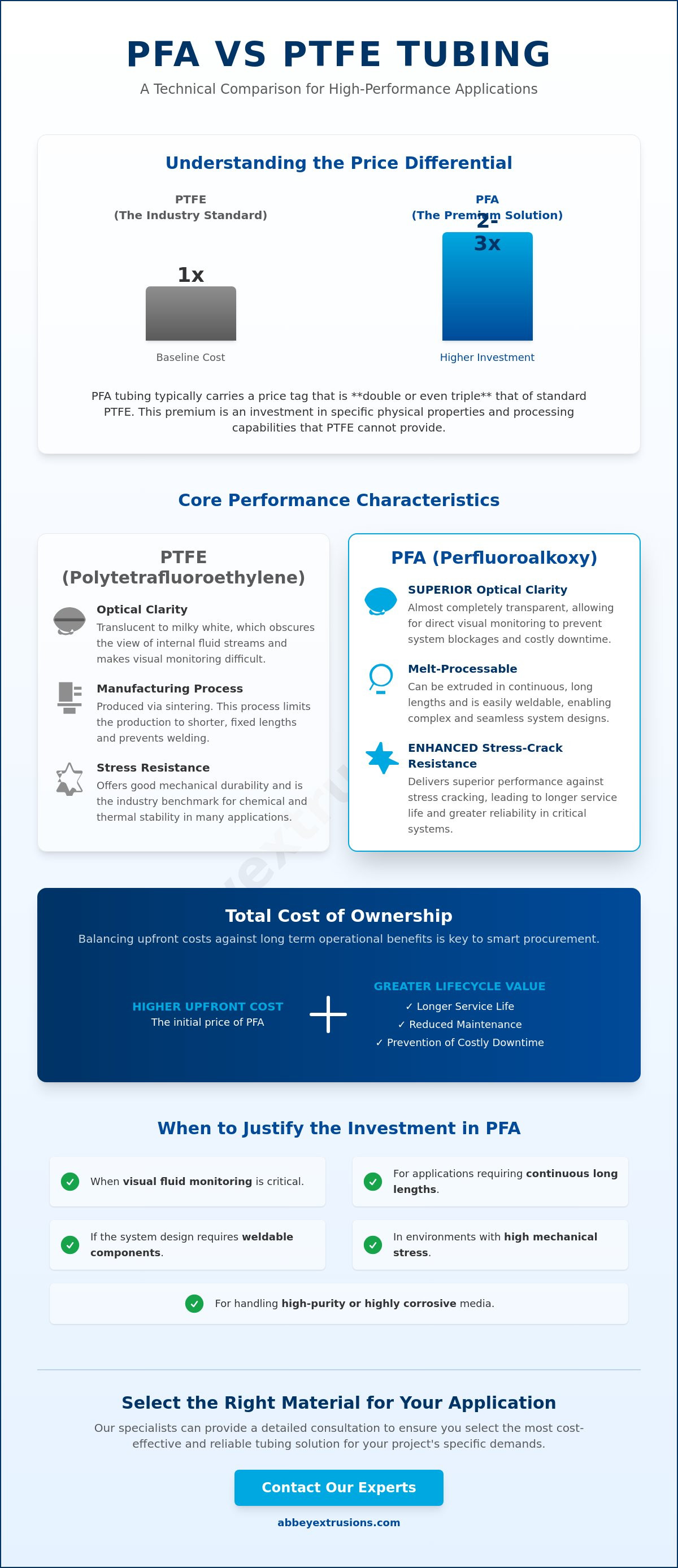
Within the field of high-performance plastics, Polytetrafluoroethylene (PTFE) serves as the primary benchmark for chemical resistance and thermal stability. It's the most widely utilised fluoropolymer in the manufacturing industry, largely due to its established production methods and relative affordability. However, when project specifications demand enhanced flexibility or optical clarity, engineers often turn to Perfluoroalkoxy (PFA). The cost of PFA tubing vs PTFE is a significant factor in procurement. PFA typically carries a price tag that is double or even triple that of standard PTFE. Whilst both materials offer exceptional resistance to aggressive chemicals, the disparity in pricing is a direct reflection of their distinct molecular structures and the complexity involved in their synthesis.
We categorise these materials as high-performance polymers to distinguish them from standard industrial plastics. Whilst standard materials are sufficient for many pneumatic and fluid transfer tasks, fluoropolymers are reserved for environments where failure is not an option. The premium paid for PFA is not merely a surcharge but an investment in specific physical properties that PTFE cannot provide.
Comparing Fluoropolymers to Standard Industrial Tubing
To understand the fluoropolymer baseline, one must contrast it with more common materials. For instance, a Nylon tube is the workhorse of general engineering, offering excellent mechanical strength at a fraction of the cost of any fluoropolymer. However, Nylon will degrade rapidly when exposed to concentrated acids or extreme temperatures. Similarly, a Polyurethane tube represents a highly cost effective solution for non-corrosive air lines and abrasive environments. Fluoropolymers like PTFE and PFA are selected only when these standard plastics reach their physical limits. The price jump from a standard industrial tube to a fluoropolymer is substantial. The jump from PTFE to PFA is an even more refined graduation in performance and cost.
Raw Material Sourcing and Market Volatility
The fundamental driver behind the higher cost of PFA lies in its chemical composition. The addition of an alkoxy modifier during the polymerisation process allows PFA to be melt-processable. This feature is one that PTFE lacks. This modifier is expensive to produce and integrate, which significantly inflates the raw resin price. Beyond this, the global supply chains for these specialised resins are subject to fluctuations that impact UK manufacturing costs. Whilst the market for PTFE resin is relatively mature and stable, the PFA market remains a niche sector. This smaller scale of production, combined with the technical difficulty of sourcing high-purity raw materials, ensures that PFA remains a premium commodity. Understanding the cost of PFA tubing vs PTFE requires a holistic view of the application's chemical and thermal demands.
To discuss your specific technical requirements and material compatibility, you may reach out to our engineering specialists for a detailed consultation.
Performance Characteristics That Influence Total Cost of Ownership
Whilst the initial purchase price is a primary consideration, a professional procurement strategy must account for the total cost of ownership over the component's lifecycle. When evaluating the cost of PFA tubing vs PTFE, technical performance factors such as clarity, permeability, and mechanical stability often offset the higher upfront investment through reduced maintenance and extended service intervals. We find that specifying the correct material from the outset is the most effective way to manage long term operational expenditure.
Optical Clarity and Flow Monitoring
One of the most distinct physical differences between these two fluoropolymers is their visual appearance. Standard extruded PTFE is typically a milky white or translucent material, which obscures the view of the internal fluid stream. In contrast, PFA offers superior optical clarity, appearing almost completely transparent. This clarity is essential in chemical processing and laboratory environments where visual inspection is the first line of defence against system failures.
The ability to monitor fluid flow, detect bubbles, or identify sediment without dismantling the system significantly reduces maintenance labour costs. If a blockage is identified early via visual inspection, a facility can avoid the catastrophic expenses associated with pump failure or contaminated batches. For many high-precision industries, this clear-view capability alone justifies the price gap. It allows for a proactive rather than reactive maintenance schedule.
PFA is also frequently specified for high-purity gas handling due to its lower gas permeability compared to PTFE. This ensures that volatile gases do not leach through the tube wall, maintaining the integrity of the process and the safety of the workspace. Additionally, PFA exhibits greater resistance to cold flow, or creep, under pressure. This mechanical stability ensures that seals and fittings remain secure for longer periods, resulting in fewer leaks and a lower frequency of component replacement.
Mechanical Durability and Stress Resistance
In dynamic applications where tubing is subject to constant movement or vibration, the flex life of the material becomes a critical cost factor. PFA generally offers a higher flex life than PTFE, meaning it can withstand a greater number of bending cycles before fatigue sets in. This durability is particularly valuable in high-heat environments where thermal cycling can induce stress cracking in lesser materials. It is a vital consideration for systems operating at the edge of their thermal limits.
By choosing a material that resists stress cracking, engineers reduce the risk of unexpected component failure. Whilst the cost of PFA tubing vs PTFE might seem high at the point of sale, the reduction in downtime and the extension of replacement cycles provide a clear economic advantage. If you are unsure which material best suits your system's pressure and temperature profiles, you can consult our technical team for a precise recommendation based on your specific industrial environment.
If you require further technical specifications or wish to discuss a bespoke manufacturing requirement, please visit our contact page to consult with our engineering team.
How Manufacturing Processes Impact the Market Price of Fluoropolymers
The substantial price gap between these materials is deeply rooted in the physical methods used to shape them. Whilst raw resin costs are a factor, the manufacturing journey from powder or pellet to a finished tube dictates much of the final market price. PTFE is notoriously difficult to process because it does not flow when heated; it must be shaped using techniques more akin to powder metallurgy. In contrast, PFA is a melt-processable fluoropolymer. This fundamental difference allows for more efficient production cycles and influences the cost of PFA tubing vs PTFE when specified for complex industrial systems.
Melt Processing vs Sintering
Sintering is the process of compressing and heating a powdered material until the particles adhere to one another without the substance reaching its melting point. This is the traditional method for producing PTFE components, but it is inherently limited. It often results in higher material waste and restricts the continuous length of the tubing that can be produced. Because PFA can be melted, it allows for sophisticated custom plastic extrusion in virtually unlimited continuous lengths.
The melt-processable nature of PFA also enables the manufacture of complex profiles and significantly tighter tolerances compared to the standard extrusion of PTFE. These manufacturing efficiencies can sometimes offset the higher resin price by reducing the need for secondary machining or finishing processes. When a project requires precise dimensions and long, uninterrupted runs, the production advantages of PFA become a vital part of the value proposition.
Assembly and Secondary Services
The ability to manipulate the material after the initial extrusion phase provides another layer of cost justification. PFA can be welded and heat sealed, which simplifies the assembly of complex fluid handling systems. This capability reduces the reliance on expensive mechanical fittings and connectors that are often prone to leaking in corrosive environments. PTFE is famously difficult to join without specialised chemical etching or bonding agents, which adds labour and material costs to the installation phase.
Furthermore, specialised services such as tube forming can be applied to PFA to create specific, permanent shapes that fit perfectly within a machine's footprint. Whilst PTFE can be formed to an extent, PFA maintains these custom geometries with greater stability. When analysing the cost of PFA tubing vs PTFE, one must consider these downstream assembly savings. A system that is easier to weld and form will always be more cost effective to install and maintain than one requiring complex mechanical joints.
For expert advice on selecting the right fluoropolymer for your industrial environment, please contact our technical specialists.
Industrial Scenarios Where PFA Justifies Its Premium Price
Determining the appropriate material requires a clinical assessment of the risks associated with system failure. In some sectors, the initial cost of PFA tubing vs PTFE is a secondary concern compared to the financial implications of a single batch contamination or an unexpected leak. Whilst PTFE remains the most efficient choice for many standard applications, PFA is indispensable when the margin for error is non-existent. We observe that the electronics and electrical sector, which accounts for a 27% share of the fluoropolymer market, increasingly relies on the specific purity levels that only PFA can provide.
High Purity and Semiconductor Applications
PFA is the undisputed gold standard for transporting aggressive acids and high-purity chemicals in semiconductor chip manufacturing. In these ultra-clean environments, the presence of even trace metallic ions can ruin an entire production run. Because PFA resin is synthesised with a focus on ultra-high purity, it lacks the metallic extractables that might be found in other fluoropolymers. The risk of using a cheaper material in a multi-million pound production line is simply too great. A single contaminated batch could result in losses that dwarf the annual procurement budget for high-end tubing.
Beyond the semiconductor cleanroom, PFA is frequently specified in food and beverage production. In these facilities, non-contamination is not merely a preference but a strict legal requirement. The smooth internal surface of PFA prevents the accumulation of bacteria and particulates, ensuring that the system remains compliant with stringent health and safety regulations over a long service life.
General Chemical Resistance and Transfer
For standard industrial acid transfer where ultra-high purity is not the primary driver, PTFE tubing is usually the most sensible and cost-effective choice. It provides the same level of chemical inertness as PFA at a much lower price point. In these scenarios, the lower material cost allows maintenance teams to implement more frequent preventative replacement schedules without straining the budget. It's a pragmatic approach for general engineering tasks where the material isn't subjected to extreme dynamic flexing or high pressures.
You should consider transitioning from PTFE to PFA when your system demands higher mechanical stability at elevated temperatures or when the installation requires welded joints. If your application involves constant vibration or thermal cycling, the superior stress-crack resistance of PFA will prevent premature failure. To ensure you are specifying the most economical material for your specific chemical profile, please enquire with our engineering team for a technical review of your project requirements.
To request a technical quotation or to discuss material compatibility for your project, please visit our contact page to speak with our engineering department.
Selecting the Most Cost Effective Tubing for Your Project
Finalising a procurement strategy for high-performance fluoropolymers requires a methodical assessment of the application's physical and chemical demands. Whilst the initial cost of PFA tubing vs PTFE remains a primary concern for many project managers, we recommend a shift in focus toward the anticipated service life and the complexity of the installation. A professional decision is rarely based on the unit price alone but on the material's ability to maintain system integrity under specific stressors. By balancing the upfront expenditure against the potential for reduced maintenance and longer replacement cycles, you can ensure a lower total cost of ownership.
Decision Matrix for Fluoropolymer Selection
To assist in your selection process, we have developed a concise checklist based on the technical parameters discussed in this guide. Standardising your choice according to these criteria will help prevent both over-specification and the risks associated with material failure.
- Is optical clarity required? If your system relies on visual flow monitoring to prevent blockages, PFA is the necessary choice.
- Are you operating in the semiconductor sector? For ultra-high purity requirements and the elimination of metallic ions, PFA is mandatory.
- Is the application a standard, static chemical transfer? If high purity and dynamic flexing are not critical, PTFE is the favourite for its cost efficiency.
- Does the assembly require welded joints? If you wish to avoid mechanical fittings, the melt-processability of PFA makes it the only viable option.
Working with a UK Extrusion Specialist
Partnering with a domestic manufacturer provides significant advantages when specifying specialised materials. Sourcing your extruded plastic tubing from a UK specialist like Abbey Extrusions ensures that you have direct access to technical expertise and a transparent supply chain. We find that custom sizing is often a more economical route than purchasing standard off-the-shelf dimensions. By producing tubing to your exact specifications, we can help reduce material waste and simplify the final assembly process, which ultimately lowers the overall project cost.
We encourage engineers and procurement officers to provide detailed technical specifications, including temperature ranges, pressure requirements, and chemical profiles. This allows us to provide a tailored material recommendation that aligns with your operational goals. Our commitment to technical excellence and decades of experience in the fluoropolymer market ensure that your industrial systems are equipped with the most reliable and cost-effective solutions available. If you require further assistance in evaluating the cost of PFA tubing vs PTFE for your specific application, please reach out to our team for a professional consultation.
To discuss your specific technical requirements and material compatibility, you may reach out to our engineering specialists for a detailed consultation.
Optimising Your Fluoropolymer Procurement Strategy
Selecting the correct material requires a balance between immediate performance requirements and long term economic efficiency. Whilst the initial cost of PFA tubing vs PTFE is higher, the investment is often offset by PFA's superior clarity and welding capabilities in critical semiconductor or high-purity chemical environments. For standard transfer tasks, the established reliability of PTFE continues to offer the most pragmatic value for your budget.
As a specialist UK manufacturer since 1985, we provide the technical expertise in fluoropolymer extrusions required to support your most demanding industrial projects. Our capabilities extend to bespoke tube forming and profile services, ensuring that each component meets your exact engineering tolerances. We invite you to leverage our decades of experience to refine your material specifications and reduce operational risks through precise manufacturing.
For a technical consultation on polymer selection or to request a quote, please contact our engineering team. We look forward to helping you achieve excellence in your fluid handling systems.
Frequently Asked Questions
Why is PFA tubing so much more expensive than PTFE
PFA is more expensive primarily due to the higher cost of its raw resin and the specialised melt-processing equipment required for its production. The alkoxy modifier used in its synthesis is a premium chemical component that grants the material its unique melting properties. When evaluating the cost of PFA tubing vs PTFE, it's essential to recognise that the manufacturing process for PFA allows for tighter tolerances and more complex profiles which adds to the final market value.
Can I use PTFE tubing for high purity chemical applications
Whilst PTFE is chemically inert, PFA is the superior choice for ultra-high purity environments such as semiconductor fabrication. PFA contains significantly fewer metallic extractables and possesses a smoother internal surface which prevents particulate accumulation. For standard laboratory or industrial acid transfer, PTFE is often sufficient, but PFA is mandatory when even trace contamination could compromise an entire production batch or sensitive chemical analysis.
Is PFA tubing more flexible than PTFE
PFA offers a significantly higher flex life and greater overall flexibility than standard PTFE. This makes it the preferred material for dynamic applications where the tubing is subjected to constant movement or vibration. In high-heat environments, PFA maintains its mechanical integrity during flexing, whereas PTFE may be more prone to stress cracking over time. This increased durability is a key factor when justifying the cost of PFA tubing vs PTFE.
Which fluoropolymer has better temperature resistance
Both materials offer exceptional thermal stability with a continuous service temperature of up to 260 degrees Celsius. However, PFA exhibits better mechanical strength and creep resistance at these elevated temperatures. Whilst PTFE remains stable, it is more susceptible to cold flow or deformation under pressure when heated. PFA's ability to maintain its shape and seal integrity at the upper limits of its temperature range makes it more reliable for high-pressure steam or hot chemical lines.
Can PFA tubing be welded or heat sealed
Yes, PFA tubing can be successfully welded and heat sealed, which is a major technical advantage over PTFE. Because PFA is melt-processable, it can be joined using thermal welding techniques to create leak-proof, permanent connections without the need for mechanical fittings. This capability simplifies the assembly of complex fluid handling systems and reduces the number of potential leak points, which is particularly valuable in corrosive chemical environments where fittings might fail.
How does the optical clarity of PFA compare to PTFE
PFA is nearly transparent and offers excellent optical clarity, whereas PTFE is typically a milky white or translucent material. This transparency allows operators to visually monitor the fluid flow and detect the presence of bubbles or contaminants in real time. In many chemical processing plants, the ability to see the media within the tube is a safety requirement that PTFE cannot meet, as it only allows for a vague silhouette of the fluid level at best.
What are the main industrial applications for PFA tubing in the UK
In the UK, PFA tubing is primarily utilised in the semiconductor industry, pharmaceutical manufacturing, and specialised chemical processing plants. It is also found in environmental monitoring equipment where high purity and low gas permeability are required. British manufacturers often specify PFA for heat exchangers and aggressive chemical delivery systems where the material's ability to be formed into bespoke shapes and welded into manifolds provides a significant engineering advantage over traditional materials.
Is PTFE tubing suitable for food and drink production
PTFE is highly suitable for food and drink production because it is non-toxic, chemically inert, and resistant to high-temperature cleaning cycles. It is widely used for transporting oils, fats, and acidic liquids as it does not impart any taste or odour to the product. Most high-quality PTFE tubing is compliant with REACH and RoHS regulations, ensuring it is free from hazardous substances and safe for contact with consumables in a professional manufacturing environment.

Article by
Bryan Cowan
Bryan Cowan is the Founder and Managing Director of Abbey Extrusions Ltd, a leading UK manufacturer of high-quality plastic tubes and hoses. With over 40 years of industry experience, Bryan established the company in 1985, growing it from a startup into a BS ISO9001-registered supplier for global sectors including aerospace, automotive, and pharmaceuticals.
Disclaimer
This article is intended for informational purposes only. Please ensure you seek expert advice or carry out your own research to confirm the information is suitable for your specific needs.