A single compromised polymer wall or a degraded seal can halt an entire production line, costing your facility thousands in lost output and emergency repairs. You likely understand that standard tubing often fails when exposed to aggressive industrial reagents, leading to frequent maintenance cycles and unnecessary safety risks from static discharge. It's a common frustration for process engineers who require absolute reliability but find that incorrect chemical resistant tubing material selection leads to premature degradation and costly system failures on the plant floor.
This technical guide provides the precise criteria needed to ensure long term compatibility and operational safety in the most demanding environments. By aligning material science with your specific fluid handling requirements, you can significantly reduce plant downtime and maintenance overheads. We'll examine the distinct performance characteristics of fluoropolymer tubing, polyurethane, and reinforced PVC, whilst highlighting how a reliable UK manufacturer can provide the custom profiles your system demands. This approach ensures your facility remains compliant and efficient, backed by the technical competence that only decades of manufacturing experience can provide.
Key Takeaways
- Learn why precise chemical resistant tubing material selection is vital for maintaining fluid integrity and preventing costly industrial downtime.
- Understand the technical performance differences between Nylon 11, Nylon 12, and high performance Fluoropolymers when handling aggressive reagents.
- Discover how anti-static tubing and reinforced hoses enhance safety protocols in volatile environments whilst managing high pressure transfers.
- Explore the operational advantages of bespoke tube forming and custom profiles for optimising complex machinery layouts and reducing assembly waste.
- Evaluate the strategic benefits of partnering with a specialised UK manufacturer to ensure a transparent and technically competent supply chain.
To discuss your specific technical requirements or request a custom extrusion quote, please get in touch with our engineering team through our contact page.
The Importance of High Performance Tubing in Chemical Processing
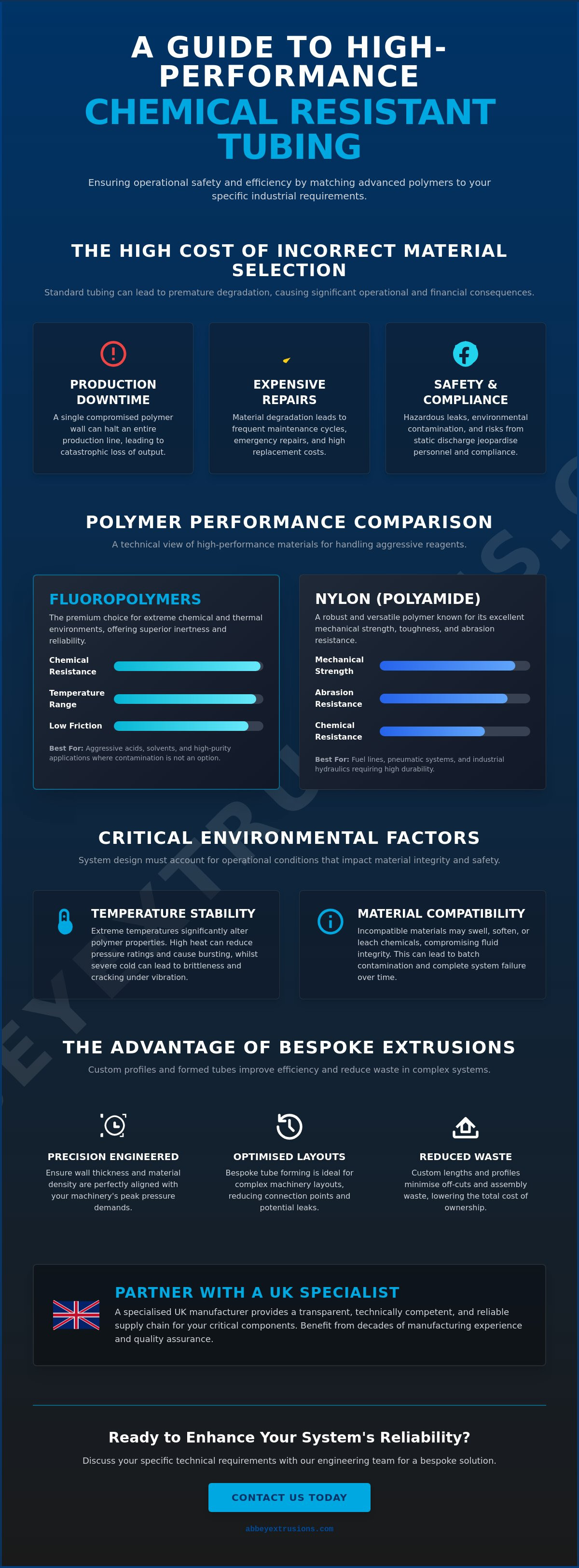
In the demanding landscape of industrial fluid handling, chemical resistant tubing serves as far more than a simple conduit. It's a critical safety barrier designed to maintain fluid integrity whilst protecting the surrounding infrastructure from corrosive damage. The process of chemical resistant tubing material selection represents a fundamental engineering decision that dictates the safety threshold and operational efficiency of an entire plant. When a polymer is chosen without sufficient regard for the specific reagents in use, the risk of catastrophic failure increases, potentially leading to hazardous leaks and environmental contamination.
Material selection directly influences both process safety and batch consistency. Inconsistent material performance can lead to leaching, where the polymer itself reacts with the transported fluid, introducing impurities that ruin entire production runs. We've seen that industrial process efficiency is dictated by the synergy between material science and precision engineered fluid transport systems. Understanding The Engineering Principles of Plastic Extrusion is vital for engineers who want to move beyond surface level procurement and into high performance system design.
Process engineers must also consider the total cost of ownership rather than focusing solely on the initial purchase price per metre. Whilst a standard tube might appear cost effective during the bidding phase, the frequent maintenance cycles and replacement costs associated with premature degradation quickly erode those perceived savings. High quality polymers, although requiring a higher initial investment, offer a significantly longer service life and reduced risk of emergency plant downtime.
Challenges in Industrial Fluid Transport
Temperature fluctuations present a significant challenge to polymer stability. As temperatures rise, the mechanical strength of many plastic piping materials can diminish, leading to a reduced pressure rating and potential tube bursting. Conversely, extreme cold can make certain materials brittle and prone to cracking under vibration. General hardware suppliers often lack the technical data to support these complex variables. Specialist manufacturers provide the necessary precision to ensure that tubing wall thickness and material density are perfectly aligned with the peak pressure requirements of your machinery.
Why Material Integrity Dictates Process Safety
Chemical compatibility is defined by a material's ability to resist physical and chemical degradation during prolonged reagent exposure. If a material is incompatible, it may swell, soften, or lose its tensile strength, which compromises the entire system. In multi use manufacturing lines, the danger of cross contamination is particularly high if the tubing absorbs trace amounts of a previous reagent. By utilising certified, chemical grade materials, you ensure that the fluid transport system remains a neutral, reliable component of your manufacturing process, maintaining the high standards required for industrial excellence.
For technical guidance on material compatibility or to discuss a bespoke manufacturing project, please reach out to our team via our enquiry form.
Material Science and Polymer Compatibility for Aggressive Reagents
Industrial fluid handling systems require a nuanced understanding of polymer behaviour under stress. The process of chemical resistant tubing material selection isn't merely about finding a tube that fits; it's about matching molecular properties to the specific chemical profile of the reagent. Whilst many general hardware suppliers focus on basic PVC, high performance environments demand more sophisticated polymers like Nylon and Fluoropolymers to ensure long term stability and safety.
Our expertise in manufacturing Nylon tube solutions highlights the importance of selecting the correct grade for the task at hand. For a deeper technical analysis of these materials, you can refer to A Comprehensive Guide to Nylon Tubing Properties. Selecting the wrong grade can lead to rapid failure, whereas the right choice ensures years of reliable service.
Nylon 11 and 12 in Chemical Applications
Nylon 11 and Nylon 12 are the preferred choices for engineers seeking a balance between flexibility and chemical resistance. Nylon 11 is often favoured for its superior impact resistance and bio based origin, whilst Nylon 12 provides exceptional dimensional stability due to its incredibly low moisture absorption. These materials are essential for fuel lines and pneumatic systems where exposure to oils and solvents is constant. In flexible workstations, using a Nylon recoil air hose ensures that the system remains organised without sacrificing the chemical resilience required in a processing plant.
Fluoropolymers for High Purity and Aggressive Acids
When dealing with ultra aggressive acids or high purity requirements, Fluoropolymers like PTFE and FEP are the industry gold standards. These materials are virtually inert, meaning they won't react with the vast majority of industrial chemicals. PTFE handles extreme temperature ranges, often operating effectively from -200°C to +260°C. FEP offers similar chemical resistance but is more easily extruded into long, continuous lengths with better clarity. For the most demanding high purity applications, PFA is often selected over FEP due to its superior mechanical strength at higher temperatures and better crack resistance.
Polyurethane remains the superior choice when abrasion resistance is the primary concern alongside chemical exposure. It's exceptionally tough and resists tearing, making it ideal for transporting abrasive slurries or granules that would quickly erode softer polymers. If you're unsure which polymer suits your specific reagent profile, we recommend you consult with our technical specialists to verify compatibility before installation.
If you require technical data sheets or wish to discuss safety compliance for your fluid handling system, please reach out to our experts via our contact page.
Safety Protocols and Quality Assurance in Chemical Fluid Transport
Managing Static Electricity in Fluid Lines
When non conductive fluids flow through plastic tubing, friction between the liquid and the inner wall generates a static charge. In environments containing flammable vapours or fine powders, this accumulation of electricity poses a severe ignition risk. We manufacture anti static tubing by incorporating specialised conductive additives during the extrusion process. These additives create a path for the charge to dissipate safely to the ground. This feature is a non negotiable safety requirement in industries such as petrochemical processing and solvent transfer, where even a small spark can lead to an explosion. Ensuring your tubing is correctly rated for static dissipation is a vital step in maintaining a safe, ATEX compliant workspace.
Mechanical Protection and High Pressure Systems
High pressure chemical transfer requires materials with enhanced structural integrity. Standard unreinforced tubes may swell or burst under peak loads, which is why Reinforced PVC tube is often the preferred choice for these applications. The internal polyester braiding provides the necessary tensile strength to manage internal pressures whilst maintaining the flexibility required for routing through complex machinery. For a deeper dive into these specifications, our Engineering Guide to Reinforced PVC Hose offers detailed performance data for process engineers.
Beyond internal pressure, external mechanical protection is equally vital. In harsh industrial settings, hoses are often subject to abrasion from moving parts or contact with rough floor surfaces. Utilising a Nylon spiral cut hose guard provides an essential layer of protection against external wear, significantly extending the service life of the primary hose. For heavy duty washdown procedures where chemical exposure is combined with high physical demand, the Triflex 2000 water hose delivers the durability required to withstand daily industrial rigours. By integrating these mechanical protections, you safeguard your investment and ensure the long term reliability of your fluid handling infrastructure.
To discuss your specific machinery requirements or to request a quote for custom profiles, please contact our technical sales team.
Improving Plant Efficiency with Bespoke Extrusion and Tube Forming
Plant efficiency is often hampered by the limitations of standard off the shelf components. Whilst the initial phase of chemical resistant tubing material selection focuses on polymer compatibility, the physical configuration of the transport system is equally vital for long term reliability. Standard tubing often requires numerous elbows and connectors to navigate complex machinery layouts, each of which introduces a potential point of failure. By moving beyond stock solutions, engineers can design systems that are more robust and easier to maintain.
The Advantages of Custom Tube Forming
Our tube forming service addresses the challenges of complex routing by providing pre shaped components tailored to specific equipment geometries. By heat setting polymers into permanent, bespoke configurations, we eliminate the need for extra fittings and joints. This reduction in leak points is a significant advantage in aggressive chemical environments where even a minor drip can cause extensive damage or safety hazards. The technical process involves precise temperature control to reorient the molecular structure of the polymer, ensuring the tube retains its shape without compromising its chemical or mechanical integrity. This results in a cleaner, more streamlined installation that's far less prone to vibration related wear.
Specialist Profiles for Industrial Infrastructure
Beyond standard circular tubes, industrial infrastructure often requires unique profiles to solve specific engineering problems. For example, Kedar cord is a vital component in tensioned fabric structures and industrial covers, providing a secure and durable attachment point that standard extrusions can't replicate. Similarly, our fluted water hose is engineered for specific drainage and suction requirements where standard profiles might collapse under vacuum or fail to provide adequate flow rates.
Engineers frequently collaborate with our manufacturing team to develop unique plastic profiles that aren't available through general distributors. This partnership allows for the creation of custom pelmet sections and specialised hoses that integrate perfectly with existing systems. By reducing the number of individual components in a system, these bespoke solutions contribute to a more streamlined and cost effective production environment. If your project requires a non standard profile or a complex heat set configuration, enquire about our custom extrusion capabilities today to see how we can optimise your layout.
To discuss your specific project requirements or to request a technical consultation, please reach out to our engineering team through our contact page.
Strategic Sourcing from Specialist Plastic Extrusion Manufacturers in the UK
The final stage of chemical resistant tubing material selection involves choosing a manufacturing partner who understands the unique regulatory and operational landscape of the United Kingdom. In an era of global supply chain volatility, a transparent, UK based manufacturer offers the stability and technical oversight that third party distributors cannot match. By sourcing directly from the factory, process engineers gain a clearer view of material provenance and quality control protocols, ensuring that every metre of tubing meets the rigorous standards required for aggressive industrial reagents.
Working with a specialist allows for a more collaborative approach to fluid handling challenges. Rather than selecting from a limited catalogue of generic products, engineers can leverage a manufacturer's deep understanding of polymer science to refine their system design. This technical synergy is particularly valuable when navigating the complexities of Polyethylene Tubing A Technical Guide, where understanding the nuances of material density and pressure ratings can prevent premature system failure.
Evaluating Manufacturer Capabilities and Expertise
A capable extrusion partner must demonstrate a broad proficiency across a variety of polymers, ranging from standard LDPE to high performance Fluoropolymers. This material versatility ensures that they can provide the most appropriate solution for your specific reagent profile without being biased toward a single product line. Furthermore, in house tool making is a critical capability for bespoke chemical orders. It allows the manufacturer to create custom dies and profiles rapidly, ensuring that even the most complex tube forming requirements are met with engineering precision. This expertise extends to specialised items like Diesel fuel hose, which must be manufactured to withstand specific hydrocarbon exposure in backup power systems and industrial machinery.
Ensuring Long Term Partnership and Technical Support
To discuss your specific project requirements or for a technical quote, please reach out to our engineering team.
Optimising Your Industrial Fluid Handling Infrastructure
We've been a specialist UK manufacturer since 1985, offering a comprehensive range of high performance polymers including PTFE and Nylon 12 to meet the most demanding industrial specifications. Our technical competence ensures that every component we produce contributes to the stability and efficiency of your production line. If you're ready to enhance your plant's operational safety and longevity, we're here to provide the precision you need.
Contact our technical team to discuss your chemical manufacturing requirements and find the ideal solution for your next process upgrade. We look forward to supporting your engineering goals with our decades of manufacturing expertise.
Frequently Asked Questions
Is Nylon 11 or Nylon 12 better for industrial chemical resistance
Nylon 12 is often the preferred choice for industrial environments requiring high dimensional stability and minimal moisture absorption. Whilst Nylon 11 offers excellent impact resistance, the lower permeability of Nylon 12 makes it more resilient against a wider range of chemicals and fuels. Selecting between these grades is a critical part of the chemical resistant tubing material selection process for pneumatic and fuel transport systems.
Can I use standard PVC tubing for aggressive industrial acids
Standard PVC tubing is generally unsuitable for aggressive industrial acids as the polymer will quickly soften or crack. For these harsh reagents, you should utilise Fluoropolymers like PTFE or FEP, which are chemically inert and maintain their integrity during prolonged exposure. Using the wrong material can lead to catastrophic leaks and significant plant downtime on your production floor.
How does anti static tubing improve safety in chemical manufacturing
Anti static tubing prevents the dangerous accumulation of static electricity that occurs when non conductive fluids flow through plastic lines. By incorporating conductive additives during the extrusion process, the tubing allows electrical charges to dissipate safely to the ground. This is a vital safety requirement in any chemical facility handling flammable solvents or operating in potentially explosive atmospheres.
What are the benefits of custom tube forming for my production line
Custom tube forming allows you to design fluid handling systems that fit your specific machinery without the need for excessive elbows or connectors. This pre shaped configuration significantly reduces the number of potential leak points and streamlines the assembly process. It's an effective way to improve plant efficiency whilst maintaining a cleaner and more professional equipment layout in complex environments.
How do I choose between PTFE and FEP for high temperature chemical transport
PTFE is the gold standard for extreme temperatures, operating effectively at up to 260°C, whilst FEP is typically limited to around 200°C. If your application requires high clarity or needs to be manufactured in very long, continuous lengths, FEP is often the more practical choice. Both materials offer exceptional resistance to almost all industrial chemicals and reagents used in modern processing.
Can Abbey Extrusions provide food grade hoses for chemical additives
Yes, we manufacture a range of food grade hoses that are suitable for transporting chemical additives used in food and beverage production. These products are engineered to meet strict hygiene standards whilst providing the chemical resilience needed for specific additive reagents. We recommend consulting our technical team to ensure the material matches your specific concentration and temperature requirements perfectly.
What is the typical lead time for bespoke extrusion profiles in the UK
Lead times for bespoke extrusion profiles in the UK are generally more favourable than sourcing from international suppliers due to the proximity of our manufacturing facility. The specific timeframe depends on the complexity of the profile and whether new tooling needs to be engineered in house. We provide clear schedules once the technical specifications and volume of your custom project are finalised.
How do I ensure my tubing meets REACH and other safety regulations
You can ensure compliance by sourcing your components from a specialist manufacturer that provides full technical documentation and material provenance for their polymers. Reliable UK manufacturers maintain strict quality control processes to ensure that all materials meet relevant REACH and safety standards. This transparency is a fundamental part of a professional chemical resistant tubing material selection strategy for any industrial facility.

Article by
Bryan Cowan
Bryan Cowan is the Founder and Managing Director of Abbey Extrusions Ltd, a leading UK manufacturer of high-quality plastic tubes and hoses. With over 40 years of industry experience, Bryan established the company in 1985, growing it from a start-up into a BS ISO9001-registered supplier for global sectors including aerospace, automotive, and pharmaceuticals.
Disclaimer
This article is intended for informational purposes only. Please ensure you seek expert advice or carry out your own research to confirm the information is suitable for your specific needs.