Commission Regulation (EU) 2025/351 came into effect on 16 March 2025, introducing the most stringent purity requirements for plastic food contact materials in a decade.
As UK extrusion specialists established in 1985, we recognise that modern food processing environments require materials that withstand both microbial growth and intense mechanical stress.
Many operators struggle with material degradation during high-temperature wash-downs or kinking in tight bend radius installations, which can compromise production efficiency.
In our view, the solution lies in precision-engineered food grade polyurethane tubing UK manufactured to tolerances of +/- 0.05mm for consistent performance.
This article provides a comprehensive technical overview of ether-based PU specifications, including working pressures up to 50 bar and ID sizes ranging from 3mm to 75mm.
You'll also learn how our bespoke profiles ensure your facility remains compliant with the ban on Bisphenol A (BPA) implemented in January 2025 whilst maintaining flexibility from -40°C to +90°C.
Key Takeaways
- Identify the specific compliance requirements of Regulation (EU) No 10/2011 and FDA 21 CFR 177.2600 for aqueous food contact applications.
- Discover why ether-based food grade polyurethane tubing UK manufactured is the preferred choice for hydrolysis resistance in environments reaching 70°C.
- Compare the abrasion resistance of polyurethane against flexible PVC to select the most durable material for high-frequency industrial processing.
- Calculate safe working pressures using a 3 to 1 safety factor whilst considering how temperature fluctuations affect performance above 20°C.
- Explore how bespoke tube forming and multi-channel extrusions can eliminate connection point stress and organise complex fluid transfer systems.
Food Grade Polyurethane Tubing Standards and Compliance
Precision manufacturing for food contact requires adherence to specific global frameworks. We produce food grade polyurethane tubing UK facilities to meet FDA 21 CFR 177.2600 standards for aqueous food contact.
As UK extrusion specialists, we advocate for full compliance with Food Contact Material Regulations such as EC1935/2004. These regulations ensure that materials don't transfer their constituents to food in quantities that endanger human health.
European operations must now align with Commission Regulation (EU) 2025/351. This amendment to Regulation (EU) No 10/2011 introduced stricter purity requirements on 16 March 2025.
We maintain strict material traceability for every batch of polyurethane tube we manufacture. This process ensures that tolerances of +/- 0.05mm are met alongside chemical purity.
Traceability involves logging raw material batches and extrusion parameters for every metre produced. This ensures that if a failure occurs, we can isolate the specific production window quickly.
In our view, specifying food grade polyurethane tubing UK manufactured ensures that your facility meets the latest safety standards. Our production capabilities cover ID sizes from 3mm to 75mm, allowing for bespoke solutions across various plant layouts.
Dissolution testing measures the total amount of substances that migrate from the plastic into a food simulant. We verify that migration levels remain below the 10 mg/dm² limit specified in EU 10/2011.
Regulatory Framework for Food Contact Materials
Best practice dictates using materials certified for repeated use in high-frequency processing environments. Abbey Extrusions has maintained these rigorous quality standards since our establishment in 1985.
Safety is ensured through rigorous dissolution tests that prevent polymer migration into the product stream. These tests verify that the material remains stable whilst exposed to various food simulants.
It's essential for maintaining the organoleptic properties of the product being processed. Any migration of polymer constituents can alter the taste or scent of the food stream.
Safety Implications of Non Compliant Polymers
Standard industrial PU may contain additives that leach into food products during fluid transfer. Specifically, the ban on Bisphenol A (BPA) implemented in January 2025 makes non-compliant legacy stocks a liability.
Non-compliant tubing often fails Shore A hardness tests after repeated exposure to cleaning chemicals. A drop of 10 Shore A points can indicate significant material degradation and potential contamination.
Chemical resistance is vital because wash-down procedures often involve caustic agents. Industrial-grade polymers can soften or swell, leading to a loss of dimensional stability.
A tube that swells by more than 5% in diameter can cause leaks at connection points. Our food grade PU maintains its 98 Shore A hardness even after prolonged contact with aqueous solutions.
Using certified food grade tubing reduces the risk of costly production line contamination. It ensures the mechanical integrity of the line remains intact under pressures up to 50 bar.
Technical Performance of Ether Based Polyurethane
Ether-based polyurethane is essential for food environments due to its superior hydrolysis resistance. This material maintains its molecular structure even whilst submerged in water at 70°C, which prevents the material from softening during intense cleaning cycles.
As UK extrusion specialists, we advocate for ether-based polymers because they resist the chemical breakdown caused by constant water contact. We manufacture food grade polyurethane tubing UK wide to ensure these performance standards are met consistently across every production run.
Microbial resistance is a core feature of ether-based PU that prevents fungal growth in damp processing conditions. Unlike ester-based alternatives, it doesn't provide a nutrient source for bacteria, which is critical for maintaining hygiene in dairy and beverage lines.
Adherence to the UK Food Contact Material Regulations requires that materials remain chemically inert during use. Our ether PU provides this stability without leaching harmful additives into the fluid stream.
We produce ether PU with ID sizes ranging from 3mm to 75mm for diverse systems. This range allows for integration into small-scale pneumatic controls and large-scale bulk ingredient transfer lines.
Flexibility is maintained even in extreme environments. Our PU retains its bend radius of 25mm on an 8mm OD tube without kinking, ensuring smooth flow in tight installations.
Ether vs Ester Based Polyurethane Performance
Ester-based PU degrades rapidly when exposed to moisture, causing material embrittlement and catastrophic failure. In our view, ether-based variants are the only suitable choice for beverage and dairy transfer applications where moisture is constant.
Ether PU maintains flexibility at low temperatures down to -40°C without cracking or losing its 98 Shore A hardness. This cold-weather performance ensures the tubing doesn't become brittle in refrigeration units or unheated production areas.
Abbey Extrusions Manufacturing Capabilities
We specialise in extruding high-clarity PU with tolerances as tight as +/- 0.05mm to ensure perfect fitment with push-fit connectors. Our Leicestershire facility, established in 1985, produces tubing capable of withstanding working pressures up to 50 bar at 20°C.
You can explore our full range of polyurethane tube for industrial use to find the correct specification for your system. We provide bespoke profiles for unique applications that require non-standard wall thicknesses or multi-lumen designs.
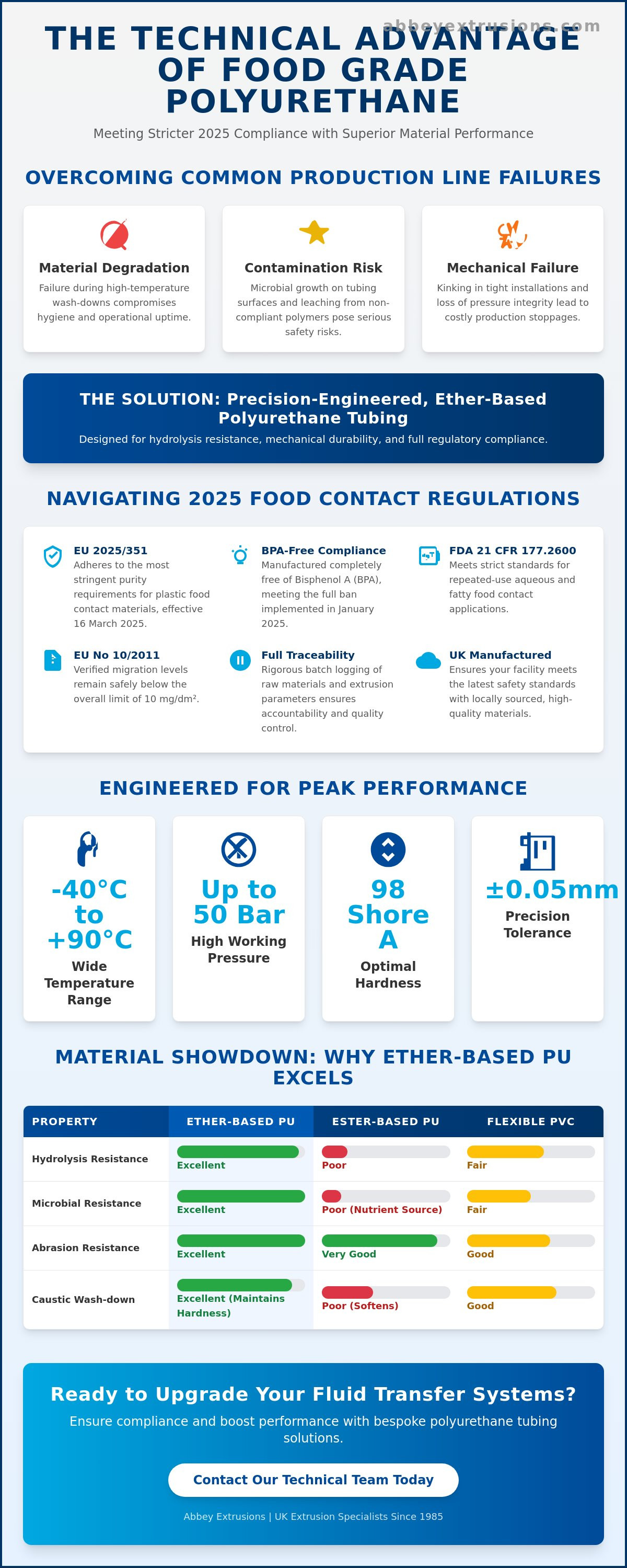
Comparing Polyurethane with Alternative Food Grade Polymers
Selecting the correct thermoplastic is vital for long-term system integrity. We manufacture food grade polyurethane tubing UK alongside PVC, Nylon, and LDPE to ensure every application is matched with a material that meets Regulation (EC) No 1935/2004.
Each polymer offers distinct mechanical properties that impact both safety and operational longevity. Polyurethane remains our primary recommendation for high-abrasion environments where material loss could lead to batch contamination.
PU vs PVC for Food Processing
Polyurethane has a lifespan up to five times longer than standard PVC in abrasive applications like grain or sugar transfer. This durability stems from its 98 Shore A hardness and a superior tensile strength of 40 MPa.
Flexible PVC often contains phthalates whilst our food grade PU is entirely phthalate-free. You can read our Engineering Guide to Reinforced PVC Hose Selection and Performance for more details on vinyl applications.
PVC is a cost-effective choice for static water transfer at pressures below 10 bar. However, it lacks the elastic memory required for dynamic installations where the tube is frequently flexed during operation.
PU vs Nylon for Pneumatic Food Lines
Nylon 11 and 12 are preferred for high-pressure air lines that must withstand up to 50 bar. However, Nylon has a larger bend radius of 45mm for an 8mm OD tube compared to PU's 25mm.
Polyurethane centres on flexibility, allowing for compact installations in complex machinery with limited internal space. See A Comprehensive Guide to Nylon Tubing Properties and Industrial Applications to compare these rigid alternatives.
Nylon also exhibits higher moisture absorption than ether-based PU. This can lead to dimensional changes in damp environments, affecting the +/- 0.05mm tolerances required for push-fit connectors.
LDPE is another cost-effective alternative for low-pressure chemical transfer. Whilst it meets food safety standards, it lacks the Shore A elasticity required for the constant compression of peristaltic pump heads.
In our view, the 300% elongation at break found in PU makes it the superior choice for pumping applications. Abbey Extrusions has provided these bespoke material selections to the industry since 1985.
Engineering Specifications for Fluid Transfer Systems
Best practice dictates that working pressure ratings are calculated with a 3 to 1 safety factor for industrial safety. This means a tube rated for 10 bar must possess a burst pressure of at least 30 bar during laboratory testing at 20°C.
We manufacture food grade polyurethane tubing UK to these exacting mechanical standards to prevent catastrophic line failures. Accurate wall thickness is vital for ensuring secure fitment with standard push-fit connectors and preventing atmospheric leaks.
Temperature fluctuations directly affect pressure ratings as the polymer chains begin to move more freely under heat. Performance typically decreases once the environment or fluid exceeds 20°C, requiring engineers to de-rate the system.
Abbey provides custom wall thicknesses to meet specific vacuum or suction requirements where standard profiles might collapse. For example, a 1.5mm wall on a 10mm OD tube provides the necessary rigidity to maintain a vacuum of -0.9 bar without deformation.
Working Pressures and Temperature Thresholds
Our food grade PU maintains structural integrity at intermittent temperatures up to 90°C during cleaning cycles. Standard 8mm OD tubing from Abbey handles 10 bar pressure at room temperature reliably whilst maintaining its 98 Shore A hardness.
Pressure testing is conducted in-house to verify performance against British manufacturing standards established since 1985. We utilise calibrated testing rigs to ensure our tubing can withstand peak pressures up to 50 bar without exceeding its elastic limit.
In our view, understanding the relationship between pressure and heat is critical for plant safety. As UK extrusion specialists, we advocate for a 20% pressure reduction for every 10°C increase above the base 20°C threshold.
Dimensions and Tolerance Standards
Precise ID and OD control ensures leak-free operation in pneumatic food sorting systems. We utilise advanced laser gauging to maintain our +/- 0.05mm tolerance during the continuous extrusion process at our Leicestershire facility.
This level of precision is critical when using 4mm to 12mm OD tubes in automated assembly lines. Custom tube forming ensures perfect fitment for machinery by setting permanent bends that reduce mechanical stress on connection points.
Our production capabilities allow for ID sizes from 3mm to 75mm to suit varied industrial scales. We monitor every metre of the extrusion to ensure that the wall thickness remains consistent, preventing thin spots that could lead to premature failure.
Bespoke Manufacturing and Tube Forming for Food Producers
Custom tube forming allows for permanent bends that reduce mechanical stress on connection points within complex machinery. We utilise thermal setting techniques to ensure the tubing retains its shape whilst maintaining a consistent ID ranging from 3mm to 75mm.
In our view, this process is essential for installations with a tight 25mm bend radius where standard tubing might kink or pull against fittings. Manufacturing food grade polyurethane tubing UK facilities ensures these tolerances of +/- 0.05mm are maintained throughout the forming process.
We offer colour-coding services in various RAL shades to help operators organise different product lines visually. This clarity reduces the risk of cross-contamination in facilities running multiple fluid streams simultaneously.
Direct access to technical support means we can solve engineering challenges within 24 hours of an inquiry. Our UK-based production allows for shorter lead times compared to overseas imports, often delivering bespoke batches in under 14 days.
Custom Profiles and Multi Tube Solutions
We produce bespoke extrusions that combine rigid and flexible elements for specialised equipment used in food automation. Multi-bore tubing reduces installation time by 40% and improves the aesthetic of food processing centres by consolidating fluid lines.
As UK extrusion specialists, we advocate for tailored solutions to improve system efficiency and reduce maintenance requirements. These tube forming capabilities allow for complex geometries that off-the-shelf components cannot achieve without risking flow restriction.
Our tooling department can create unique profiles designed to integrate multiple fluid channels into a single extrusion. This ensures that even complex 50 bar systems remain organised and easy to inspect during routine safety audits.
Quality Assurance in UK Extrusion
Every metre of Abbey tubing undergoes visual and dimensional inspection before dispatch from our Leicestershire factory, which has operated since 1985. We use only virgin polymers to guarantee food-grade purity and consistent performance across all 98 Shore A hardness specifications.
You can learn more about our process in The Engineering Principles of Plastic Extrusion for Industrial Applications. We reject any material that fails our rigorous 40 MPa tensile strength verification to ensure batch consistency.
Our commitment to quality ensures that every bespoke profile meets the specific needs of the dairy, beverage, and dry food sectors. We maintain full traceability records for all raw materials used in our food-safe production lines.
Contact Abbey Extrusions for a bespoke quotation at https://www.abbeyextrusions.com/contactus
Optimising Your Food Processing Line with Precision Extrusions
Selecting the right material is a technical necessity for maintaining system safety and operational longevity. Our ether-based PU maintains a durable 98 Shore A hardness whilst resisting microbial growth in damp conditions.
UK-based manufacturing at our Leicestershire facility ensures that every food grade polyurethane tubing UK batch meets accurate tolerances of +/- 0.05mm. Since our establishment in 1985, we've prioritised material traceability to ensure full compliance with the latest 2025 purity standards.
Bespoke tube forming allows you to integrate complex geometries with a tight 25mm bend radius without risking mechanical fatigue. This precision engineering reduces the failure risks associated with maintaining a 3 to 1 safety factor in high-pressure environments.
We look forward to supporting your next engineering project with high-performance thermoplastics that withstand pressures up to 50 bar. Our technical team is ready to assist with your specific fluid transfer challenges to ensure your facility operates at peak efficiency.
Frequently Asked Questions
Is polyurethane tubing safe for drinking water
Ether-based food grade polyurethane tubing UK manufactured is safe for drinking water when certified to Regulation (EU) No 10/2011 standards.
This material maintains a 98 Shore A hardness to prevent leachable contaminants from entering the water stream. We've ensured these safety standards are met since our establishment in 1985.
What is the maximum temperature for food grade PU
The maximum intermittent operating temperature for food grade PU is 90°C whilst continuous use is typically rated at 60°C.
Working pressure ratings decrease by 20% for every 10°C increase above the base 20°C threshold. Standard 8mm OD tubing handles 10 bar pressure reliably at room temperature.
How do I clean food grade polyurethane tubing
Cleaning should be performed using standard aqueous CIP (Clean-In-Place) solutions that don't exceed the material's chemical resistance limits.
Ether-based PU is essential here as it maintains its molecular structure even whilst submerged in water at 70°C. This ensures the +/- 0.05mm tolerances remain stable after repeated thermal cycles.
What is the difference between ether and ester polyurethane
Ether-based polyurethane offers superior hydrolysis and microbial resistance compared to ester-based variants which degrade rapidly when exposed to moisture.
Ester PU will exhibit material embrittlement and failure if used in beverage or dairy lines where water is present. Our Leicestershire facility exclusively produces ether-based PU for food contact to ensure a 40 MPa tensile strength.
Can polyurethane tubing be used with fatty foods
Polyurethane is highly suitable for fatty foods as it resists the absorption of oils that typically cause standard PVC to stiffen.
It meets the simulant D2 requirements of Regulation (EU) No 10/2011 for oils and fats. This material provides a 300% elongation at break to ensure it remains flexible in high-fat processing environments.
What ID sizes are available for food grade PU
We manufacture food grade polyurethane tubing UK wide with internal diameters ranging from 3mm to 75mm.
Every extrusion is monitored with laser gauging to ensure a strict tolerance of +/- 0.05mm. These bespoke sizes allow for integration into systems ranging from small pneumatic controls to 50 bar fluid transfer lines.

Article by
Bryan Cowan
Bryan Cowan is the Founder and Managing Director of Abbey Extrusions Ltd, a leading UK manufacturer of high-quality plastic tubes and hoses. With over 40 years of industry experience, Bryan established the company in 1985, growing it from a startup into a BS ISO9001-registered supplier for global sectors including aerospace, automotive, and pharmaceuticals.
Disclaimer
This article is intended for informational purposes only. Please ensure you seek expert advice or carry out your own research to confirm the information is suitable for your specific needs.