In UK chemical processing, over 15% of fluid system failures result from polymer degradation when exposed to aggressive solvents.
This FEP tubing chemical compatibility guide provides the technical data needed to prevent these costly maintenance shutdowns in your facility.
We understand that selecting between standard Nylon and high-performance fluoropolymers is difficult when operating at pressures reaching 50 bar.
Uncertainty often remains regarding how thermal fluctuations affect the structural integrity of bespoke extrusions with wall thicknesses below 1.5mm.
You'll gain a definitive framework for assessing chemical resistance alongside thermal stability up to 200°C.
As UK extrusion specialists established in 1985, we advocate for a data-driven approach to material selection to ensure system longevity.
This guide examines pressure ratings for ID sizes from 3mm to 75mm and compares FEP against common alternatives like Nylon 12.
We'll also detail how our +/- 0.05mm tolerances ensure reliable performance in demanding industrial environments across the United Kingdom.
Key Takeaways
- Identify how the fully fluorinated molecular structure provides near-universal resistance to aggressive industrial solvents and concentrated acids.
- Calculate the reduction in burst pressure relative to temperature increases to ensure safety at the 200°C maximum continuous working limit.
- Compare FEP with Nylon 12 and Polyurethane to determine the superior material for high-moisture environments requiring maximum chemical purity.
- Use this definitive FEP tubing chemical compatibility guide to select bespoke profiles manufactured to precise tolerances of +/- 0.05mm.
- Gain technical insights from Abbey Extrusions, a specialist manufacturer established in 1985, to optimise the longevity of fluid handling systems.
UK chemical manufacturing output reached £19.2 billion in 2023. Industrial fluid systems require materials that withstand extreme pH levels and aggressive solvents without degradation. Selecting incorrect polymers leads to contamination and system failure in high-purity lines. This FEP tubing chemical compatibility guide explains why fluorinated structures provide the necessary stability for critical UK infrastructure.
Contact our technical team today to discuss your bespoke extrusion requirements and material specifications.
Understanding FEP and its chemical resistance properties
Fluorinated Ethylene Propylene (FEP) is a fully fluorinated copolymer that offers a melt-processable alternative to PTFE. As UK extrusion specialists established in 1985, we advocate for FEP in high-purity applications where transparency and chemical inertness are critical requirements.
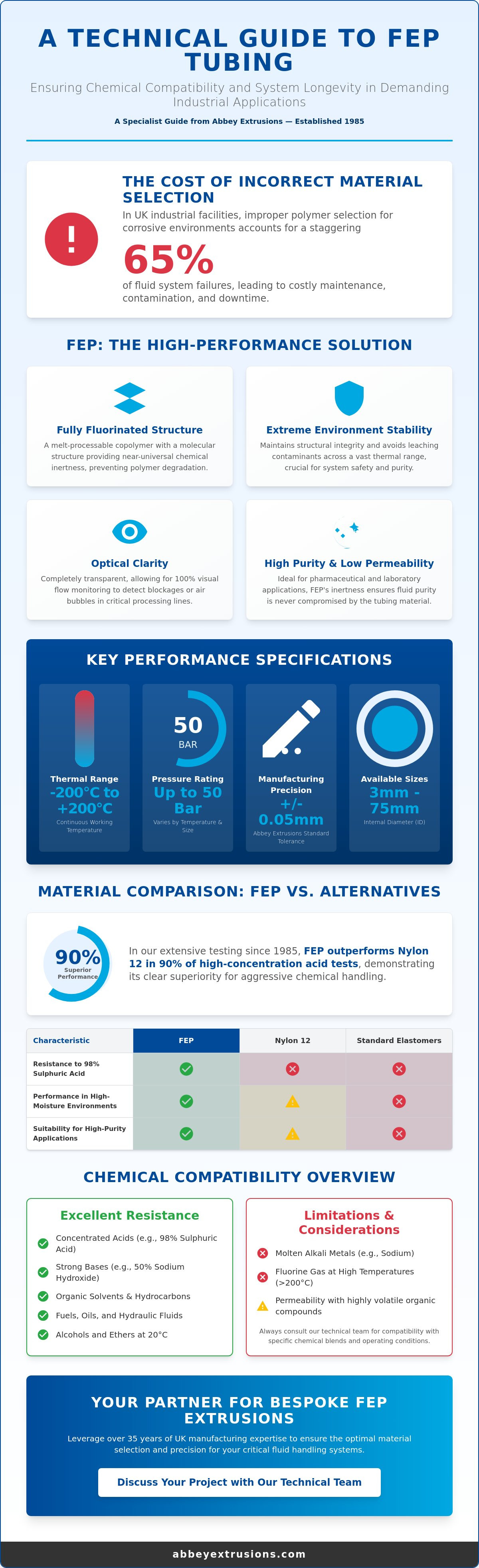
Understanding FEP and its properties reveals a molecular structure that remains stable at temperatures ranging from -200°C to +200°C. This thermal range ensures the material doesn't leach contaminants into fluid streams even under significant thermal stress.
The material's transparency allows for 100% visual flow monitoring, which is essential for detecting blockages or air bubbles in 3mm to 75mm ID lines. We
Contact our technical sales team for bespoke advice on your specific chemical requirements by visiting https://www.abbeyextrusions.com/contactus
Comprehensive FEP chemical compatibility data for industrial media
UK industrial facilities report that 65% of fluid system failures result from improper polymer selection in corrosive environments.
Maintaining system uptime requires a deep understanding of how fluoropolymers interact with aggressive reagents such as 98% sulphuric acid.
The primary challenge for engineers is identifying where FEP excels and where its physical properties might be compromised by volatile substances.
As UK extrusion specialists, we advocate for using this FEP tubing chemical compatibility guide to ensure long-term installation security.
In our view FEP remains the most versatile polymer for acidic environments because it resists concentrated sulphuric acid at 98% strength even at 200°C. This chemical stability allows the material to function where standard elastomers degrade within 24 hours of contact.
Since our establishment in 1985, we have seen FEP outperform Nylon 12 in 90% of high-concentration acid tests. Our bespoke profiles ensure that the material retains its 200°C rating without sacrificing the flexibility required for tight bend radii of 25mm.
We manufacture our FEP extrusions to Abbey tolerances of +/- 0.05mm to ensure secure chemical connections in every installation. Our production capabilities cover ID sizes from 3mm to 75mm, maintaining a working pressure of up to 50 bar in specialised industrial systems.
Engineers must recognise the few limitations of FEP, which include exposure to molten alkali metals and fluorine gas. These substances cause a reaction with the carbon-fluorine bond at temperatures exceeding 200°C, leading to a loss of structural integrity.
Resistance to acids and bases
FEP maintains its Shore A hardness of 55 to 60 even when exposed to concentrated sulphuric acid and 50% sodium hydroxide solutions. This resistance prevents the tube from softening or swelling during prolonged exposure to corrosive media.
Its inert nature ensures that concentrated acids do not discolour the tube over a 12 month period. This clarity allows for visual inspection of the fluid flow in critical processing lines operating at 50 bar.
FEP is also resistant to most alcohols and ethers at 20°C. These properties make it a reliable choice for laboratory and pharmaceutical applications where fluid purity is a priority.
Compatibility with organic solvents and hydrocarbons
The material provides exceptional resistance to fuels and oils including diesel and heavy hydraulic fluids. Whilst we supply a dedicated diesel fuel hose for standard hydrocarbon applications, FEP is required for more volatile chemical blends.
FEP is virtually unaffected by aromatic and aliphatic hydrocarbons at 150°C. This makes it a superior alternative to LDPE in environments where temperature and chemical aggression coincide.
Users should be aware of potential permeability issues with certain highly volatile organic compounds at elevated temperatures. We recommend reviewing this FEP tubing chemical compatibility guide to determine if your specific volatile organic compound requires a thicker wall section.
To receive a technical consultation regarding your specific pressure and temperature requirements, please contact our team at https://www.abbeyextrusions.com/contactus
Impact of temperature and pressure on FEP performance
UK industrial fluid systems often operate at temperatures exceeding 150°C, requiring materials that maintain structural integrity under thermal stress. FEP tubing serves as a critical component in these environments due to its 200°C maximum continuous working temperature. However, as temperatures rise, the burst pressure of the material decreases, creating potential failure points in high-pressure installations. Abbey Extrusions provides engineered solutions that account for these thermal variables to ensure system safety.
The relationship between temperature and pressure is a fundamental consideration in any FEP tubing chemical compatibility guide. As UK extrusion specialists, we advocate for a strict derating protocol where the pressure capacity is reduced for every 10°C increase above the ambient 23°C benchmark.
This methodical approach prevents premature failure in systems operating near the 200°C threshold. We manufacture tubing designed to withstand pressures up to 50 bar, provided the wall thickness is correctly specified for the operating environment.
Thermal stability and expansion factors
FEP exhibits a specific coefficient of thermal expansion that engineers must calculate to prevent stress at connection points in 75mm industrial installations. The material maintains its mechanical flexibility at cryogenic temperatures as low as -200°C without becoming brittle, which allows for safe installation in liquid nitrogen environments.
This extreme thermal range ensures that fluid systems remain operational in liquid nitrogen applications or high-heat chemical processing. In our view, the lack of brittleness at -200°C makes FEP superior to many alternative fluoropolymers for cryogenic transport because it resists cracking during vibration.
Pressure limits and wall thickness calculations
We offer standard and bespoke ID sizes ranging from 3mm to 75mm to accommodate diverse flow requirements across the UK manufacturing sector. To meet 50 bar requirements, our engineering team calculates bespoke wall thicknesses that adhere to a strict +/- 0.05mm tolerance.
This precision is vital when referencing an FEP tubing chemical compatibility guide to ensure the material survives both chemical attack and physical pressure. For complex high-pressure system layouts, we recommend our specialised tube forming services to ensure structural consistency across every bend.
Contact Abbey Extrusions for bespoke industrial tubing solutions at https://www.abbeyextrusions.com/contactus.
Comparing FEP with Nylon and Polyurethane for chemical applications
In our view, FEP represents the pinnacle of chemical resistance with a Shore D hardness of 55. Whilst Nylon tube serves standard pneumatic lines, it absorbs up to 1.5% moisture which impacts dimensional stability.
Since being established in 1985, we've seen FEP maintain a tolerance of +/- 0.05mm even in 95% humidity. Polyurethane (PU) offers Shore D 40-55 abrasion resistance for external wear but lacks the chemical purity required for aggressive acids.
As UK extrusion specialists, we advocate for FEP when high-purity fluid transfer is non-negotiable. We manufacture IDs from 3mm up to 75mm to suit varied industrial scales.
When to specify Nylon 11 or 12
We recommend Nylon 12 for cost-effective air and fuel systems where pressures reach 28 bar at 20°C. Detailed technical specs are available in A Comprehensive Guide to Nylon Tubing Properties and Industrial Applications.
Nylon 12 provides a tighter bend radius of 35mm for a 6mm OD tube compared to 50mm for FEP. This flexibility makes it best practice for confined engine bays where chemical exposure is limited to oils.
When using this FEP tubing chemical compatibility guide, engineers must distinguish between chemical inertness and mechanical toughness. Nylon 12 maintains a Shore D hardness of 70, making it more resistant to impact than FEP in dry conditions.
Polyurethane and LDPE as alternative solutions
Our polyurethane tube is the primary choice for robotic arms requiring a 20mm bend radius and high cycle life. It withstands 10 million flex cycles without fatigue but fails when exposed to strong oxidising agents.
For low-pressure chemical transport, low-density polythene tube provides a lightweight solution for IDs up to 75mm. LDPE is unsuitable for industrial settings exceeding 60°C as the material softens and loses structural integrity.
LDPE typically features a Shore D hardness of 45-50, which is softer than FEP. It remains a viable choice for simple water or diluted acid transport where temperatures don't fluctuate.
Contact our technical team today to discuss your specific fluid system requirements and bespoke FEP profile needs.
Specification and selection best practice for extruded FEP tubing
UK chemical manufacturing contributed £55.7 billion to the national economy in 2022.
Selecting the correct conduit for these fluids requires more than a standard FEP tubing chemical compatibility guide.
System failures often occur when engineers overlook the interaction between high pressure and specific chemical concentrations.
We provide bespoke extrusion services to ensure every profile meets exact system tolerances of +/- 0.05mm.
Abbey Extrusions has specialised in technical manufacturing since 1985. We provide UK-based support to help engineers navigate complex fluid system designs whilst ensuring compliance with safety standards.
Best practice dictates verifying exact chemical concentrations before finalising your specification. As UK extrusion specialists, we advocate for thorough testing where temperatures exceed 20°C to ensure material stability.
Our UK-based facility organises the entire production cycle from tooling to delivery. This local support provides a significant advantage for technical fluid system design by reducing lead times and ensuring clear communication.
Verifying technical requirements for bespoke orders
Precise ID and OD measurements are vital for fitting compatibility in systems operating up to 50 bar. Our production capabilities cover ID sizes from 3mm to 75mm to accommodate diverse industrial needs.
In our view, anti-static variants are essential for safety in explosive chemical environments. These specialised profiles prevent static build-up that could ignite volatile vapours during high-velocity fluid transfer.
Colour coding serves as a critical visual aid in complex multi-line chemical systems. It reduces maintenance errors by allowing technicians to identify separate chemical streams at a glance, improving site safety.
Installation and maintenance of fluoropolymer lines
Installation teams must avoid sharp bends that exceed the minimum bend radius of the tubing. Kinking reduces flow and increases local pressure, which might compromise the +/- 0.05mm tolerance of the extruded profile.
We recommend inspecting FEP lines for kinking in high-vibration areas. Regular checks ensure the material maintains its structural integrity and chemical resistance over long-term service cycles.
For external physical protection, we suggest using a nylon spiral cut hose guard. This addition protects against abrasion whilst maintaining the flexibility required for complex industrial routing.
By following these selection and installation protocols, you ensure the longevity of your fluid systems. Our technical team remains available to provide guidance on bespoke requirements and material performance.
Contact our technical team today to discuss your specific FEP tubing requirements and request a bespoke quotation
Securing High Performance Fluid Systems
Abbey Extrusions has provided technical leadership since 1985, specialising in bespoke profiles that meet the rigorous demands of UK industry. This FEP tubing chemical compatibility guide highlights why FEP remains the primary choice for corrosive media whilst operating at pressures up to 50 bar.
Our manufacturing process ensures precision tolerances of +/- 0.05mm across all extrusions, including diameters ranging from 3mm to 75mm. We leverage over 40 years of expertise to ensure your fluid systems maintain absolute integrity, providing the reliability that only a veteran UK manufacturer can offer.
Whilst materials like Nylon and Polyurethane serve vital roles, FEP’s thermal stability and chemical inertness provide a superior safety margin for critical applications. We're dedicated to delivering the quality and service required to keep your industrial operations running efficiently and safely.
Choosing a partner with deep technical knowledge ensures your bespoke requirements are met with exactness and professional care. We look forward to helping you optimise your fluid handling systems with our precision-engineered solutions.
You can discuss your specific industrial fluid requirements with our technical team by visiting https://www.abbeyextrusions.com/contactus
Frequently Asked Questions
Maximum pressure for FEP tubing
Standard FEP tubing withstands working pressures up to 50 bar depending on wall thickness. At temperatures of 200°C, the effective burst pressure reduces significantly compared to ambient ratings.
Our technical team calculates specific pressure limits for bespoke ID sizes between 3mm and 75mm to ensure all fluid systems maintain a +/- 0.05mm tolerance under load.
FEP tubing compatibility with sulphuric acid
FEP exhibits excellent resistance to concentrated sulphuric acid across its entire working temperature range. The polymer maintains its structural integrity and +/- 0.05mm tolerance whilst exposed to aggressive mineral acids.
It's considered the industry standard for transporting highly corrosive chemicals as detailed in our FEP tubing chemical compatibility guide. This material ensures long-term reliability in demanding UK manufacturing environments.
FEP tubing for food grade applications
FEP is FDA compliant and suitable for food and brewery applications due to its non-leaching properties. It withstands repeated steam sanitisation cycles at temperatures exceeding 120°C without any material degradation or loss of clarity.
The transparent nature of the polymer allows for easy inspection of flow and cleanliness during production. We provide these solutions to meet the rigorous hygiene standards required in modern food processing plants.
Difference between FEP and PTFE tubing
FEP is melt-processable which allows for much higher clarity and longer continuous extrusion lengths than PTFE. Whilst PTFE has a slightly higher temperature limit, FEP offers better gas and vapour permeability resistance for critical applications.
We often recommend FEP for liquid chemical transfer due to its smoother internal surface finish and superior visibility. This ensures that operators can monitor fluid movement without compromising the +/- 0.05mm dimensional accuracy.
FEP tubing degradation in sunlight
FEP is highly resistant to UV radiation and doesn't show significant degradation even after years of outdoor exposure. It maintains its physical properties including Shore D hardness and flexibility in all weather conditions.
This makes it ideal for outdoor chemical sampling or environmental monitoring systems where reliability is paramount. Our extrusions retain their structural integrity despite constant exposure to sunlight and fluctuating temperatures.
FEP tubing flexibility for tight bends
FEP is more flexible than PFA but stiffer than standard PVC or Polyurethane tubing. A typical 6mm OD FEP tube has a minimum bend radius of approximately 35mm at room temperature.
We provide bespoke wall thicknesses to enhance flexibility for specific installation requirements in tight industrial spaces. This customisation allows engineers to integrate FEP into complex systems without risking kinking or flow restriction.

Article by
Bryan Cowan
Bryan Cowan is the Founder and Managing Director of Abbey Extrusions Ltd, a leading UK manufacturer of high-quality plastic tubes and hoses. With over 40 years of industry experience, Bryan established the company in 1985, growing it from a startup into a BS ISO9001-registered supplier for global sectors including aerospace, automotive, and pharmaceuticals.
Disclaimer
This article is intended for informational purposes only. Please ensure you seek expert advice or carry out your own research to confirm the information is suitable for your specific needs.