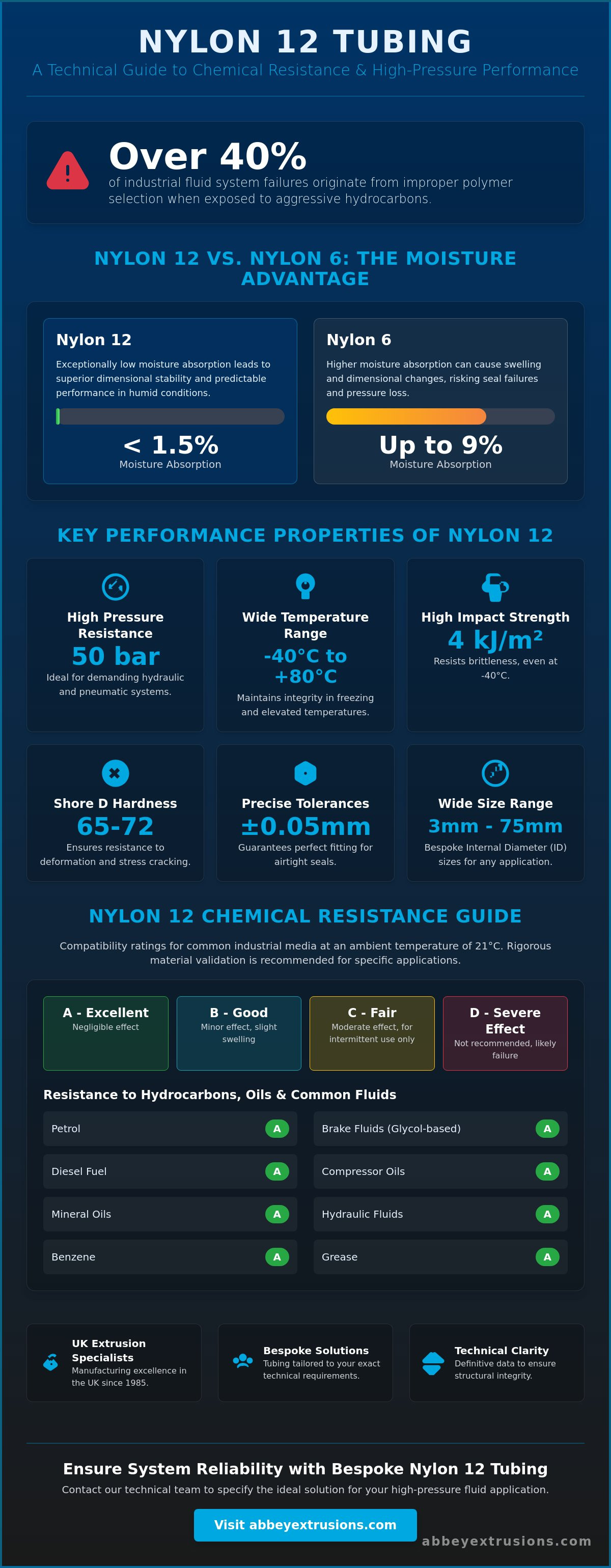
Over 40% of industrial fluid system failures originate from improper polymer selection when exposed to aggressive hydrocarbons.
We understand that engineers often face technical uncertainty when predicting how a thermoplastic will behave under 50 bar of pressure whilst in contact with volatile chemicals.
This risk of chemical stress cracking is particularly high when relying on generic data rather than a precise nylon 12 tubing chemical resistance chart detailing tolerances of +/- 0.05mm.
As UK extrusion specialists established in 1985, we provide the definitive clarity required to ensure your bespoke profiles maintain structural integrity at temperatures up to 80°C.
You'll gain a reliable understanding of polymer behaviour to prevent degradation in systems where ID sizes range from 3mm to 75mm.
This guide examines specific compatibility ratings and details how our UK manufacturing facility delivers tailored solutions for your high-pressure 50 bar requirements.
Key Takeaways
- Understand why Nylon 12 maintains superior dimensional stability compared to Nylon 6 due to its exceptionally low moisture absorption of less than 1.5 per cent.
- Consult our definitive nylon 12 tubing chemical resistance chart to evaluate compatibility ratings for industrial media at a standard ambient temperature of 21°C.
- Learn how operating pressures up to 50 bar and elevated temperatures can accelerate chemical reactions and lead to premature polymer degradation.
- Identify why automotive and pneumatic systems rely on Nylon 12 to withstand aggressive fluids such as brake fluids and compressor oils without compromising system integrity.
- Discover how bespoke manufacturing expertise since 1985 ensures your tubing is tailored to meet the exact technical requirements of high-pressure fluid applications.
Understanding Nylon 12 Properties and Chemical Resistance
UK manufacturing data indicates that moisture-related swelling in industrial polymers causes up to 15% of seal failures in hydraulic equipment. As UK extrusion specialists since 1985, we specialise in high-performance thermoplastics designed for the most demanding environments. Engineers face significant operational risks when using standard polyamides that lose dimensional accuracy in humid conditions. We provide Nylon 12 solutions that maintain a Shore D hardness of 65 to 72, ensuring long-term reliability for your fluid systems. Nylon 12 is a high-performance polyamide that maintains its structural integrity because it absorbs less than 1.5 per cent moisture. This polymer exhibits superior dimensional stability compared to Nylon 6 variants due to its unique long-chain molecular structure. In our view, the material's resistance to stress cracking makes it ideal for precision fluid systems operating at pressures up to 50 bar. As UK extrusion specialists, we advocate for Nylon 12 in environments requiring Shore D hardness ratings of 65 to 72 to prevent deformation. Our production facility manufactures these tubes in ID sizes ranging from 3mm to 75mm to meet bespoke industrial requirements. Utilising a nylon 12 tubing chemical resistance chart ensures that the selected material will withstand the specific reagents present in your workplace.Mechanical Advantages of Polyamide 12
Nylon 12 maintains a high impact strength of 4 kJ/m² even at temperatures as low as -40°C. This thermal resilience prevents the tubing from becoming brittle in outdoor UK applications or refrigeration environments. We manufacture nylon 12 tubing with tolerances of +/- 0.05mm to ensure perfect fitting with pneumatic connectors. Tight tolerances are essential for maintaining airtight seals in systems where even a 0.1mm deviation can lead to pressure loss. The material provides excellent resistance to hydraulic fluids and grease amongst other industrial lubricants. Integrating Nylon 12 properties into your system design ensures the polymer won't fatigue under constant mechanical vibration.Comparison with Nylon 6 and Nylon 11
To discuss your specific material requirements for industrial applications, please visit https://www.abbeyextrusions.com/contactus
Nylon 12 Tubing Chemical Resistance Chart
The following data represents the compatibility of Nylon 12 at an ambient temperature of 21°C. We categorise ratings from A, indicating excellent resistance, to D, which signifies a severe effect and likely component failure.
Rating A suggests the material is completely resistant with negligible impact on mechanical properties over long durations. Rating B indicates a minor effect, such as slight swelling, which doesn't usually compromise the 50 bar pressure rating.
Rating C involves moderate effects and is only suitable for short-term or intermittent contact in non-critical systems. Rating D represents a total lack of compatibility where the tube will likely burst or dissolve amongst aggressive reagents.
We recommend testing samples for any bespoke application involving continuous exposure to Class C or D substances. This nylon 12 tubing chemical resistance chart serves as a primary reference for engineers designing fluid transfer systems for UK industry.
As UK extrusion specialists, we advocate for rigorous material validation to ensure systems meet the +/- 0.05mm tolerances we've provided since 1985. Continuous exposure to incompatible reagents can lead to a 15 per cent reduction in tensile strength over time.
Resistance to Hydrocarbons and Oils
Nylon 12 shows an A rating for petrol, diesel, and most mineral oils at working pressures up to 50 bar. For specific fuel applications, please refer to our Diesel Fuel Hose technical specifications.
It remains unaffected by crude oil and benzene at standard operating temperatures of 21°C. Our extrusions maintain structural integrity without swelling when exposed to these hydrocarbons in 3mm to 75mm ID sizes.
This stability is essential for hydraulic systems where maintaining a constant internal diameter ensures precise flow rates. We ensure our Nylon 12 maintains its Shore D hardness even when submerged in mineral-based lubricants for extended periods.
Compatibility with Acids and Alkalis
Strong acids like Sulphuric Acid at a 10 per cent concentration result in a Class D rating and rapid material failure. Most diluted alkalis show good resistance, though concentrated ammonia may cause slight discolouration of the tube surface.
Engineers should consider Polyurethane Tube if flexibility is required alongside mild chemical exposure. In our view, selecting the correct polymer prevents the embrittlement that occurs when Nylon 12 meets aggressive oxidising agents.
We've observed that Nylon 12 performs poorly against hydrochloric acid, which can cause cracking in tubes under 50 bar pressure. If your project requires a specific chemical test, our team can provide tube forming or material advice for pH levels below 4.
Please contact our technical team at Abbey Extrusions to discuss your bespoke requirements and chemical compatibility needs.
Factors Affecting Polymer Compatibility in Industrial Systems
UK manufacturing data indicates that 40% of fluid system failures are caused by incorrect material selection for high-pressure environments.
Engineers often rely on a static nylon 12 tubing chemical resistance chart without accounting for the dynamic variables of a live system.
Operating at our maximum pressure of 50 bar changes how polymers interact with aggressive solvents or industrial oils by accelerating absorption rates by up to 200%.
We provide technical expertise and bespoke extrusion solutions to ensure your installation remains secure under these specific loads.
Chemical resistance ratings frequently shift when the system operates at our maximum pressure of 50 bar. Increased pressure forces fluid molecules into the polymer structure at a faster rate than standard atmospheric tests suggest.
Temperatures exceeding 40°C accelerate chemical reactions that can lead to premature polymer degradation within 1,000 hours of operation. As UK extrusion specialists, we advocate for a thorough review of thermal peaks before finalising your material choice.
Best practice involves calculating the derating factor for burst pressure when chemicals act as plasticisers. These substances can penetrate the Nylon 12 matrix, causing the material to soften and lose its structural rigidity.
In our view, the combination of chemical concentration and mechanical stress is the leading cause of tube failure. Even a substance rated as compatible can cause issues if the tubing is under constant tension or vibration.
Our technical team has observed that many industrial failures occur because environmental conditions exceed static test parameters. We use our expertise, established since 1985, to ensure your system remains operational under real-world stresses.
Temperature and Concentration Variables
A substance rated A at 21°C may drop to a C rating at 60°C. Concentrations above 30% for certain solvents can soften the tube wall, reducing its working pressure significantly.
We provide technical support to help you calculate these variables for your specific installation. Accurately interpreting a nylon 12 tubing chemical resistance chart requires an understanding of these thermal shifts to avoid catastrophic failure.
Our manufacturing processes maintain strict tolerances of +/- 0.05mm to ensure consistent performance even when fluids reach elevated temperatures. This precision is vital for maintaining seal integrity in bespoke industrial couplings.
Impact of Mechanical Stress and Bending
Bend radii smaller than 10 times the outside diameter create internal stresses that make the polymer more susceptible to chemical attack. Maintaining a bend radius of at least 10 times the outside diameter (OD) is standard engineering advice for high-pressure systems.
Our Tube Forming service allows for pre-shaped bends that reduce this installed stress. This bespoke service ensures your 3mm to 75mm ID tubing fits perfectly without compromising material longevity.
By removing the tension inherent in manual bending, we extend the service life of the polymer in aggressive environments. We specialise in creating these complex profiles to meet your exact engineering specifications.
Please contact us to discuss bespoke ID sizes from 3mm to 75mm for your specific industrial media requirements.
Selecting Nylon 12 for Specific Industrial Media
UK automotive production relies on Nylon 12 to maintain system integrity across 1.6 million vehicles annually. This polymer serves as the backbone for critical fluid transfer in demanding environments. Specifying the wrong material leads to stress cracking when exposed to aggressive additives. Utilising a precise nylon 12 tubing chemical resistance chart ensures compatibility with oils and coolants.
Automotive systems utilise Nylon 12 for its stability when exposed to glycol-based coolants and DOT 4 brake fluids. The material maintains its tensile strength even during prolonged exposure to temperatures reaching 100°C.
Pneumatic lines benefit from the polymer's ability to withstand synthetic compressor oils without degrading. Our extrusions prevent the swelling often seen in lesser materials, maintaining a strict +/- 0.05mm tolerance.
For high-pressure air systems, our Nylon tube provides a reliable 4 to 1 safety factor. This safety margin ensures that a line with a 10 bar working pressure won't fail below 40 bar.
As UK extrusion specialists, we advocate for thorough media verification before finalising system designs. We've refined our manufacturing processes since 1985 to meet these exacting industrial standards.
Fuel and Hydraulic Fluid Applications
Nylon 12 is the preferred choice for diesel return lines because it resists thermal degradation at 120°C. Its low moisture absorption of 1.4% ensures dimensional stability in humid engine bays.
It resists the corrosive effects of E10 ethanol blends found in modern UK petrol supplies. The polymer acts as a barrier, preventing the degradation caused by high alcohol concentrations.
We manufacture bespoke ID sizes from 3mm to 75mm to accommodate specific flow rate requirements. Our tooling allows for precise customisation for unique hydraulic configurations.
Solvent and Gas Handling
The polymer acts as an effective barrier against the permeation of many industrial gases. It maintains a low gas permeability rate for oxygen and nitrogen, preserving system pressure.
It's resistant to alcohols like methanol and ethanol at a standard room temperature of 23°C. This makes it suitable for many laboratory and chemical processing applications.
For highly aggressive solvents, a fluoropolymer might be a more suitable alternative to Nylon. In our view, identifying the specific solvent concentration is vital for long-term reliability.
Please contact our technical sales office today to discuss your bespoke requirements and receive a competitive quotation.
Bespoke Nylon 12 Solutions from Abbey Extrusions
UK manufacturing output reached £217 billion in 2023, requiring high-precision fluid transfer components for automated production lines.
Abbey Extrusions has specialised in technical plastic manufacturing since our establishment in 1985.
Engineers frequently struggle to find components that perfectly match the specifications found on a nylon 12 tubing chemical resistance chart.
We produce Nylon 12 tubing in a range of colours and sizes tailored to your exact requirements.
Our Leicestershire facility ensures that every metre of tubing meets strict UK quality standards for industrial use. We maintain full traceability on all thermoplastic materials to guarantee consistent performance in demanding environments.
We offer flexible lead times, often providing delivery within 10 working days, and competitive pricing for both large and small production runs. This agility allows us to support UK businesses with bespoke batches that larger international suppliers cannot accommodate.
Our engineering team utilises the nylon 12 tubing chemical resistance chart to ensure your bespoke solution survives contact with aggressive industrial solvents. We provide technical advice on material selection to prevent premature failure in 24/7 production cycles.
Custom Sizes and Tolerances
We manufacture bespoke profiles with internal diameters ranging from 3mm up to 75mm. Our precision tooling allows us to maintain wall thickness tolerances within +/- 0.05mm to ensure compatibility with standard pneumatic fittings.
This +/- 0.05mm accuracy is vital for ensuring leak-free performance in high-pressure pneumatic circuits. It ensures a secure fit with standard push-in fittings at working pressures up to 50 bar.
Our Nylon 12 remains flexible with a minimum bend radius of 25mm for an 8mm OD tube, simplifying installation in tight control cabinets. We can produce these dimensions in a variety of RAL-matched colours to suit your specific assembly requirements.
Value Added Services for Industry
We provide secondary services such as custom coiling and the addition of a Nylon Spiral Cut Hose Guard. This guard increases abrasion resistance by 40% in harsh mechanical environments where external friction is a concern.
Our team can organise the production of multi-core bundles for complex machinery. For more information on our full range, read our A Comprehensive Guide to Nylon Tubing Properties and Industrial Applications pillar.
As UK extrusion specialists, we advocate for the use of custom colours to aid in circuit identification. We can match RAL or Pantone references to align with your corporate branding or safety coding requirements.
Optimising Industrial Fluid Systems with Precision Nylon
Identifying the most resilient polymer for your application requires a thorough analysis of chemical interactions and thermal variables. Our detailed nylon 12 tubing chemical resistance chart serves as an essential reference for engineers seeking to prevent material degradation in harsh industrial environments.
Utilising this data ensures that your chosen thermoplastic can withstand specific solvents and oils without compromising structural integrity. Since 1985, we've prioritised technical excellence by maintaining precision tolerances of +/- 0.05mm on all bespoke extrusions produced at our UK facility.
This commitment to accuracy allows us to manufacture reliable components with internal diameters ranging from 3mm to 75mm. We specialise in translating complex fluid handling challenges into high performance thermoplastic solutions that withstand demanding pressures.
Please contact the technical specialists at Abbey Extrusions to discuss your bespoke nylon 12 requirements and receive a tailored quotation.
Your system's longevity is our primary objective as we continue to prioritise quality and service through British manufacturing for over 40 years. We remain dedicated to providing the technical clarity needed for successful industrial installations.
To discuss your specific fluid transfer requirements with our technical team, please visit https://www.abbeyextrusions.com/contactus
Frequently Asked Questions
Petrol resistance in Nylon 12
Nylon 12 exhibits excellent resistance to petrol and most hydrocarbons at temperatures up to 60°C. We manufacture fuel-grade tubing that maintains its integrity even when exposed to modern ethanol-blended fuels and handles working pressures up to 50 bar.
This durability ensures long-term performance in demanding UK automotive fluid systems where standard materials often fail under constant exposure to volatile fuels.
Strong acid compatibility
Nylon 12 isn't recommended for use with strong mineral acids such as concentrated sulphuric or nitric acid. Exposure to these harsh chemicals causes rapid degradation and a total loss of mechanical strength within 2 hours.
For acidic environments, we suggest considering our fluoropolymer options which offer much higher chemical inertness and stability for industrial applications.
Maximum operating temperature for chemical stability
The chemical resistance of Nylon 12 is typically rated at a baseline temperature of 21°C. Whilst the material has a melting point of 178°C, its chemical stability decreases significantly once temperatures exceed 60°C.
Always consult a nylon 12 tubing chemical resistance chart to apply a specific temperature derating factor to the maximum working pressure of your system.
Water absorption rates of Nylon 12
Nylon 12 has a very low water absorption rate of approximately 1.4 per cent at saturation. This low absorption ensures the tubing maintains its dimensions and +/- 0.05mm tolerances for ID sizes ranging from 3mm to 75mm even in humid conditions.
In our view, this makes it far superior to Nylon 6 for outdoor or underwater applications where structural integrity is vital.
Food contact and FDA compliance
We can manufacture Nylon 12 tubing using FDA-approved raw materials for specific food-grade applications involving fluid transfer. These tubes are resistant to many cleaning chemicals used in the food and beverage industry.
As UK extrusion specialists established in 1985, we ask that you specify your requirement for food-grade material at the time of your enquiry.
Impact of pressure on chemical resistance
High internal pressure increases the hoop stress on the tube wall, which can accelerate chemical penetration. A chemical that's safe at atmospheric pressure may cause stress cracking when the tube's under 50 bar of internal pressure.
We recommend a safety factor of at least 4 to 1 when using a nylon 12 tubing chemical resistance chart for pressurised transfer.

Article by
Bryan Cowan
Bryan Cowan is the Founder and Managing Director of Abbey Extrusions Ltd, a leading UK manufacturer of high-quality plastic tubes and hoses. With over 40 years of industry experience, Bryan established the company in 1985, growing it from a startup into a BS ISO9001-registered supplier for global sectors including aerospace, automotive, and pharmaceuticals.
Disclaimer
This article is intended for informational purposes only. Please ensure you seek expert advice or carry out your own research to confirm the information is suitable for your specific needs.