Recent industry data suggests that 20% of pneumatic system failures in UK heavy industry stem from material degradation in inaccessible lubrication points.
We understand it's essential that high pressure nylon tubing for pneumatics maintains system integrity at pressures reaching 50 bar.
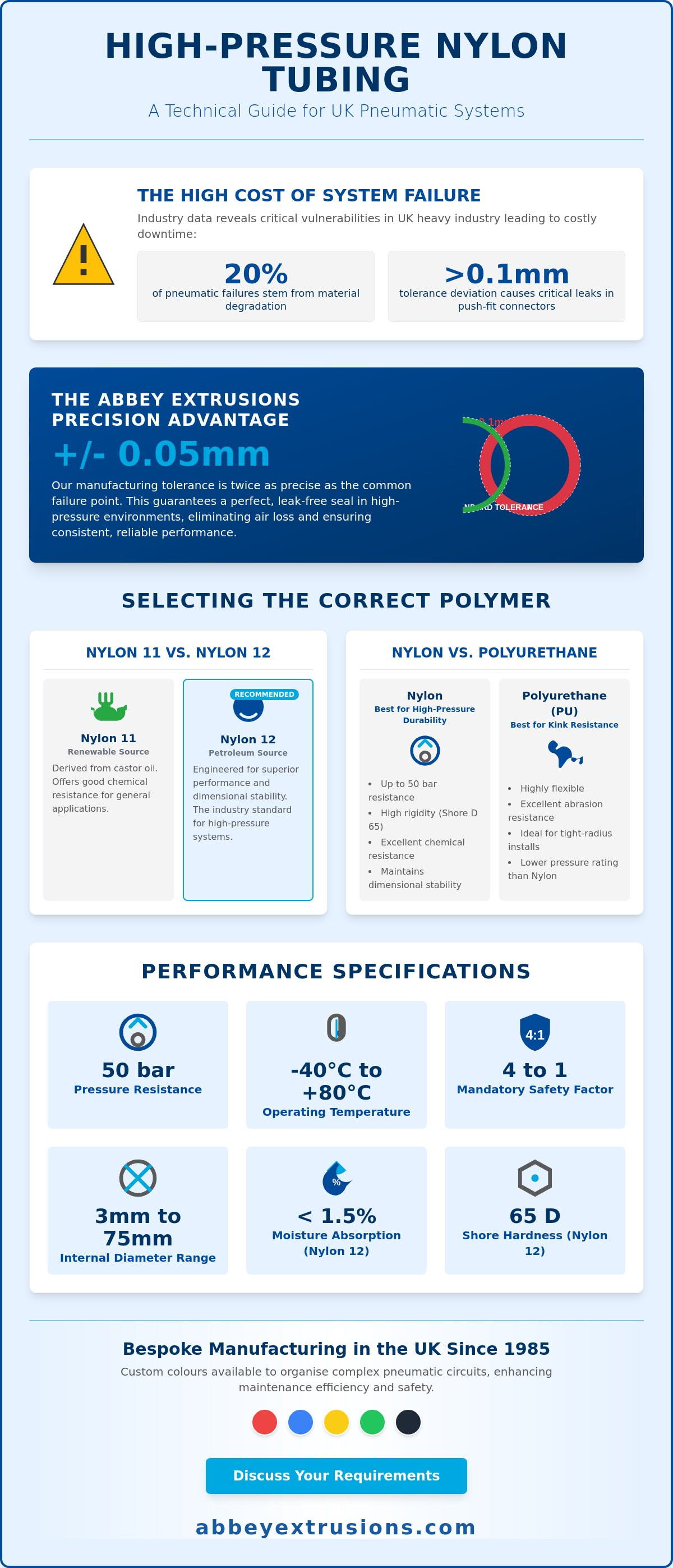
Engineers often face inconsistent fitment issues when OD tolerances deviate by more than 0.1mm, which inevitably leads to leaks in push-fit connectors and costly system downtime.
Since 1985, Abbey Extrusions has manufactured bespoke Nylon 11 and 12 tubing with a precision tolerance of +/- 0.05mm to ensure reliable performance in high-pressure environments.
You likely recognise that long-term system reliability isn't possible without materials that resist chemical swelling and mechanical fatigue.
This guide examines how our extrusion process prevents caustic degradation from industrial lubricants whilst maintaining the dimensional stability required for IDs ranging from 3mm to 75mm.
Key Takeaways
- Understand why high pressure nylon tubing for pneumatics is considered the industry standard for fluid power systems requiring resistance up to 50 bar.
- Learn the technical distinctions between renewable Nylon 11 and petroleum-based Nylon 12 to select the most suitable polymer for your specific manufacturing environment.
- Discover the best practice for calculating safe working pressures by applying a mandatory 4 to 1 safety factor across all pneumatic circuits.
- Compare the performance characteristics of nylon against polyurethane to ensure your installation balances kink resistance with high-pressure durability.
- Explore how bespoke manufacturing and custom colours enable engineers to organise complex pneumatic systems by function for improved maintenance and safety.
Understanding high pressure nylon tubing for pneumatic systems
In our view, high pressure nylon is the industry standard for fluid power systems requiring 50 bar resistance. We have manufactured these specialised components in the UK since 1985 to meet the rigorous demands of the automotive and aerospace sectors.
As UK extrusion specialists, we advocate for Nylon 12 due to its low moisture absorption rate of less than 1.5% at saturation. This material choice ensures the tubing doesn't swell or lose dimensional stability in humid factory environments, which is a common failure point for lesser grades.
Precision manufacturing ensures these tubes remain stable in temperatures ranging from -40°C to +80°C without becoming brittle. Our production process focuses on long-term durability, ensuring the high pressure nylon tubing for pneumatics maintains its burst pressure rating throughout its service life.
The role of nylon in modern fluid power
Pneumatic tubing serves as the critical link in automated lubrication and air systems where precision is non-negotiable. It facilitates the movement of compressed air to drive actuators and valves with minimal energy loss across the production line.
Nylon 12 provides a Shore D hardness of approximately 65, offering the necessary rigidity to prevent kinking during tight-radius installations. We produce these tubes with ID sizes ranging from 3mm to 75mm to accommodate diverse industrial flow rates and bespoke machine configurations.
Why British manufacturing standards matter
Achieving +/- 0.05mm tolerances is essential for ensuring leak-free push-in fitting connections in high-pressure environments. Precise outer diameters prevent the air loss that typically occurs with imported alternatives that don't adhere to such strict calibration.
You can view our full range of technical specifications for Nylon tube on our product pages. UK-sourced materials ensure consistent polymer quality across production batches, which prevents the formation of brittle spots during the extrusion process.
Technical specifications of Nylon 11 and Nylon 12
UK manufacturing output reached £224 billion in 2023, necessitating high-performance fluid systems.
Modern pneumatic circuits rely on precise material selection to maintain system integrity under 50 bar pressures.
Selecting between Polyamide grades often presents a challenge for engineers prioritising long-term dimensional stability.
As UK extrusion specialists, we advocate for a data-driven approach to high pressure nylon tubing for pneumatics to ensure optimal performance.
Nylon 11 is derived from renewable castor oil, whilst Nylon 12 is a petroleum-based polymer engineered for specific industrial tolerances. Both materials provide excellent chemical resistance to oils and hydraulic fluids found in UK factories, maintaining their structure at temperatures up to 80°C.
Best practice dictates choosing Nylon 12 for applications requiring the highest dimensional stability, as it maintains a tolerance of +/- 0.05mm. Our extrusion process, refined since 1985, ensures a smooth bore to minimise pressure drops across long distances, ensuring consistent 7 bar delivery at the actuator.
Chemical resistance and environmental stability
Nylon 12 resists stress cracking when exposed to aggressive industrial detergents, ensuring a service life exceeding 10 years in harsh environments. This durability is further proven by its resistance to UV radiation in outdoor pneumatic installations, adhering to the ISO 11619:2024 standard for polyamide tubing, which ensures material longevity.
In our view, the moisture absorption rate is a critical factor for long-term fitment reliability in humid factory conditions. Nylon 12 features a moisture absorption rate of only 1.4% at saturation, which prevents the tube from swelling and compromising connection points over time.
Mechanical properties and bend radius
Flexibility is defined by a specific bend radius of 35mm for a 6mm OD tube, allowing for compact routing without flow restriction or kinking. Shore D hardness, typically rated at 65D, affects the installation behaviour in tight spaces by providing the rigidity needed for push-fit connectors to seal effectively.
We specialise in extruding IDs from 3mm to 75mm to accommodate diverse pneumatic requirements across the UK. We manufacture bespoke nylon tube profiles to meet specific industrial tolerances and pressure requirements.
For a deeper understanding of molecular structures and how they impact thermal expansion, consult A Comprehensive Guide to Nylon Tubing Properties and Industrial Applications for deep material science. Our technical team ensures every batch produced in our facility meets the rigorous demands of modern British engineering.
Selecting the correct tubing for high pressure applications
UK manufacturing facilities often operate pneumatic systems at pressures exceeding 7 bar. Selecting high pressure nylon tubing for pneumatics requires a precise balance between wall thickness and material grade.
Standard off-the-shelf solutions frequently fail under the thermal stresses of continuous production cycles. We provide high-grade Nylon 12 extrusions that maintain integrity up to a 50 bar working limit.
System failures in fluid power circuits often stem from inadequate safety margins. In our view, working pressure must always be calculated with a safety factor of 4 to 1 to ensure long-term reliability.
This conservative approach protects personnel and equipment from the energy released during a potential tube rupture. We have applied this engineering principle since our establishment in 1985 to support the industrial infrastructure of the UK.
We provide bespoke tube forming to ensure lines stay organised in complex machinery. Lines that are heat-set to specific shapes prevent the abrasion and mechanical wear caused by loose, vibrating hoses.
Pressure to temperature ratios
Thermoplastic materials experience significant pressure de-rating as temperatures exceed the standard 20°C benchmark. A tube rated for a 50 bar working limit at room temperature may only handle 25 bar at 60°C due to molecular softening.
As UK extrusion specialists, we advocate for precise wall thickness calculations to mitigate these thermal risks. Our 2mm wall thickness profiles maintain structural stiffness even when ambient factory temperatures rise during peak summer months.
We ensure that every batch of Nylon 6 and 12 meets these rigorous thermal performance criteria. This data-driven approach prevents the deformation that leads to fitting detachment or wall thinning.
Sizing and fitment for pneumatic circuits
Precise fitment is essential for maintaining airtight seals in high-vibration environments. We manufacture all tubing to a +/- 0.05mm tolerance to prevent blow-outs at the connection point of standard UK pneumatic fittings.
Best practice dictates using permanent bends for high pressure layouts to reduce stress on the polymer chain. Our internal link to tube forming helps in creating these configurations without compromising the 50 bar burst threshold.
Matching the outer diameter (OD) to specific push-in or compression fittings ensures zero-leakage performance across ID sizes from 3mm to 75mm. This accuracy is vital for maintaining the energy efficiency of the entire pneumatic circuit.
Our commitment to quality and service ensures that every component integrates seamlessly into your existing assembly. We prioritise the technical competence required to manufacture high pressure nylon tubing for pneumatics that withstands the rigours of modern manufacturing.
Comparing nylon with polyurethane in pneumatic circuits
UK pneumatic systems often face pressure spikes that exceed standard 7 bar ratings. Engineers must choose between the elasticity of polyurethane and the mechanical strength of nylon. Using a material with insufficient hoop strength causes tube expansion and pressure drops across the circuit. As UK extrusion specialists, we advocate for Nylon 12 to ensure system integrity at 50 bar.Polyurethane typically features a Shore A hardness of 95A, making it ideal for pneumatic tools that require constant movement. Whilst PU is excellent for short connections, Nylon 12 maintains its shape under a constant 50 bar load whilst PU may expand or soften.
Nylon is the preferred choice for long-run piping because its lower friction coefficient minimises energy loss over distance. For low-pressure tool connections requiring high flexibility, our Polyurethane Tube is a reliable alternative.
In our view, nylon is the only choice for primary high pressure supply lines. We specialise in both materials to give engineers the favourite choice for their specific setup.
Since 1985, we've refined our tooling to produce internal diameters from 3mm up to 75mm. Our manufacturing process ensures that every batch meets the strict quality standards required by the British manufacturing sector.
When to choose Nylon over PU
Nylon 12 offers a rigid structure that resists swelling when exposed to hydraulic oils or common workshop chemicals. This stability is essential for high pressure nylon tubing for pneumatics where dimensional accuracy is required for push-in fittings.
We maintain tolerances of +/- 0.05mm to ensure a leak-free seal across all pneumatic circuits. If your application involves temperatures reaching +80°C, nylon provides a higher thermal ceiling than standard 95A polyurethane.
Polyurethane remains the favourite for robotic arms where the bend radius must be extremely tight. However, for the main backbone of a fluid system, the rigidity of nylon prevents the "snaking" effect often seen in softer tubing under pressure.
Kink resistance and installation challenges
Every diameter of Nylon 12 has a specific favourite bend radius, such as 60mm for a 12mm OD tube, to prevent flow restriction. If an installer exceeds this radius, the tube may collapse and permanently deform, unlike the more forgiving PU.
A wall thickness of 1.25mm on a 10mm tube provides the structural integrity needed for 50 bar environments. We ensure that our high pressure nylon tubing for pneumatics retains its burst strength even after prolonged exposure to UV light or vibration.
If your application requires both high pressure and extreme flexibility, our Nylon Recoil Air Hose offers a pre-formed solution. This design allows for 360-degree movement without the risk of kinking the primary supply line.
Our technical team ensures that every bespoke extrusion meets the rigorous standards of British manufacturing. We provide the expertise needed to select between Nylon 6, Nylon 12, or PU based on your specific pressure and temperature data.
Please contact us to discuss your specific project requirements with our technical team.
Bespoke manufacturing for UK pneumatic requirements
UK manufacturing sectors demand 99.9% reliability from fluid power components to prevent costly production downtime.
Standard off-the-shelf tubing often fails to integrate perfectly with the compact dimensions of modern CNC machine centres or specialised robotic arms.
Engineers frequently face the challenge of routing lines through restricted spaces without compromising the minimum bend radius or flow rate.
Abbey Extrusions delivers tailored solutions through bespoke profiles and precision material selection to resolve these complex integration issues.
Established in 1985, we've developed a deep understanding of the evolving technical needs within the UK fluid power sector. Our Leicestershire facility is equipped to provide rapid turnaround for specialised industrial orders, ensuring your production schedules remain on track.
We manufacture high pressure nylon tubing for pneumatics with tolerances as tight as +/- 0.05mm to ensure perfect fitment with push-to-connect fittings. Our bespoke extrusion profiles can be designed to fit unique machine housings, providing a streamlined finish that standard circular tubing cannot achieve.
We offer internal diameters ranging from 3mm to 75mm to accommodate various flow requirements across industrial systems. As UK extrusion specialists, we advocate for using Nylon 12 for applications requiring superior moisture resistance and dimensional stability.
Custom colours and branding
Custom colours allow engineers to organise complex pneumatic circuits by function, which significantly reduces the risk of errors during assembly. Using Blue for compressed air and Red for lubrication lines improves maintenance safety by providing immediate visual identification of the media being transported.
We offer the ability to produce bespoke translucent or opaque finishes to suit specific aesthetic or functional requirements. Our high-grade pigments are tested to resist fading under intense industrial lighting, maintaining clear circuit identification for the entire service life of the machinery.
In our view, branding your tubing with specific part numbers or company logos adds an extra layer of professional quality to your equipment. This permanent marking helps technicians identify the exact specification of high pressure nylon tubing for pneumatics required during field repairs.
Sourcing from a specialist UK manufacturer
Dealing directly with a manufacturer allows you to access technical advice regarding material suitability for pressures up to 50 bar. We reference The Engineering Principles of Plastic Extrusion for Industrial Applications to ensure every profile meets rigorous performance standards.
We can supply bespoke lengths up to 500 metres to reduce the need for intermediate couplings in large-scale factory installations. This approach minimises potential leak points and reduces the total cost of ownership for your fluid power systems.
Our team provides expert guidance on selecting between Nylon 6 and Nylon 12 based on the chemical environment and temperature range of your facility. By sourcing locally, you benefit from reduced logistics costs and a partner who understands the specific standards of British engineering.
For technical advice or a bespoke quote, please contact the team at Abbey Extrusions today
Secure Industrial Efficiency with Bespoke Extrusions
UK manufacturers require components that withstand rigorous industrial environments whilst maintaining safety standards for 50 bar systems. Selecting high pressure nylon tubing for pneumatics ensures your circuits operate at these elevated pressures without risk of wall failure.
We've been a specialist UK manufacturer since 1985, delivering bespoke profiles from 3mm to 75mm ID that meet exact engineering specifications. Our production processes maintain precision tolerances of +/- 0.05mm to guarantee secure fitment with standard pneumatic fittings.
Choosing Nylon 12 provides excellent chemical resistance and dimensional stability for circuits operating between -40°C and +80°C. This reliability reduces downtime.
We provide necessary technical expertise. Our bespoke nylon solutions support critical infrastructure by offering burst pressures significantly higher than standard flexible PVC.
As UK extrusion specialists, we advocate for Nylon 11 or 12 in applications where stability under a 50 bar load is essential. Every millimetre of tubing we produce reflects our commitment to quality and service, and we look forward to supporting your next project.
Frequently Asked Questions
Maximum working pressure for nylon tubing
Our standard Nylon 12 tubing operates safely at pressures up to 50 bar at 20°C. This rating assumes a 4 to 1 safety factor against the ultimate burst pressure of the polymer.
Higher temperatures reduce this limit, so de-rating charts must be consulted for systems exceeding 30°C.
Using nylon tubing for grease points
High pressure nylon is the preferred material for automatic lubrication systems due to its chemical compatibility with mineral oils. Its rigid nature allows it to be piped out to inaccessible grease points with a Shore D hardness of 65.
We recommend Nylon 12 for these applications to ensure the tube doesn't swell or soften over time.
Impact of tolerances on pneumatic fittings
Our manufacturing process maintains a strict tolerance of +/- 0.05mm on the outside diameter to ensure high pressure nylon tubing for pneumatics performs reliably. This precision is essential for push-in fittings, where a variation of 0.1mm can cause O-ring bypass or tube ejection.
Consistent wall thickness also ensures the internal flow remains laminar and predictable.
Difference between Nylon 11 and Nylon 12
Whilst Nylon 11 is a bio-based polymer, Nylon 12 offers superior dimensional stability and lower moisture absorption of less than 1.5% at saturation. In our view, Nylon 12 is the superior choice for long-term fitment in high pressure pneumatic applications.
UV stabilisation of nylon tubing
We manufacture nylon tubing with specific UV stabilisers to prevent embrittlement in outdoor UK environments. Black nylon typically offers the best natural resistance to ultraviolet degradation due to the carbon black content.
Standard natural or coloured tubes should be protected from direct sunlight to maintain their 50 bar pressure rating.
Available sizes of nylon tubing
We produce a comprehensive range of metric and imperial sizes with outside diameters from 3mm up to 75mm. Bespoke internal diameters can be extruded to meet specific flow requirements for specialised machinery.
Most standard pneumatic sizes, such as 4mm, 6mm, and 8mm, are available for immediate dispatch from our UK facility.

Article by
Bryan Cowan
Bryan Cowan is the Founder and Managing Director of Abbey Extrusions Ltd, a leading UK manufacturer of high-quality plastic tubes and hoses. With over 40 years of industry experience, Bryan established the company in 1985, growing it from a startup into a BS ISO9001-registered supplier for global sectors including aerospace, automotive, and pharmaceuticals.
Disclaimer
This article is intended for informational purposes only. Please ensure you seek expert advice or carry out your own research to confirm the information is suitable for your specific needs.