Specifying the wrong polymer for a high-pressure pneumatic system is a choice that often remains hidden until the moment of catastrophic failure. You likely recognise the frustration of unplanned downtime caused by a tube that has brittle-cracked or degraded due to unforeseen chemical exposure. It's a persistent challenge for UK manufacturers to balance technical performance with procurement costs whilst seeking a reliable extrusion partner for bespoke, large-scale volumes. Choosing between nylon vs polyurethane tubing requires a deep understanding of how these materials behave under operational stress.
This guide provides the precise technical justification you need to resolve this material selection for your 2026 industrial systems. We will examine how the latest ISO 2507:2026 standards affect thermal performance and compare the mechanical resilience of these polymers. Our collective expertise in bespoke extrusion ensures that you can move beyond generic specifications to find a tailored solution. By the end of this analysis, you'll possess the data required to select the most durable material for your specific custom requirements, ultimately reducing maintenance costs and strengthening your supply chain.
Key Takeaways
- Establish a clear technical distinction between the rigid structural properties of nylon and the elastic resilience of polyurethane for industrial fluid systems.
- Compare the pressure ratings and tensile strength of nylon vs polyurethane tubing to ensure your system meets 2026 safety and performance benchmarks.
- Determine how chemical compatibility and environmental stressors like humidity affect the durable performance of extruded polymer chains.
- Develop a robust framework for selecting materials that align with specific industrial certifications and bespoke machinery requirements.
- Recognise the logistical and quality benefits of sourcing custom tube profiles from a specialist UK manufacturer to support high volume production.
For technical assistance with large volume orders or to discuss bespoke extrusion profiles for your industrial systems, please contact our specialist engineering team.
Fundamental Characteristics of Nylon and Polyurethane Tubing
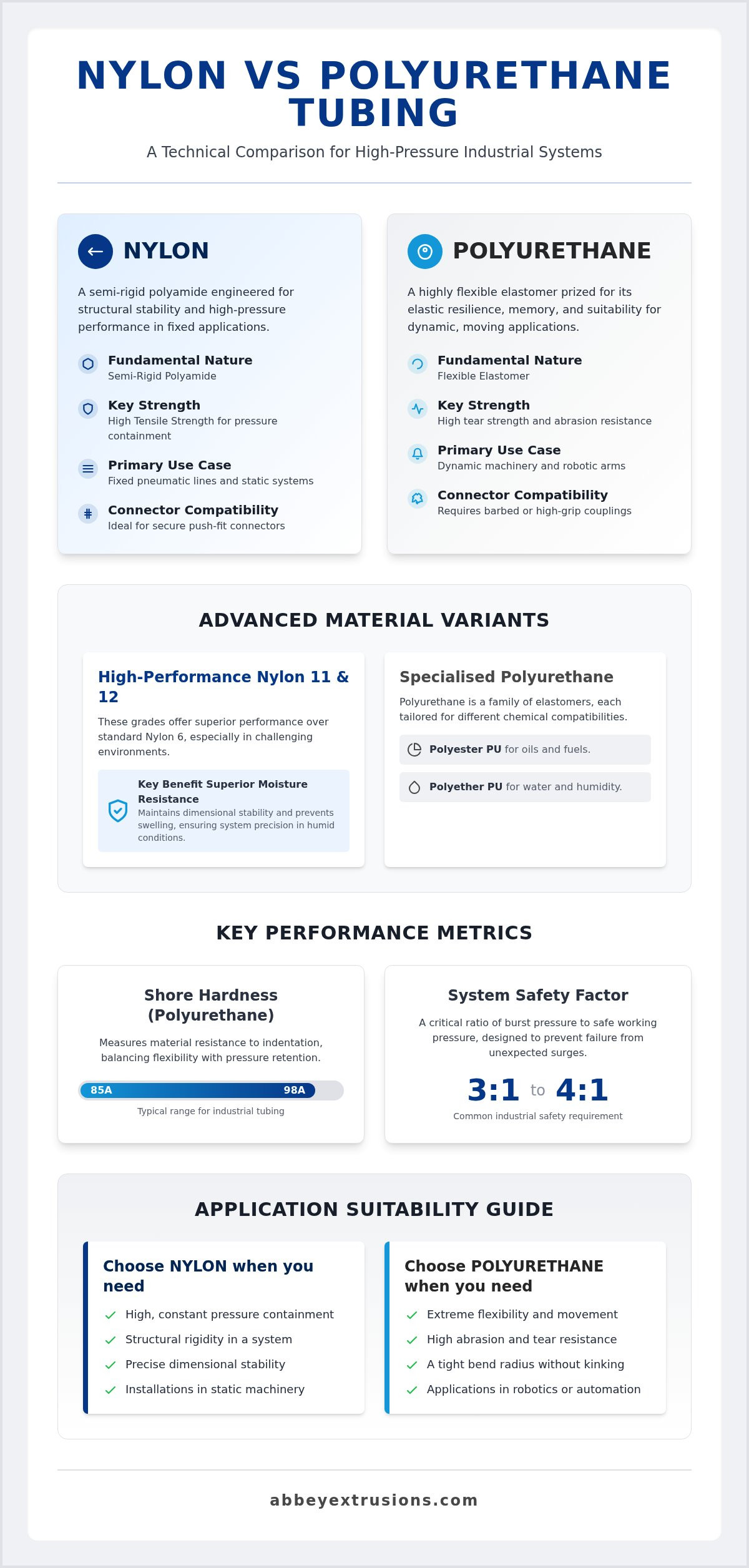
In modern manufacturing, selecting the correct polymer is a fundamental engineering decision. Nylon and polyurethane serve as the primary materials for fluid and air transfer, yet their molecular behaviours differ significantly. When evaluating nylon vs polyurethane tubing, we must consider that nylon is a semi rigid polyamide designed for structural stability, whilst polyurethane is a highly flexible elastomer capable of extreme deformation. Both materials are produced through precision plastic extrusion, a process where raw polymer resins are melted and formed into specific profiles. Correct specification depends on understanding how these materials respond to the specific environmental stresses of your application.
Material Composition and Basic Properties
The molecular structure of polyamides determines their high mechanical strength and resistance to heat. These Nylon characteristics create a material with a high modulus of elasticity, providing the rigidity required for fixed pneumatic lines. When comparing nylon vs polyurethane tubing for long term installations, the chemical structure of the polymer chain is the deciding factor. The elastic behaviour of polyurethane allows it to stretch and return to its original shape without permanent set. This makes it ideal for dynamic applications where the tube must move with machinery. Surface hardness also plays a critical role in fitting compatibility; the harder surface of nylon provides a secure grip for push-fit connectors, whereas the softer polyurethane may require barbed fittings or specific high grip couplings to prevent blow-off under pressure.
The Distinction Between Nylon 11 and Nylon 12
Not all polyamides are equal in industrial performance. At Abbey Extrusions, we focus on the production of Nylon 11 and 12 flexible tubing because these grades offer superior moisture resistance compared to standard Nylon 6. Standard grades often absorb water, which leads to swelling and a loss of dimensional stability. Nylon 11 and 12 maintain their tolerances even in humid environments, making them the preferred choice for critical industrial systems where precision is paramount. These high performance grades ensure that your system remains reliable over long periods, even when exposed to fluctuating atmospheric conditions. Our manufacturing process ensures that every batch meets the rigorous demands of large volume industrial supply.
Polyurethane Variants Including Polyether and Polyester
Polyurethane is not a single material but a family of elastomers with varying chemical resistances. Polyester based PU offers exceptional resistance to oils and fuels, making it suitable for lubrication lines. Polyether based PU provides better hydrolytic stability, which is essential if the tubing is exposed to water or high humidity where polyester variants might degrade. These variants allow for precise customisation based on the specific fluid being transported. We define the flexibility of polyurethane tube using the Shore hardness scale, which measures the resistance of the material to indentation. This measurement typically ranges from 85A to 98A for industrial applications to balance flexibility with pressure retention.
For technical specifications regarding high volume industrial orders, please enquire about our bespoke extrusion capabilities.
Mechanical Performance and Pressure Resistance Comparison
The mechanical reliability of an industrial system often hinges on the subtle trade-offs found in nylon vs polyurethane tubing. Nylon possesses high tensile strength, providing the structural rigidity required for high pressure pneumatic circuits. In contrast, polyurethane is characterised by its high tear strength, which prevents failure in environments where the tubing is subject to external abrasion or sharp impacts. We ensure that our extruded profiles account for wall thickness variations, as this parameter directly influences the safe working load. Safety factors, typically calculated at a 3:1 or 4:1 ratio relative to burst pressure, are essential to protect the system against unexpected surge pressures that might otherwise cause permanent deformation.
Burst Pressure and Working Load Limits
When comparing a standard 10mm outside diameter tube, nylon typically provides a significantly higher working pressure than polyurethane. At an ambient temperature of 20 degrees Celsius, a nylon tube might handle 20 bar or more, whilst a polyurethane equivalent of the same size is often rated for approximately 10 bar. This performance gap widens as operating temperatures increase. Nylon 12 maintains its structural integrity at elevated temperatures far more effectively than polyurethane, which can soften and lose its pressure retaining capabilities. The higher material density of polyamides contributes to this superior pressure retention, making them the standard choice for fixed industrial lines.
Flexibility and Minimum Bend Radius Requirements
Minimum bend radius is the smallest diameter a tube can form without kinking or restricting flow. When selecting nylon vs polyurethane tubing for robotic applications, the elastic limit of the material is the primary concern. Polyurethane is the superior choice for applications requiring constant motion, such as robotic arms or automated assembly lines, due to its low bend radius and elastic memory. It can be routed through tight spaces where a semi rigid material would fail. Nylon tubing carries a higher risk of kinking if forced into tight radii; once a kink occurs, the structural integrity of the polyamide is compromised. For static installations where the layout is fixed, the rigidity of nylon is an advantage, but for dynamic systems, the flexibility of an elastomer is required.
Fatigue Resistance in Dynamic Applications
Flexural fatigue life refers to the ability of a polymer to withstand repeated bending without cracking. Polyurethane absorbs mechanical vibration, protecting sensitive fittings and components from the stress of high frequency cycles. Nylon tends to transmit vibration, which can lead to loosening of push fit connectors over time. However, the self retracting properties of certain polyamides make them ideal for specific tools. For example, a nylon recoil air hose provides the necessary spring back force for overhead workstations, balancing durability with functional design. If your system requires specific pressure testing data for custom volumes, speak with our technical department.
For technical guidance on material compatibility for high volume industrial applications, please contact our specialist engineering team.
Environmental Durability and Chemical Compatibility
The longevity of an industrial system depends heavily on how the chosen polymer reacts to its operational environment. When evaluating nylon vs polyurethane tubing, engineers must account for the chemical concentrations of the transferred media and the external atmosphere. Exposure to ultraviolet light or aggressive industrial solvents can initiate chain scission, leading to premature brittleness or swelling. It's vital to consult technical data sheets for specific chemical variants, as even minor additives in a fluid can alter the degradation rate of the tubing. A successful installation requires a material that remains inert under both internal fluid pressure and external environmental stress.
Resistance to Abrasion and Mechanical Wear
Polyurethane is the industry standard for applications involving sliding, dragging, or frequent contact with abrasive surfaces. Its elastomeric nature allows it to absorb impact energy that would otherwise score or crack a more rigid material. Nylon provides excellent friction resistance in high speed assembly environments where the tube might rub against machine frames, but it doesn't match the tear resistance of PU. In systems where primary lines are exposed to extreme mechanical threats, we recommend the use of a nylon spiral cut hose guard to provide an additional layer of durable protection. This ensures the integrity of the fluid path is maintained even in the most demanding workshop conditions.
Behaviour in the Presence of Chemicals and Moisture
Nylon 11 and 12 exhibit exceptional resistance to oils, greases, and hydraulic fluids, making them the preferred choice for automotive and heavy machinery lubrication lines. Whilst polyurethane is generally resistant to oils, certain polyester based grades are susceptible to hydrolysis when exposed to warm, damp conditions. This chemical breakdown can cause the material to lose its mechanical strength over time. Nylon also has a lower moisture absorption rate than many other polyamides, ensuring that dimensional tolerances remain stable. If your application involves constant exposure to water or high humidity, specifying a polyether based PU or a high grade Nylon 12 is essential to prevent premature failure.
Temperature Tolerance and Thermal Stability
Thermal performance is a critical differentiator in the nylon vs polyurethane tubing debate. Nylon maintains its structural integrity and mechanical properties at temperatures where polyurethane would begin to soften and lose its secure grip on fittings. The updated ISO 2507:2026 standards highlight the importance of measuring Vicat softening temperatures to ensure safety in high heat environments. Conversely, at extremely low temperatures, polyurethane remains flexible whilst nylon can become prone to impact embrittlement. We've observed that systems operating in sub zero conditions benefit from the elastic resilience of PU, whereas high temperature pneumatic circuits require the thermal stability of a high grade polyamide extrusion.
To discuss technical specifications for your specific industrial application, please contact our specialist engineering team.
Industry Specific Applications and Selection Criteria
Choosing between nylon vs polyurethane tubing requires more than a simple comparison of technical data sheets. It demands a holistic view of the system intent and the specific regulatory landscape of the industry in question. Engineers must evaluate the role of certifications and the compatibility of existing fitting systems before making a final specification. Whilst the upfront cost of a polymer may seem attractive, the cheapest material often results in the highest long term maintenance costs due to frequent replacement cycles and system downtime. We focus on providing technical justifications that ensure the chosen material supports the longevity of the entire industrial installation.
Pneumatic and Hydraulic System Requirements
Polyurethane dominates low pressure pneumatic logic and hand held tooling where the operator requires ease of movement and vibration damping. In contrast, nylon remains the industry standard for high pressure hydraulic pilot lines that require dimensional stability under load. For applications involving simple air transfer where mechanical stress and chemical exposure are minimal, we often recommend low density polythene tube as a cost effective alternative that still meets fundamental industrial requirements. The choice of fittings also influences this decision; nylon provides the surface hardness required for secure push fit connections in high pressure circuits, whereas polyurethane often requires additional support in dynamic pneumatic systems.
Fuel Lines and Specialist Fluid Transfer
Fluid transfer applications introduce additional layers of complexity regarding chemical purity and material permeability. For example, a diesel fuel hose must be manufactured from a material that resists swelling and degradation when exposed to hydrocarbons. Nylon is frequently specified here for its exceptionally low permeability and resistance to fuel additives. In sectors such as food production or beverage dispensing, the focus shifts to chemical purity and the prevention of fluid contamination. Our brewery hose specifications are designed to meet these stringent requirements, ensuring that the transport of specialised liquids does not compromise product quality or safety. When comparing nylon vs polyurethane tubing for these sectors, the specific concentration of the fluid is the primary deciding factor.
Automotive and Aerospace Engineering Standards
The automotive and aerospace sectors demand some of the most rigorous testing protocols for polymer tubing, particularly for braking and fuel delivery systems. High performance polymers offer significant weight saving advantages over traditional metal piping, which is a critical factor in modern vehicle and aircraft design. Nylon 11 and 12 are widely recognised for meeting these demanding international standards, providing a reliable solution for critical safety systems. These materials maintain their mechanical properties under the extreme pressure and temperature fluctuations found in aerospace environments. If you require a custom extrusion profile that adheres to specific aerospace or automotive benchmarks, enquire about our bespoke extrusion services to discuss your requirements.
For technical support regarding large volume orders or to discuss bespoke extrusion profiles for your machinery, please consult our technical team for bespoke extrusion requirements.
Custom Extrusion Solutions for Complex Industrial Requirements
Whilst the technical debate regarding nylon vs polyurethane tubing often centres on material properties, the physical configuration of the tube is equally vital for high performance systems. Standard off the shelf products frequently fall short when integrated into bespoke machinery that requires specific tolerances or unconventional geometries. By partnering with a specialist UK manufacturer, engineers gain access to technical support that extends from the initial design phase through to large scale production. This collaboration ensures that the final extrusion is perfectly aligned with the operational demands and spatial constraints of the industrial application. Our Leicestershire based facility has provided this level of engineering precision since 1985, ensuring that every custom enquiry receives the benefit of decades of manufacturing experience.
Bespoke Profiles and Large Volume Manufacturing
Our facility specialises in the creation of custom extrusion dies, allowing us to produce unique cross sections tailored to specific OEM requirements. This capability is essential for industrial manufacturers who require more than a standard circular profile to achieve optimal performance. Large volume manufacturing runs provide significant cost efficiencies and ensure supply chain security for national industrial partners, reducing the risks associated with international logistics. Beyond standard fluid transfer, our expertise extends to specialised items such as kedar cord and curtainsider pelmet sections, demonstrating our ability to handle diverse industrial profiles with precision. We maintain a rigorous quality control process across every production batch to ensure that bespoke profiles meet the same high standards as our core product ranges.
Secondary Operations and Custom Tube Forming Services
The integration of tubing into tight compartments, such as engine bays or complex assembly lines, often requires more than a flexible length of polymer. Our tube forming services allow for the production of pre-bent shapes that retain their geometry through permanent heat setting. This process simplifies the assembly of industrial systems by ensuring the tubing follows a precise path without the risk of kinking or stress on the connectors. When comparing the installation of nylon vs polyurethane tubing in confined spaces, pre-formed shapes significantly reduce the need for additional elbows and fittings. This reduction in components directly translates to fewer potential leak points and lower long term maintenance costs for the end user. Our technical team works closely with clients to develop these formed solutions, ensuring that every bend radius and fitting interface is optimised for the intended industrial environment.
To discuss your bespoke industrial tubing requirements or to request a technical quote for large volume orders, contact our specialist engineering team today.
Advancing Your Industrial Systems with Precision Extrusion
Selecting the appropriate polymer for your 2026 industrial system requires a precise balance between mechanical rigidity and elastic resilience. The technical distinction between nylon vs polyurethane tubing dictates how your machinery handles pressure surges, chemical exposure, and repetitive motion over long operational cycles. Nylon 11 and 12 remain the benchmark for high pressure stability and fuel resistance, whilst polyurethane offers the abrasion resistance and flexibility necessary for dynamic pneumatic lines and robotic applications.
At Abbey Extrusions, we've operated as a specialist UK manufacturer since 1985, providing an extensive range of Nylon 11 and 12 technical tubing alongside bespoke tube forming and profile extrusion capabilities. Our commitment to engineering excellence ensures that your custom requirements are met with the highest degree of accuracy. To discuss your specific project or to request a technical quote for large volume orders, contact our specialist engineering team today. We look forward to providing the reliable, British-made solutions your industrial infrastructure demands.
Frequently Asked Questions
Is nylon tubing better than polyurethane for high pressure applications?
Nylon tubing is generally superior to polyurethane for high pressure applications due to its higher tensile strength and structural rigidity. When comparing nylon vs polyurethane tubing, nylon 11 and nylon 12 grades are specifically engineered to withstand significantly higher burst pressures. This makes nylon the preferred choice for industrial pneumatic systems and hydraulic lines where maintaining integrity under load is critical for safety and performance in demanding environments.
What is the primary difference between polyether and polyester polyurethane tubing?
The primary difference lies in their chemical stability when exposed to specific environments. Polyether based polyurethane offers excellent resistance to moisture and microbial growth, making it ideal for humid conditions or water transfer. In contrast, polyester based polyurethane provides superior resistance to oils, fuels, and chemicals. Our technical team can advise on the correct formulation based on the specific media your industrial application handles to ensure long term durability and performance.
Can nylon tubing be used safely for diesel fuel lines?
Nylon tubing is an excellent choice for diesel fuel lines because of its exceptional chemical resistance and thermal stability. Specifically, Nylon 11 and Nylon 12 materials are widely used in automotive and industrial fuel systems as they don't degrade when in contact with petroleum products. This material maintains its dimensional stability and prevents leaching, ensuring that the fuel system remains clean and the tubing remains flexible over many years of intensive service.
Does polyurethane tubing tend to kink more easily than nylon?
Polyurethane tubing is actually less likely to kink than nylon because it possesses a much smaller bend radius and greater elasticity. Whilst nylon is more rigid and can permanently deform or kink if bent beyond its limits, polyurethane behaves more like rubber. This high level of flexibility allows polyurethane to recover its shape after being compressed or tightly coiled, which is why it's often used in robotics and moving machinery parts.
Which material offers better resistance to chemicals and industrial oils?
Nylon offers broader resistance to a wide range of chemicals, industrial oils, and solvents compared to standard polyurethane. When evaluating nylon vs polyurethane tubing for chemical compatibility, nylon 12 is frequently selected for its ability to withstand harsh industrial fluids without swelling or weakening. For applications specifically involving oils where flexibility is also required, polyester based polyurethane remains a highly effective and durable alternative for many manufacturing environments.
How does extreme temperature affect the performance of nylon and polyurethane?
Extreme temperatures affect these materials differently, as nylon maintains its strength at higher temperatures whilst polyurethane excels in sub zero conditions. Nylon tubing can typically operate in environments up to 80 or 100 degrees Celsius without significant loss of pressure rating. Conversely, polyurethane remains flexible at much lower temperatures where nylon might become brittle. This makes it the superior choice for outdoor applications in cold climates or refrigerated industrial spaces.
Is it possible to get custom colours or bespoke sizes for industrial tubing?
We specialise in providing bespoke extrusion solutions that include custom colours and specific dimensional requirements tailored to your project. Our manufacturing facility in Leicestershire can produce tubing in a vast array of colours for easy line identification or brand consistency. We also accommodate non standard wall thicknesses and diameters for large volume orders. This ensures that the final product meets the exact technical specifications required for your industrial machinery or distribution network.
What are the benefits of using a UK based manufacturer for large volume tubing orders?
Sourcing from a UK based manufacturer like Abbey Extrusions provides significant advantages in terms of supply chain reliability and quality assurance. Large volume orders benefit from reduced lead times and lower shipping costs compared to international imports. Our partners also receive direct access to technical expertise and responsive customer service. This ensures that any bespoke requirements or quality control standards are met with the precision that decades of British manufacturing experience provide.

Article by
Bryan Cowan
Bryan Cowan is the Founder and Managing Director of Abbey Extrusions Ltd, a leading UK manufacturer of high-quality plastic tubes and hoses. With over 40 years of industry experience, Bryan established the company in 1985, growing it from a startup into a BS ISO9001-registered supplier for global sectors including aerospace, automotive, and pharmaceuticals.
Disclaimer
This article is intended for informational purposes only. Please ensure you seek expert advice or carry out your own research to confirm the information is suitable for your specific needs.