The integrity of a bespoke industrial component rests entirely upon the precise synergy between polymer selection and manufacturing accuracy. When a profile fails under specific chemical stress or environmental pressure, the cause is rarely a simple production glitch; it is often a fundamental misalignment between material properties and application requirements. You likely recognise the frustration of managing inconsistent quality from overseas sources or struggling to find a technical plastic profile manufacturer with the capability for complex custom tube forming.
Our expertise ensures that you can move beyond these operational hurdles by identifying a UK partner with the deep polymer knowledge necessary for high-performance applications. This guide provides the technical framework to help you select a partner that offers long-term supply reliability whilst helping to optimise your profile designs for maximum efficiency. We will examine how to navigate rising material costs and evolving BSI standards to ensure your bespoke profiles meet every rigorous industrial benchmark.
Key Takeaways
- Distinguish between precision engineered components and standard commodity products to ensure your industrial applications meet exact performance tolerances.
- Utilise a structured framework for polymer selection that prioritises chemical compatibility and thermal stability whilst reducing the risk of material failure.
- Learn how a specialist technical plastic profile manufacturer can optimise your design for manufacturing efficiency and provide advanced secondary operations like tube forming.
- Establish long term supply reliability and material traceability by choosing a UK based partner with extensive experience in high performance polymers.
If you require assistance with a specific industrial application, please contact our engineering team to discuss your technical requirements.
Understanding Technical Plastic Profile Manufacturing
Technical plastic profiles represent the pinnacle of precision engineering within the polymer industry. Unlike standard commodity extrusions, which often serve generic structural purposes, these components are designed to perform specific industrial functions under rigorous conditions. A professional technical plastic profile manufacturer treats each project as a unique engineering challenge, focusing on the synergy between material behaviour and geometric stability. This approach ensures that the final product integrates seamlessly into larger mechanical assemblies where failure is not an option.
The distinction between high performance profiles and standard extrusions lies in the complexity of the Plastic extrusion process. Whilst commodity production prioritises volume and cost, technical profiles demand exceptional dimensional accuracy. This precision ensures that every millimetre of a profile contributes to its final application, whether that involves airtight sealing or precise fluid flow. Achieving repeatable quality across large industrial batches is essential; even a minor variance in wall thickness can lead to performance issues in high pressure environments. Bespoke extrusion serves as the primary solution for these unique engineering challenges, providing a level of customisation that standard products cannot match.
The Role of Precision Extrusion in Modern Industry
Modern manufacturing increasingly relies on technical profiles to replace traditional metal components. Polymers offer superior chemical resistance and significant weight savings, which are critical factors in the automotive and aerospace sectors. Precision in the extrusion die is the foundation of this performance. A well engineered die accounts for material shrinkage and flow dynamics, ensuring the finished profile maintains its intended properties throughout its service life. This level of detail is what separates a specialised manufacturer from a generalist supplier.
Flexible vs Rigid Technical Profiles
The choice between flexible and rigid materials depends entirely on the mechanical demands of the system. Flexible profiles are indispensable for fluid and gas transfer, where they must withstand vibration and movement without cracking. These materials require specialised cooling and handling during manufacture to prevent deformation before the polymer sets. Abbey Extrusions specialises in high performance flexible solutions, ensuring that products like our reinforced PVC hose and polyurethane tubing meet the highest industrial standards. We understand that the manufacturing requirements for flexible polymers differ significantly from rigid ones, requiring precise control over temperature and tension throughout the production line.
To ensure your material choice aligns with your performance requirements, you can speak with our technical specialists today.
Selecting Materials for High Performance Applications
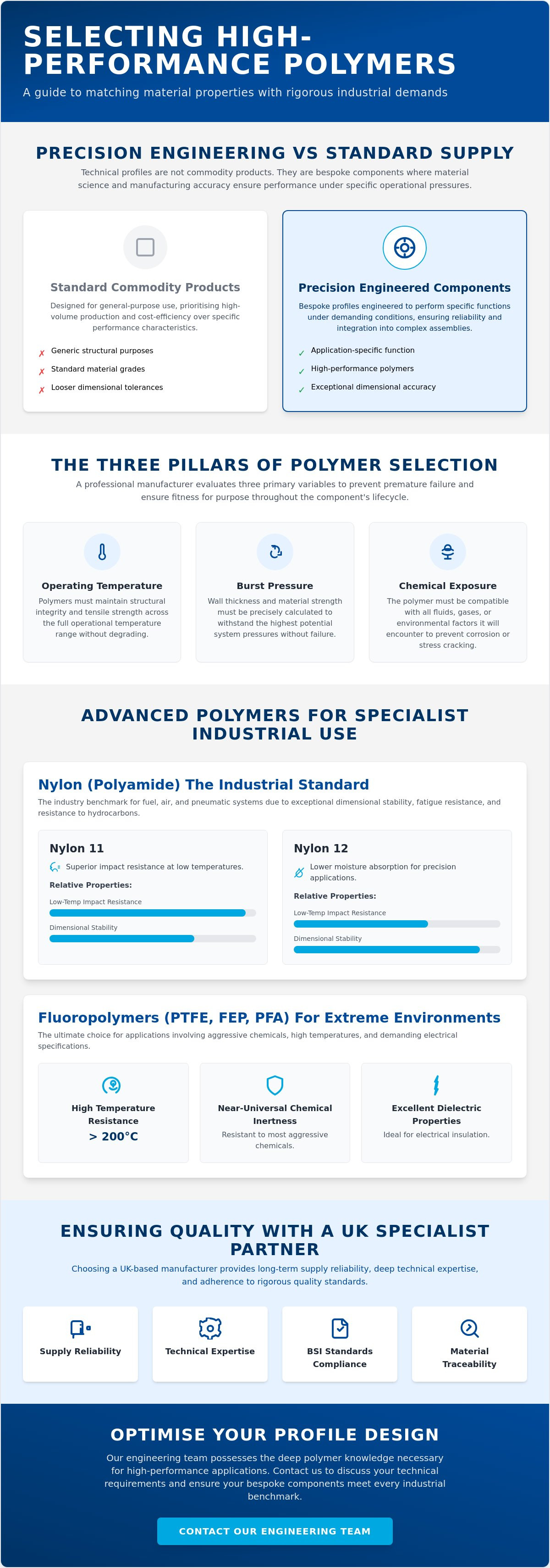
Selecting the correct polymer is the most critical decision in the engineering phase. A professional technical plastic profile manufacturer must evaluate three primary variables: operating temperature, burst pressure, and chemical exposure. Whilst some polymers maintain structural integrity at elevated temperatures, others may lose tensile strength or suffer from environmental stress cracking. We provide a rigorous framework for material selection that ensures the profile remains fit for purpose throughout its intended lifecycle. This methodical approach prevents premature failure and reduces long term maintenance costs for the end user.
Chemical compatibility is equally vital when selecting a profile material. Nylon 11 and 12 are the industry standards for fuel and air systems due to their exceptional dimensional stability and resistance to hydrocarbons. Nylon 11 is often preferred for its superior impact resistance at low temperatures, whilst Nylon 12 offers lower moisture absorption. This makes it ideal for precision pneumatic applications where size consistency is paramount. For extreme environments involving aggressive chemicals or temperatures exceeding 200°C, fluoropolymers such as PTFE, FEP, and PFA provide near-universal chemical inertness and excellent dielectric properties.
Advanced Polymers for Specialist Industrial Use
The use of Nylon tube in pneumatic systems offers a high strength to weight ratio and excellent fatigue resistance. In contrast, Polyurethane tube profiles provide superior flexibility and abrasion resistance, making them suitable for dynamic applications where constant movement is required. For low pressure and food grade applications, LDPE remains a cost effective solution due to its excellent moisture barrier properties and chemical neutrality. Each material choice directly influences the manufacturing process and the final performance of the component.
Specialised Material Grades for Compliance
Food grade and brewery grade requirements demand materials that do not leach chemicals or affect the flavour of the media being transported. We ensure that our brewery hose and food grade solutions meet these strict safety standards. In sensitive electronic or explosive environments, the necessity of anti-static properties cannot be overstated; these materials prevent the dangerous buildup of static electricity. Chemical resistance benchmarks for industrial hoses are determined by measuring the change in physical properties, such as weight and tensile strength, after immersion in specific reagents. If you are unsure which polymer suits your environment, you may wish to enquire about material testing for your specific application.
If you are developing a new component, you can request a technical consultation with our engineering team to ensure your design is optimised for production.
Custom Extrusion and the Design for Manufacture Process
The transition from a conceptual drawing to a functional industrial component requires a methodical Design for Manufacture (DfM) approach. We believe that early collaboration between the client and the technical plastic profile manufacturer is essential to identify potential production bottlenecks before they incur significant costs. The process begins with a detailed review of the profile's intended function, followed by material selection and the development of high precision tooling. This structured workflow ensures that the final component meets all mechanical requirements whilst remaining cost-effective to produce at scale.
Material choice significantly dictates the achievable geometric complexity of a profile. For instance, high performance polymers like Nylon 11 have different flow characteristics compared to flexible PVC, which directly impacts the minimum wall thickness and the sharpness of internal radii. Our in-house expertise allows us to refine these designs, ensuring they are not only functional but also optimised for stable manufacturing. We focus on eliminating design features that could lead to material stress or uneven cooling, as these factors often result in dimensional instability during the extrusion process.
Engineering Bespoke Profile Geometries
Creating bespoke profile shapes involves the development of custom extrusion dies tailored to the specific rheology of the chosen polymer. It is vital to consider the principles of plastic extrusion during the design phase to avoid production delays. We often advise on wall thickness consistency and the inclusion of generous radii to ensure a more durable final product. These technical adjustments help maintain the integrity of the polymer structure, especially in profiles with complex internal chambers or asymmetrical features.
Prototyping and Quality Verification
Prototyping serves as a critical verification step to confirm fit and function within the intended industrial assembly. Small batch production runs allow us to test the performance of new profiles under real world conditions, such as high pressure or chemical exposure, before committing to full scale manufacturing. During these runs, we maintain strict dimensional tolerances, using advanced monitoring equipment to ensure every metre of the profile adheres to the specified engineering standards. This rigorous verification process is particularly important for profiles used in safety-critical systems where reliability is non-negotiable. We document every stage of this process to provide the material traceability that modern industrial sectors demand.
For bespoke components that require complex post-extrusion shaping, please contact our technical team to discuss your project.
Advanced Profile Forming and Secondary Operations
Secondary operations represent the final stage in the production of high performance industrial components. Whilst the extrusion process defines the cross-sectional geometry, secondary techniques transform these raw lengths into application-ready parts. A specialised technical plastic profile manufacturer provides these additional services to ensure that the profile integrates perfectly into the client's assembly line. This includes everything from precision cutting and drilling to the integration of Kedar cord into larger industrial products like marquee covers or transport curtains. These operations are not mere additions; they're essential for ensuring the profile meets the functional demands of the end user.
One of the most technically demanding secondary operations is tube forming. This process involves the application of controlled heat to a thermoplastic profile to create permanent, repeatable bends. Unlike manual bending, which can cause kinking or wall thinning, precision forming ensures that the internal diameter and flow characteristics remain consistent throughout the bend. For manufacturers of specialised vehicles, we produce curtainsider pelmet sections that require exact tolerances to function correctly in heavy duty environments. These bespoke solutions demonstrate the engineering depth required to move from a simple extrusion to a finished industrial component.
The Benefits of Precision Tube Forming
Heat forming allows for the creation of complex, permanent layouts in Nylon and other high performance polymers. For Original Equipment Manufacturers (OEMs), utilising pre-formed tubes significantly reduces assembly time by eliminating the need for multiple fittings and manual shaping on the production floor. By maintaining a uniform internal diameter, these formed profiles ensure that fluid and gas transfer systems operate at peak efficiency without pressure drops or turbulence. This precision is a hallmark of a dedicated technical plastic profile manufacturer, focusing on the long term reliability of the component.
Specialist Industrial Hoses and Profiles
Beyond standard profiles, the manufacturing of reinforced hoses for water and air requires a sophisticated understanding of material bonding and reinforcement layers. Our fluted water hose is specifically designed for industrial drainage applications where external crush resistance is as important as internal flow. Additionally, we manufacture Nylon spiral cut hose guards that provide essential abrasion protection for hydraulic lines. These specialised profiles provide a protective barrier that extends the service life of more expensive machinery parts. If your application requires a finished component with integrated secondary features, enquire about our forming capabilities to see how we can streamline your production process.
To discuss a reliable supply chain for your industrial components, please contact our UK manufacturing facility today.
Ensuring Quality and Reliability in UK Plastic Extrusion
Partnering with a UK based technical plastic profile manufacturer offers logistical and technical advantages that overseas competitors struggle to match. In an era of global supply chain volatility, the importance of long term reliability and material traceability cannot be overstated. We focus on providing bespoke solutions that meet exact engineering specifications, moving away from the compromises often found in mass-market commodity products. By maintaining production within the United Kingdom, we reduce lead times and simplify the technical communication required for complex industrial projects.
The current economic climate for polymers has seen significant shifts, with material price inflation affecting global markets throughout early 2026. For instance, Polyethylene prices have recorded increases of up to €300 per tonne in Europe, whilst Polypropylene has risen over 30% year-to-date. A national supplier with deep industry connections is better positioned to navigate these fluctuations, ensuring a stable supply of high performance materials. This stability is essential for OEMs who require consistent delivery schedules to maintain their own production timelines.
Quality Standards and Material Traceability
Sourcing polymers from reputable, verified suppliers is the foundation of product longevity. We ensure that every batch of raw material is fully traceable, which is a critical requirement for sectors governed by strict British Standards. New regulations, such as PAS 510, now address the management of plastic pellets to prevent environmental leakage, and we adhere to these evolving norms. For those requiring specific data on polymer performance, our technical guide to nylon tubing provides the quality benchmarks necessary for industrial applications. Consistent manufacturing processes ensure that the physical properties of the profile remain stable over thousands of metres.
The Advantage of Independent UK Manufacturing
If you would like to discuss a specific project with our engineers, please contact us for technical advice regarding your profile requirements.
Advancing Industrial Performance through Engineering Excellence
The selection of a technical plastic profile manufacturer represents a critical investment in the operational integrity of your industrial systems. We have seen that the synergy between polymer expertise and advanced secondary processes is what allows a component to thrive in demanding environments. By choosing bespoke engineering, you move beyond the limitations of standard parts to achieve a solution perfectly aligned with your performance goals.
Since 1985, Abbey Extrusions has supported the industrial sector as a specialist UK manufacturer of Nylon 11 and 12 flexible tubing. Our in-house tube forming and custom profile capabilities ensure that we can provide finished parts that meet the most exacting tolerances. We are committed to the precision and reliability that your high performance applications require.
Contact our technical team today to discuss your bespoke profile requirements and discover how our manufacturing expertise can benefit your next project. We look forward to helping you optimise your industrial designs.
Frequently Asked Questions
What are the advantages of using a technical plastic profile manufacturer in the UK
Partnering with a UK based technical plastic profile manufacturer ensures significantly shorter lead times and simplified communication for complex engineering projects. National suppliers provide full material traceability and adhere to specific British Standards, which is essential for safety critical industrial applications. This proximity allows for more responsive technical support and eliminates the logistical risks associated with overseas shipping.
Which materials are best for technical profiles requiring chemical resistance
Fluoropolymers such as PTFE, FEP, and PFA offer the highest level of chemical resistance for extreme industrial environments involving aggressive reagents. For fuel and air systems, Nylon 11 and 12 provide excellent resistance to hydrocarbons whilst maintaining dimensional stability. The final choice depends on the specific chemicals involved and the operating temperature range of your application.
Can you provide bespoke profile shapes for unique industrial applications
We specialise in the development of bespoke profile geometries tailored to unique engineering requirements through custom die production. This process involves designing precision tooling that accounts for the specific flow characteristics and shrinkage rates of the chosen polymer. Our engineering team works directly with clients to refine these shapes for manufacturing efficiency and long term performance.
What is the difference between Nylon 11 and Nylon 12 for flexible tubing
Nylon 11 is a bio based polymer known for superior impact resistance, particularly at lower temperatures, and excellent flexibility. Nylon 12 offers lower moisture absorption and exceptional dimensional stability, making it the preferred choice for precision pneumatic systems where size consistency is paramount. Both materials provide high resistance to stress cracking and chemical exposure in demanding industrial layouts.
Do you offer secondary services such as tube forming or custom cutting
We provide a comprehensive range of secondary operations including precision tube forming and custom cutting to length. These services allow us to deliver finished components that are ready for immediate integration into your assembly line without further processing. Our capabilities also include creating spiral cut hose guards and integrating Kedar cord into specialised industrial profiles.
How do I ensure that my plastic profile meets food grade or brewery standards
Compliance is ensured by using specific raw materials that meet strict FDA or European food contact regulations. We manufacture products like brewery hose and food grade hoses under controlled conditions to ensure chemical neutrality and prevent media contamination. Documentation regarding material grades and compliance certificates can be provided to verify that these standards are met for your specific project.
What information is required to receive a quote for a custom extrusion project
To provide an accurate technical quote, we require a detailed engineering drawing or a physical sample of the profile. Information regarding the intended application, required polymer grade, estimated annual volume, and any secondary operations like tube forming is also essential. This data allows our technical team to assess the tooling requirements and production feasibility for your project.
Do you provide on site installation for the plastic profiles you manufacture
We do not provide on site installation services for the profiles or hoses we manufacture. Our expertise is focused strictly on the precision extrusion and secondary forming of technical components within our dedicated facility. We deliver finished products directly to your site or assembly plant, ready for your own engineering teams to integrate into the final system.

Article by
Bryan Cowan
Bryan Cowan is the Founder and Managing Director of Abbey Extrusions Ltd, a leading UK manufacturer of high-quality plastic tubes and hoses. With over 40 years of industry experience, Bryan established the company in 1985, growing it from a startup into a BS ISO9001-registered supplier for global sectors including aerospace, automotive, and pharmaceuticals.
Disclaimer
This article is intended for informational purposes only. Please ensure you seek expert advice or carry out your own research to confirm the information is suitable for your specific needs.