With the publication of ISO/TS 24110:2026 in April 2026, the industry has finally established a formalised method for testing how combined UV radiation and creep load affect polymer specimens, highlighting why traditional material selection for bespoke plastic extrusions often falls short in real world environments. You likely recognise that a single error in assessing chemical compatibility or thermal limits can result in costly material failure and operational downtime whilst increasing production waste. We understand that the pressure to get it right's compounded by volatile resin markets, where the US Producer Price Index for plastics rose by 5.44% in April 2026 alone.
This guide offers a detailed technical analysis to ensure your custom profiles meet every environmental and mechanical demand. We'll guide you through the critical properties of polymers such as Nylon 11, LDPE, and various Fluoropolymers, providing the clarity needed to specify materials that are both functional and formable. By following this three pillar framework, you can reduce the risk of product failure and handle the complexities of modern industrial requirements with total professional confidence.
Key Takeaways
- Recognise why the initial design phase serves as the most vital stage for securing the long term integrity of custom industrial profiles.
- Evaluate how primary environmental stressors, including UV radiation and oxidative atmospheres, dictate the choice of polymer for harsh applications.
- Master the technical principles of material selection for bespoke plastic extrusions to achieve the ideal balance between chemical resistance and mechanical behaviour.
- Understand the specific role of Shore hardness in determining the flexibility and secondary forming potential of materials like Nylon 11 and Polyurethane.
- Identify the precise technical parameters and data points necessary to ensure your manufacturer provides a reliable and accurate material recommendation.
Please contact our technical team to discuss your specific requirements and ensure your project starts with the most appropriate material foundation.
Understanding the Importance of Strategic Material Selection
Material selection for bespoke plastic extrusions represents the most influential decision within the engineering cycle. Whilst the Plastic Extrusion Process is a highly refined mechanical operation, the ultimate success of the final profile depends entirely on the chemical and physical properties of the chosen resin. Selecting an inappropriate polymer often leads to premature failure, such as environmental stress cracking or thermal degradation. These failures carry significant financial implications, including the cost of replacement parts, lost production time, and potential damage to a company's reputation for reliability. In many cases, the cost of a failed component's far lower than the labour costs required to replace it in a complex industrial system.
Our methodology focuses on achieving a precise balance between technical performance and commercial viability. Over-specification, whilst seemingly a safe option, introduces unnecessary costs that can erode project margins. Conversely, under-specification risks catastrophic failure in the field. By adhering to the Engineering Principles of Plastic Extrusion, we ensure that every material recommended is fit for its specific industrial purpose without inflating the budget through redundant properties.
Defining Bespoke Extrusion Requirements
Identifying the primary function of a profile is the first step in the design process. You must distinguish whether the component serves as a structural profile, such as our curtainsider pelmet sections, or as fluid conveyance tubing, like Nylon tube. Structural profiles require high rigidity and impact resistance, whereas tubing often demands specific burst pressures and chemical compatibility. Defining these requirements, alongside strict dimensional tolerances and surface finish standards, prevents costly revisions later in the manufacturing cycle. Precision in these early stages ensures the final product integrates perfectly with existing hardware.
The Impact of Polymer Choice on Product Longevity
Please contact our specialist team for a chemical compatibility check to ensure your chosen polymer withstands its intended operating environment.
Evaluating Environmental and Chemical Resistance Factors
Industrial applications subject extruded profiles to a variety of harsh conditions that can compromise structural integrity. UV radiation and oxidative environments represent the primary environmental stressors that engineers must account for during the design phase. When performing material selection for bespoke plastic extrusions, it's vital to consider how photo-oxidation affects the polymer surface. Unprotected materials often suffer from chain scission, which manifests as surface chalking, discolouration, and a significant loss of impact resistance over time. To ensure technical accuracy, we cross reference polyethylene resins against the ASTM D4976 Standard, which provides the necessary benchmarks for material performance and density classifications.
The distinction between intermittent and continuous chemical exposure's another critical factor in maintaining product longevity. Whilst some materials can tolerate occasional splashes of industrial fluids, continuous contact requires a much higher degree of chemical inertness. Continuous exposure to oils, detergents, or solvents can lead to swelling or environmental stress cracking (ESC), where the polymer fails at stress levels far below its rated tensile strength. For low stress environments where chemical purity and moisture resistance are the priority, Low-Density Polythene Tube remains a preferred choice due to its inherent stability and cost-effectiveness.
Thermal Stability and Temperature Ranges
Every polymer has a specific thermal window where it maintains its mechanical properties. Rigid and flexible PVC typically operate effectively between -10°C and +60°C; however, exceeding these limits leads to rapid softening and loss of dimensional stability. In contrast, Polyurethane (PU) offers superior performance in colder climates, often retaining its flexibility at temperatures as low as -40°C. Choosing a material without considering low temperature brittleness can result in catastrophic failure when the profile's subjected to vibration or impact in sub-zero conditions. If you are unsure about the thermal limits of a specific grade, we recommend a technical consultation with our laboratory team.
Chemical Compatibility and Fluid Handling
Selecting the correct material for fluid conveyance requires a deep understanding of hydrocarbon resistance and permeability. For instance, our diesel fuel hose is specifically engineered to resist the leaching of plasticisers, which would otherwise cause the hose to harden and crack. Whilst standard polymers suffice for water or air, aggressive acids and solvents demand the use of Fluoropolymers. Materials such as PTFE, FEP, and PFA are considered the gold standard for chemical handling because they're almost entirely inert to the vast majority of industrial chemicals and maintain their integrity under extreme conditions.
For projects requiring precise chemical resistance or specific mechanical properties, we suggest a technical consultation for custom polymer blends to ensure the final profile meets your exact operational criteria.
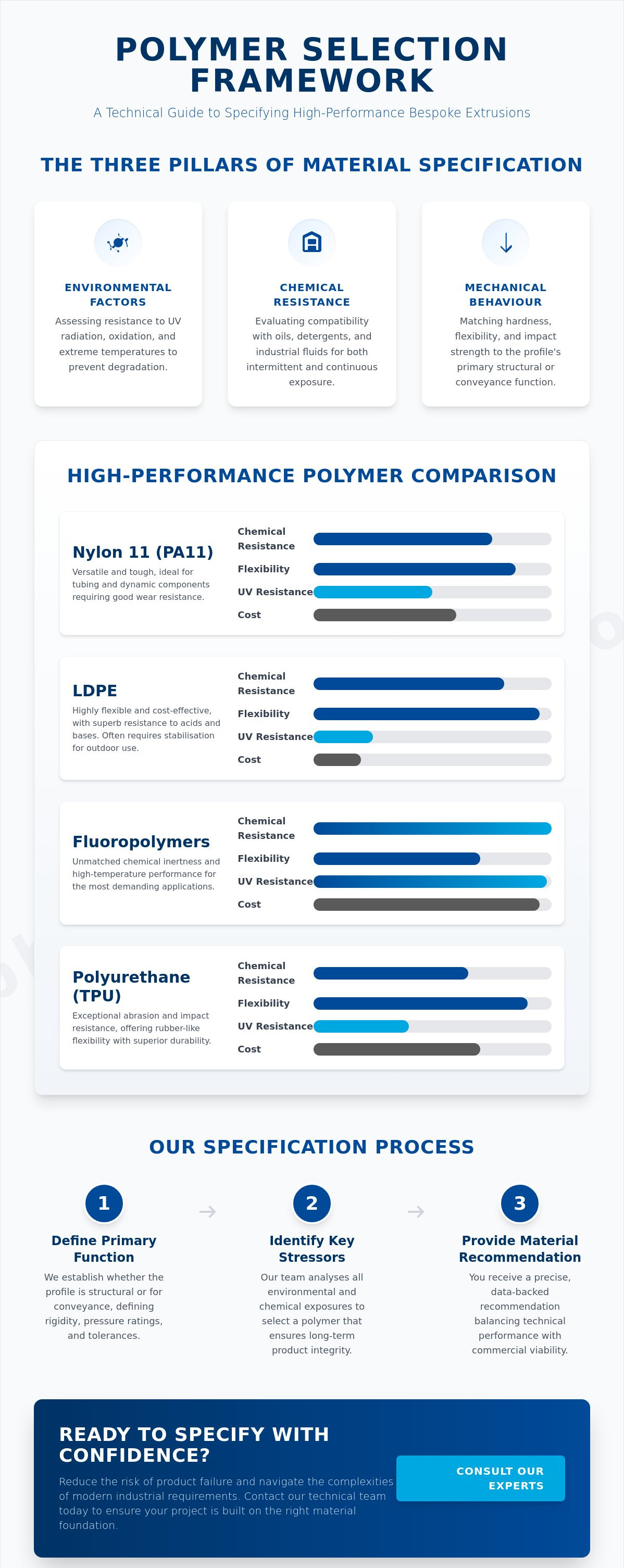
Comparing High Performance Polymers for Industrial Profiles
Whilst standard polyethylene serves many general purposes, material selection for bespoke plastic extrusions often necessitates the superior mechanical properties of engineering polyamides. Nylon 11 and 12 provide significantly higher tensile strength and burst pressure ratings compared to LDPE. These materials offer a level of dimensional stability that's essential for precision engineering. Selecting between these polyamides requires an understanding of their specific molecular structures and how they interact with their intended environment. We recommend reviewing our Nylon Tubing Technical Guide for specific data on pressure ratings and chemical resistance.
Polyurethane (PU) stands out in applications where high abrasion resistance and flexibility are paramount. Unlike standard PVC, Polyurethane Tube maintains its elasticity without the risk of plasticiser migration. This makes it ideal for dynamic environments where constant movement or friction would cause other materials to fail or become brittle. PU's also highly resistant to oils and greases, which extends its service life in mechanical assemblies. For the most demanding environments, Fluoropolymer tubing offers near-total chemical inertness and can handle temperatures up to 260°C whilst maintaining its structural integrity.
The Versatility of Nylon 11 and 12
Nylon 12's known for its exceptionally low moisture absorption. This ensures that the profile retains its dimensions and mechanical strength even in high humidity environments. This characteristic makes Nylon tube the preferred choice for pneumatic and hydraulic systems where water ingress could lead to system failure. Additionally, its superior fatigue resistance makes it the ideal material for recoil or spiral applications that undergo repeated stress cycles. Nylon 11 offers similar benefits but with even greater impact resistance at sub-zero temperatures, making it a staple for outdoor industrial use.
Fluoropolymers for Extreme Environments
Please enquire about our tube forming services to understand how specific polymer choices facilitate the creation of complex, pre-shaped components.
Mechanical Properties and Post Extrusion Versatility
Material memory represents another vital consideration, particularly for components that must retain their shape after being deformed. Polymers with excellent elastic memory, such as certain grades of Polyurethane and Nylon, are essential for products like Nylon recoil air hoses. Without this inherent property, a coiled hose would lose its tension and fail to retract, leading to safety hazards and reduced efficiency in the workplace. The relationship between polymer selection and the efficacy of our tube forming services is absolute; the material must be capable of being heat set into a permanent geometry without compromising its molecular stability.
Flexibility versus Rigidity in Custom Profiles
The mechanical behaviour of rigid PVC tube differs significantly from its flexible counterparts. We use specific plasticisers to modify the flexibility of standard polymers, allowing us to tailor the material to the application's requirements. However, you must consider the trade-off between flexibility and performance. Generally, a highly flexible material will have a lower burst pressure rating than a more rigid variant of the same thickness. Balancing these factors is a core part of material selection for bespoke plastic extrusions to ensure the product remains functional whilst meeting safety margins. If your application requires a specific bend radius, our technical specialists can recommend the optimal polymer grade.
Material Suitability for Tube Forming Services
Post extrusion forming involves heat setting a polymer into a specific shape, such as a multi-bore coil or a pre-bent tube for tight engine bays. Materials like Polyurethane and Nylon are exceptionally well suited for this process because they respond predictably to thermal manipulation. In contrast, certain rigid plastics or highly filled compounds may prove difficult to form into complex shapes without causing stress whitening or structural weakness. Understanding these limitations early in the design phase prevents production delays and ensures the final component performs reliably in its intended environment.
We invite those ready to start their bespoke extrusion project to consult with our engineering department to ensure every technical variable's accounted for before production begins.
Navigating the Specification Process with Technical Experts
The successful execution of a custom project relies on a structured exchange of technical data between the client and the manufacturer. Material selection for bespoke plastic extrusions isn't merely a preliminary step; it's a collaborative process that defines the entire manufacturing strategy. To provide an accurate recommendation, we require a comprehensive set of data points, including the minimum and maximum operating temperatures, peak surge pressures, and a definitive list of all chemicals the profile will encounter. Providing this environmental data early prevents the specification of materials that might suffer from premature degradation or mechanical failure in the field.
Specialist manufacturers organise the transition from material selection to tooling and production through a methodical workflow. Once the polymer's specified, our engineering team designs the extrusion dies and downstream equipment specifically for that material's flow characteristics and shrink rates. There's immense value in a technical partnership amongst UK based manufacturers and industrial clients, as it allows for direct communication and a shared understanding of local regulatory standards. This proximity ensures that any design adjustments are handled with precision, maintaining the project's timeline and quality benchmarks.
Documenting Application Constraints
A robust technical brief serves as the foundation for any bespoke project. You must account for regulatory compliance requirements, such as the EU Packaging and Packaging Waste Regulation (PPWR) taking effect on 12 August 2026, which introduces a ban on PFAS in food packaging and stricter recycling targets. If your application involves the conveyance of consumables, specifying food grade materials is non-negotiable. Additionally, consider the assembly and installation requirements; a material that's too rigid might snap during fitting, whilst a material that's too soft might fail to provide the necessary structural support for components like curtainsider pelmet sections.
Prototyping and Material Validation
Securing Long Term Performance for Custom Industrial Profiles
Achieving a reliable outcome for your project depends on an uncompromising approach to polymer science. We've detailed how environmental resistance and chemical compatibility must be balanced against mechanical requirements such as tensile strength and Shore hardness. Successful material selection for bespoke plastic extrusions ensures that your final component remains functional and formable throughout its entire service life. By integrating these technical principles early in the design cycle, you eliminate the risks that often lead to operational downtime or material failure.
As a UK based specialist manufacturer since 1985, we maintain a comprehensive range of high performance polymers, including Nylon 11 and 12, to meet your specific industrial needs. Our expert tube forming and bespoke profile capabilities allow us to deliver precision engineered solutions for the most complex applications. Please discuss your bespoke plastic extrusion requirements with our technical team today to ensure your project benefits from decades of manufacturing expertise. We look forward to helping you achieve a durable and high quality result for your next industrial challenge.
Frequently Asked Questions
How do I choose the right plastic for my bespoke extrusion project
Choosing the correct polymer requires a systematic evaluation of your application's mechanical and environmental demands. You must first identify if the profile requires structural rigidity or flexibility for fluid conveyance. This decision's the core of material selection for bespoke plastic extrusions, as it dictates whether you should opt for engineering polyamides or commodity resins like LDPE to ensure long term reliability.
What is the primary difference between Nylon 11 and Nylon 12 in industrial applications
Nylon 12 offers superior dimensional stability due to its exceptionally low moisture absorption compared to Nylon 11. Whilst both materials are high performance polyamides, Nylon 11's often selected for its superior impact resistance in sub zero temperatures. Nylon 12 remains the preferred choice for precision pneumatic systems where maintaining consistent tolerances in humid environments is vital.
Are there specific materials recommended for food grade bespoke extrusions
We recommend using specific grades of LDPE, PVC, or Fluoropolymers that are certified for food contact and meet strict safety standards. These materials are engineered to be non toxic and resistant to the bacterial growth often associated with food and beverage processing. Choosing a food grade hose ensures compliance with safety regulations whilst maintaining the purity of the conveyed substance.
How does UV exposure influence the selection of polymers for outdoor profiles
UV radiation causes photo oxidation, which leads to surface cracking and a loss of structural integrity in unprotected polymers. For outdoor profiles, you should specify UV stabilised grades or materials with inherent resistance to ultraviolet light to prevent embrittlement. This choice ensures the polymer chains don't break down when subjected to prolonged sunlight exposure in harsh industrial environments.
Which materials offer the highest resistance to aggressive industrial chemicals
Fluoropolymers such as PTFE, FEP, and PFA provide the highest level of resistance to aggressive industrial acids and solvents. These materials are almost entirely chemically inert and maintain their mechanical properties even when in constant contact with highly corrosive substances. They're essential for chemical processing lines where standard polymers would fail or degrade rapidly.
Can I use the same material for both rigid profiles and flexible tubing
Whilst some base resins like PVC can be modified with plasticisers to create both rigid and flexible versions, most industrial applications require distinct material grades. Rigid profiles typically use unplasticised polymers for structural strength, whereas flexible tubing requires elastomers like Polyurethane. Selecting the correct grade's a fundamental part of material selection for bespoke plastic extrusions to ensure fitness for purpose.
How does the tube forming process affect the choice of material
The tube forming process requires materials with excellent thermal stability and elastic memory to retain a permanent shape after heat setting. Polymers like Nylon and Polyurethane are ideal because they can be formed into coils or bends without losing their molecular integrity. Rigid or highly filled plastics often lack this versatility and may crack or stress whiten during secondary forming operations.
What information should I provide to a manufacturer for an accurate material recommendation
You should provide detailed data regarding the operating temperature range, maximum working pressure, and a full list of chemicals involved. Additionally, specifying the required dimensional tolerances and any regulatory certifications, such as anti static or food grade requirements, allows our engineers to provide a precise recommendation. Accurate environmental data's the only way to ensure the final profile performs reliably.

Article by
Bryan Cowan
Bryan Cowan is the Founder and Managing Director of Abbey Extrusions Ltd, a leading UK manufacturer of high-quality plastic tubes and hoses. With over 40 years of industry experience, Bryan established the company in 1985, growing it from a start-up into a BS ISO9001-registered supplier for global sectors including aerospace, automotive, and pharmaceuticals.
Disclaimer
This article is intended for informational purposes only. Please ensure you seek expert advice or carry out your own research to confirm the information is suitable for your specific needs.