Could a 7.4% projected compound annual growth rate in the industrial hose market by 2030 signal a shift towards more demanding safety and performance standards for your facility? As industrial systems become increasingly complex, the selection of a high pressure pneumatic hose requires more than a simple catalogue search; it demands a deep understanding of polymer science and mechanical thresholds. We recognise that for many engineers, the persistent threat of rapid hose degradation in caustic environments or the uncertainty of inaccurate pressure ratings is a significant operational risk that shouldn't be ignored.
You likely understand that maintaining system integrity whilst meeting strict bar ratings is absolutely essential for any high pressure application. This expert engineering guide provides the technical clarity you'll need to select, specify, and source the ideal hose for even the most demanding industrial settings. We'll examine the specific properties of materials like Nylon 11 and Polyurethane, review the essential safety requirements of ISO 4414:2010, and outline how to organise a reliable supply chain with a UK manufacturer for bespoke lengths and custom orders.
To discuss your specific requirements for custom lengths or technical specifications, please contact our engineering team.
Key Takeaways
- Learn to define technical requirements for systems exceeding standard 10 bar ratings to ensure operational safety and compliance.
- Discover why selecting a high pressure pneumatic hose made from specific polymers like Nylon 11 or 12 is critical for maintaining precision.
- Understand the relationship between internal diameters and hose length to minimise pressure drop and optimise energy efficiency.
- Identify the mechanical factors, such as bend radius and material memory, that prevent kinking when integrating hoses with storage reels.
- Explore the technical advantages of sourcing directly from a UK manufacturer to secure bespoke dimensions and safety critical markings.
If you require technical assistance or wish to discuss bespoke specifications for your facility, please contact our engineering team.
Understanding High Pressure Pneumatic Hose Requirements in Modern Industry
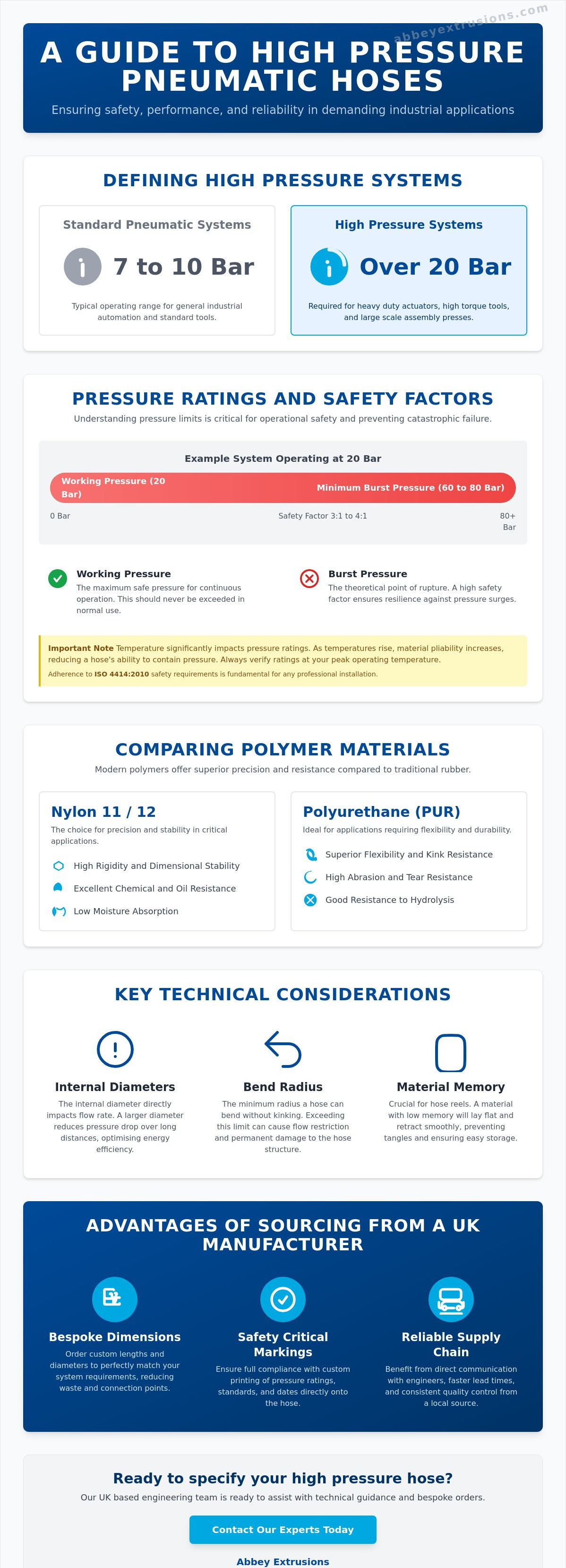
Whilst standard pneumatic systems typically operate within a 7 to 10 bar range, the evolution of industrial automation has necessitated a shift towards higher thresholds. A high pressure pneumatic hose is generally defined by its ability to perform reliably at pressures exceeding 20 bar. In modern manufacturing, these systems provide the necessary force for heavy duty actuators and high torque pneumatic tools. We observe that as facilities move towards greater efficiency, the demand for higher pressure delivery grows, making the correct specification of hoses a primary concern for plant managers.
Selecting a hose that only meets the nominal pressure of your compressor is a dangerous oversight. High pressure environments are dynamic; they involve rapid cycling and potential surges that can momentarily exceed the rated capacity of your equipment. An under-specified hose will suffer from accelerated fatigue, leading to micro-cracks or catastrophic failure. In a high pressure system, a hose failure isn't just a maintenance issue; it can lead to severe injury due to the rapid release of stored energy. This is why adherence to safety requirements, such as those outlined in ISO 4414:2010, is a fundamental necessity for any professional installation.
Pressure Ratings and Safety Factors
To ensure operational security, engineers must distinguish between the maximum working pressure and the ultimate burst pressure. The working pressure represents the safe limit for continuous use, whilst the burst pressure is the theoretical point of rupture. Amongst reputable UK manufacturers, a safety factor of 3 to 1 or 4 to 1 is standard practice. For example, a system operating at 20 bar requires a hose with a minimum burst pressure of 60 to 80 bar. It's also vital to recognise that temperature significantly influences these ratings. As the operating environment warms, the thermoplastic or rubber compounds become more pliable, which reduces the hose's ability to contain pressure. Always verify the pressure rating at your specific peak operating temperature to avoid unexpected failures.
Common Applications for High Pressure Air Delivery
These robust delivery systems are essential in heavy duty workshops and large scale manufacturing lines where high force density is required. From pneumatic clamping in CNC machining to the operation of large scale assembly presses, the integrity of the air line is paramount. The transport and automotive sectors also rely heavily on these components for air brake systems and heavy vehicle maintenance. For such demanding environments, we recommend specialised products like the Air 60 Air Hose. This specific solution is engineered to withstand the rigours of high pressure delivery whilst maintaining the flexibility required for ease of use in busy industrial settings. Choosing the right high pressure pneumatic hose ensures that your tools receive the consistent power they need without compromising the safety of the workspace.
For technical guidance on material compatibility or to request samples of our industrial tubing, please contact our specialist team.
Comparing Polymer Materials for High Pressure Air Systems
Selecting the right material for a high pressure pneumatic hose is a decision that dictates the long term reliability of your system. Whilst traditional rubber hoses are often cited for their ruggedness, modern polymers offer a level of precision and chemical resistance that rubber simply cannot match. In environments where exposure to industrial solvents or oils is common, selecting a material with the correct molecular structure is essential to prevent swelling or degradation. We focus on matching the specific polymer to the mechanical demands of the application to ensure a stable and secure connection that maintains its integrity under load.
The choice between different polymers depends heavily on the balance of rigidity and flexibility required for your specific layout. Every material we utilise is selected for its ability to withstand consistent pressure whilst resisting environmental stressors. When designing these systems, it's vital to cross reference material capabilities with established safety regulations to ensure that the chosen compound can handle the stored energy of compressed air without risk of premature fatigue.
Nylon 11 and 12 Properties
Nylon tube remains the industry standard for precision applications due to its exceptional dimensional stability. Unlike many other plastics, Nylon 11 and 12 exhibit very low moisture absorption, which means they won't swell or lose their mechanical properties in humid or wet conditions. Nylon 12 is particularly valued for its high impact resistance and its ability to maintain performance in cold weather climates where other materials might become brittle. For systems requiring strict tolerances and high burst pressures, we offer both rigid and flexible variants to suit complex layouts. If you require a specific grade for your project, you can consult with our materials experts for a detailed compatibility analysis.
Polyurethane and PVC Performance
For applications that require frequent movement or tight routing, Polyurethane tube is often the superior choice. It possesses excellent memory properties, allowing it to return to its original shape after being flexed or stretched. This kink resistance is a vital feature for any high pressure pneumatic hose used in dynamic machinery or handheld tools. Alternatively, for larger scale air delivery where cost effectiveness is a priority, Reinforced PVC tube provides a balanced solution. By embedding a high tensile textile braid within the PVC wall, we can achieve high pressure ratings whilst keeping the hose lightweight and easy to handle. Each polymer type offers a different service life expectation, generally ranging from five to ten years depending on the intensity of use and environmental exposure.
If you require a technical review of your system's pressure capacity or wish to discuss custom reinforcement options for your facility, please speak with our technical department.
Technical Specifications and Safety Factors for Pneumatic Hose Selection
Specifying a high pressure pneumatic hose involves more than just selecting a material; it requires a precise calculation of internal and external diameters. The internal diameter must be sized correctly to prevent excessive pressure drop, which directly impacts the efficiency of your tools and actuators. For every additional ten metres of hose, the friction between the compressed air and the inner wall reduces the available pressure at the outlet. We advise engineers to choose the largest practical internal diameter to ensure consistent performance across the entire production line whilst minimising energy waste from the compressor.
Compliance with international and British safety standards is a fundamental requirement for industrial peace of mind. For instance, understanding the OSHA safety requirements for pneumatic hoses helps in implementing necessary safety devices that prevent hose whip in the event of a coupling failure. These mechanical safeguards, combined with the correct technical specification and a robust safety factor, form the basis of a secure high pressure system that protects both your machinery and your personnel.
The Role of Reinforcement in High Pressure Hoses
To achieve higher bar ratings, a high pressure pneumatic hose typically incorporates one or more reinforcement layers. Textile braiding, often manufactured from high-tensile polyester or aramid yarns, provides the necessary strength without sacrificing the flexibility required for routing. A single braid is often sufficient for medium duty applications, whilst double braiding is utilised for more extreme pressure requirements. The angle at which these fibres are applied is a critical engineering detail; a neutral braid angle ensures the hose remains dimensionally stable under pressure, preventing unnecessary expansion or contraction that could strain your connections.
Environmental Resistance and Longevity
The longevity of your pneumatic system is often determined by the external environment. If your air lines are exposed to direct sunlight or high intensity artificial light, specifying UV stabilised polymers is essential to prevent the material from becoming brittle over time. Similarly, in applications where hoses are dragged across factory floors or integrated into moving machinery, abrasion resistance becomes the primary factor in determining service life. Utilising a Nylon Spiral Cut Hose Guard provides an additional sacrificial layer of protection against mechanical wear. This simple addition can significantly extend the replacement cycle of your pneumatic assets, reducing both maintenance downtime and long term procurement costs.
To ensure your hose reel systems are equipped with the correct technical specifications for your specific industrial application, please contact our specialist engineering team.
Integrating High Pressure Hoses with Pneumatic Hose Reels and Storage Systems
Selecting the appropriate high pressure pneumatic hose for an automatic or manual reel system is a critical engineering decision that directly impacts the lifespan of the assembly. Unlike static air lines, hoses on reels are subject to constant mechanical stress, including tension, abrasion, and repeated bending. We've observed that many industrial failures occur because the hose's minimum bend radius wasn't properly matched to the reel's drum diameter. If a hose is forced into a tighter curve than its molecular structure allows, the internal reinforcement can fatigue prematurely, leading to a loss of pressure integrity.
For workspaces that require high mobility without the clutter of trailing lines, a Nylon Recoil Air Hose offers a self-organising solution. These coiled systems rely on the material memory of the polymer to retract after use, but they must be manufactured with precision to ensure they don't lose their tension over time. Maintaining these systems involves regular cleaning to remove grit that can act as an abrasive during the coiling process, alongside periodic checks for any permanent deformation in the coils. Proper storage and organisation prevent the accidental damage that often occurs in busy workshops.
Hose Reel Compatibility and Installation
Optimising flow requires a precise match between the hose diameter and the reel drum size. A drum that's too small for a thick walled high pressure pneumatic hose will cause unnecessary stress at the connection point. High quality swivels and connectors are equally vital in high pressure reels to prevent leaks at the rotation axis. In busy industrial centres, ensuring smooth deployment is essential for worker productivity and safety. We recommend verifying the maximum capacity of your reel before installation to avoid overloading the retraction spring.
Preventing Mechanical Failure in Coiled Systems
Hoses used on automatic retraction reels often show signs of fatigue through surface crazing or slight discolouration near the coupling. Hose stoppers play a significant role in protecting the assembly by preventing the hose from retracting too far and straining the internal fittings. Regular inspection is a vital component of safety compliance, especially in systems where the stored energy is significant. If you need assistance in selecting the correct hose for your storage systems, request a technical consultation with our team to discuss your specific requirements.
To discuss your specific manufacturing requirements or to request a quote for custom pneumatic components, please contact our specialist team.
Sourcing High Performance Pneumatic Hoses from UK Manufacturers
Working directly with a UK manufacturer like Abbey Extrusions offers a level of technical oversight that third party distributors simply cannot provide. When you source a high pressure pneumatic hose from the point of manufacture, you gain the ability to specify the exact parameters of the polymer blend and the reinforcement architecture. This direct relationship ensures that your supply chain remains resilient and that every metre of tubing meets your internal quality benchmarks. We take pride in our ability to translate complex engineering requirements into reliable, high performance products that serve the most demanding industrial sectors.
Customising hose colours and surface markings is not merely an aesthetic choice; it's a vital safety protocol for identifying different gas lines or pressure zones within a complex facility. We can organise production runs that include specific branding, safety warnings, or technical data printed directly onto the hose surface. Our capacity for Tube Forming adds another layer of utility by allowing for the creation of pre-shaped pneumatic lines. These formed components are designed to fit perfectly into tight machinery enclosures, significantly reducing the assembly time and eliminating the risk of kinking that often occurs with standard flexible tubing in confined spaces.
Bespoke Extrusion Capabilities
Our facility is equipped to handle non-standard requests that go beyond the typical catalogues of general suppliers. You can request custom wall thicknesses to meet specific pressure requirements or develop a custom profile for unique pneumatic fittings that require a non-cylindrical interface. By ordering exact lengths tailored to your specific machinery, you can reduce material waste and streamline your procurement process. This bespoke approach ensures that your high pressure pneumatic hose is perfectly matched to its intended application, providing a more stable and efficient air delivery system. For broader facility maintenance beyond your air lines, you can visit Composites Construction UK to explore structural strengthening and concrete repair services.
Quality Assurance and Technical Support
A primary advantage of a direct manufacturing partnership is the immediate access to comprehensive technical support. We provide detailed technical data sheets and chemical compatibility charts to ensure that your chosen polymer is suitable for your specific operating environment. This expert advice is particularly valuable when transitioning to higher pressure systems where the margin for error is significantly reduced. We ensure that our manufacturing processes align with the latest engineering principles of plastic extrusion, maintaining the consistency and precision that industrial partners expect from a traditional UK manufacturer.
Optimising Your Pneumatic Infrastructure for Long Term Performance
Abbey Extrusions has been a cornerstone of UK manufacturing since 1985, providing the technical competence required for demanding industrial applications. We are specialists in high performance Nylon 11 and 12 tubing, offering bespoke tube forming and custom extrusion services to meet your most complex system layouts. Our commitment to precision and quality ensures that every component we produce provides the reliability your business depends on.
To ensure your systems are equipped with the most durable and compliant components, please contact our technical team for expert advice on your pneumatic requirements. We look forward to supporting your next engineering project with the stability and expertise that only decades of manufacturing experience can provide.
Frequently Asked Questions
What is the maximum pressure a standard pneumatic hose can handle
Standard pneumatic hoses are typically rated for 10 bar, which is approximately 145 psi. A high pressure pneumatic hose is required for systems operating at 20 bar or above, with some specialised reinforced polymers reaching much higher thresholds. Always check the manufacturer's technical data sheet for the specific working pressure and burst pressure ratings before installation.
Can I use a high pressure pneumatic hose for water or oil delivery
How do I calculate the pressure drop over a long pneumatic hose run
Pressure drop is calculated based on the internal diameter, the flow rate, and the total length of the hose run. For every ten metres of hose, friction between the compressed air and the inner wall causes a measurable loss in bar rating. To minimise this, engineers should select the largest practical internal diameter and keep hose runs as short as possible to maintain tool performance.
What is the difference between Nylon 11 and Nylon 12 for high pressure air
Nylon 12 offers superior impact resistance and maintains its flexibility in cold weather environments compared to Nylon 11. Whilst both materials provide excellent dimensional stability and low moisture absorption, Nylon 11 is often preferred for its higher temperature resistance and bio-based origin. Both are excellent choices for precision high pressure applications where reliability is paramount for the system.
How often should high pressure pneumatic hoses be replaced in a factory
Most industrial hoses have a service life of five to ten years depending on the intensity of the application and environmental exposure. In high pressure environments, you should implement a regular inspection schedule to check for surface crazing, discolouration, or softening. If any signs of fatigue are present, the hose should be replaced immediately to prevent catastrophic failure and maintain workplace safety.
Is a reinforced PVC hose suitable for 40 bar applications
Reinforced PVC is generally unsuitable for 40 bar applications as its safe working pressure typically peaks around 20 bar at ambient temperatures. For pressures reaching 40 bar, a high tensile Nylon 12 or a specifically engineered rubber hose with multiple reinforcement layers is required. Always verify that the hose has a safety factor of at least 3 to 1 or 4 to 1 for such high loads.
Can high pressure pneumatic hoses be repaired if they develop a leak
We strongly advise against repairing a high pressure pneumatic hose that has developed a leak or puncture. High pressure systems contain significant stored energy, and any patch or splice represents a mechanical weak point that could fail under load. The safest and most cost effective solution is to replace the entire length with a new, factory tested assembly to ensure compliance with safety standards.
What safety equipment is required when working with 20 bar pneumatic systems
Safety requirements for 20 bar systems include the installation of whip checks and safety cables to prevent the hose from flailing if a coupling fails. Operators should also use high quality push to connect or threaded fittings that are specifically rated for high pressure. Adhering to ISO 4414 standards ensures that all components, including regulators and valves, are matched to the system's peak output.

Article by
Bryan Cowan
Bryan Cowan is the Founder and Managing Director of Abbey Extrusions Ltd, a leading UK manufacturer of high-quality plastic tubes and hoses. With over 40 years of industry experience, Bryan established the company in 1985, growing it from a start-up into a BS ISO9001-registered supplier for global sectors including aerospace, automotive, and pharmaceuticals.
Disclaimer
This article is intended for informational purposes only. Please ensure you seek expert advice or carry out your own research to confirm the information is suitable for your specific needs.