Why should a requirement for fifty metres of bespoke tubing carry the same lead time and administrative burden as a five-thousand-metre production run? Many procurement managers and design engineers across Britain feel the frustration of being sidelined by large-scale manufacturers who prioritise volume over technical precision. With resin prices for polyethylene and polypropylene seeing synchronised increases of up to €500 per tonne in May 2026, the financial burden of stock is rising. Holding excess inventory isn't a sustainable strategy for agile businesses seeking a reliable small batch plastic extrusion service.
By utilising a specialised manufacturing partner, you can secure high quality bespoke extrusions in smaller quantities without the excessive lead times or overheads associated with mass production. We understand that your project may require specialist polymers such as Nylon 11 or 12, which often present sourcing challenges when order volumes are modest. This article explores how a UK-based manufacturing partnership ensures your custom profiles meet exact technical specifications whilst significantly reducing your stock holding costs. We'll outline the process of streamlining bespoke tooling and how local expertise provides the communication and speed necessary to navigate today's volatile supply chain.
Key Takeaways
- Understand why small batch production is a strategic choice for specific project requirements rather than simply a way to manage inventory.
- Discover how a professional small batch plastic extrusion service allows you to access bespoke components without the burden of high minimum order quantities.
- Compare the technical merits of continuous extrusion against subtractive CNC fabrication to select the most cost-effective manufacturing route.
- Learn how specialist polymers like Nylon and Polyurethane can be utilised in smaller runs to meet demanding industrial specifications.
- Explore the benefits of working with a UK-based manufacturer to ensure direct communication with the technical team responsible for your production.
To discuss your specific manufacturing requirements or to request a technical consultation, please contact our specialist team.
Managing the challenges of low volume plastic production
Small batch extrusion refers to production runs engineered to meet specific project requirements rather than for the simple purpose of building inventory. In a manufacturing environment where resin prices for materials such as polyethylene and polypropylene have seen synchronised increases of up to €500 per tonne in May 2026, the ability to order precisely what is needed provides a significant financial advantage. UK businesses developing prototypes or niche industrial components require a manufacturing partner that prioritises engineering precision over sheer volume. A dedicated small batch plastic extrusion service allows for iterative design improvements, enabling engineers to test a profile and refine dimensions without wasting kilometres of material.
Large scale manufacturers often impose high minimum order quantities, sometimes requiring several tonnes of material before a machine is even commissioned. This is because the standard plastic extrusion process involves significant preparation and calibration. For many mass producers, a small order is viewed as a disruption to their high speed workflows. By contrast, an agile manufacturing approach supports the development of bespoke components, such as a specialised Nylon tube for a specific hydraulic application, without the pressure of excessive stock holding.
Why traditional high volume manufacturers avoid small runs
Setup costs remain the primary deterrent for high volume facilities. Changing a die and calibrating the vacuum cooling tanks requires substantial time. If the production run is short, the machine downtime often costs more than the finished product. Additionally, the complexity of cleaning extruders between different polymer types is a meticulous task. Transitioning from a standard PVC to a specialised low-density polythene tube requires thorough purging to prevent contamination. Large firms find the administrative overheads and technical labour required for these short cycles often exceed the total invoice value of the order.
The economic benefits of agile production schedules
By ordering only the required volume, firms can effectively reduce capital tied up in slow moving stock. This is particularly relevant in 2026, as the Plastic Packaging Tax (PPT) at £228.82 per tonne adds further cost implications to excess material. Agile production ensures faster response times to urgent maintenance needs or sudden market shifts. It also allows for the validation of material properties, such as abrasion resistance or chemical compatibility, in real world conditions before committing to a full scale rollout. Choosing a small batch plastic extrusion service ensures that technical excellence is maintained regardless of the total metreage required.
To explore how specific polymer properties can enhance your project performance, we invite you to speak with our technical engineers.
Technical polymers suitable for bespoke small batch runs
Selecting the correct raw material is fundamental to the success of any engineering project. A professional small batch plastic extrusion service provides the flexibility to utilise high performance technical polymers that larger manufacturers might restrict to high volume contracts. As a specialist British extrusion manufacturer, we understand that the specific chemical and physical demands of an application dictate the choice of polymer. Whether the requirement is for high pressure resistance or exceptional flexibility, the material must perform reliably under industrial conditions.
Nylon tube remains a staple for many UK industries due to its impressive strength and chemical compatibility. In smaller production runs, we can provide bespoke dimensions in various grades, ensuring that the final product meets the precise tolerances required for pneumatic or hydraulic systems. This adaptability is essential for maintaining operational efficiency in specialised sectors.
Selecting between Nylon 11 and Nylon 12
Nylon 11 and Nylon 12 offer distinct advantages depending on the environment. Nylon 11 is often preferred for its impact resistance and bio-sourced origins, whilst Nylon 12 provides superior dimensional stability due to its lower moisture absorption rates. For fuel delivery systems, Nylon 12 is generally the technical choice, whereas Nylon 11 excels in cold weather pneumatic applications. Even in limited quantities, these materials can be produced in specific colours to assist with system identification.
When flexibility is the priority, polyurethane tube offers performance that standard PVC cannot match. Its inherent memory properties and resistance to kinking make it ideal for dynamic applications where the tubing is subject to constant movement. This material is particularly effective in environments where abrasion resistance is a critical factor for long term durability.
The advantages of Polyurethane in technical applications
Polyurethane is highly sought after in the robotics and automation sectors because of its exceptional abrasion resistance. Unlike rigid plastics, PU can withstand significant mechanical stress without failure. A flexible small batch plastic extrusion service allows engineers to specify particular Shore hardness levels, ensuring the tubing is neither too soft for fittings nor too stiff for the required bend radius. This level of customisation is vital for developing high performance industrial equipment.
For applications where cost effectiveness must be balanced with chemical inertness, low density polythene tube is an excellent solution. It provides reliable performance for fluid transfer in less demanding environments. For extreme conditions, such as those involving aggressive chemicals or high temperatures, we also process high performance Fluoropolymers. These materials are often required in very specific, small quantities for laboratory or aerospace settings. If you are unsure which polymer fits your technical specification, you may consult our material experts for detailed advice.
To begin your project or discuss technical specifications, please get in touch with our technical team for expert guidance.
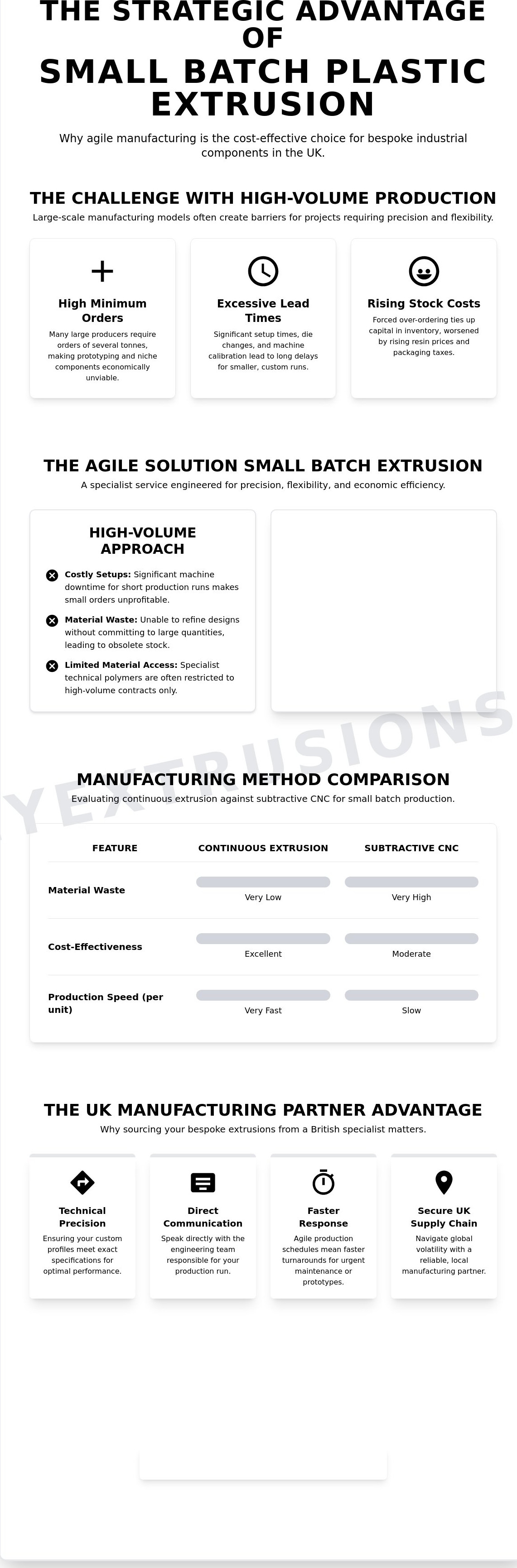
Evaluating extrusion against CNC fabrication for small batches
Selecting the most efficient manufacturing method for small production runs requires a clear understanding of the fundamental differences between extrusion and CNC machining. Extrusion is inherently a continuous process that forces molten polymer through a precision die to create a profile. In contrast, CNC fabrication is a subtractive method where material is cut away from a solid block or rod. For any application requiring long lengths or a consistent cross section, a small batch plastic extrusion service offers advantages that machining simply cannot replicate. The efficiency of the process ensures that the cost per metre remains competitive even when total volumes are modest.
Structural integrity is a significant factor in this comparison. During extrusion, the polymer chains align as they pass through the die, creating a grain structure that enhances the mechanical properties of the final profile. Machining often interrupts this flow, potentially introducing stress points or micro cracks where the cutting tool has removed material. For technical components such as a high pressure Nylon tube, this internal consistency is vital for long term reliability. Equally, the material wastage associated with CNC machining is substantial. With resin prices for polyethylene and polypropylene seeing synchronised increases of up to €500 per tonne in May 2026, turning expensive technical polymers into swarf is an avoidable financial drain.
When to choose extrusion over machining
Extrusion is the superior choice for any profile that maintains a uniform shape over several metres. It allows for the creation of complex hollow sections and thin walled geometries that are difficult, or sometimes impossible, to achieve through subtractive machining. Once the initial profile is produced, secondary processes such as tube forming can add further value by shaping the component to meet specific assembly requirements. This combination of continuous production and post-extrusion shaping provides a versatile solution for niche industrial applications.
Cost considerations for small batch tooling
The primary financial difference lies in the initial investment. CNC machining requires programming time and bespoke fixtures, which are often charged per part. Extrusion requires a one-off investment in a hardened steel die. Whilst the initial die cost might seem higher for the very first run, it is a reusable asset. For subsequent orders, the setup time is significantly reduced, and the unit cost drops sharply. When calculating the break even point, engineers must consider the total lifecycle of the part. If the design is finalised and repeat orders are likely, the long term savings of a small batch plastic extrusion service far outweigh the perceived flexibility of machining.
If you require a bespoke profile or a specific technical hose, you may contact our Leicestershire office to discuss your requirements.
Ensuring precision and quality in custom profile extrusion
Precision in engineering is non-negotiable. For industrial components such as curtainsider pelmet sections, dimensional accuracy ensures the longevity of the final assembly. A small batch plastic extrusion service must implement the same rigorous quality checks as a high volume facility. This includes full material traceability and certification, which are essential for compliance with UK industrial standards and safety regulations. We maintain a strict audit trail for every batch, ensuring that the polymers used meet the exact technical data sheets provided by the resin manufacturers.
Bespoke profiles, such as kedar cord, require meticulous die design to account for the specific shrink rates of the polymer. Our technical team oversees every stage of the process, from the initial die cut to the final cooling phase. This hands-on approach guarantees that the technical specifications provided by the client are met with absolute fidelity. By controlling the entire workflow within our UK facility, we can address minor adjustments immediately, ensuring the first metre of the run is as accurate as the last.
Maintaining tolerances in short production cycles
Achieving thermal stability is the primary challenge during the startup of a short run. Unlike continuous production, where the machinery runs for days, a small batch requires the extruder to reach a steady state quickly. We manage this through precise temperature control and real-time monitoring of the melt flow. Laser measurement systems provide constant feedback on the profile dimensions, whilst manual checks confirm the physical properties of the extrusion. Consistent cooling is equally critical. For complex profiles, uneven cooling can lead to warping or internal stresses. We use calibrated vacuum tanks and cooling troughs to ensure every metre of the run remains identical to the approved sample.
Material purity and anti static requirements
Switching between different polymer batches requires a disciplined approach to prevent cross-contamination. This is particularly vital when manufacturing anti-static variants or food grade hoses. A thorough purging process ensures that the extruder barrel and screw are completely clear of previous materials. For sensitive industrial environments, we produce specialised anti-static tubing that prevents the buildup of electrical charges. Similarly, our production of brewery and food grade materials adheres to strict purity standards. We ensure that every component, from brewery hose to Air 60 air hose, is manufactured in a controlled environment. If your project demands high purity or specific industrial certifications, please submit an enquiry through our contact page to discuss your technical requirements.
To request a quote for your small batch extrusion project, please submit an enquiry through our contact page today.
The benefits of choosing a specialist British extrusion manufacturer
Sourcing components locally eliminates the logistical complexities and risks associated with international supply chains. In May 2026, as global resin prices fluctuate and geopolitical tensions impact shipping routes, the stability of a domestic partner is invaluable. Working with a UK manufacturer reduces lead times significantly and removes the uncertainty of port delays or sudden changes in import tariffs. By opting for a dedicated small batch plastic extrusion service based in Britain, procurement teams can maintain leaner inventory levels without compromising on the availability of critical parts.
Abbey Extrusions brings decades of technical experience to every project, providing a level of engineering oversight that ensures product longevity. Direct communication serves as the cornerstone of our professional relationship. Unlike large-scale suppliers where technical queries are often filtered through administrative layers, our clients speak directly with the engineers responsible for machine setup and calibration. This transparency ensures that the specific requirements of your design are understood and implemented correctly from the very first production cycle, resulting in better product performance and reduced waste.
Expertise in specialist industrial applications
Our technical knowledge assists clients in selecting the most appropriate polymer for their specific operating environment. We understand how different materials react to mechanical stress, UV exposure, and chemical contact. Our portfolio includes high-performance items such as diesel fuel hose and triflex 2000 water hose, which are engineered for demanding industrial roles. This expertise allows us to provide niche products like fluted water hose in manageable quantities that suit your project timeline, ensuring you never have to compromise on material quality due to order volume.
Supporting UK innovation through bespoke production
We take a collaborative approach to problem-solving during the design and tooling phase. By providing high-quality bespoke components in smaller runs, we help smaller UK firms compete effectively with larger rivals. This partnership fosters innovation by allowing for the development of specialised equipment without the financial burden of massive upfront orders. Our commitment to precision and service defines our manufacturing ethos. Choosing our small batch plastic extrusion service means investing in a partnership that values technical excellence as much as you do. We invite you to discuss your technical challenges with our team to see how our bespoke production can support your next project.
To discuss your specific manufacturing requirements or to request a technical consultation, please speak with our specialist team.
Securing technical excellence for your next project
Selecting a dedicated small batch plastic extrusion service ensures your project benefits from engineering precision without the financial strain of excess inventory. We've explored how selecting the correct technical polymers, such as high-performance Nylon 11 and 12, can significantly enhance the durability and function of your components. By prioritising a UK-based partnership, you gain the advantage of direct communication with manufacturing experts and a more resilient supply chain.
Abbey Extrusions has been an independent UK manufacturer since 1985, building a reputation for technical expertise in bespoke profile creation and specialised tube forming. Our commitment to quality control and material traceability remains consistent, regardless of the production volume. We focus on delivering tailored solutions that meet your exact specifications whilst avoiding the long lead times often found amongst larger mass producers.
Contact Abbey Extrusions for a bespoke small batch quotation to discuss how our decades of experience can support your industrial requirements. We look forward to helping you achieve your manufacturing goals with precision and reliability.
Frequently Asked Questions
What is considered a small batch in plastic extrusion
A small batch typically refers to production runs that range from 500 metres to 1000 metres, depending on the specific profile dimensions and material weight. Whilst mass producers require multi-tonne orders to justify machine downtime, a specialist service focuses on meeting exact project requirements. This approach is ideal for prototype development or niche industrial applications where holding vast amounts of inventory is neither practical nor cost-effective.
How long does it typically take to produce a custom small batch run
Lead times for production can be as short as five working days if the required extrusion die already exists. If your project requires a bespoke profile, the design and manufacturing of new tooling typically takes between four and twelve weeks. These timelines ensure that every technical specification is validated before the final production run commences, maintaining the high standards expected in UK manufacturing.
Are there specific materials that are better suited for small runs
Technical polymers such as Nylon 11, Nylon 12, and Polyurethane are exceptionally well-suited for small production runs due to their specialised industrial uses. These materials often require precise temperature control and expert handling, which is a hallmark of a professional small batch plastic extrusion service. Standard materials like LDPE and PVC are also frequently processed in smaller quantities for specific fluid transfer or protective applications.
Can you help with the design of the extrusion die
Technical assistance is available throughout the design and tooling phase to ensure your profile is optimised for the extrusion process. Our engineers provide guidance on wall thickness, tolerances, and material behaviour to prevent issues such as warping or excessive shrinkage. This collaborative approach ensures that the final die produces a component that meets your exact mechanical requirements and fits perfectly within your assembly.
What are the typical tooling costs for a bespoke profile
Tooling costs are determined on a per-project basis and depend entirely on the complexity and size of the required profile. A hardened steel die represents a one-off investment that remains available for all your future production requirements. By investing in high-quality tooling at the start, you ensure consistent dimensional accuracy and reduce the unit cost of the extrusion over the long term as the die is reused.
Do you provide material certification for industrial or food grade applications
Full material traceability and certification are provided for every order to meet rigorous industrial and safety standards. Whether you require a brewery hose or a technical fuel line, we provide the necessary documentation to prove the polymer meets the required specifications. This transparency is vital for clients operating in regulated sectors where material purity and performance validation are non-negotiable requirements.
Is it possible to have different colours in a small batch order
Bespoke colours can be achieved by incorporating specific masterbatch pigments into the base polymer during the manufacturing process. This customisation is a standard feature of a professional small batch plastic extrusion service, allowing for colour-coded systems or brand-specific aesthetics. Whilst colour changes require a thorough cleaning of the extruder, we manage this process efficiently to maintain the high quality of the finished tubing or profile.
Can you manufacture custom lengths or coils for small orders
Extruded products can be supplied in precise cut lengths or continuous coils to suit your specific installation or assembly needs. We use calibrated cutting equipment to ensure every piece meets your dimensional requirements with minimal waste. Additionally, secondary processes such as tube forming can be applied to create specific shapes or bends, providing a complete solution for complex industrial components.

Article by
Bryan Cowan
Bryan Cowan is the Founder and Managing Director of Abbey Extrusions Ltd, a leading UK manufacturer of high-quality plastic tubes and hoses. With over 40 years of industry experience, Bryan established the company in 1985, growing it from a startup into a BS ISO9001-registered supplier for global sectors including aerospace, automotive, and pharmaceuticals.
Disclaimer
This article is intended for informational purposes only. Please ensure you seek expert advice or carry out your own research to confirm the information is suitable for your specific needs.