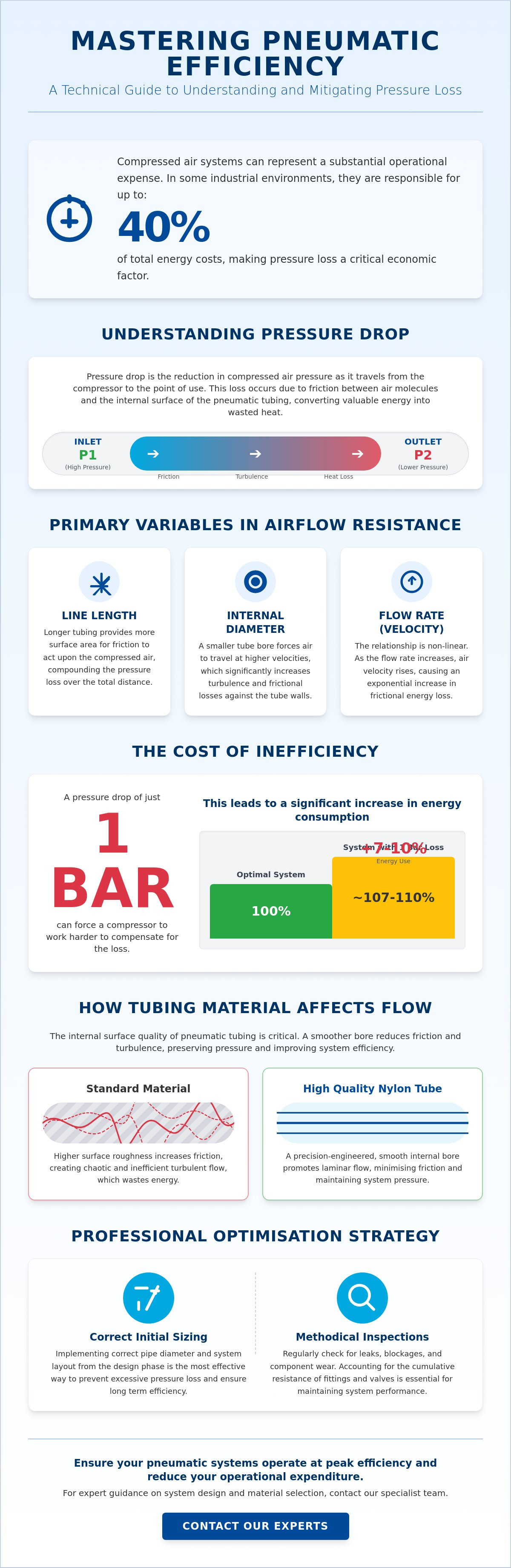
Did you know that compressed air systems can account for up to 40% of total industrial energy costs? This significant figure highlights why precision in calculating pressure loss in pneumatic lines is not merely a technical exercise but a vital economic necessity for modern manufacturing. We understand the frustration of encountering unexpected pressure drops at the point of use, particularly whilst navigating the complexities of different mathematical formulae for flexible tubing. It's a challenge that many experienced engineers face when attempting to organise a system that balances performance with long term reliability.
This article provides the technical clarity needed to master the variables and formulae required to accurately calculate and minimise pressure drop in your pneumatic tubing systems. We'll guide you through a methodical approach to system design, from understanding the Darcy-Weisbach equation to selecting the most efficient tubing materials. By following this step by step method, you'll gain the confidence to optimise your industrial air systems for maximum efficiency and reduced operational expenditure.
Key Takeaways
- Determine the precise difference between inlet and outlet pressure by applying established engineering formulae such as the Harris and Darcy-Weisbach equations.
- Gain a technical advantage by calculating pressure loss in pneumatic lines whilst accounting for the specific friction coefficients of various polymer materials.
- Learn why the internal surface characteristics of Nylon tube make it the preferred material for maintaining flow efficiency over extended distances.
- Account for the cumulative resistance of system components by using the equivalent length method for all fittings and valves within the network.
- Implement a professional optimisation strategy that focuses on correct initial sizing and methodical inspections to ensure long term system reliability.
For professional assistance with your technical specifications and system design, please reach out to our specialist team.
Understanding the Fundamentals of Pneumatic Pressure Loss
Pressure drop represents the inevitable reduction in compressed air pressure as it travels from the compressor discharge point to the final pneumatic tool or actuator. This phenomenon occurs because air is a viscous fluid. As it flows through a system, air molecules experience friction both amongst themselves and against the internal walls of the tubing. This resistance converts kinetic energy into heat, which then dissipates into the environment, effectively wasting a portion of the work performed by the compressor. Gaining a deep technical grasp of the fundamental principles of pressure drop is essential for any engineer tasked with calculating pressure loss in pneumatic lines to ensure system performance remains within specified tolerances.
When air moves at high velocities, the flow often becomes turbulent. In this state, air molecules no longer move in smooth, parallel layers but instead form chaotic eddies and swirls. This turbulence significantly increases the energy dissipation within the line. For a traditional manufacturing facility, failing to account for these molecular interactions leads to "starved" tools that cannot reach their rated torque or speed, resulting in inconsistent production quality and increased cycle times.
Primary Variables in Airflow Resistance
Several physical factors dictate the magnitude of resistance within a closed pneumatic system. The relationship between flow rate and resistance is non-linear. As demand at the point of use increases, the air velocity must rise, which exponentially amplifies frictional losses. Internal diameter plays a critical role in this calculation. A smaller bore forces air to move at higher speeds, creating a thicker boundary layer and more interaction with the tube walls. Conversely, extending the length of a line provides more opportunity for these frictional forces to act, compounding the total loss over the distance. We frequently observe that selecting a high quality Nylon tube with a precision engineered, smooth internal bore can mitigate these effects more effectively than materials with higher surface roughness.
The Cost of Energy Inefficiency
The economic consequences of ignored pressure drops are substantial and often represent a significant drain on operational budgets. In many UK manufacturing environments, compressed air is the most expensive utility. A pressure drop of just 1 bar can force a compressor to operate at a significantly higher set point to compensate for the loss, which may increase energy consumption by approximately 7% to 10%. This inefficiency doesn't just impact the bottom line; it also places unnecessary strain on the compressor's motor and cooling systems, potentially shortening its service life. By precisely calculating pressure loss in pneumatic lines during the design phase, companies can avoid these hidden costs and ensure their systems operate at peak thermodynamic efficiency whilst reducing their overall carbon footprint.
To ensure your system design meets the highest technical standards, you may consult our engineering experts for tailored guidance.
Mathematical Methods for Calculating Pressure Drop
Achieving precision in industrial pneumatic design requires more than simple estimation. When calculating pressure loss in pneumatic lines, engineers must select a methodology that aligns with the required level of accuracy for the specific application. Whilst quick reference nomograms offer a convenient visual aid for preliminary sizing, they often lack the granularity needed for complex or high flow systems. For definitive results, we rely on established mathematical models that account for the physical properties of air and the geometric constraints of the tubing network. If you require assistance with complex system modelling, you can request a technical review of your proposed layout.
Consistency in units is the most frequent point of failure in these calculations. Industrial systems in the UK often mix metric and imperial measurements, combining flow rates in litres per minute with pressures in PSI. To avoid catastrophic design errors, all variables should be converted to a unified system before beginning the calculation. We typically recommend using the SI system to maintain clarity amongst multidisciplinary teams.
The Empirical Formula for Compressed Air
The Harris formula is a widely respected empirical method for determining pressure drop in compressed air systems. It's particularly effective because it incorporates the compression ratio, which accounts for the fact that air becomes more resistant to flow as it's compressed. The calculation requires three primary inputs: the flow rate expressed as Free Air Delivery (FAD), the initial gauge pressure, and the internal diameter of the tube. By applying this formula, you can determine how much of your initial energy is lost over a specific distance. It's vital to remember that FAD refers to the volume of air at atmospheric conditions, not the volume of the compressed air inside the line. Neglecting this distinction will lead to an undersized system that fails to meet demand.
Factors Influencing the Friction Coefficient
For high precision engineering, the Darcy-Weisbach equation provides a more rigorous approach. This method centres on the friction factor, a dimensionless value that changes based on the flow regime. We first determine the Reynolds number to identify whether the air is moving in a laminar or turbulent state. Most industrial pneumatic systems operate in the turbulent zone, where the friction factor is influenced by the relative roughness of the internal tube wall. Using a Moody chart allows us to find the exact friction factor for materials like Nylon tube, which boasts a significantly lower friction coefficient than traditional metal piping. Air temperature and density also play a role; as air cools down the line, its density increases, which subtly alters the velocity and the resulting pressure drop.
To discuss specific material compatibility for your industrial system, contact our technical department today.
The Impact of Tubing Material on Pneumatic Efficiency
Material selection is a pivotal variable when calculating pressure loss in pneumatic lines. Many generic engineering guides use average friction factors based on oxidised metal piping, which doesn't always account for the superior internal finish of high quality extruded polymers. The molecular structure of the tubing material dictates how air interacts with the boundary layer, directly influencing the energy required to maintain flow. Choosing a material that offers low surface resistance is essential for minimising the work your compressor must perform.
Surface Roughness in Nylon and Polyurethane
Precision extruded Nylon tube and Polyurethane tube offer significantly lower absolute roughness values compared to traditional materials. This smoothness reduces the boundary layer thickness, allowing air to flow with minimal resistance. Whilst metal pipes may have a roughness of 0.045mm, precision extruded polymers often achieve values below 0.005mm. This difference is critical for maintaining high flow rates in long distance runs. Manufacturing precision ensures that the internal bore remains consistent throughout the entire length of the coil, preventing localised turbulence. Key advantages of these smooth internal walls include:
- Reduced friction amongst air molecules at high velocities.
- Lower energy dissipation during turbulent flow regimes.
- Consistent delivery of required pressure to the point of use.
- Prevention of internal moisture trap points that occur in rougher materials.
Dimensional Stability and Internal Diameters
The actual internal diameter used when calculating pressure loss in pneumatic lines is rarely a static figure. Under constant pneumatic load, some materials experience slight dilation or pressure expansion. Nylon tube is highly valued amongst engineers for its exceptional dimensional stability. It maintains its shape and bore size even at peak operating pressures, ensuring that the initial calculations remain accurate over the life of the installation. For applications requiring high flexibility, such as robotic assemblies or point of use connections, Polyurethane tube is the technical choice. However, designers must account for wall thickness tolerances, as even a 0.5mm variance in the bore can significantly alter the resulting pressure loss in a high velocity system.
Long term performance also depends on the material's resistance to environmental factors. Over years of service, inferior materials may suffer from internal pitting or chemical degradation, which increases surface friction and energy loss. By selecting a polymer that resists oil, moisture, and UV exposure, you ensure that the system's efficiency doesn't deteriorate prematurely. Accurate design must consider both the day one performance and the predicted behaviour of the material after thousands of duty cycles.
If you require a detailed audit of your existing system architecture, please speak with our technical consultants.
Accounting for Fittings and System Architecture
Straight runs of tubing are rarely the reality in complex industrial installations. When calculating pressure loss in pneumatic lines, failing to account for the resistance offered by fittings, valves, and manifolds will result in a significant underestimation of total system loss. Every time compressed air is forced to change direction or pass through a restriction, it loses kinetic energy. This energy dissipation is caused by localised turbulence and the sudden contraction or expansion of the air stream as it enters a connector. To maintain precision, designers must look beyond the linear distance and evaluate the entire pneumatic circuit as a series of resistive elements.
Equivalent Lengths of Pneumatic Fittings
The most precise method for integrating these losses is the equivalent length technique. This approach treats each fitting as a specific length of straight tubing that would produce the same pressure drop. A standard 90 degree elbow might have an equivalent length of 0.5 metres of straight pipe. Summing these values allows engineers to calculate the cumulative effect of a complex assembly without requiring fluid dynamics simulations for every joint. We recommend selecting full bore fittings. They maintain a consistent internal diameter and minimise the restrictive bottleneck effect often found in cheaper alternatives. By reducing the number of connectors and choosing streamlined globe valves, you can significantly lower the total resistance of the network.
Managing Bends and Coiled Air Hoses
Directional changes create centrifugal forces that drive air molecules against the outer wall of the bend, heightening friction. Whilst straight runs of Nylon tube are ideal for main headers, point of use applications often require the flexibility of a nylon recoil air hose. The coiled geometry of these hoses introduces a continuous curve. This inherently increases the pressure drop compared to a straight hose of the same extended length. Designers should organise the routing to avoid sharp radius bends and unnecessary loops. Using the correct hose length for the specific reach required prevents excessive pressure loss whilst maintaining tool ergonomics. Strategic placement of manifolds also helps by distributing air through shorter, more direct secondary lines.
For assistance in specifying the correct fittings for your project, contact our team for expert advice.
To ensure your industrial air systems are designed for peak efficiency, please get in touch with our technical team.
Optimising Pneumatic Lines for Long Term Performance
Long term efficiency in a pneumatic network isn't achieved by a single calculation; it's maintained through strategic design and physical protection. When engineers are calculating pressure loss in pneumatic lines, they should integrate a safety margin of approximately 10% to 20% to account for future system expansion. This foresight prevents the need for a complete system overhaul when new machinery is added to the production floor. The fundamental reliability of the entire circuit rests upon the quality of the plastic extrusion process, as inconsistent wall thickness or internal defects will create permanent, unfixable pressure drops.
External environmental factors can also compromise the integrity of flexible lines. In busy manufacturing environments, tubing is often exposed to mechanical abrasion or heavy foot traffic. Implementing a nylon spiral cut hose guard provides a robust layer of protection against external damage and prevents the tubing from collapsing under stress. This simple addition ensures that the internal bore remains unobstructed, maintaining the flow characteristics established during the initial design phase.
Selecting the Right Tubing for Your Application
Choosing the correct polymer involves matching the material's chemical compatibility and temperature ratings to the specific factory environment. For instance, low density polythene tube is an excellent, cost-effective choice for low pressure logic circuits and instrumentation where extreme flexibility isn't the primary requirement. For more demanding or bespoke requirements, consulting with a specialist UK manufacturer ensures that the tubing meets the precise technical standards required for your unique application. We pride ourselves on providing the engineering certainty that only decades of manufacturing experience can offer.
Preventive Maintenance and Leak Detection
Rigorous maintenance schedules are the final component of a high performance system. Even the most accurate method for calculating pressure loss in pneumatic lines is rendered moot if the system develops leaks. Small hissing sounds at joints or connectors can account for a significant percentage of wasted compressor capacity. We recommend scheduling regular pressure audits and ensuring that the air remains clean and dry. Moisture or oil carryover can degrade the internal surface smoothness over time, gradually increasing friction and energy costs. By scheduling methodical inspections, you can identify kinks or internal obstructions before they result in a critical system failure.
For personalised technical support or to request a quote for your next project, please consult with our technical specialists.
Achieving Engineering Certainty in Air Systems
Mastering the technical variables involved in calculating pressure loss in pneumatic lines is the foundation of a cost-effective industrial operation. By synthesising mathematical precision with the selection of high performance materials, engineers can significantly reduce energy waste and ensure consistent tool performance. We have explored how internal surface roughness, the equivalent length of fittings, and robust maintenance schedules all contribute to the overall health of your compressed air network.
As a dedicated UK manufacturer since 1985, we provide the engineering expertise required to optimise these complex systems. We're specialists in high performance Nylon 11 and 12 flexible tubing, offering bespoke tube forming and extrusion services tailored to your specific industrial requirements. Our commitment to quality ensures that every component supports the long term reliability of your system.
Speak with our technical team today for expert guidance on pneumatic tubing and begin the process of refining your industrial air systems for maximum performance.
Frequently Asked Questions
What is considered an acceptable pressure drop in a pneumatic system
An acceptable pressure drop is typically defined as less than 10% of the compressor's discharge pressure from the plant to the point of use. For peak efficiency in industrial distribution, engineers often aim for a drop of no more than 0.1 bar in the main distribution headers. If the drop exceeds these values, the compressor must operate at a higher set point, which significantly increases energy consumption and wear on the machinery.
How does increasing the tube diameter affect the pressure loss calculation
Increasing the internal diameter significantly reduces pressure loss because air velocity decreases for the same volume of delivery. In the mathematical process of calculating pressure loss in pneumatic lines, the diameter variable is often raised to the fifth power. This relationship means that even a small increase in the bore size results in a dramatic reduction in frictional resistance and energy dissipation.
Does the air temperature significantly impact the rate of pressure drop
Air temperature does impact the rate of pressure drop because it alters the density and viscosity of the compressed air. As air temperature rises, its volume expands, which increases the velocity through the tubing and subsequently amplifies frictional losses against the internal walls. Systems located in high temperature environments must be designed with larger diameters to compensate for this increased resistance.
Can I use water pressure loss calculators for pneumatic air lines
You cannot accurately use water pressure loss calculators for pneumatic systems because air is a compressible gas whilst water is an incompressible fluid. Pneumatic calculations must account for the compression ratio and the change in air density as it moves through the system. Using hydraulic formulae will lead to significant design errors and an undersized tubing network that cannot meet tool demand.
What is the difference between gauge pressure and absolute pressure in calculations
Absolute pressure is the sum of gauge pressure plus the local atmospheric pressure, which is approximately 1.013 bar at sea level. Most engineering formulae for calculating pressure loss in pneumatic lines require absolute pressure values to correctly determine the air's density and compression state. Using gauge pressure alone in these equations will result in an inaccurate representation of the air's physical behaviour.
How do I calculate the pressure drop for a coiled air hose
To calculate the drop for a coiled air hose, you must account for the helical geometry which increases the centrifugal force of the air against the tube walls. This is usually managed by using the fully extended length of the hose and applying a specific correction factor or an equivalent length multiplier. Coiled configurations inherently produce higher resistance than straight runs of the same material and length.
Why does a dirty filter cause a higher pressure drop than the tubing itself
A dirty filter causes a high pressure drop because the accumulated contaminants create a physical barrier that restricts the effective flow area. This obstruction forces the air through significantly smaller openings at much higher velocities, creating intense turbulence and energy loss. This localised restriction often becomes the primary bottleneck in a system, overshadowing the frictional losses of the tubing itself.
Does the type of fitting used change the mathematical result
The type of fitting used changes the mathematical result because different geometries create varying levels of flow disturbance. A standard sharp elbow creates more resistance than a long radius sweep, and these differences are represented by different equivalent length values in your final calculation. Selecting streamlined, full bore fittings is a professional strategy for maintaining the pressure established at the compressor.

Article by
Bryan Cowan
Bryan Cowan is the Founder and Managing Director of Abbey Extrusions Ltd, a leading UK manufacturer of high-quality plastic tubes and hoses. With over 40 years of industry experience, Bryan established the company in 1985, growing it from a start-up into a BS ISO9001-registered supplier for global sectors including aerospace, automotive, and pharmaceuticals.
Disclaimer
This article is intended for informational purposes only. Please ensure you seek expert advice or carry out your own research to confirm the information is suitable for your specific needs.