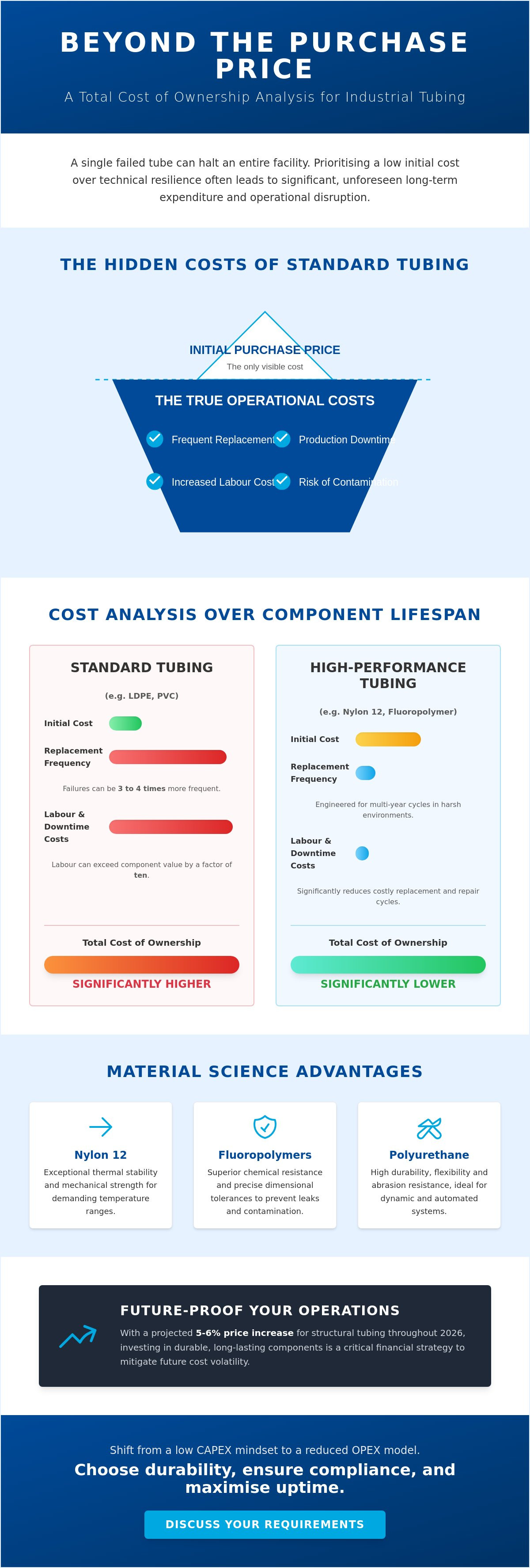
What if the most expensive component on your production line is actually the cheapest part you buy? It is a frustrating reality that a single failed tube can halt an entire facility; yet, many procurement strategies still prioritise low initial purchase prices over technical resilience. We understand that justifying the cost of high-performance tubing feels challenging when budgets are under scrutiny, particularly as the domestic structural tubing market faces a projected 5 to 6 percent price increase throughout 2026.
You likely recognise that frequent production line downtime and rising maintenance labour costs are unsustainable for a lean operation. This article demonstrates how to evaluate the long term value of premium plastic extrusions, such as Nylon 12 or Fluoropolymer tubing, to significantly reduce your total cost of ownership. We will explore how a strategic shift from a low CAPEX mindset to a reduced OPEX model ensures safety compliance in demanding environments whilst lowering the frequency of costly replacement cycles.
Key Takeaways
- Understand how low initial procurement costs for standard tubing often result in significantly higher long term operational expenditure through frequent failure.
- Learn a structured approach for justifying the cost of high-performance tubing by evaluating the total cost of ownership rather than just the purchase price.
- Compare the technical performance of Nylon 12 and Fluoropolymers against standard options to see how material science reduces maintenance labour.
- Discover how selecting the correct polymer grade can mitigate the risk of leaks and environmental contamination in food or fuel environments.
- Identify the benefits of early technical consultation to ensure your specific industrial application uses the most durable and cost effective extrusion solution.
To discuss your specific technical requirements with our engineering team, please contact our specialist department.
The Economics of High Performance Tubing in Industrial Systems
Industrial procurement often falls into a recurring trap where short term savings create long term liabilities. Selecting a Low-density polythene tube for an application that requires the thermal stability of a Nylon tube might save a small amount on the initial purchase order, but it inevitably leads to inflated operational expenditure. High-performance tubing refers to extrusions engineered from High-performance plastics that maintain their physical properties under extreme mechanical or chemical stress. In 2026, as industrial systems become more integrated and automated, the tolerance for material fatigue has narrowed significantly. Justifying the cost of high-performance tubing is no longer a matter of luxury; it's a critical calculation of system uptime and asset protection.
The global market for advanced polymers is evolving rapidly, and the domestic structural tubing market is expected to see a 5 to 6 percent year-on-year increase throughout 2026. This volatility makes it essential to choose materials that offer genuine longevity. We focus on ensuring that every extrusion provides a stable return on investment through material integrity that lasts for multi-year cycles, even in aggressive environments where standard products fail to perform. When you factor in the rising costs of raw materials, the financial argument for durable, high-specification components becomes even more compelling.
The Real Price of Component Failure
UK manufacturers are well aware that a halted production line is one of the most expensive events in the factory lifecycle. Whilst the failing part might cost very little, the hourly rate for a skilled maintenance engineer, combined with the loss of potential output, can reach thousands of pounds very quickly. Often, the labour costs associated with diagnosing, accessing, and replacing a failed tube exceed the component's value by a factor of ten. There is also the secondary impact to consider. A leak in a Diesel Fuel Hose or a chemical transport line can contaminate adjacent machinery, leading to the failure of much more expensive electronic or mechanical hardware.
Material Evolution and Industrial Demands
Standard PVC often lacks the chemical resistance required for modern synthetic lubricants or aggressive cleaning agents used in food and fuel environments. As environmental regulations tighten throughout 2026, companies must move toward specialised polymers that prevent leaching and environmental contamination. Automated systems also require precise dimensional tolerances that generic tubing cannot guarantee. Our Polyurethane tube and Fluoropolymer options are designed to meet these exact specifications. By prioritising material integrity from the outset, you ensure that your systems operate at peak efficiency without the risk of premature degradation caused by chemical incompatibility or pressure spikes.
To discuss your specific technical requirements with our engineering team, please contact our specialist department.
Total Cost of Ownership vs Initial Purchase Price
Whilst initial procurement costs are easily tracked, the true financial burden of a component is revealed through a Life Cycle Cost Analysis. This methodology is central to justifying the cost of high-performance tubing, as it accounts for the cumulative expenses of procurement, installation, maintenance, and eventual disposal. Selecting a Low-density polythene tube for a high-stress application might appear cost-effective on a purchase order, but the replacement frequency of such materials can be three to four times higher than that of a Nylon tube. This increased frequency raises material costs and creates a cycle of waste that conflicts with modern sustainability goals. By choosing more durable extrusions, manufacturers can reduce their overall plastic waste and lower the volume of inventory held in reserve for emergency repairs.
The financial benefit of reduced inventory requirements is often overlooked during the procurement phase. When you utilise materials that are engineered for longevity, the need to stock vast quantities of spare parts for reactive maintenance disappears. This frees up working capital and reduces the warehouse footprint required for component storage. High-performance tubing contributes to a leaner operation by ensuring that the parts you install stay in service for their intended lifecycle without requiring constant monitoring or early replacement due to material fatigue.
Quantifying the Lifespan of Premium Polymers
Premium polymers are engineered with specific additives to resist oxidative degradation and ultraviolet exposure, which are the primary causes of failure in standard plastics. Nylon 11 provides a service life exceeding twenty years in outdoor environments due to its exceptional resistance to ultraviolet degradation and stress cracking. The inherent fatigue resistance found in a polyurethane tube ensures that moving parts in pneumatic systems don't suffer from premature hardening. This performance justifies the higher upfront investment through years of uninterrupted service and predictable material behaviour.
Labour and Installation Savings
The physical properties of high-performance materials also translate directly into labour savings during the assembly phase. Superior flexibility and kink resistance allow for faster routing through complex machinery, which reduces the ergonomic strain on installation teams and speeds up production. Our tube forming services further streamline this process by providing pre-shaped components that eliminate the need for manual bending or additional fittings. By using extrusions with consistent material tolerances, you reduce the risk of installation errors and ensure that every connection is secure from the first day of operation. For a detailed technical evaluation of your current system requirements, speak with our engineering consultants today.
To receive a bespoke quotation or material compatibility assessment for your next project, please contact our technical sales department.
Material Science and Engineering Benefits of Premium Polymers
The technical transition from commodity plastics to engineering grade polymers represents a strategic shift towards long term system stability. Whilst standard polyethylene options provide a cost effective solution for low pressure, ambient temperature water transport, they lack the molecular density required for rigorous industrial cycles. Nylon 11 and 12 offer superior dimensional stability and significantly lower moisture absorption than standard polyamides; this ensures that fittings remain secure and tolerances are maintained over years of service. Justifying the cost of high-performance tubing becomes straightforward when you examine the mechanical properties that prevent kinking and flow restriction in critical lines, which are common failure points in cheaper alternatives.
Temperature stability remains a primary deciding factor for high performance applications in 2026. Standard extrusions often suffer from thermal softening at temperatures as low as 50 degrees Celsius, leading to pressure rating drops and eventual wall failure. In contrast, Fluoropolymers such as PTFE and FEP maintain their structural integrity across a vast thermal range, whilst also offering near-total chemical inertness. This material science ensures that your fluid transfer systems do not become the weak link in your operational chain, especially when dealing with aggressive solvents or high pressure pneumatic cycles.
Specialist Solutions for Demanding Applications
Certain industries require material characteristics that go beyond basic durability. For example, the use of a dedicated brewery hose is essential for maintaining flavour integrity and hygiene, as it prevents the absorption of taints and resists the harsh caustic chemicals used in clean in place (CIP) cycles. Similarly, a diesel fuel hose must be engineered with specific permeation resistance to prevent hazardous leaks and hydrocarbon emissions. When transport involves ultra high purity fluids or extremely corrosive chemical transport, Fluoropolymers provide a level of security that standard plastics simply cannot match.
The Advantage of Bespoke Extrusion Profiles
Engineering precision is not limited to the polymer itself but extends to the physical profile of the extrusion. Custom profiles like kedar cord offer specific structural advantages for industrial fabric tensioning that off the shelf parts cannot replicate. In the transport sector, the design of curtainsider pelmet sections requires exact tolerances to ensure weather sealing and aerodynamic efficiency. Bespoke extrusions reduce the need for secondary joining processes by integrating multiple functional features into a single, continuous profile, which simplifies assembly and reduces potential leak paths. Nylon 11 provides a service life exceeding twenty years in outdoor environments due to its exceptional resistance to ultraviolet degradation and stress cracking.
To discuss how we can help secure your supply chain with technical extrusions, enquire about our specialist manufacturing services.
Risk Mitigation and Operational Continuity Strategies
The primary objection to premium materials is almost always the initial capital requirement. However, a robust risk assessment often reveals that the potential for environmental contamination or health and safety breaches far outweighs any procurement savings. Justifying the cost of high-performance tubing is essentially an exercise in business continuity. If a low-specification hose fails in a critical fuel or food environment, the resulting fines and clean-up costs can be catastrophic. By investing in material integrity today, you are effectively buying insurance against the most volatile variables in your production line.
UK health and safety standards for pressurised systems are increasingly stringent. Choosing materials that meet these standards is not optional for companies that prioritise safety and operational longevity. We see many facilities in 2026 moving away from generic components in favour of technical extrusions that provide predictable performance under stress. This shift is driven by the need to protect both personnel and the environment from the consequences of component fatigue. Using high-integrity materials ensures that your systems remain within legal compliance whilst maintaining a steady output.
Safety and Regulatory Compliance
In regulated production environments, using Food Grade Hoses is a fundamental requirement for hygiene and consumer safety. These materials are engineered to prevent leaching and resist bacterial growth, ensuring that your facility remains compliant with industry audits. In volatile areas where flammable vapours are present, Anti-Static Tubing is necessary to prevent static discharge and catastrophic sparks. Many insurance providers now offer more favourable terms to facilities that can demonstrate the use of certified, high-performance components, as this directly reduces the likelihood of a major claim. Compliance is not merely about ticking boxes; it's about protecting your commercial reputation.
Supply Chain Reliability and Lead Times
Sourcing from a UK-based manufacturer like Abbey Extrusions provides a significant advantage in risk mitigation. Relying on imported components exposes your operation to global supply chain disruptions and volatile shipping costs. The cost of waiting for a specialist part to arrive from overseas is often far higher than the price difference of a locally manufactured alternative. We provide direct technical support and can organise custom stocking programmes to ensure that your most critical components are always available. This proximity reduces logistical overheads and allows for a more agile response to maintenance requirements. To ensure your facility has a reliable supply of high-specification components, contact our procurement team for a consultation.
To discuss your specific technical requirements with our engineering team, please contact our specialist department.
Selecting the Right Abbey Extrusions Solution for Your Project
Choosing the correct polymer is a technical exercise that requires a deep understanding of both material science and the specific stresses of your operational environment. Our approach focuses on matching the physical properties of an extrusion to the chemical, thermal, and mechanical demands of the application. Whilst we have explored the high-end benefits of specialist polymers, our nylon tube range often provides the most balanced solution for general industrial use. It offers excellent pressure resistance and durability whilst remaining more cost effective than fluoropolymers. Justifying the cost of high-performance tubing becomes a transparent process when we align these material benefits with your long term production goals.
The transition from a standard component to a high-performance asset is most successful when it begins with early stage collaboration. By involving our technical team during the design or procurement phase, you gain access to decades of manufacturing data that can prevent expensive over-specification or, conversely, catastrophic under-specification. We prioritise a methodical evaluation of your system to ensure that every metre of tubing installed contributes to a lower total cost of ownership and higher system reliability.
Consultative Engineering for Cost Optimisation
Not every application requires the extreme resistance of a fluoropolymer or the high-tensile strength of Nylon 12. We work closely with your engineers to identify areas where a low density polythene tube is perfectly sufficient for the task, such as in low-pressure fluid transfer or ambient temperature environments. This consultative approach ensures that your budget is organised effectively, allowing you to invest in premium materials only where high stress points or aggressive chemicals make them essential. With over 40 years of experience in the UK extrusion industry, our collective expertise allows us to provide precise recommendations that balance technical necessity with commercial reality.
From Prototype to National Supply
Our manufacturing facility is equipped to handle everything from initial bespoke profile requirements to large scale national supply contracts. We maintain strict control over our extrusion processes to ensure that material tolerances and quality remain consistent across every batch, which is vital for automated systems that rely on precision. Whether you require a unique profile for a complex industrial challenge or a standard high-specification hose, we provide the stability and reliability that only a traditional UK manufacturer can offer. We invite you to contact our team for a comprehensive total cost of ownership analysis to determine the exact financial benefits for your specific facility.
To ensure your fluid transfer systems are prepared for future industrial challenges, speak with our technical extrusion specialists.
Securing Long Term Value Through Engineering Excellence
The transition toward high-specification polymers is a strategic investment in the long term reliability of your industrial systems. By prioritising total cost of ownership over the initial purchase price, you effectively eliminate the hidden expenses of frequent maintenance labour and unplanned production downtime. Justifying the cost of high-performance tubing becomes a logical, data-driven decision when you consider the superior oxidative resistance and thermal stability provided by technical materials like Nylon 11 and 12. These polymers ensure that your critical lines remain functional under pressures that would cause standard commodity plastics to fail prematurely.
As an independent UK manufacturer founded in 1985, we've spent over four decades refining our expertise in specialist polymer extrusions. We offer comprehensive bespoke tube forming and profile extrusion services, ensuring that every component is tailored to the exact requirements of your facility. Our commitment to technical precision and material integrity helps you maintain safety compliance whilst reducing your overall operational expenditure. We are here to help you move away from the cycle of component failure and towards a model of sustained operational continuity.
Contact our technical team to discuss your high performance tubing requirements
Frequently Asked Questions
How does the lifespan of Nylon 12 compare to standard PVC tubing
Nylon 12 offers a significantly longer service life, often lasting several times longer than standard PVC in demanding industrial environments. Whilst PVC is prone to leaching plasticisers and becoming brittle over time, Nylon 12 maintains its flexibility and dimensional stability even under constant mechanical stress. This longevity is particularly evident in pneumatic systems where vibration and pressure fluctuations lead to premature stress cracking in lower grade materials.
Can using high performance tubing actually reduce my annual maintenance budget
Transitioning to premium materials reduces the frequency of component failure and the associated labour costs for replacement. By justifying the cost of high-performance tubing, you minimise the need for emergency repairs and the expensive production downtime that often accompanies them. A more durable system requires fewer intervention cycles, allowing your maintenance team to focus on preventative measures rather than reactive fixes.
Are there specific industries where premium polymers are legally required
The food, beverage, and petrochemical sectors operate under strict legal frameworks that mandate the use of specific polymer grades for safety and hygiene. For instance, food grade hoses must comply with stringent regulations to prevent chemical leaching, whilst fuel transport requires materials with specific permeation resistance. Using non-compliant or standard grade tubing in these environments can result in significant legal liabilities and heavy fines under UK health and safety legislation.
What are the most common hidden costs associated with cheap industrial tubing
The most significant hidden costs include lost production revenue during downtime, increased labour hours for frequent replacements, and potential damage to adjacent machinery from leaks. Cheap tubing often lacks the chemical resistance of premium options, leading to gradual degradation that might go unnoticed until a catastrophic failure occurs. These indirect expenses frequently exceed the initial procurement savings within the first year of operation.
How do bespoke extrusion profiles help in justifying the initial investment
Bespoke profiles are engineered to fit a specific application perfectly, which eliminates the need for secondary joining processes or complex manual bending. This precision reduces the number of potential leak points in a system and simplifies the installation process for your team. By optimising the design through custom extrusions, you improve the overall efficiency of the assembly and reduce the long term risk of mechanical failure at connection points.
Does Abbey Extrusions provide technical data sheets to help justify costs to procurement
We provide comprehensive technical data sheets for our entire range, including Nylon 11, Nylon 12, and Fluoropolymer extrusions. These documents detail pressure ratings, thermal stability, and chemical resistance profiles, which are essential for justifying the cost of high-performance tubing to procurement departments. Having access to verified material performance data allows for a more accurate Life Cycle Cost Analysis during the tender process.
What is the typical lead time for custom formed tubing in the UK
Lead times for custom formed tubing vary based on the complexity of the profile, but sourcing from a UK manufacturer typically reduces wait times compared to international imports. We organise our production schedules to provide agile responses to bespoke requirements, often delivering within a few weeks. This proximity allows for better communication and faster technical adjustments during the prototyping phase than overseas suppliers can offer.
How does chemical compatibility affect the total cost of ownership
Material incompatibility is a primary driver of premature tubing failure, as it causes swelling, softening, or stress cracking when exposed to certain fluids. When a tube is not compatible with the transported media or external cleaning agents, its service life is drastically shortened. Selecting a chemically inert material ensures the system remains intact for its intended lifespan, thereby lowering the total cost of ownership through reduced replacement cycles.

Article by
Bryan Cowan
Bryan Cowan is the Founder and Managing Director of Abbey Extrusions Ltd, a leading UK manufacturer of high-quality plastic tubes and hoses. With over 40 years of industry experience, Bryan established the company in 1985, growing it from a startup into a BS ISO9001-registered supplier for global sectors including aerospace, automotive, and pharmaceuticals.
Disclaimer
This article is intended for informational purposes only. Please ensure you seek expert advice or carry out your own research to confirm the information is suitable for your specific needs.