Why do even the most sophisticated automation systems frequently suffer from failures at the most basic connection points? If you are managing a complex layout, you likely understand the frustration of leaking connections and the difficulty of organising multiple lines in tight spaces. These issues often stem from using standard components where custom formed pneumatic tubing is required to meet the specific demands of the environment. Many engineers accept premature hose failure as an unavoidable consequence of chemical exposure, but this doesn't have to be the case.
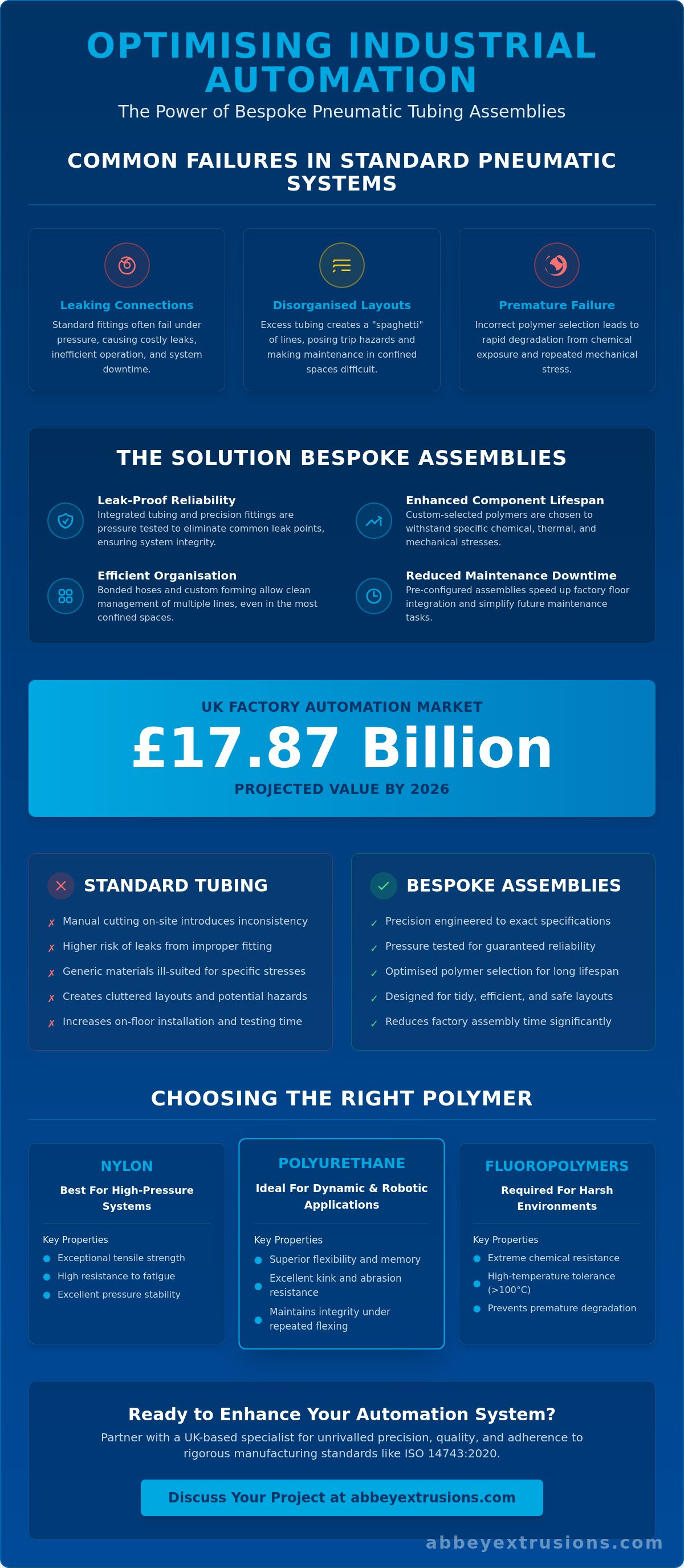
We recognise that maintaining a tidy and reliable pneumatic system is essential for operational efficiency, especially as the UK factory automation market is projected to reach £17.87 billion by 2026. This article will show you how bespoke pneumatic assemblies and precise material selection can optimise your industrial systems and significantly reduce maintenance downtime. You'll discover how choosing the right polymers, such as Nylon 11 or polyurethane, can lead to a longer component lifespan and faster assembly times on the factory floor.
Key Takeaways
- Learn how integrated systems of tubing and precision fittings eliminate common leak points to ensure the long term reliability of industrial automation systems.
- Understand the technical advantages of custom formed pneumatic tubing made from specialised polymers to withstand specific chemical exposures and mechanical stresses.
- Discover how bonded hoses and bespoke tube forming allow for the efficient management of multiple lines in confined spaces whilst reducing clutter.
- Identify the critical specification criteria necessary to design bespoke assemblies that reduce maintenance downtime and improve component lifespan.
- Recognise the value of sourcing directly from a UK based extrusion specialist to ensure adherence to rigorous manufacturing standards and technical precision.
Get in touch with our technical team today to discuss your project requirements.
Understanding the Role of Custom Pneumatic Tubing Assemblies in Automation
Pneumatic assemblies are integrated systems where tubing and precision fittings work in unison to maintain pressure and flow. In the field of Pneumatics, the move towards custom formed pneumatic tubing represents a shift towards higher operational reliability. Standardised bulk tubing often requires manual cutting and fitting on the factory floor, which introduces variables that can lead to leaks. By using bespoke, pre-configured solutions, manufacturers can ensure that every connection meets exact engineering tolerances.
Modern robotics and automated production lines require components that fit perfectly within restricted footprints. Generic hosing often lacks the necessary bend radii or chemical resistance for specific industrial environments. In the UK, industrial safety and efficiency are governed by strict manufacturing standards. Adhering to regulations like ISO 14743:2020 for connectors ensures that these assemblies can withstand the rigours of 24/7 operation without risk to personnel or equipment. This is particularly relevant as the UK factory automation market is forecasted to reach £17.87 billion by 2026.
The Components of a High Performance Assembly
A reliable assembly starts with the base tube, often extruded from high grade polymers like Nylon 11 or Polyurethane. We focus on material consistency throughout the extrusion process, as any variation in wall thickness can compromise the seal at the coupling interface. Precision cutting is equally vital. A clean, square cut ensures the tubing sits perfectly within the fitting, preventing the micro-leaks that often plague hurriedly assembled systems. Our expertise in tube forming ensures that the interface between the tube and the connector is seamless.
Why Bespoke Solutions Outperform Standard Tubing
The transition to pre-assembled components offers clear economic advantages. We've observed that using pre-cut and fitted solutions significantly reduces installation time on the factory floor. Custom lengths eliminate the spaghetti of excess tubing often seen in older installations, which removes dangerous trip hazards and simplifies maintenance. Every piece of custom formed pneumatic tubing we provide is manufactured to exact specifications, ensuring it fits the intended layout perfectly. Every bespoke assembly is pressure tested before it reaches the site. This rigorous quality control ensures that the components are ready for immediate integration into the production line, providing a level of reliability that standard bulk tubing simply cannot match.
Contact our specialists for advice on material compatibility and custom specifications.
Selecting the Right Polymers for Bespoke Pneumatic Applications
Choosing the correct polymer is a critical engineering decision that dictates the efficiency and longevity of an automated system. When engineers specify pneumatic tubing and fittings, they must account for pressure, temperature, and chemical compatibility. Whilst standard rubber hoses are common in basic workshops, industrial automation demands the precision of advanced polymers. Using custom formed pneumatic tubing allows for these materials to be shaped into configurations that maintain their structural integrity even under constant mechanical stress.
For high pressure air systems, nylon tube remains the industry standard due to its exceptional tensile strength and resistance to fatigue. In contrast, polyurethane tube offers superior flexibility, making it ideal for dynamic applications where the line must flex repeatedly. For extreme environments involving aggressive chemicals or temperatures exceeding 100°C, fluoropolymers such as PTFE or FEP are required to prevent premature degradation. Selecting the wrong material often leads to the premature hose failure mentioned earlier, which can be costly in a high volume production environment.
Nylon 11 and 12 for Precision Pneumatics
Nylon 12 is distinguished by its low moisture absorption and excellent dimensional stability, ensuring that fittings remain secure over long operational cycles. Amongst technical buyers, Nylon 11 is often preferred for its bio-based origin and slightly higher flexibility compared to Nylon 12. These properties are essential for maintaining tight tolerances in custom formed pneumatic tubing. For a deeper analysis of these materials, our nylon tubing properties technical guide provides comprehensive data on tensile strength and thermal performance.
Polyurethane and PVC Options
Polyurethane (PU) is the primary choice for robotic arms and moving machinery due to its remarkable kink resistance and elastic memory. It's often used in coiled formats to allow for significant reach without tangling. Whilst it lacks the high pressure rating of nylon, its ability to return to its original shape is vital in a busy manufacturing centre. For lower pressure lines where cost efficiency is a priority, pvc tube provides a versatile solution. It offers a favourable cost to performance ratio for general air transfer, provided the environment is free from aggressive solvents.
If you're unsure which material best suits your specific environmental conditions, our technical team can provide a compatibility assessment for your project.
Speak with our engineers regarding bespoke tube forming and assembly solutions.
The Technical Advantages of Bonded Hoses and Custom Tube Forming
In complex industrial environments, managing multiple pneumatic lines can become a significant logistical challenge. Bonded hoses provide a streamlined solution by joining separate tubes into a single, flat ribbon. This manufacturing process involves thermally bonding the outer surfaces of the tubes without compromising the internal diameter or the structural integrity of the polymer. By using this method, we can integrate various lines into one manageable component. This is particularly beneficial in tight enclosures where space is at a premium and clutter must be avoided at all costs.
The concept of custom formed pneumatic tubing takes this precision a step further by allowing for permanent routing within a machine's architecture. Unlike standard flexible hoses that can shift or sag over time, formed tubes are engineered to maintain a specific geometry. This stability is essential for high speed automation where clearances are minimal and any movement in the pneumatic lines could lead to mechanical interference. These specialised services don't just improve the functionality of the system; they also enhance the overall aesthetics, reflecting a higher standard of engineering.
Organising Systems with Bonded Hoses
Organising systems with bonded hoses offers significant operational advantages. By bonding different colours of tubing, such as blue for supply and red for return, engineers can achieve instant line identification. This clarity reduces the risk of connection errors during maintenance or initial installation. Additionally, a single bonded ribbon is inherently safer than a tangled cluster of individual tubes. It eliminates snagging points and prevents the "spaghetti" effect often found in poorly managed systems. In specific technical applications, we can even bond different materials together, such as a nylon line for high pressure alongside a polyurethane line for flexibility, provided the thermal properties are compatible.
Precision Routing via Custom Formed Pneumatic Tubing
Tube forming is the technical process of setting a permanent shape into a polymer tube using heat and specialised jigs. Once the material has been set, it retains its profile even under thermal cycling and mechanical vibration. These formed tubes are superior to flexible hoses in fixed machinery positions because they follow a predetermined path that cannot be easily disturbed. By engineering the tube to follow the exact contours of the machine, we significantly reduce the need for elbow fittings and intermediate connectors. This reduction in the number of potential leak points directly translates to a more reliable system and lower maintenance costs over the lifespan of the equipment. Using tube forming ensures that every component is tailored to the specific geometry of the application, resulting in a cleaner finish.
Reach out to our technical team for a comprehensive quote on pneumatic assemblies.
Key Specification Criteria for Industrial Pneumatic Assemblies
Designing a bespoke pneumatic system requires a meticulous approach to technical data. To ensure the reliability of custom formed pneumatic tubing, engineers must provide precise specifications regarding the operational environment. Key data points include the internal and external diameters, the required minimum bend radius, and the specific type of media being transported. We also consider the frequency of pressure pulses and the potential for mechanical abrasion within the machine housing. Overlooking a single variable can lead to premature material degradation or system failure. We maintain a rigorous quality control process to ensure every assembly meets these exact parameters before dispatch.
Pressure and Temperature Ratings
Temperature significantly influences the mechanical properties of all polymers. A common rule of thumb in polymer extrusion is that for every 10°C increase above 20°C, the working pressure rating of a thermoplastic tube decreases by approximately 10%. This applies to both the ambient temperature of the factory floor and the temperature of the compressed air or gas itself. It's vital to distinguish between working pressure and burst pressure. The working pressure is the maximum safe operational load, whilst the burst pressure represents the point of catastrophic failure. We typically apply a safety factor of at least 3 to 1 to ensure long term stability under fluctuating loads. For systems requiring higher thresholds, reinforced PVC tube provides the necessary tensile strength through its integrated braiding, which prevents the tube from expanding under high pressure.
Environmental and Chemical Compatibility
External factors are just as critical as the media flowing through the lines. In outdoor applications, such as those found in the transportation or construction sectors, selecting UV resistant materials is essential to prevent the polymer from becoming brittle over time. Similarly, factory washdown areas in the food and beverage industry often involve aggressive cleaning agents that can cause standard tubing to crack or discolour. In these scenarios, a chemically resistant material like Nylon 12 or a specific fluoropolymer grade is required to maintain system integrity. Incorporating these factors into the initial design of custom formed pneumatic tubing ensures a safer and more durable installation that stands up to the harshest industrial conditions.
To ensure your system meets these rigorous standards, request a technical specification review from our engineering department.
Discuss your industrial tubing needs with a leading UK manufacturer.
Partnering with a Specialist UK Manufacturer for Bespoke Extrusions
Sourcing custom formed pneumatic tubing directly from a British manufacturer offers distinct logistical and technical advantages. Unlike purchasing from general stockists, working with the source allows for precise control over the polymer's properties and the final configuration. Direct communication between your engineering department and our production team ensures that technical requirements are understood from the outset. This collaborative approach leads to better outcomes, particularly when you're designing for specific pressure ratings or challenging chemical environments.
Having both the extrusion and the assembly processes under one roof provides a significant quality control advantage that's difficult to replicate through a fragmented supply chain. It allows for a seamless transition from the raw polymer bead to the finished, fitted component, ensuring that the tubing's integrity isn't compromised during the fitting process. We maintain a strict commitment to technical excellence, focusing on long term reliability rather than short term cost savings. This focus is essential for UK industries where even an hour of downtime can be extremely costly in a high volume production environment.
Technical Support and Engineering Expertise
Abbey Extrusions has been a specialist in plastic extrusion since 1985. This decades long experience allows us to provide valuable insights during the design phase of any automation project. We don't just manufacture; we assist in material selection and profile design to ensure the final product meets the application's specific demands. Our engineers understand the nuances of how different polymers behave under stress and thermal cycling. To facilitate project validation, we can provide samples for testing in your specific environment. This step is vital for verifying the performance of custom formed pneumatic tubing before you commit to full scale production.
Quality Assurance and Traceability
Quality assurance is at the heart of our manufacturing philosophy. Every custom assembly undergoes internal testing protocols to verify its structural integrity and leak resistance, ensuring it meets the high standards required for modern automation. In regulated industries such as automotive manufacturing or chemical processing, material traceability is a fundamental requirement for compliance. We ensure that every batch of polymer can be traced back to its source, providing full transparency and peace of mind for our partners. If you're facing a complex pneumatic challenge that standard off the shelf solutions simply can't solve, our technical team is available to discuss a bespoke solution that fits your exact operational needs.
Get in touch with our technical team to discuss your bespoke assembly requirements.
Optimising Industrial Systems with Precision Engineering
The transition to bespoke engineering represents a strategic investment in the longevity of UK production lines. By prioritising high performance materials and precise configurations, businesses can effectively eliminate the common pain points of leaking connections and cluttered layouts. We've seen how integrating custom formed pneumatic tubing ensures that every connection is purpose-built for the specific geometry of your system. This approach provides a level of reliability that standard components simply cannot achieve in a high-demand environment.
Abbey Extrusions remains dedicated to the principles of precision and technical competence that have defined our operations since 1985. Our decades of experience in high performance Nylon 11 and 12 tubing ensure that your systems benefit from the highest manufacturing standards. Contact Abbey Extrusions to discuss your custom pneumatic tubing requirements and ensure your industrial systems are built for lasting performance. We look forward to supporting your next automation project with our specialised expertise.
Frequently Asked Questions
What are the main benefits of using bonded hoses in pneumatic systems?
Bonded hoses provide a streamlined solution for managing multiple lines by joining individual tubes into a single flat ribbon. This configuration prevents tangling and simplifies routing within restricted machinery footprints. It also enhances operational safety by removing snagging points and makes system maintenance significantly more efficient by keeping lines organised.
Can I specify different colours for each line in a custom assembly?
Yes, we can bond tubes of varying colours to assist with instant line identification during installation and maintenance. This is a common requirement for complex automated systems where engineers must distinguish between supply and return lines. Using colour coding reduces the risk of connection errors and simplifies troubleshooting on the factory floor.
How does tube forming differ from using standard flexible hoses?
Tube forming involves setting a permanent shape into the polymer using heat and specialised jigs to ensure it retains its profile. Unlike flexible hoses that can sag or shift over time, custom formed pneumatic tubing maintains its exact geometry within the machine architecture. This stability reduces mechanical interference and eliminates the need for numerous elbow fittings and potential leak points.
What information is required to get a quote for a bespoke pneumatic assembly?
We require the internal and external diameters, the preferred polymer material, and the expected working pressure and temperature. Details regarding the media being transported and the specific environment, such as chemical or UV exposure, are also essential. Providing a technical drawing or a physical sample can further accelerate the design and quoting process.
Are these custom assemblies compatible with standard push in fittings?
Yes, our tubing is manufactured to precise tolerances that ensure full compatibility with standard push in connectors. We adhere to rigorous industry standards to guarantee a secure and leak resistant fit. The consistency of our extrusion process ensures that the tubing wall thickness remains uniform, which is vital for maintaining a reliable seal under pressure.
What is the maximum pressure rating for a custom nylon assembly?
The pressure rating depends on the specific grade of nylon, the wall thickness, and the operational temperature of the system. Nylon 11 and 12 are renowned for their high tensile strength and can handle significant pressure in industrial environments. We always recommend applying a safety factor of at least 3 to 1 to account for pressure fluctuations and ensure long term reliability.
Do you offer assemblies made from food grade or chemical resistant materials?
We manufacture assemblies using a wide range of specialised polymers, including food grade hoses and chemical resistant fluoropolymers. Materials like Nylon 12 and PTFE are ideal for environments involving aggressive cleaning agents or washdown procedures. Our technical team can advise on the most suitable material for your specific regulatory or environmental requirements.
How do you ensure the quality and safety of each pneumatic assembly?
Every assembly undergoes rigorous internal testing protocols, including pressure validation, before it leaves our facility. We maintain full material traceability to ensure compliance with industrial safety standards and regulated industry requirements. Our manufacturing process is backed by over 40 years of expertise, ensuring that every custom formed pneumatic tubing solution meets our strict quality benchmarks.

Article by
Bryan Cowan
Bryan Cowan is the Founder and Managing Director of Abbey Extrusions Ltd, a leading UK manufacturer of high-quality plastic tubes and hoses. With over 40 years of industry experience, Bryan established the company in 1985, growing it from a startup into a BS ISO9001-registered supplier for global sectors including aerospace, automotive, and pharmaceuticals.
Disclaimer
This article is intended for informational purposes only. Please ensure you seek expert advice or carry out your own research to confirm the information is suitable for your specific needs.