A single kink in a compressed air line can bring an entire production sequence to a standstill, costing your facility significant productivity losses before the fault is even located. We recognise that selecting the wrong non-kinking pneumatic tubing leads to restricted airflow in tight machinery spaces, which is not merely a minor technical hurdle; it is a systemic risk to your operational efficiency and equipment longevity. You likely find that frequent air line failures due to tubing collapse are an unacceptable drain on resources, particularly when high-quality UK-made components seem difficult to source reliably.
By implementing the correct kink-resistant solutions, you can eliminate these frequent failures and ensure your pneumatic circuits achieve their maximum service life. We promise to guide you through the process of selecting the ideal materials to eliminate downtime and optimise airflow in 2026. This article provides a detailed technical overview of material performance, from the flexibility of polyurethane to the pressure ratings of nylon, ensuring your supply chain remains robust and your systems comply with BS EN ISO 4414:2010 standards.
Key Takeaways
- Learn how precise material selection, including Polyurethane and flexible Nylon, prevents flow restriction and premature material fatigue.
- Understand the technical relationship between Shore hardness ratings and the performance of non-kinking pneumatic tubing in high pressure environments.
- Master the calculation of minimum bend radius to avoid catastrophic tubing collapse and ensure compliance with industrial safety standards.
- Explore how bespoke tube forming and nylon recoil air hoses provide effective airflow management within restricted or mobile machinery spaces.
- Discover the operational benefits of establishing a direct technical partnership with a UK based extrusion specialist for consistent quality control.
To discuss your specific technical requirements or to request a sample of our industrial-grade tubing, please contact our extrusion specialists.
Understanding why pneumatic tubing kinks and the impact on performance
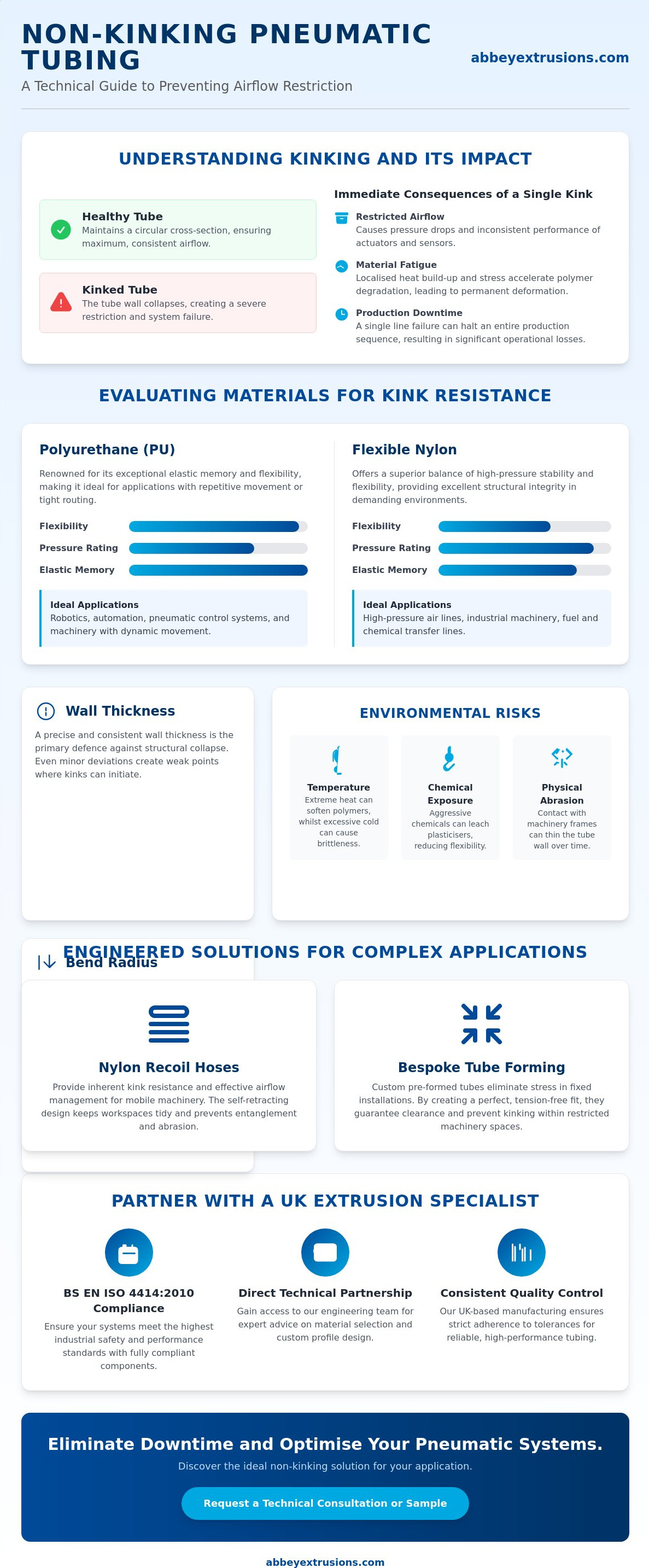
Kinking occurs when the structural limit of a tube is exceeded during a bend, causing the circular cross-section to collapse into an elliptical or flattened shape. This collapse creates an immediate restriction in airflow, which disrupts the pressure balance within the circuit. For high-precision systems, this lack of consistency isn't just a nuisance; it's a mechanical failure that compromises the entire operation. When a line kinks, the sudden drop in downstream pressure can cause actuators to stall or sensors to trigger false alarms, leading to immediate system errors.
Beyond the immediate drop in pressure, kinking introduces secondary failures that are often harder to diagnose. Restricted flow causes the compressor to work harder to maintain system pressure, which often leads to localised heat build-up within the tube walls. Over time, this thermal stress accelerates material fatigue and degrades the polymer. When non-kinking pneumatic tubing is not utilised, the material can suffer from permanent deformation. This means the tube will never return to its original shape even once the external stress is removed. Choosing the correct material, such as a high-grade Polyurethane tube, is essential for maintaining long-term circuit integrity.
Industrial downtime is the ultimate consequence of these failures. In a high-speed production environment, a single collapsed line can halt a multi-stage process. Replacing damaged lines isn't just a maintenance cost. It represents lost production hours and potential damage to downstream components that rely on steady air pressure. Reliability in these systems is governed by BS EN ISO 4414:2010, which emphasises the need for components that can withstand the rigours of industrial use without failing.
The relationship between wall thickness and structural integrity
Maintaining a precise wall thickness is the primary defence against structural collapse. We ensure that our extrusion processes adhere to strict tolerances, as even a minor deviation in wall consistency creates a weak spot where a kink is likely to initiate. Whilst internal air pressure provides some support to the tube walls, the inherent structural memory of a Nylon tube or similar polymer must be strong enough to resist external forces when the system is depressurised. A thicker wall generally offers better kink resistance but may reduce the overall flexibility of the line.
Environmental factors that increase the risk of kinking
The performance of various plastic tubing materials is heavily influenced by the surrounding environment. Temperature fluctuations are particularly critical. Excessive heat can soften a polymer, making it more susceptible to kinking under its own weight or during movement. Conversely, extreme cold can make certain materials brittle. Chemical exposure also plays a role by potentially leaching plasticisers from the material, which reduces flexibility and increases the risk of a permanent crease. In dynamic settings, physical abrasion against machinery frames can thin the tube wall, further compromising the integrity of your non-kinking pneumatic tubing.
If you require technical assistance in selecting the correct polymer for your application, you can reach out to our engineering team for expert advice.
Evaluating material properties for maximum flexibility and kink resistance
Material selection is the most significant factor in determining how a pneumatic circuit will behave under stress. The primary distinction between various polymers lies in their elastic memory, which is the material's ability to return to its original shape after being deformed. Polyurethane (PU) is widely regarded for its exceptional elastic memory, allowing it to recover from temporary folds without developing a permanent crease. Flexible Nylon, whilst more rigid, provides a different set of benefits, particularly where high-pressure stability is required. Choosing the right non-kinking pneumatic tubing involves a careful balance between these mechanical characteristics and the specific demands of your machinery.
Shore hardness ratings are a critical metric for any engineer to consider. These ratings correlate directly with both flexibility and kink resistance. A higher Shore A rating, such as 98A, indicates a harder material that offers more structural "backbone" to resist initial collapse. However, if a harder material does eventually kink, it's more likely to suffer permanent damage than a softer, more resilient grade. For low-pressure, non-critical applications where cost is a primary driver, Low-Density Polythene Tube (LDPE) is often utilised. Whilst LDPE lacks the rapid recovery speed of PU, it remains a stable choice for static lines that won't undergo frequent movement.
Polyurethane tubing for high flex applications
When your pneumatic lines must navigate the complex, multi-axis movements of robotic arms, a polyurethane tube is almost always the superior choice. Its molecular structure allows for tight bend radii that would cause other materials to fail instantly. The superior kink recovery of PU ensures that even if a line is momentarily pinched during a cycle, it will likely snap back to its full diameter once released. The trade-off for this extreme flexibility is a lower maximum working pressure compared to semi-rigid alternatives. You must ensure that your system's peak pressures don't exceed the material's burst rating, especially in high-temperature environments where PU can soften.
Nylon tubing for stability and chemical resistance
For static installations or environments where exposure to oils and solvents is a concern, a nylon tube offers unmatched technical advantages. Nylon 11 and 12 grades are particularly valued for their high-pressure stability and resistance to "permanent set," which is the tendency of a material to stay bent after being held in a curved position. These grades maintain their integrity over long periods, ensuring that your non-kinking pneumatic tubing doesn't become brittle or lose its shape. To understand the molecular differences between these grades, you can read more about polymer science in our guide to nylon tubing.
For technical specifications regarding bend radii or to discuss bespoke extrusion tolerances, you may speak with our technical team.
Calculating minimum bend radius and pressure ratings for air lines
Industrial efficiency depends on the precise calculation of mechanical limits. The minimum bend radius is defined as the smallest radius a tube can be bent into without suffering from a flattened cross-section or structural compromise. When installing non-kinking pneumatic tubing, engineers must respect these limits to prevent catastrophic kinking. A kinked line represents a point of extreme stress where the polymer is stretched beyond its elastic limit. This often leads to micro-fractures in the material wall, which eventually causes the line to burst under standard operating pressures.
Pressure ratings are not static figures. They are inherently linked to the thermal environment of the application. As the ambient or internal temperature increases, the molecular bonds of the polymer weaken. This leads to a necessary de-rating of the maximum working pressure. For example, a tube rated for 10 bar at 20°C might only be safe for 6 bar at 50°C. We always recommend a safety factor of at least 3:1 or 4:1 between the burst pressure and the working pressure to account for unforeseen surges or environmental stressors. This ensures the non-kinking pneumatic tubing maintains its integrity throughout its service life.
How to measure bend radius in your installation
Measuring the available space before installation prevents premature failure. A static bend radius applies to fixed lines that remain in a set position, whilst a dynamic bend radius is required for moving machinery where the tubing is constantly flexing. Dynamic applications require a significantly larger radius to prevent material fatigue. You should ensure that the tubing enters fittings in a straight line for at least twice its outside diameter to avoid creating stress points at the connection interface.
Pressure performance at the limit of flexibility
Tight bends naturally increase the tension on the outer wall of the tube, which can lower its effective burst pressure. Navigating complex machinery layouts requires a material that maintains consistent flow rates without internal obstruction. Selecting the correct low density polythene tube is essential for specific pressure tiers in non-critical environments. Whilst LDPE is versatile, its pressure limits must be strictly observed when navigating sharp turns to ensure the system remains safe and efficient.
To discuss your bespoke requirements for pre-formed components or coiled assemblies, please enquire with our manufacturing team today.
Preventing kinks in restricted spaces with coiled hoses and tube forming
Industrial environments often demand airflow delivery in spaces where traditional straight-line routing is impractical. In these scenarios, the risk of a line collapsing increases significantly. A nylon recoil air hose offers an effective solution for dynamic applications, such as assembly lines or mobile pneumatic tools. These hoses are engineered to retract to their original coiled state, which naturally manages excess length and prevents the tangling that often leads to accidental kinking. By maintaining a constant tension and a defined coil diameter, they function as a reliable non-kinking pneumatic tubing solution that keeps work areas clear and safe.
Beyond standard coils, many complex machinery footprints require permanent, tight-radius bends that standard tubing cannot sustain without support. This is where tube forming becomes an essential manufacturing process. Rather than relying on multiple elbow fittings, which introduce potential leak paths and pressure drops, we can heat-set the polymer into a specific geometry. This ensures the tube maintains its full internal diameter even in the sharpest turns, providing a permanent non-kinking bend that is tailored to the machine's chassis.
The benefits of bespoke tube forming services
Additional protection for high wear areas
In environments where tubing is exposed to external mechanical stress, a non-kinking pneumatic tubing setup may require additional reinforcement. Integrating a nylon spiral cut hose guard provides a robust layer of protection against crushing and physical impact. These guards are particularly useful for bundling multiple lines together, which prevents snagging on moving parts and keeps the pneumatic circuit organised. This level of protection ensures that external forces don't compromise the internal airflow, extending the service life of the entire installation.
If your machinery requires a custom-shaped solution to maintain airflow in confined spaces, request a technical consultation to discuss our tube forming capabilities.
To learn more about our manufacturing capabilities or to request a technical data sheet, please contact our British extrusion facility.
Sourcing high quality non-kinking pneumatic tubing from a UK manufacturer
Sourcing components directly from a domestic manufacturer provides a level of technical oversight that global distributors cannot match. When you specify non-kinking pneumatic tubing for a critical industrial application, the ability to communicate directly with the extrusion team ensures that your specific tolerances and environmental requirements are fully understood. This direct partnership eliminates the ambiguity often found in generic product catalogues, allowing for a more precise alignment between component performance and system demands. Direct access to the manufacturing floor means that technical queries regarding Shore hardness or chemical compatibility are answered by specialists rather than sales agents.
Supply chain resilience has become a primary concern for UK businesses in recent years. By partnering with a local manufacturer, you significantly reduce lead times and mitigate the risks associated with international logistics and customs delays. We maintain rigorous compliance with British industrial standards, including BS EN ISO 4414:2010, ensuring that every metre of tubing meets the safety and performance benchmarks required for modern pneumatic fluid power systems. This commitment to domestic production supports the wider British manufacturing sector whilst ensuring you receive a product that is traceable and consistent in quality.
Quality control in the extrusion process
Our commitment to excellence begins with material purity. We monitor every stage of the extrusion process to ensure that the polymer behaves consistently, which is vital for maintaining the structural memory required for non-kinking pneumatic tubing. Our extrusion lines are calibrated to maintain tight tolerances, preventing the thin spots that often lead to premature failure in lower-quality alternatives. Every production batch undergoes rigorous testing protocols, including pressure burst tests and kink resistance evaluations, to verify that the final product exceeds industrial expectations. This methodical approach to quality control ensures that our nylon tube and polyurethane tube offerings remain the industry standard.
Partnering for technical success
Technical success is built on specialist advice and decades of practical experience. With over four decades of experience in the UK market, Abbey Extrusions provides the deep material knowledge necessary to solve unique pneumatic challenges. Our team offers bespoke solutions, from custom colour matching for line identification to specific tube forming for restricted spaces. Supporting British industry through high quality manufacturing isn't just about supply; it's about providing the reliability and technical partnership that keeps your production lines moving without interruption. We take pride in our ability to adapt our manufacturing processes to meet the evolving needs of the automation and logistics sectors.
Optimising your pneumatic circuits for long term reliability
The selection of non-kinking pneumatic tubing is a fundamental engineering decision that dictates the overall efficiency and safety of your industrial systems. By prioritising materials with superior elastic memory and respecting calculated bend radii, you ensure that your airflow remains consistent whilst avoiding the permanent deformation that leads to system failure. We've explored how bespoke tube forming and the strategic use of recoil hoses can solve the challenges of restricted spaces, reducing the need for leak prone fittings and complex manual routing.
Since 1985, we've operated as a specialist UK manufacturer, refining our expertise in Nylon 11, Nylon 12, and Polyurethane extrusions. This depth of experience allows us to provide technical guidance that generic distributors simply cannot offer. Whether you require standard coils or complex pre-formed sections, our focus remains on precision and durability. For expert advice on non-kinking pneumatic tubing, contact the Abbey Extrusions team today to discuss your specific operational requirements. We look forward to supporting your next project with British made engineering excellence.
Frequently Asked Questions
What is the difference between kink resistance and flexibility
Flexibility refers to the force required to bend a tube, whereas kink resistance is the material's ability to maintain its internal diameter without collapsing during that bend. A very flexible tube might still kink easily if it lacks structural backbone. High quality non-kinking pneumatic tubing balances these traits by using polymers with high elastic memory to ensure the walls don't buckle when the tube is manipulated into tight spaces.
How do I choose between Nylon and Polyurethane for my air line
Your choice depends on the application's movement and pressure requirements. Polyurethane is the preferred material for dynamic applications, such as robotics, due to its superior flexibility and recovery. Nylon 11 or 12 is better suited for static installations where higher working pressures and chemical resistance are necessary. If your system requires a semi-rigid structure that won't sag over time, nylon is the technically superior option for your air line.
Can I use standard fittings with non-kinking pneumatic tubing
Standard push-in or compression fittings are compatible with this tubing as long as the outside diameter tolerances are strictly maintained. We ensure our extrusion process produces consistent dimensions to guarantee a leak-free seal with industrial fittings. It's essential to verify that the fitting material is also compatible with the specific polymer and the environmental conditions of your facility to avoid premature joint failure at the connection points.
What happens to kink resistance at high temperatures
Kink resistance typically decreases as temperatures rise because the polymer chains within the material become more mobile and soft. This softening makes the tube wall more susceptible to collapsing under its own weight or external tension. When operating in environments above 20°C, you must account for a reduction in both the burst pressure and the structural integrity of the non-kinking pneumatic tubing to maintain system safety.
How does the bend radius affect the lifespan of the tubing
Operating a tube at or beyond its minimum bend radius significantly shortens its service life by inducing constant mechanical stress on the outer wall. This stress leads to material fatigue and micro-cracking, which eventually results in a burst. Maintaining a generous bend radius ensures the polymer remains within its elastic region, preventing the permanent deformation that compromises the long-term reliability and airflow of the pneumatic circuit.
Is it better to use a coiled hose or a formed tube in tight spaces
A coiled hose is ideal for applications requiring reach and retraction, such as hand-held tools or assembly stations. However, for fixed installations within a compact machine chassis, a formed tube is often the better technical choice. Formed tubes are heat-set into specific shapes, allowing them to navigate sharp corners without the risk of kinking or the need for additional elbow fittings that could introduce potential leak paths.
What are the signs that my pneumatic tubing is about to fail
Visible discolouration, surface cracking, or permanent creases in the material are clear indicators of impending failure. If a tube no longer returns to its original shape after being bent, the internal molecular structure has been compromised. You should also check for localised swelling or thinning of the tube wall, as these signs suggest the material can no longer withstand the internal system pressure and requires replacement before a burst occurs.

Article by
Bryan Cowan
Bryan Cowan is the Founder and Managing Director of Abbey Extrusions Ltd, a leading UK manufacturer of high-quality plastic tubes and hoses. With over 40 years of industry experience, Bryan established the company in 1985, growing it from a startup into a BS ISO9001-registered supplier for global sectors including aerospace, automotive, and pharmaceuticals.
Disclaimer
This article is intended for informational purposes only. Please ensure you seek expert advice or carry out your own research to confirm the information is suitable for your specific needs.