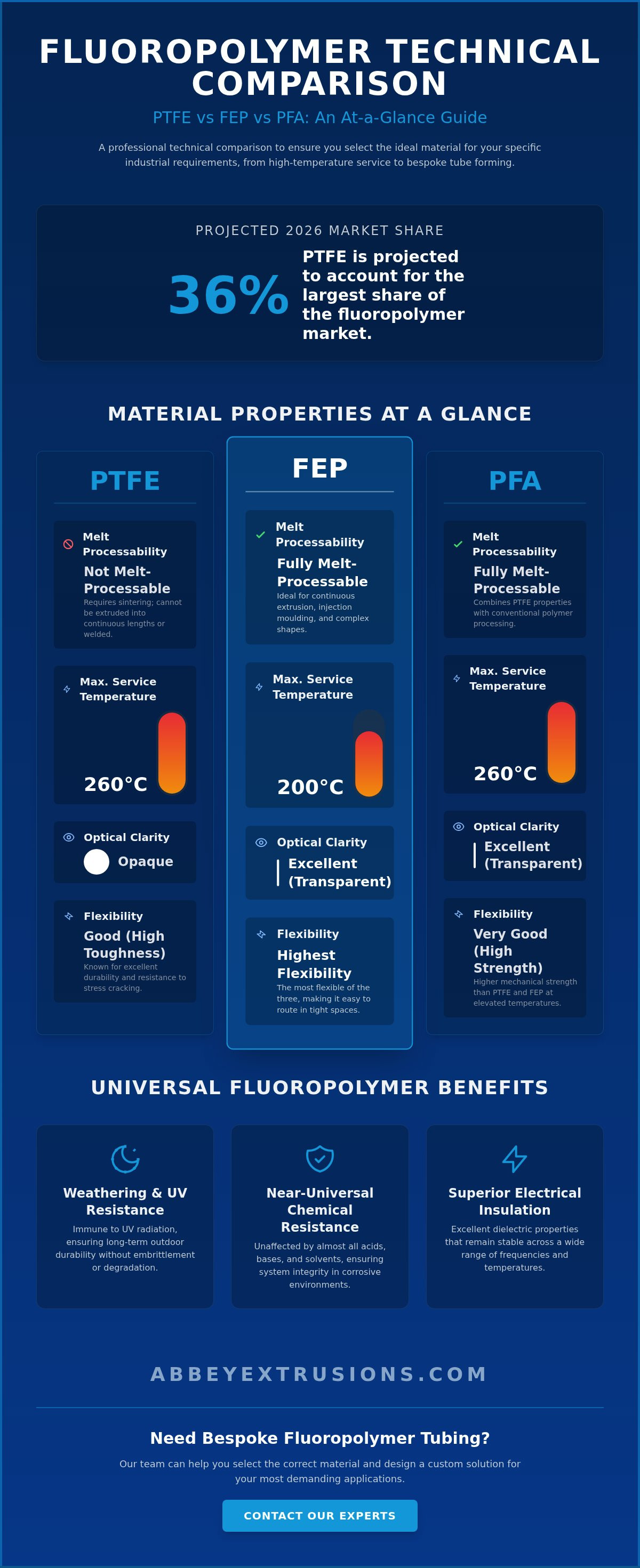
With PTFE projected to account for 36.0% of the fluoropolymer market share in 2026, selecting the correct material amongst a sea of high-performance alternatives requires more than just a surface-level understanding. We recognise that many engineers and procurement specialists find themselves faced with a complex array of similar-sounding acronyms, often questioning what is the difference between PTFE FEP and PFA when specifying tubing for corrosive or high-temperature environments. It's a valid concern, as the risk of material failure is high if the subtle distinctions between melt-processability and thermal stability aren't fully understood during the design phase.
This article provides a professional technical comparison of these three essential fluoropolymers to ensure you select the ideal material for your specific industrial requirements. Whilst all fluoropolymers offer exceptional chemical resistance, we'll examine the thermal limits of each polymer, clarify which materials support bespoke tube forming, and detail the compatibility profiles necessary for maintaining system integrity. By the end of this guide, you'll have the confidence to choose the correct tubing for even the most demanding and qualification-heavy applications.
Key Takeaways
- Identify the critical distinction between sintered materials and melt-processable polymers to determine which tubing allows for bespoke tube forming.
- Gain clarity on what is the difference between PTFE FEP and PFA regarding thermal stability, specifically focusing on the 260°C service limit of PFA and PTFE.
- Evaluate optical requirements for your fluid handling systems, as FEP and PFA provide superior transparency compared to the opaque nature of PTFE.
- Understand how mechanical stiffness and flexibility vary across the fluoropolymer family to prevent material failure in high-vibration or high-pressure environments.
- Learn how to apply a selection framework that balances chemical inertness with cost efficiency for large-scale industrial projects.
For technical assistance with material selection or to discuss your specific project requirements, please reach out to our team via our contact page.
Understanding the role of fluoropolymers in modern engineering
Fluoropolymers represent a specialised class of high-performance plastics defined by the presence of carbon-fluorine bonds. These bonds are amongst the strongest in organic chemistry, providing the material with exceptional stability. We often encounter engineers who are unsure what is the difference between PTFE FEP and PFA, yet they recognise that standard polymers simply cannot withstand the aggressive environments found in chemical processing or semiconductor manufacturing. A Fluoropolymer offers a unique combination of properties that make them indispensable for modern engineering. Their low coefficient of friction ensures smooth fluid flow, whilst their high dielectric strength provides reliable electrical insulation even in extreme conditions.
The evolution of high performance plastics
Industrial requirements have progressed significantly since the accidental discovery of PTFE in the late 1930s. Whilst standard materials like nylon tube are excellent for pneumatic applications and general industrial use, they lack the thermal and chemical resilience required for safety-critical environments. PTFE was the pioneer of this family, but its inability to be melt-processed led to the development of FEP and PFA variants. These newer materials allow for more complex shapes and consistent lengths through traditional extrusion methods. In safety-critical sectors, these materials are favoured because they don't degrade when exposed to harsh reagents or volatile temperatures.
Key characteristics shared by PTFE FEP and PFA
Common benefits shared across these fluoropolymers include:
- Weathering resistance. They're immune to UV radiation, ensuring long-term outdoor durability without embrittlement.
- Electrical insulation. They provide superior dielectric properties that remain stable across a wide range of frequencies and temperatures.
- Low outgassing. This characteristic is essential for high-purity applications, such as those found in cleanroom environments.
By understanding these foundational properties, we can better appreciate why these materials are selected for the most demanding fluid handling systems. Each material builds upon this base of chemical inertness with specific thermal and mechanical advantages.
For technical guidance on material selection or to request a quote for high-performance tubing, please contact our specialist team.
Comparing the physical and chemical properties of PTFE FEP and PFA
Understanding the chemical and physical properties of fluoropolymers is essential when selecting a material that must perform under extreme stress. Whilst these polymers share a common ancestry, their molecular structures lead to distinct mechanical behaviours. When engineers ask what is the difference between PTFE FEP and PFA, they're often looking for the precise balance between rigidity and flexibility. PTFE is known for its relatively low tensile strength but incredible toughness. In contrast, PFA offers higher mechanical strength at elevated temperatures, whilst FEP is generally the most flexible of the three, making it easier to manipulate in tight installations.
Chemical inertness remains a hallmark of this family. There are, however, subtle differences in how they interact with specific reagents. PTFE and PFA provide near-identical resistance to almost all chemicals. FEP is slightly more susceptible to certain strong oxidising agents at high temperatures. Another critical factor is the coefficient of friction. PTFE holds the lowest value amongst all solid materials, which significantly enhances flow rates and prevents clogging in tubing systems. PFA and FEP have slightly higher friction coefficients, yet they still outperform traditional engineering plastics by a considerable margin. If you require advice on specific chemical compatibility, our engineers can discuss your application requirements in detail.
Optical clarity and transparency differences
Visual monitoring is often a requirement in laboratory or pharmaceutical fluid paths. FEP is the preferred choice here because it offers the highest level of optical clarity. It's essentially transparent, allowing operators to inspect fluid flow or check for bubbles easily. PFA is translucent, which provides some visibility but lacks the water-clear quality of FEP. PTFE is entirely opaque and appears milky white due to its highly crystalline structure. This opacity makes it unsuitable for any application where visual confirmation of the internal contents is necessary.
Mechanical durability and wear resistance
Durability under mechanical load varies. FEP is softer and more prone to abrasion than its counterparts. PFA provides the greatest rigidity and maintains its structural integrity even when subjected to high pressures. Stress crack resistance is another area where these materials diverge. The flex life of PFA is significantly superior for dynamic applications compared to both FEP and PTFE. This makes PFA the ideal candidate for systems involving constant movement or vibration, where other fluoropolymers might eventually fail due to fatigue.
If you require bespoke tubing profiles or need advice on thermal limits for your specific application, please visit our contact page to speak with a technical advisor.
Thermal performance and melt processing capabilities
Thermal management is a cornerstone of material selection for high-performance fluid systems. When engineers evaluate what is the difference between PTFE FEP and PFA, the conversation inevitably turns to thermal stability and manufacturing constraints. Both PTFE and PFA offer a continuous service temperature of 260°C, making them suitable for the most extreme heat environments. FEP, whilst still highly capable, typically reaches its service limit at approximately 204°C. These thermal thresholds are not merely numbers; they define the boundaries of system safety and material longevity in industrial heaters, aerospace components, and chemical reactors.
Processing PTFE through sintering
Unlike standard pvc-tube, PTFE cannot be processed through conventional melt extrusion because its melt viscosity is too high. Instead, it's manufactured using a process similar to powder metallurgy. Fine resin is compressed into a preform and then heated in a controlled oven until the particles fuse together. This sintering process creates a robust, highly crystalline structure, but it limits the ability to produce bespoke shapes or extremely long, seamless coils. The resulting tubing is incredibly tough, yet the manufacturing path is fundamentally different from its melt-processable counterparts.
Extrusion advantages of FEP and PFA
To receive a technical consultation regarding material compatibility for your specific industrial environment, please visit our contact page.
Selecting the correct polymer for your industrial application
Selecting the appropriate fluoropolymer requires a methodical evaluation of environmental stressors. When deciding what is the difference between PTFE FEP and PFA for a specific system, engineers must prioritise the primary failure mode of the application. If the system operates under high pressure, the mechanical rigidity of PFA is often the deciding factor. For applications where visual monitoring is paramount, the transparency of FEP provides the necessary clarity. Cost considerations also play a vital role in value engineering, especially for large scale projects where the premium price of PFA must be justified by its superior flex life or thermal stability.
Integration with existing infrastructure depends on absolute chemical compatibility. Whilst all three materials are largely inert, the presence of specific surfactants or aggressive solvents at elevated temperatures can influence the choice. PFA is frequently specified for the most demanding chemical transfer lines because it maintains its integrity where FEP might reach its operational limit. We encourage a thorough review of all process variables before finalising a specification to ensure long term reliability and safety.
Applications for food and beverage production
In the food and beverage industry, hygiene and residue prevention are critical. Fluoropolymers are ideal here because their non-stick behaviour prevents the build up of bacteria or product remnants. Compliance with safety standards, such as FDA regulations verified in May 2026, ensures that these materials are suitable for contact with consumables. This level of purity is particularly important in the production of brewery hose and dairy processing lines where frequent cleaning cycles are mandatory. The hydrophobic nature of these polymers allows for efficient drainage and reduces the time required for system wash downs.
Chemical and petrochemical processing
The petrochemical sector presents some of the most aggressive environments for fluid handling. Handling concentrated acids or volatile solvents requires a material that won't embrittle or swell over time. PFA is the definitive choice for high temperature chemical transfer, offering the same 260°C limit as PTFE but with the added benefit of being melt processable into complex, leak free systems. Understanding the engineering principles of plastic extrusion is essential when designing these systems to ensure that wall thickness and tolerances are optimised for safety. If your project involves the transfer of hazardous fluids, we recommend that you request a technical review from our manufacturing team.
To discuss your specific manufacturing requirements or to request a technical data sheet for our fluoropolymer range, please visit our contact page.
Bespoke fluoropolymer tubing solutions from Abbey Extrusions
Abbey Extrusions operates with a focus on engineering precision that only comes from decades of manufacturing experience. We understand that selecting a material based on a general understanding of what is the difference between PTFE FEP and PFA is only the first step. The true challenge lies in ensuring the final product integrates perfectly with your industrial layout. Our UK based facility is equipped to handle complex technical extrusions where standard off the shelf solutions would fail. We maintain a close relationship with our clients, providing the technical competence needed to navigate the nuances of fluoropolymer performance. This collaborative approach allows us to refine the production process to meet the specific demands of your sector, whether that involves high temperature chemical transfer or high purity fluid handling.
Custom tube forming and profile creation
Many industrial environments require more than just straight lengths of tubing. We specialise in tube forming to help engineers overcome space constraints and complex routing challenges. This process is particularly effective with melt processable materials like FEP and PFA, which can be shaped into coils or bespoke profiles without compromising their structural integrity. We don't just provide the material; we provide a tailored solution that addresses the specific mechanical stressors of your system, which is vital when you are evaluating what is the difference between PTFE FEP and PFA for a custom installation. Our expertise allows us to create profiles that maintain consistent flow rates even in the most restricted spaces. Working with a UK manufacturer ensures you have direct access to technical support throughout the design and production phases, giving you a significant advantage when dealing with tight project deadlines.
Quality assurance and material traceability
For expert assistance with material specifications or to discuss your bespoke tubing requirements, please get in touch with our team.
Optimising your high performance fluid systems
Selecting the right polymer is fundamental to the longevity of industrial systems. We've established that whilst all fluoropolymers offer chemical inertness, the choice between them is dictated by thermal limits and manufacturing flexibility. Understanding what is the difference between PTFE FEP and PFA ensures that you don't over-specify for simple fluid paths or under-specify for dynamic, high-heat environments. By prioritising mechanical durability and optical requirements, you can maintain system integrity even in the most corrosive environments.
Abbey Extrusions has operated as a UK based manufacturer since 1985, providing a national supply of high performance polymers to the engineering sector. We are specialists in technical tube forming and precision extrusions, ensuring that every product we manufacture meets your exact specifications. If you're ready to enhance your fluid handling capabilities, please contact our technical team for bespoke fluoropolymer tubing advice. We look forward to supporting your next project with our manufacturing expertise.
Frequently Asked Questions
What is the primary difference between PTFE and PFA tubing
The primary difference lies in the manufacturing process and mechanical durability. PTFE is a non-melt processable polymer that requires a sintering process, whilst PFA is a thermoplastic that can be melt-extruded into continuous lengths. This allows PFA to offer higher mechanical strength at elevated temperatures and enables the creation of more complex geometries that aren't achievable with sintered PTFE resins.
Is FEP or PFA better for applications requiring transparency
FEP is the superior choice for applications where optical clarity is a priority. It provides a water-clear transparency that allows operators to monitor fluid flow and detect air bubbles with ease. Whilst PFA is translucent and allows some light through, it lacks the water-clear quality of FEP, making FEP the standard for visual flow monitoring in laboratory environments.
Can PTFE be melt processed into bespoke profiles
No, PTFE cannot be melt processed because its melt viscosity is too high for traditional extrusion equipment. It must be manufactured through a sintering process, which limits the ability to create complex bespoke profiles or extremely long, seamless coils. If your engineering challenge requires a custom profile, melt-processable materials like FEP or PFA are the necessary alternatives.
Which fluoropolymer has the highest service temperature
Both PTFE and PFA share the highest continuous service temperature limit of 260°C. This thermal stability is a defining factor when engineers evaluate what is the difference between PTFE FEP and PFA for heat-intensive systems. FEP has a significantly lower thermal threshold, with its continuous service limit typically reaching approximately 204°C before the material begins to lose structural integrity.
Why is PFA often chosen over FEP for chemical processing
PFA is favoured in chemical processing because it combines the 260°C thermal limit of PTFE with superior stress-crack resistance. It maintains its mechanical properties in dynamic systems where FEP might fail due to fatigue. This makes PFA the definitive choice for handling aggressive reagents or volatile solvents at temperatures that exceed the 204°C limit of standard FEP tubing.
Are these fluoropolymers resistant to UV and weathering
Yes, PTFE, FEP, and PFA all exhibit exceptional resistance to UV radiation and environmental weathering. They don't embrittle or degrade when exposed to direct sunlight or harsh outdoor conditions over many years. This inherent stability makes them ideal for outdoor industrial installations and aerospace applications where long-term material integrity is essential for system safety.
How does the cost of PTFE compare to FEP and PFA
PTFE is generally the most cost-effective option amongst the three fluoropolymers due to its high market share and established manufacturing routes. FEP occupies a mid-range price point, whilst PFA is typically the most expensive material. The premium cost of PFA is justified by its unique combination of high-temperature resilience and the precision allowed by melt-extrusion processing.
Can these materials be used for food grade applications
Yes, all three fluoropolymers are suitable for food grade applications and comply with stringent safety standards. Their non-stick behaviour prevents the build-up of food residues and bacteria, which is critical for maintaining hygiene in consumable production. We frequently supply these materials for use in brewery hose and dairy processing lines where purity and ease of cleaning are mandatory.

Article by
Bryan Cowan
Bryan Cowan is the Founder and Managing Director of Abbey Extrusions Ltd, a leading UK manufacturer of high-quality plastic tubes and hoses. With over 40 years of industry experience, Bryan established the company in 1985, growing it from a startup into a BS ISO9001-registered supplier for global sectors including aerospace, automotive, and pharmaceuticals.
Disclaimer
This article is intended for informational purposes only. Please ensure you seek expert advice or carry out your own research to confirm the information is suitable for your specific needs.