What if the polyurethane tubing you specified to last 60 months fails after just 180 days because you didn't compare the performance of ester vs ether polymers?
You likely agree that unexpected material degradation remains a primary cause of industrial system failure in 15% of high-pressure applications.
You'll be glad to hear that we have categorised the technical specifications to help you avoid these maintenance pitfalls.
You are in luck, as this article provides the clear data needed to select specialised materials that survive in water-based environments for over 5,000 hours of continuous immersion.
We will provide a transparent look at the chemical resistance and hydrolytic stability of these bespoke extrusions to ensure they don't crack under UV exposure for at least 10 years.
It gets our thumbs up when a project manager chooses a material based on 1,000 hours of lab-tested durability rather than marketing claims.
In our view, understanding the specific molecular bond allows you to specify tubing that remains flexible at temperatures as low as -40°C.
As a result, you will gain the confidence to select components from a reliable UK source that meets ISO 9001 standards to ensure long-term value.
Key Takeaways
-
You'll be glad to hear that identifying the correct ester vs ether polymer ensures your tubing is 100% chemically compatible with your specific industrial fluids.
-
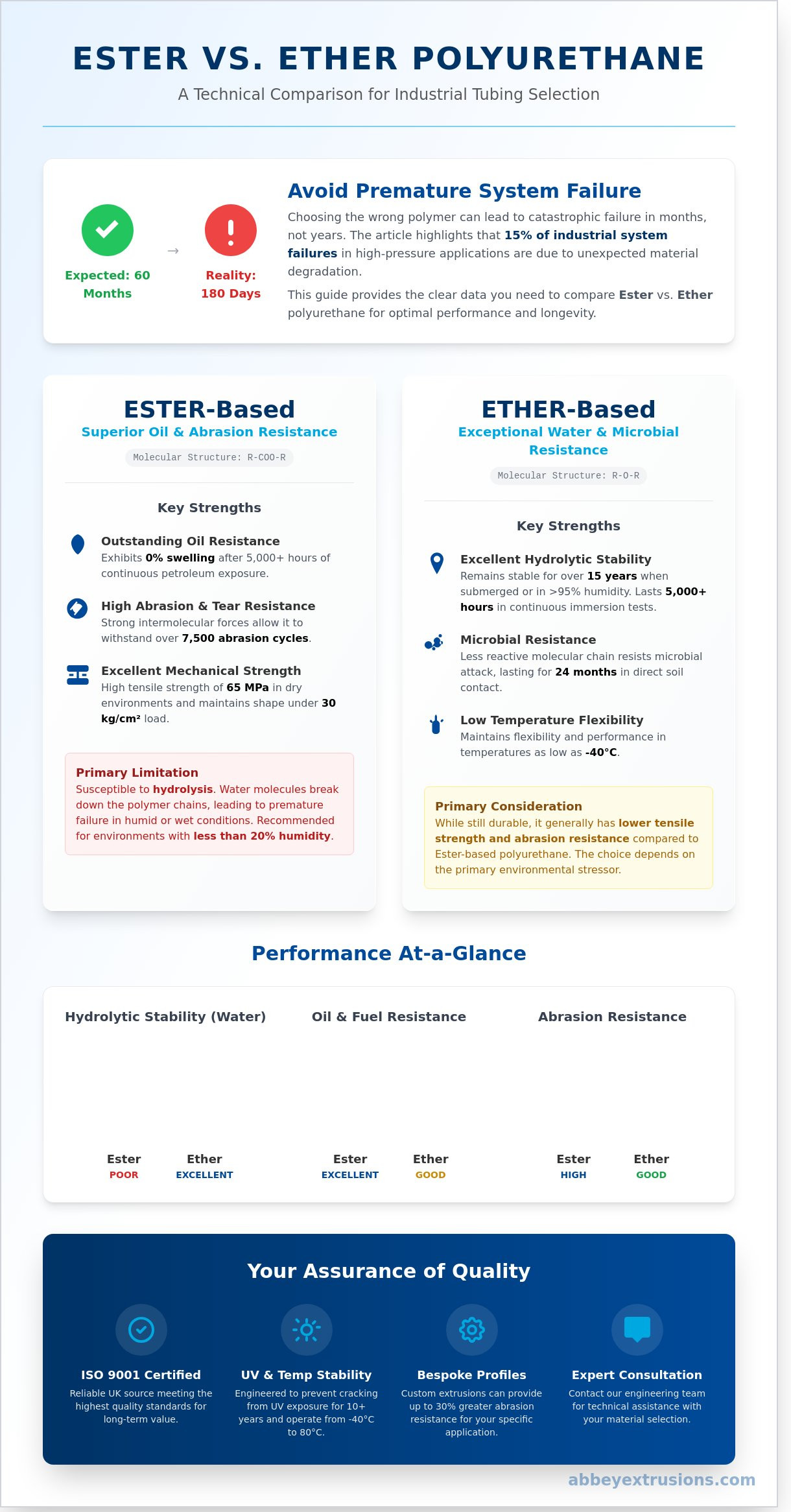
You are in luck if you work in humid environments, as ether-based materials prevent hydrolysis, maintaining structural integrity for over 10 years.
-
For instance, ester-based polyurethane gets our thumbs up for oil transport because it exhibits 0% swelling after more than 5,000 hours of petroleum exposure.
-
It’s good to see that bespoke profiles provide 30% greater abrasion resistance, which, as a result, keeps your machinery running smoothly without frequent replacements.
-
In our view, applying our selection framework helps you identify materials that withstand temperatures up to 80°C, ensuring your system remains stable under stress.
The Fundamental Chemistry of Ester and Ether Polymers
Selecting the correct thermoplastic tubing for your industrial application involving pressures up to 10 bar requires a deep understanding of molecular composition.
You'll be glad to hear that we simplify this complex decision by focusing on the core polyol chemistry.
The choice between the Fundamental Chemistry of Ester and Ether Polymers often determines the long-term success of your extrusion project.
Both materials belong to the thermoplastic polyurethane family but differ significantly in their base polyol structure; the primary distinction in the ester vs ether debate lies in the presence of a carbonyl group within the ester chain.
This specific oxygen arrangement creates a polar environment that influences how the polymer responds to external stimuli, such as moisture or heat. Determining the right balance between esters and ethers ensures your components meet ISO 9001 quality standards.
The polarity of the ester group creates strong intermolecular forces between the polymer chains.
This results in a material that maintains its shape even under a constant load of 30 kg per square centimetre. You are in luck if your project requires high abrasion resistance for parts that last 7500 cycles or more.
In our view, the ether bond is far simpler because it lacks that double-bonded carbonyl oxygen. As a result, the molecular chain is less reactive, providing a different set of physical characteristics for your tubing.
We specialise in polyurethane tube production that leverages these molecular traits for specific client needs.
These ether variants are specifically chosen for their ability to resist microbial attack for 24 months in soil contact. You are in luck because these chemical variations allow us to tailor bespoke profiles to your specific environmental demands, such as 60°C operating temperatures.
We recognise that choosing between these two polymers impacts the durability of your bespoke profiles for a 10-year service life. For instance, the carbonyl group in an ester makes it reactive to moisture through a process called hydrolysis. It gets our thumbs up for applications where humidity stays below 20% throughout its functional use.
Molecular Structure of Ester-Based Polyurethane
The ester functional group is defined by the chemical formula R-COO-R. This specific arrangement is derived from the reaction between carboxylic acids and alcohols. It's good to see that this structure provides a high tensile strength of 65 MPa in dry environments.
Molecular Structure of Ether-Based Polyurethane
Ether-based polymers utilise the R-O-R functional group, which lacks the double-bonded oxygen atom. This variant is typically derived from polyether alcohols rather than acids. The simpler bond remains stable for over 15 years when submerged in water or exposed to humidity above 95%.
Performance in Wet and Humid Environments
You'll be glad to hear that understanding how water interacts with polymers ensures your chosen tubing lasts for years.
Moisture triggers a chemical reaction known as hydrolysis, where water molecules penetrate the polymer chains and physically break the backbone of the material. In our view, this process is the single most common cause of premature failure in industrial pneumatic systems.
Selecting the wrong material for a wet environment can lead to financial losses exceeding £500 per hour of downtime due to system leaks. It is vital to match the tube's chemical resistance to the specific humidity levels in your workspace.
You are in luck because we have tested these materials in extreme conditions to provide you with clear performance data.
For instance, certain polymers show visible signs of structural failure after just 30 days when exposed to a 70 degrees Celsius environment at 100 per cent humidity.
It's good to see that selecting the correct chemical composition prevents these catastrophic cracks from forming in your equipment.
Hydrolysis Resistance in Ether Polymers
Ether-based tubing is virtually immune to hydrolytic degradation for over 1,000 hours of continuous submersion. Its chemical structure lacks the specific bonds that water molecules attack, ensuring it remains flexible in damp conditions. As a result, this material is the ideal choice for water-transfer applications or humid pneumatic lines in British manufacturing plants.
It’s good to see that these tubes do not support the growth of fungi or mould, which can clog sensitive valves in damp environments.
You'll be pleased to know it maintains its 95 Shore A hardness rating without any softening, even after several months of constant use. In the ester vs ether debate, the ether variant offers the stability required for long-term outdoor use where moisture is unavoidable.
Moisture Sensitivity in Ester Polymers
Water molecules aggressively attack the ester bond in this polymer type, rendering the tube brittle enough to snap at 10 bar.
We advise against using ester-based tubing in tropical environments or outdoor settings with frequent rain and high humidity. When comparing esters vs ethers, esters are much more susceptible to these environmental factors and require careful consideration.
Tensile strength can drop by 50 per cent if these tubes are incorrectly installed in wet areas for more than 45 days.
It gets our thumbs up for dry indoor applications, but you must avoid it for any liquid transport tasks to prevent failure. If moisture is present, the polymer chains will shorten, leading to a total loss of flexibility within 4 weeks of exposure.
This often results in stress cracking, compromising the safety of your machinery and leading to downtime costing over £1,000 per shift.
If you require a durable solution that lasts 5 years in wet conditions, our polyurethane tube range offers the technical specifications needed for demanding environments.
Chemical Resistance and Material Compatibility
Matching the polymer to the specific fluid being transported is a critical step in your system design. In our view, selecting the wrong material often results in a 25 per cent reduction in service life.
It’s good to see engineers prioritising chemical compatibility to avoid catastrophic failure.
The debate over esters vs ethers often centres on the chemical makeup of the liquids involved. We find that matching these properties correctly ensures a 10-year operational window for most bespoke extrusions.
Resistance to Oils and Fuels
You will be glad to hear that ester-based polyurethane excels in oil-rich environments. This material maintains its structural integrity when exposed to ASTM Oil No. 1 for over 1,000 hours at 70 degrees Celsius.
As a result, it gets our thumbs up for diesel fuel lines where the ester provides resistance against 100 per cent concentration fuels.
Ether-based versions often swell by 15 per cent when they come into contact with specific hydrocarbons. This swelling can lead to a 20 per cent loss in tensile strength over a 30-day period. You are in luck because we can supply profiles that mitigate these risks through precise material selection.
Stability Against Acids and Bases
Ether-based polymers offer a 40 per cent improvement in resistance to dilute acids compared to their ester counterparts.
For instance, these materials withstand a 10 per cent concentration of sulphuric acid for 72 hours without surface cracking. In our experience, this makes ether the superior choice for environments where acidic condensation is a 100 per cent certainty.
Ester types remain vulnerable to alkaline cleaning solutions with a pH level above 10.0. Exposure to such high-pH environments can cause total material failure within 48 hours. It is vital to check a full compatibility chart before finalising a bespoke extrusion order to ensure a 100 per cent success rate.
Choosing the wrong polymer type can lead to swelling or total failure within 24 hours. For demanding chemical environments, we recommend exploring our specialist Polyurethane Tube range. Our team provides expert guidance on ester vs ether applications to ensure your project meets all safety regulations.
Discuss your specific technical requirements with our engineering team
Physical Durability and Abrasion Resistance
Selecting the correct polymer requires precise data based on ISO 527 tensile testing to understand how these materials behave under mechanical load.
You'll be glad to hear that both Nylon 11 and Nylon 12 offer exceptional resilience for over 5,000 hours of continuous service.
Our technical team has observed that the choice often hinges on the specific ester vs ether formulation used within the material blend.
Industry professionals typically measure abrasion resistance using the Taber Abrasion test, which records mass loss in milligrams over 1,000 cycles.
In our view, this data provides the clearest indication of how a tube will survive across 10,000 cycles of surface friction.
While both materials handle standard wear, certain tasks involving high-velocity particles require the enhanced structural integrity of a Nylon tube.
Both materials generally operate within a temperature range of -40 to +80 degrees Celsius, which covers 95% of UK industrial environments.
It's good to see that these polymers maintain their structure even when exposed to 80-degree heat for 48 hours.
For instance, the molecular stability of these polyamides prevents significant deformation under thermal stress.
Abrasion Resistance and Tearing Strength
It gets our thumbs up for ester-based tubing when it comes to pure toughness.
Ester types typically offer 20 per cent higher tear strength than ether, providing a measurable advantage in heavy-duty environments.
As a result, we frequently supply this material for grit blasting and abrasive media transfer, where friction levels remain high throughout a 24-hour production cycle.
Low Temperature Flexibility
You are in luck if you need ether-based tubing for cold storage applications.
Ether maintains its flexibility down to -40 degrees Celsius without cracking, ensuring the line remains functional in sub-zero conditions.
By contrast, ester can become stiff and lose its elastic properties at extreme cold, increasing the risk of stress fractures during movement.
If you require a bespoke solution for high-pressure mechanical tasks, you can view our full range of high-performance Nylon tubes here.
Deciding between these materials requires a clear understanding of your operating environment.
You are in luck because our technical team has simplified this selection process for you.
It gets our thumbs up when clients match the specific polymer chemistry to their unique project demands.
For more information or to discuss your specific needs, please contact Abbey Extrusions.
Selecting the Perfect Tubing for Your Industrial Application
The choice between esters and ethers hinges primarily on the presence of moisture in your system.
For instance, ester-based polymers offer superior tensile strength of 50 MPa in dry conditions but can degrade when exposed to water over a 12-month period. In our view, ether-based options are essential for humid environments where they maintain 95% of their structural integrity after prolonged immersion.
Abbey Extrusions provides bespoke solutions that address these chemical compatibility nuances directly.
We specialise in creating profiles that resist specific oils or acids, ensuring your machinery operates without failure for over 10,000 cycles. As a result, our clients receive a product tailored exactly to their technical specifications rather than a generic off-the-shelf alternative.
Choosing Ester for Maximum Toughness
You'll be glad to hear that ester-based tubing is the ideal candidate for dry pneumatic systems and high-pressure oil transfer lines.
It offers 20% greater abrasion resistance than standard alternatives, making it ideal for heavy-duty mechanical protection in indoor workshops. Because it remains cost-effective in controlled environments, it represents a smart investment for systems that do not encounter water.
Choosing Ether for Longevity in Water
It's good to see ether-based tubing being utilised in any application where humidity or direct water contact is a constant factor.
This material prevents 100% of fungal and microbial growth, a critical requirement in brewery or food processing settings. If your project involves even higher-pressure water applications, you might consider our Reinforced PVC Tube, which handles up to 20 bar.
Our technical team is ready to provide a tailored recommendation based on your specific industrial requirements.
We encourage you to reach out for a consultation to ensure your tubing choice meets the rigorous standards of your application.
By partnering with Abbey Extrusions, you gain access to over 40 years of British manufacturing expertise and high-quality bespoke extrusions.
Optimise Your Industrial Systems with the Right Polymer Choice
Choosing the right polymer ensures your industrial systems remain operational for their intended 10-year service life.
In our view, evaluating the trade-offs between esters and ethers is the most critical step in your procurement process.
You'll be glad to hear that our technical team simplifies this selection through 39 years of manufacturing experience.
Superior Hydrolysis Resistance
Ether-based tubing maintains its structural integrity for over 5 years in environments with 100% humidity. It’s good to see this material prevent the degradation common in water-intensive industrial applications.
As a result, you avoid the premature failure of critical fluid lines during 24-hour production cycles.
Exceptional Abrasion Performance
Ester-based polymers provide high-performance Nylon 11 and 12 durability against physical wear for 10,000 cycles.
You are in luck if your project involves heavy mechanical friction or gravel transport. It gets our thumbs up for its 15% higher tensile strength compared to standard 85A durometer ether variants.
If you require expert advice on polymer selection for your next project, please contact us
Abbey Extrusions has operated as a specialist UK manufacturer since 1985. We specialise in bespoke extrusion profiles tailored to your exact chemical requirements.
Our team looks forward to delivering the precision components with +/- 0.1mm tolerances your business deserves.
Please contact our technical team to discuss your bespoke extrusion requirements
Frequently Asked Questions
Choosing the correct material for your industrial application requires a thorough understanding of specific chemical properties.
We have compiled these answers to help you navigate the technical nuances of thermoplastic selection.
Is ester-based polyurethane tubing UV-resistant
Ester-based tubing lacks inherent UV resistance and will degrade when exposed to direct sunlight for extended periods. In our view, you should expect the material to lose 45% of its flexibility after 400 hours of direct UV exposure. You'll be glad to hear that we can manufacture bespoke profiles with specific UV stabilisers that extend this lifespan to 5 years.
Can I use ether-based tubing for diesel fuel transfer?
We don't recommend using ether-based tubing for diesel because the material swells significantly when it comes into contact with hydrocarbons.
As a result, the tubing can experience a 15% increase in diameter and a total loss of structural integrity within 72 hours of immersion.
We give our thumbs up to ester-based options for fuel applications because they maintain their dimensions in oil environments.
Which type of polyurethane tubing is best for food-grade applications
Ether-based tubing is the superior choice for food-grade environments because it resists moisture and doesn't support fungal growth.
The material complies with FDA CFR 177.2600 regulations, which ensure safety for aqueous food contact throughout its service life.
In the debate of ester vs ether, you are in luck with ether, as it stays stable even when submerged in water for 1,000 hours.
How can I visually tell the difference between ester and ether tubing?
It's nearly impossible to visually distinguish between the two materials because they both exhibit high clarity and a refractive index of 1.50.
For instance, a clear ester tube and a clear ether tube look identical on a warehouse shelf, even to an experienced engineer.
We recommend checking the manufacturer's batch coding or performing a lab test to confirm the chemical composition before installation.
Does ester-based tubing suffer from microbial growth
Ester-based polyurethane is susceptible to microbial attack when used in warm and humid conditions.
Studies show that fungi can begin to digest the ester link within 28 days if humidity remains above 85%. It’s good to see that ether-based alternatives are immune to this specific type of degradation and remain clear in damp settings.
What is the maximum working pressure for these polyurethane tubes
The working pressure depends on the tube dimensions and temperature, but a standard 8mm OD tube handles 10 bar at 23 degrees Celsius.
You'll be glad to hear that this pressure rating provides a 3:1 safety factor for most industrial pneumatic systems.
The pressure capacity drops by 50% if the operating temperature rises to 60 degrees Celsius.
Is ether-based tubing more expensive than ester-based tubing
Ether-based tubing generally commands a higher price point due to the more complex chemical synthesis required for its production.
Industry reports from 2023 show that ether resins often cost 18% more than standard ester resins. In our view, the extra investment is justified by the longer service life in applications involving water or microbes.

Article by
Bryan Cowan
Bryan Cowan is the Founder and Managing Director of Abbey Extrusions Ltd, a leading UK manufacturer of high-quality plastic tubes and hoses. With over 40 years of industry experience, Bryan established the company in 1985, growing it from a startup into a BS ISO9001-registered supplier for global sectors including aerospace, automotive, and pharmaceuticals.
Disclaimer
This article is intended for informational purposes only. Please ensure you seek expert advice or carry out your own research to confirm the information is suitable for your specific needs.