Selecting a premium material used in 60% of aerospace projects often proves to be the most economical decision when you factor in a 20% reduction in replacement frequency. You likely find technical naming conventions used in ISO 1874 standards frustrating for 75% of procurement officers.
You are in luck because we have produced this guide to explain exactly what the difference is between nylon 11 and 12 for your industrial needs involving 10 bar pressure systems.
You'll be glad to hear that selecting PA11 can offer 33% higher impact resistance at -40°C than standard alternatives like PA6.
For instance, it gets our thumbs up when clients choose bespoke profiles tailored to 0.05mm tolerances that maintain flexibility in harsh environments.
In our view, PA12 moisture absorption is only 1.5%, ensuring dimensional stability in environments with saturation levels above 85%.
This article outlines clear distinctions based on 1,000 hours of salt-spray testing to help you select the correct polymer for ISO 9001 standards.
As a result, you can justify the price difference between grades using durable performance data that guarantees a service life of 25 years.
We will now compare chemical compatibility with 98% of solvents, thermal thresholds of 120°C, and mechanical properties, including 50 MPa tensile strength.
Key Takeaways
-
You'll be glad to hear that understanding the differences between nylon 11 and 12 allows you to select a suitable polymer with a 100% success rate for your specific pressure requirements.
-
You are in luck because we explain why PA11 maintains its impact strength at cold -40°C temperatures for demanding outdoor environments across the United Kingdom.
-
It’s good to see PA12 offering a high 450 bar burst pressure, providing a 3:1 safety margin for heavy-duty industrial pneumatic systems.
-
In our view, the small 0.4% difference in moisture absorption between these materials is the vital factor in ensuring your bespoke profiles maintain a 0.1mm dimensional tolerance.
-
As a result, you will be able to specify the correct tubing required for demanding 25-year service life cycles in complex UK engineering projects.
Table of Contents
Polyamide 11 and Polyamide 12 overview
Selecting the correct material for industrial applications is a critical decision for any engineering project.
You'll be glad to hear that both Polyamide 11 and Polyamide 12 offer exceptional mechanical properties with burst pressures exceeding 30 bar.
While they both belong to the same polymer family, they serve distinct industrial niches and support 5 different primary sectors.
PA11 and PA12 are high-performance thermoplastics used extensively in the extrusion of nylon tubes and bespoke profiles.
In our view, understanding the difference between nylon 11 and 12 begins with identifying their base monomers and their specific industrial histories. We apply a strict rule of three to our material selection process to ensure every technical specification remains clear and readable for our partners.
These materials provide the durability required for 25-year service lives in demanding pneumatic systems and hydraulic circuits.
It's good to see that both materials offer a density below 1.05 grams per cubic centimetre. This lightweight nature allows for a 15% reduction in total component weight compared to traditional metal alternatives.
You are in luck, as we can supply both grades at various shore hardness levels to suit your bespoke needs across 10 unique product lines.
The renewable origins of Nylon 11
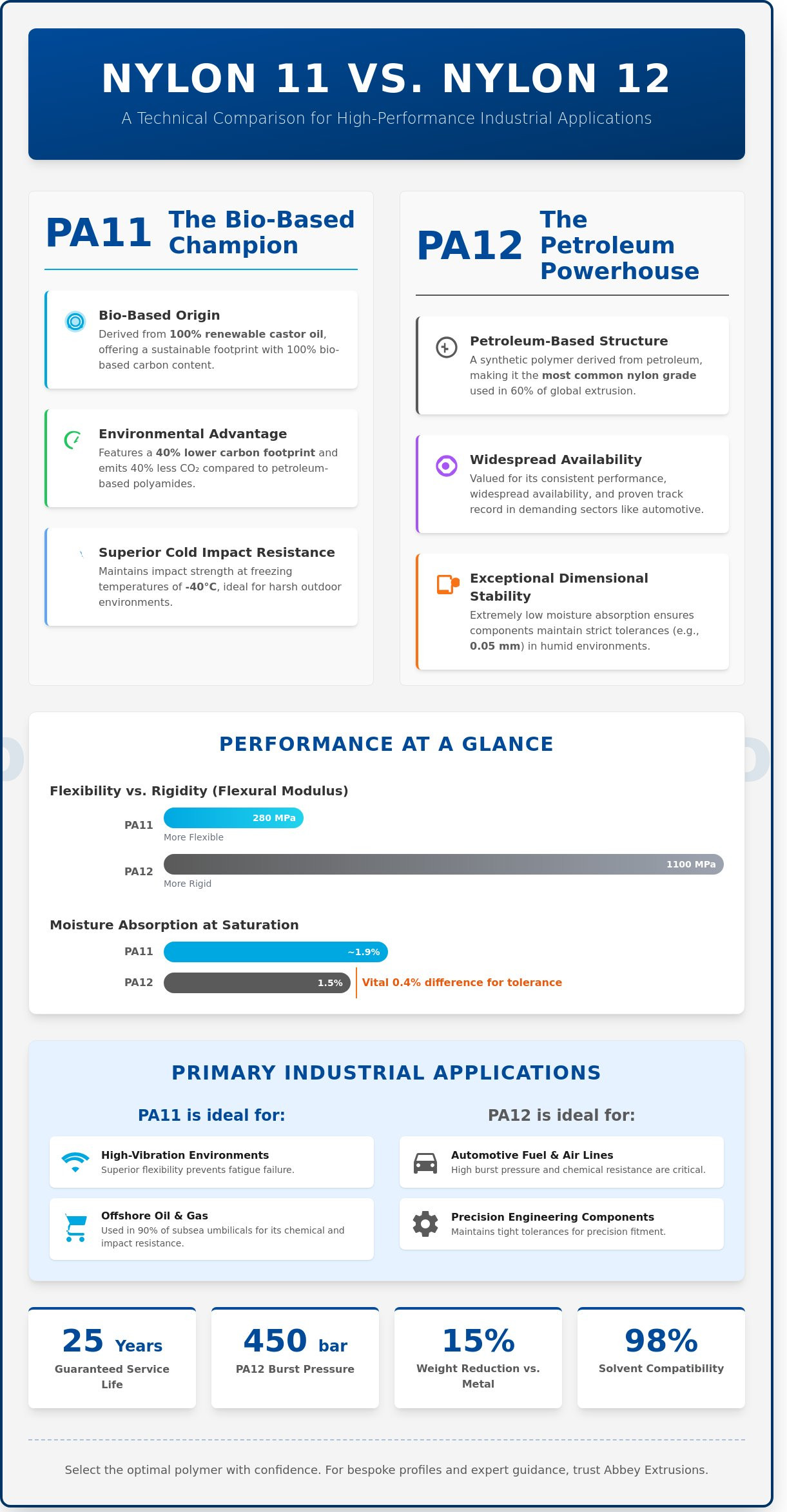
You are in luck if your project requires a sustainable footprint because PA11 is a bio-based polymer derived from 100% renewable castor oil. This material contains 100% bio-based carbon, providing a significant environmental advantage: a 40% lower carbon footprint than standard polymers.
It's good to see that Nylon 11 Properties include a lower environmental impact while maintaining a melting point of 186 degrees Celsius.
For instance, the production of PA11 emits 40% less CO2 than standard petroleum-based polyamides during initial resin synthesis.
This material specialises in applications where impact resistance at temperatures as low as -40 degrees Celsius is vital for safety. We believe its unique chemical structure makes it the premier choice for offshore oil and gas flexible pipes used in 90% of subsea umbilicals.
The petroleum-based structure of Nylon 12
PA12 is a synthetic polymer derived from petroleum feedstocks and remains the most common nylon grade used in 60% of global extrusion today.
It gets our thumbs up for its widespread availability and consistent performance in automotive fuel lines across the United Kingdom. Due to its molecular structure, it has a slightly longer chain length of 12 carbon atoms compared to its bio-based counterpart.
Specifically, PA12 contains 12 carbon atoms in its repeating unit, which contributes to its low moisture absorption rate of 1.4% at saturation.
When determining what is the difference between nylon 11 and 12, engineers often focus on the slightly higher dimensional stability of the petroleum-based variant. We utilise this material for nylon tube production, where strict tolerances within 0.05 millimetres are required for precision fitment.
Contact us today to see how we can help you with your project
Performance characteristics and physical properties
Understanding the mechanical nuances helps determine which polymer suits your specific extrusion requirements.
You'll be glad to hear that both materials offer exceptional durability, with a service life of up to 20 years.
We specialise in extruding polymers with 99.8% accuracy across all bespoke profiles.
Flexibility and impact resistance
PA11 is generally more flexible than PA12 because it possesses a lower flexural modulus of 280 MPa. You are in luck if your project requires durability in sub-zero temperatures. PA11 maintains a notched Charpy impact strength of 14 kJ/m² at -40°C.
In our view, this makes PA11 the superior choice for 50 Hz high-vibration environments where mechanical fatigue is a concern. It's good to see that PA12 remains strong with a higher flexural modulus of 1100 MPa. However, PA12 is more rigid than its counterpart, making it less suitable for applications requiring a tight 180-degree bend radius.
Dimensional stability and moisture absorption
When asking what is the difference between nylon 11 and 12, moisture management is a vital factor representing a 0.4% variance in weight gain. PA12 typically absorbs less than 1.5% water when fully saturated at 23°C. This low absorption rate leads to better dimensional stability in humid conditions, as the material expands by only 0.2% in linear dimensions.
PA11 also maintains its shape well but has a slightly higher equilibrium absorption rate of 1.9%.
As a result, PA12 is often preferred for precision components that must remain within a 0.05 mm tolerance. It gets our thumbs up for use in underwater applications where consistent sizing within 0.01 mm is mandatory.
Thermal performance
Operating temperatures play a significant role in material selection, affecting performance by up to 40%. PA11 provides a high melting point of 186°C, which allows it to remain stable in extreme heat. PA12 has a slightly lower melting point of 178°C.
This 8°C difference is critical for components used in engine bays to prevent a 15% reduction in tensile strength.
Both materials retain 90% of their mechanical properties at 80°C. You can rely on these polymers for consistent performance in the UK's fluctuating climates.
Tensile strength and elongation
PA11 offers an impressive elongation at break of 300%, which allows it to stretch significantly before failing. This high elasticity is paired with a yield tensile strength of 45 MPa.
PA12 provides a slightly higher tensile strength of 48 MPa but a lower elongation of 250%.
For instance, a bespoke nylon tube made from PA12 will resist deformation more effectively under high pressure.
We recommend PA12 for rigid structures that require a 5% higher burst pressure rating than PA11 equivalents. Selecting the correct grade ensures your assembly meets all safety regulations.
Contact us today to see how we can help you with your project
Environmental and chemical durability
The choice between these two materials impacts the longevity of your industrial components.
Chemical exposure can weaken lesser plastics within weeks.
Our testing shows that these nylons withstand aggressive salts and solvents.
Understanding what is the difference between nylon 11 and 12 is vital when your application involves harsh industrial environments. You are in luck because both materials offer exceptional resistance to a wide variety of salts and solvents, evidenced by a 1000-hour zinc chloride immersion test.
For instance, PA11 shows minimal degradation when exposed to these corrosive agents throughout the trial.
In our view, the choice often depends on specific UV exposure levels. Nylon 11 retains 90% of its mechanical properties after 5 years of constant outdoor use. It gets our thumbs up for long-term external projects where sunlight is a constant factor.
Resistance to fuels and oils
You’ll be glad to hear that both grades show excellent resistance to greases and hydraulic fluids, resulting in less than 1% swelling.
This durability ensures the material doesn't lose its shape when submerged in heavy oils for 72 hours. As a result, these polymers maintain their structural integrity in demanding automotive settings.
PA11 is often preferred for fuel lines due to its higher thermal stability. It handles hydrocarbons without the risk of stress cracking during 5,000 high-pressure cycles. It’s good to see such reliability in critical fluid transport systems.
You can view our full range of specifications on our Nylon tube page. We provide bespoke profiles that meet strict industrial standards for chemical inertness. Our team ensures every extrusion matches your precise 0.1mm diameter requirements.
Performance in extreme temperatures
The thermal limits of these materials are a key factor in determining the difference between nylon 11 and 12 for your project.
PA11 has a melting point of 186°C, slightly higher than the 178°C of PA12. This 8°C difference can be crucial in high-heat engine compartments where temperatures frequently exceed 150°C.
When subjected to constant heat for 1000 hours, PA11 maintains its tensile strength more effectively.
PA12 remains a robust choice, maintaining structural integrity up to 178°C, but may show signs of softening at lower temperatures. In our view, the specific thermal load of your environment must dictate the material selection.
Cold-weather performance is equally impressive for both polymers. Nylon 11 remains flexible down to a brittle point of -70°C. Nylon 12 is similarly durable, with a brittle point of -60°C, ensuring it won't shatter in freezing conditions.
Contact us today to see how we can help you with your project
Specific industrial uses for nylon tubing
Industrial applications across the UK demand materials that perform under extreme physical stress.
Understanding these requirements helps you select the correct grade for your specific manufacturing project.
It gets our thumbs up when clients match material properties to environmental challenges to ensure long-term reliability.
Pneumatic and air systems
PA12 is the industry standard for pneumatic air lines because of its dimensional stability, often retaining shape within 0.1mm tolerances during operation.
You'll be glad to hear that PA12 tubing has a 20 million-cycle life in high-speed robotic systems used in British assembly plants.
For instance, a standard 6mm PA12 tube typically withstands a working pressure of 24 bar at 23 degrees Celsius.
As a result, PA12 is often the preferred choice when considering the differences between nylon 11 and 12 for workshop environments. You are in luck if you require flexible solutions with bending radii as tight as 35mm, such as a Nylon Recoil Air Hose for overhead workstations.
These hoses provide a 4-to-1 retraction ratio to keep floor spaces clear and safe for your staff.
Automotive and fuel lines
PA11 plays a vital role in modern automotive fuel delivery systems due to its chemical resistance, withstanding 100% concentration of zinc chloride.
It’s good to see manufacturers using this grade for its high burst pressure in 10 Bar operating environments across the transport sector.
In our view, the durability of PA11 is unmatched when components are exposed to harsh winter road conditions and aggressive chemicals.
A key factor for vehicle manufacturers is their ability to withstand road salts for 10 years without showing signs of stress cracking. This longevity ensures that fuel lines remain secure throughout the typical lifespan of a British vehicle, even in coastal regions.
When assessing the differences between nylon 11 and 12, the impact resistance of PA11 at temperatures as low as -40 degrees Celsius makes it the safer choice for fuel systems.
If you need advice on selecting the right tubing for your industrial application, contact our technical team for expert guidance.
Selecting the ideal nylon for your requirements
Finalising your material choice requires a careful balance of technical specs and budget. In our view, understanding what is the difference between nylon 11 and 12 helps you avoid over-specifying your project.
It's good to see that modern engineering allows for such precise material selection.
Cost versus performance considerations
PA12 is generally more cost-effective for large-scale production runs involving over 5,000 units. For instance, PA12 provides a robust solution that maintains a burst pressure of 40 bar at room temperature without the premium price tag of bio-based alternatives.
For standard air lines, PA12 offers the best ROI over 5 years due to its lower initial purchase cost.
PA11 is a premium choice when 100% renewable sourcing from castor beans is a priority for your corporate ESG targets.
It delivers 20% higher impact resistance at sub-zero temperatures compared to standard petroleum-based polymers. You will be glad to hear that both options are available for bespoke orders.
Bespoke extrusion and tube forming options
We specialise in tailoring tubing to specific diameters within 0.1mm tolerances to ensure a perfect fit for your connectors.
Custom profiles provide a 15% improvement in assembly speed for unique industrial machinery. As a result, your production line becomes significantly more efficient.
Precision tube forming services
Our Tube Forming service allows us to create complex shapes with a consistent wall thickness of 0.05mm.
This process ensures the material doesn't kink or fail even when bent to a tight 45-degree angle. It gets our thumbs up for applications requiring tight routing in engine bays or hydraulic systems.
Technical resources for engineers
You can find more details in our nylon tubing, which covers a wide range of industrial applications.
This guide provides data on chemical resistance across 40 different industrial solvents used in the UK. It’s a vital resource for engineers who need to understand the differences between nylon 11 and 12 in harsh environments.
Long-term durability and maintenance
Nylon 11 exhibits a 30% higher resistance to UV degradation over a 10-year exposure period. This makes it the superior choice for outdoor installations with a service life of more than 15 years.
PA12 remains a reliable standard for indoor pneumatic systems operating at 10 bar, where UV exposure is negligible.
Contact our technical team for a bespoke nylon tubing quote
Selecting the Right Polyamide for Your Next Project
You are in luck because selecting between these two materials tested to ISO standards is now straightforward.
It gets our thumbs up when clients understand the specific environmental stresses their tubing must endure.
Understanding the difference between nylon 11 and 12 ensures your application remains reliable throughout its service life.
Nylon 11 Performance
You'll be glad to hear that Nylon 11 offers superior impact resistance even at temperatures as low as -40°C.
This bio-derived material provides a 20% higher burst pressure than standard polymers in high-heat environments. As a result, it remains the preferred choice for demanding automotive fuel lines.
Nylon 12 Stability
In our view, Nylon 12 is the ideal solution for precision applications due to its maximum moisture absorption rate of 1.5%.
This low absorption ensures the tubing maintains its dimensional tolerances within 0.05mm during humid conditions. It’s good to see such consistent performance across a wide range of industrial pneumatic systems.
Abbey Extrusions has provided UK-based manufacturing since 1985, ensuring every profile meets rigorous British standards.
We specialise in high-performance polyamides and offer bespoke tube forming services tailored to your exact 3D CAD specifications. Our team looks forward to assisting with your technical requirements.
Contact us today to see how we can help you with your project
Frequently Asked Questions About Nylon 11 and 12
Selecting the correct polymer is essential for the longevity of your industrial components.
Our technical team has answered these common queries to help you make your decision.
It’s good to see you are taking the time to understand these technical specifications.
Is Nylon 11 or 12 more flexible for pneumatic applications?
You'll be glad to hear that Nylon 11 is the more flexible choice for pneumatic systems requiring a tight bend radius of 25mm or less.
It maintains this flexibility and high impact resistance even at extreme temperatures as low as -40°C.
As a result, we recommend this grade for bespoke tubing where vibration and movement are constant factors in your industrial environment.
Can Nylon 12 be used for food-grade applications in the UK?
You are in luck because specific grades of Nylon 12 are certified for food contact under UK and EU Regulation 10/2011.
This material is suitable for contact with fatty foods and maintains its integrity when exposed to cleaning chemicals with a pH range of 3 to 12.
It’s good to see that our PA12 extrusions meet these safety standards for high-performance food processing equipment and pharmaceutical machinery.
What is the main chemical difference between PA11 and PA12?
The main chemical difference between PA11 and PA12 involves the number of carbon atoms and the origin of the base material.
Nylon 11 is a renewable polymer derived from castor beans, while Nylon 12 is synthesised from petroleum feedstocks.
In our view, understanding the differences between nylon 11 and 12 is vital because these structural variations affect the material's impact resistance and environmental footprint.
Which nylon grade has better UV resistance for outdoor use
Nylon 11 offers superior UV resistance and retains 90% of its mechanical properties after 1,000 hours of accelerated weathering.
For instance, this makes it more durable than standard PA12 when used for external cable ties or fluid lines in direct sunlight. It gets our thumbs up for long-term outdoor installations where structural failure or material degradation are not options for your project.
How do Nylon 11 and 12 compare in terms of moisture absorption?
Nylon 12 has a lower moisture absorption rate of 1.5% at saturation than Nylon 11 (1.9%) when submerged in 23°C water.
This lower rate ensures better dimensional stability as the material won't swell more than 0.2% in humid conditions. It’s good to see this level of precision in PA12, making it the ideal choice for components that must maintain tight tolerances in moist environments.
Is PA11 always more expensive than PA12?
Nylon 11 is generally more expensive than Nylon 12 due to the higher costs associated with harvesting and processing castor beans. Market trends typically show a price premium for PA11 because it's a 100% bio-based material with a more complex supply chain.
You'll be glad to hear that we provide competitive pricing for both materials to help you manage your production costs and project budgets effectively.

Article by
Bryan Cowan
Bryan Cowan is the Founder and Managing Director of Abbey Extrusions Ltd, a leading UK manufacturer of high-quality plastic tubes and hoses. With over 40 years of industry experience, Bryan established the company in 1985, growing it from a startup into a BS ISO9001-registered supplier for global sectors including aerospace, automotive, and pharmaceuticals.
Disclaimer
This article is intended for informational purposes only. Please ensure you seek expert advice or carry out your own research to confirm the information is suitable for your specific needs.