The structural integrity of a vacuum system often rests on a counterintuitive principle; external reinforcement is frequently less critical than the precise ratio between a polymer's shore hardness and its wall thickness. We understand the operational setbacks caused by vacuum rated flexible tubing collapsing at critical moments or reacting poorly with specialised pump oils. These failures don't just stall production; they compromise the precision and safety of your entire industrial process. It's a challenge that requires a deep understanding of material science rather than simply choosing the thickest hose available on the market.
We've developed this engineering guide to provide a rigorous technical breakdown of how to specify the correct materials for high performance vacuum applications in 2026. You'll learn how to calculate sufficient wall thickness for specific negative pressure levels and navigate the implications of the latest EN 16820 regulations. We'll also outline how sourcing UK manufactured, bespoke solutions can eliminate the common struggle of finding exact fits for non-standard vacuum fittings whilst ensuring long term durability in harsh environments. This overview of polymer behaviour and manufacturing precision will equip you to make informed procurement decisions for your facility.
Key Takeaways
- Understand how hoop stress and external atmospheric pressure dictate the performance limits and structural integrity of vacuum lines.
- Learn why Nylon 11 and 12 are preferred for high rigidity whilst Polyurethane offers a balance of flexibility and collapse resistance.
- Master the calculation of safety factors by analysing the critical relationship between wall thickness and internal diameter for industrial systems.
- Discover how to specify vacuum rated flexible tubing for demanding industrial environments such as automated pick and place systems.
- Explore the technical advantages of sourcing bespoke UK manufactured extrusions to meet non standard requirements for specific vacuum fittings.
For technical advice regarding specific industrial requirements, please contact our engineering team.
Understanding the mechanics of vacuum rated flexible tubing
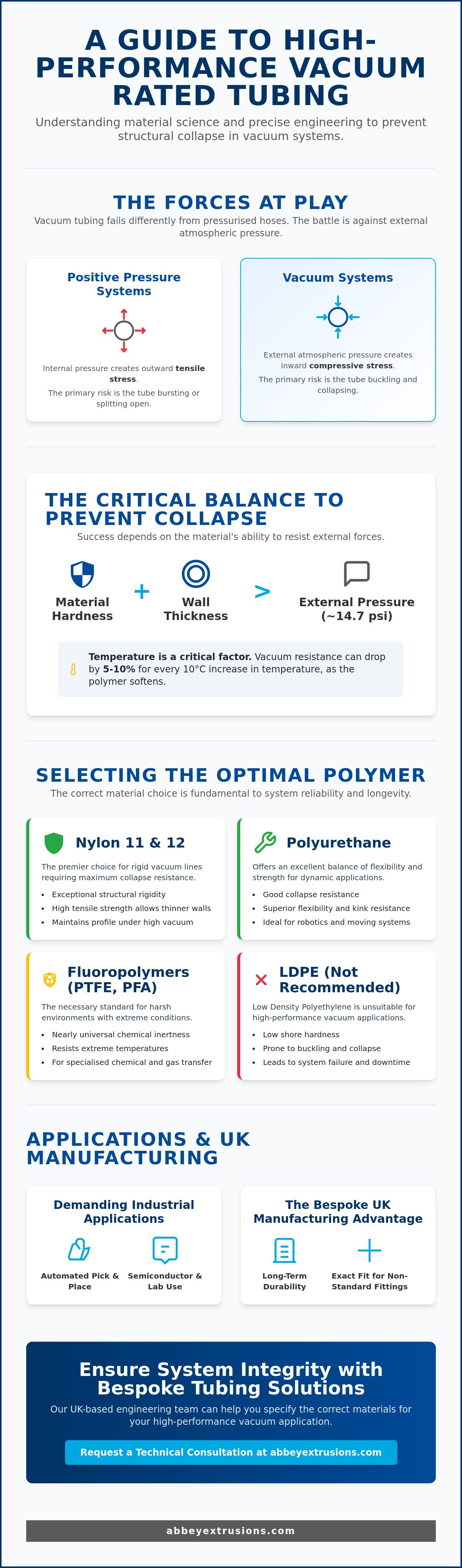
A vacuum rating identifies the capacity of a hollow cylinder to resist the compressive force of the surrounding atmosphere when internal pressure is reduced. Whilst many engineers focus on internal burst pressures, vacuum rated flexible tubing must be engineered to withstand the external weight of the air itself. Understanding the mechanics of vacuum is vital because the physics of failure differs significantly from positive pressure systems. In a standard pressurised hose, the material experiences tensile hoop stress as it tries to expand; in a vacuum, the material is subjected to compressive stress that seeks to crush the tube inward.
Standard tubing often fails because it lacks the necessary wall ratio to maintain its profile under negative pressure. Once the external pressure exceeds the material's structural limit, the tube undergoes a rapid transition from elastic deformation to total collapse. This creates a flat spot that immediately halts flow and can damage connected machinery. We ensure our extrusions are designed to prevent this buckling by balancing polymer density with precise wall dimensions.
Atmospheric pressure and tube behaviour
At sea level, the atmosphere exerts approximately 14.7 psi of pressure on every surface. For a hollow tube, this force acts uniformly around the circumference. If the material is too soft or the wall is too thin, the tube will buckle. Temperature is a critical variable in this equation; as polymers warm, their shore hardness decreases, making them more susceptible to collapse. Technical data suggests that for semi-crystalline polymers, vacuum resistance can drop by 5% to 10% for every 10°C increase above ambient room temperature. This makes material selection for industrial environments a high precision task.
Vacuum vs suction applications
It is essential to distinguish between high vacuum gas transfer and simple suction for dust extraction. Suction applications, such as those found in industrial vacuum cleaners, primarily require high airflow and resistance to kinking during movement. In contrast, high vacuum applications in laboratory or semiconductor environments require a tube that can maintain a near-perfect seal and structural integrity at pressures as low as -0.9 bar. Whilst suction hoses often rely on internal wire coils, high performance polyurethane tube or nylon variants achieve their rating through superior material density and specific wall thickness. This structural integrity ensures that the tube does not narrow during operation, which would otherwise restrict flow and reduce system efficiency.
To discuss specific material compatibility for your system, you can request a technical consultation with our specialists.
Selecting the right polymer for vacuum applications
Selecting the correct polymer is a fundamental engineering decision that determines the longevity and reliability of any vacuum system. Whilst many suppliers default to wire-reinforced hoses, a more sophisticated approach involves matching the material's shore hardness to the specific vacuum level required. Choosing the wrong material, such as Low Density Polyethylene (LDPE), often leads to failure in high-vacuum environments because its lower shore hardness cannot withstand sustained negative pressure without buckling. For high-performance vacuum rated flexible tubing, the focus shifts to materials that maintain their profile through inherent structural rigidity.
For environments involving highly aggressive chemicals or extreme temperatures, Fluoropolymers like PTFE or PFA are the necessary standard. These materials provide nearly universal chemical inertness, ensuring that the tube does not degrade when exposed to corrosive gases or specialised solvents. However, for the majority of industrial applications, Nylon and Polyurethane remain the primary choices for balancing cost and performance.
Nylon 11 and 12 performance
Nylon 11 and 12 are widely regarded as the premier choice for rigid vacuum lines. Their high tensile strength allows for thinner walls whilst maintaining exceptional resistance to atmospheric crushing. A key advantage of using Nylon tube is its inherent compatibility with vacuum pump oils and common industrial chemicals. Whether you require standard or heavy wall configurations, these polymers offer the stability needed for precision gas transfer. Engineers often refer to Technical specifications for collapse resistance to understand how material density influences the buckling point of these polymers in high-stress environments.
Polyurethane and PVC alternatives
If your application requires frequent movement or tight routing, Polyurethane tube provides a superior alternative to rigid nylon. PU is celebrated for its elastic memory and superior kink resistance, making it ideal for robotic arms and automated machinery. It possesses enough shore hardness to serve as effective vacuum rated flexible tubing in moderate pressure scenarios whilst remaining easy to manipulate.
In contrast, for larger diameter suction requirements, a reinforced PVC tube is often the most cost-effective solution. These hoses typically incorporate a polyester braid or a rigid helix to prevent collapse across wider bores where unreinforced plastics might fail. For smaller, high-precision lines, the unreinforced rigidity of Nylon usually offers better performance and a cleaner internal profile. If you are unsure which polymer suits your specific chemical environment, our team can provide a material compatibility assessment to ensure your system remains operational for the long term.
If you require a detailed technical assessment of your system tolerances, please consult with our engineering specialists.
Technical specifications and collapse resistance
Specifying vacuum rated flexible tubing requires a precise understanding of the pressure differential between the atmosphere and the internal bore. In industrial systems, vacuum ratings are typically expressed in millimetres of mercury (mmHg) or bar, where -1 bar represents a theoretical perfect vacuum. When calculating the safety factor, engineers must account for the margin between the operational vacuum level and the critical collapse pressure of the material. Unlike positive pressure systems where failure results in a burst, vacuum failure is characterised by structural buckling. A safety factor of at least 3:1 is recommended to ensure that transient pressure spikes or environmental variations don't compromise the system's integrity.
The bend radius of the installation also plays a significant role in maintaining vacuum integrity. As a tube is bent, it naturally begins to ovalise, which creates a structural vulnerability. This deviation from a perfect circular profile gives external atmospheric pressure a point of leverage, significantly lowering the pressure at which the tube will fail. Ensuring that your layout respects the minimum bend radius of the chosen polymer is vital for preventing premature collapse in the field.
Wall thickness and tube geometry
The structural capacity of a tube is primarily defined by the ratio between its wall thickness and its outside diameter. A thicker wall provides the necessary reinforcement to maintain a circular profile against the crushing force of external air. In many industrial polymers, doubling the wall thickness can quadruple collapse resistance in certain polymers. This geometric advantage is why heavy wall configurations are often preferred for high vacuum lines where unreinforced materials might otherwise buckle. By maintaining a high wall-to-diameter ratio, the tube can resist the transition from elastic deformation to total collapse even as internal pressures reach near-perfect vacuum levels.
Environmental factors affecting ratings
External conditions can significantly degrade the theoretical vacuum rating of any plastic extrusion. Heat is the most common factor; as temperature rises, polymers soften and their modulus of elasticity decreases, making them more susceptible to atmospheric crushing. Long term vacuum exposure can also lead to material fatigue, where the polymer chain begins to weaken under constant compressive stress. Additionally, whilst often overlooked in indoor facilities, UV exposure can lead to embrittlement in certain materials. This loss of flexibility makes the tube brittle and prone to stress cracking, which eventually leads to vacuum failure and system leaks. Regular inspection of vacuum rated flexible tubing in harsh environments is essential for maintaining operational safety.
To ensure your facility is equipped with the most reliable material for your specific industrial application, please contact our technical advisory team.
Industrial applications for vacuum rated hoses
The versatility of vacuum rated flexible tubing allows it to serve as a critical component across diverse industrial sectors. Whilst basic suction might suffice for waste removal, high precision manufacturing environments require tubing that maintains strict dimensional tolerances under load. In automated assembly lines, for instance, any slight collapse in the tubing can lead to a drop in suction pressure, causing pick and place systems to misfire. This results in costly downtime and potential damage to sensitive electronic components. By selecting a material with the correct shore hardness, engineers can maintain the necessary pressure differential for continuous, reliable operation.
Manufacturing and automation
High speed automation requires pneumatic circuits that respond with absolute consistency. Using Nylon tube is often the preferred choice for these precision circuits because it offers the necessary rigidity to prevent ID (internal diameter) fluctuations. When a vacuum cycle triggers at several hundred times per minute, even a millisecond of delay caused by a narrowing tube wall can disrupt the entire synchronisation of the machine. By minimising flow restriction and maintaining a constant internal profile, engineers can ensure that vacuum suction cups achieve a secure grip instantly. This level of reliability is particularly vital in the electronics and automotive sectors where precision is a non negotiable standard.
Chemical and food processing
In laboratory and food grade environments, the requirements extend beyond mechanical strength to material purity. Vacuum transfer is frequently used for the degasification of sensitive fluids or the pneumatic conveying of powders and granules. In these scenarios, using non leaching materials is essential to prevent contamination of the product stream. Fluoropolymer tubing is typically specified for high purity vacuum applications where chemical resistance and thermal stability are paramount. These materials ensure that the vacuum environment remains sterile and that no plasticisers migrate into the media. For those managing complex fluid transfer systems, we can develop bespoke tubing profiles that meet specific regulatory and performance criteria.
Industrial printing and packaging machinery also relies heavily on vacuum systems to feed paper and maintain tension on high speed webs. Packaging equipment uses similar technology to open bags or position cartons before filling. In these environments, the durability of the vacuum line is tested by constant movement and mechanical vibration. Selecting a tube with the correct fatigue resistance ensures that the system does not fail prematurely due to embrittlement or stress cracking. The ability of the vacuum rated flexible tubing to withstand these repetitive cycles without losing its rating is what separates industrial grade solutions from standard commercial offerings.
For a tailored quotation regarding your specific industrial requirements, please contact our Leicestershire facility.
Bespoke vacuum tubing solutions from Abbey Extrusions
Finding a reliable source for vacuum rated flexible tubing that deviates from standard catalogue dimensions is a common challenge for design engineers. Many suppliers only offer off-the-shelf sizes that don't always align with specialised vacuum fittings or specific pressure requirements. At Abbey Extrusions, we bridge this gap by providing custom manufacturing capabilities that prioritise technical precision over mass-market convenience. Our ability to adjust wall thicknesses and polymer blends ensures that your system operates at peak efficiency without the risk of structural failure.
We don't just supply raw materials; we provide engineered solutions. This includes specialised tube forming services for pre-bent vacuum lines. Pre-formed tubing is particularly beneficial in tight industrial cabinets where a standard flexible hose might kink or ovalise, compromising the vacuum seal. By setting the polymer into a specific radius during production, we maintain the internal diameter and structural integrity of the line even in complex configurations.
Custom manufacturing in the UK
Sourcing your components from a Leicestershire manufacturer provides distinct advantages in quality control and logistics. We maintain a rigorous oversight of the entire extrusion process, ensuring that every batch of vacuum rated flexible tubing meets our internal benchmarks for density and shore hardness. This proximity allows for significantly faster lead times compared to international sourcing, which is vital for maintaining project timelines. We also offer the flexibility to colour match your tubing to existing machinery or brand guidelines, whilst providing branding options for OEM applications. If you're developing a prototype vacuum system, our small batch production capabilities allow you to test specific profiles before committing to full scale manufacturing.
Technical support and consultation
Our engineers are available to help you define the exact specifications required for your negative pressure environment. We understand that selecting the right polymer involves balancing chemical compatibility, temperature resistance, and mechanical strength. You can work directly with our team to discuss your specifications and request material testing for unique environmental factors. We also provide samples for vacuum integrity testing, allowing you to verify performance under real-world conditions before finalising your procurement. This collaborative approach ensures that the final product isn't just a component, but a reliable part of your industrial infrastructure.
Securing structural integrity in vacuum applications
Engineering a reliable vacuum system requires more than just selecting a standard hose. Material science is the priority. It's about understanding the precise relationship between polymer density and wall thickness to prevent collapse under atmospheric pressure. We've explored how selecting high performance materials like Nylon 11 and 12 ensures that your lines maintain their profile whilst resisting chemical degradation from pump oils. These technical considerations are the foundation of a system that avoids costly downtime and maintains consistent flow rates across high speed cycles.
As a specialist UK manufacturer since 1985, Abbey Extrusions provides the technical expertise needed to specify the correct vacuum rated flexible tubing for your specific facility. Whether you require standard straight lengths or bespoke tube forming services for complex routing, we ensure every extrusion meets rigorous industrial standards. For technical advice on vacuum rated tubing or to request a bespoke extrusion quote, please get in touch with our team. We're ready to help you build a more efficient and durable vacuum infrastructure.
Frequently Asked Questions
What is the best material for vacuum rated flexible tubing
Nylon 11 and 12 are widely regarded as the premier materials for high performance vacuum rated flexible tubing due to their exceptional shore hardness and tensile strength. These polymers maintain their structural profile under significant negative pressure whilst offering excellent resistance to vacuum pump oils. For applications requiring greater flexibility, polyurethane provides a resilient alternative that resists kinking during repetitive movements in automated environments.
Will standard PVC tubing collapse under a full vacuum
Standard unreinforced PVC tubing will almost certainly collapse under a full vacuum because it lacks the necessary wall density to resist external atmospheric pressure. Without a rigid internal helix or a specifically engineered wall ratio, the soft polymer buckles as soon as internal pressure drops below a certain threshold. It is essential to use a reinforced variant or a harder polymer like nylon for any system reaching near-perfect vacuum levels.
How do I calculate the vacuum rating for a plastic tube
Calculating a vacuum rating involves analysing the ratio between the wall thickness and the outside diameter of the tube. Engineers use the buckling pressure formula for thin-walled cylinders to determine the point at which external atmospheric pressure will overcome the material's elastic modulus. This calculation must also incorporate a safety factor, typically 3:1, to account for environmental variables and material fatigue over the system's operational lifespan.
Does wall thickness affect the vacuum performance of a hose
Wall thickness is the primary mechanical factor determining the collapse resistance of a vacuum rated flexible tubing installation. Increasing the thickness of the wall provides the structural reinforcement needed to maintain a circular profile against the crushing force of external air. In many semi-crystalline polymers, doubling the wall thickness can quadruple the pressure threshold at which the tube begins to deform or buckle under load.
Can I use reinforced hoses for high vacuum applications
Reinforced hoses are highly effective for high vacuum applications, particularly when using larger diameters where unreinforced plastics would naturally fail. These hoses often incorporate a polyester braid or a rigid plastic helix to provide the necessary structural support against external pressure. Whilst they offer excellent durability, unreinforced nylon or polyurethane tubes are frequently preferred for smaller, high-precision lines due to their smoother internal profile.
What is the difference between a suction hose and a vacuum hose
The primary difference lies in the pressure differential and flow requirements of the specific application. A suction hose is typically designed for high-volume airflow at low negative pressures, such as dust extraction or material conveying. In contrast, a vacuum hose is engineered to maintain structural integrity under high negative pressure with minimal airflow, often found in laboratory gas transfer or automated pick and place machinery.
Are Nylon tubes suitable for vacuum pump systems
Nylon 11 and 12 tubes are exceptionally well-suited for vacuum pump systems because of their high rigidity and chemical compatibility. They don't degrade when exposed to the specialised oils found in vacuum pumps and maintain a consistent internal diameter even under sustained load. This stability ensures that the pump operates at maximum efficiency without the risk of the line narrowing and restricting the draw of air during the cycle.
How does temperature affect the vacuum rating of flexible tubing
Temperature has a direct inverse relationship with a tube's vacuum rating because heat softens the polymer and reduces its shore hardness. As the material becomes more pliable, its resistance to buckling decreases significantly. Technical data suggests that for every 10°C increase above ambient room temperature, the vacuum rating of a plastic tube can drop by as much as 10% depending on the specific polymer used.

Article by
Bryan Cowan
Bryan Cowan is the Founder and Managing Director of Abbey Extrusions Ltd, a leading UK manufacturer of high-quality plastic tubes and hoses. With over 40 years of industry experience, Bryan established the company in 1985, growing it from a startup into a BS ISO9001-registered supplier for global sectors including aerospace, automotive, and pharmaceuticals.
Disclaimer
This article is intended for informational purposes only. Please ensure you seek expert advice or carry out your own research to confirm the information is suitable for your specific needs.