A single specification error in polymer selection can lead to industrial system failures costing thousands of pounds in downtime and material waste. With the UK engineering plastics market estimated at 484.54 kilotons in 2026, the complexity of choosing the correct substrate has never been higher. Most engineers recognise that whilst the variety of available thermoplastics is vast, the margin for error remains remarkably small. This plastic tubing material selection guide provides a rigorous technical framework to ensure your chosen polymer withstands the specific thermal, chemical, and mechanical stresses of your application.
Our expertise allows us to bridge the gap between theoretical material properties and practical, high performance results. We'll examine the nuanced behaviours of materials like Nylon 11 and 12, Polyurethane, and Fluoropolymers under stress. This article outlines how to navigate evolving 2026 regulations, such as the UK Plastic Packaging Tax, whilst identifying a reliable UK partner for custom tube forming and profile extrusion. By understanding the synergy between chemical environment and mechanical load, you can secure the long term stability and safety of your industrial systems.
Key Takeaways
- Learn to align polymer molecular structures with environmental demands to eliminate the risk of chemical stress cracking and embrittlement.
- Implement this plastic tubing material selection guide to rigorously evaluate chemical compatibility and thermal performance metrics for any application.
- Assess the technical superiority of Nylon 11 and 12 for industrial pneumatic systems requiring high dimensional stability and low moisture absorption.
- Navigate the stringent purity standards and regulatory frameworks governing high performance food grade and brewery hosing.
- Identify the efficiency gains provided by bespoke profile extrusion and custom tube forming for complex industrial components.
To discuss your specific technical requirements or request a sample for testing, please contact our engineering team through our dedicated enquiry page.
The Importance of Accurate Plastic Tubing Material Selection
In the field of industrial engineering, selecting the correct polymer is not merely a procurement task; it's a critical design decision. Every application presents a unique profile of chemical exposure, pressure cycles, and thermal fluctuations. Achieving success requires a precise alignment between the polymer's molecular structure and these environmental demands. This plastic tubing material selection guide serves as a technical framework to prevent the catastrophic failures associated with poor specification.
When an engineer specifies a material incorrectly, the consequences are often delayed but severe. Premature embrittlement or chemical stress cracking can occur when a polymer is exposed to incompatible fluids or excessive UV radiation. These failures don't just stop production; they pose significant safety risks to personnel. Understanding the fundamental properties of Plastic pipework and tubing is the first step in mitigating these operational hazards.
Defining Industrial Tubing Performance
The distinction between rigid and flexible tubing applications often dictates the initial material shortlist. Whilst rigid pipes are selected for structural integrity, flexible tubing must maintain its physical properties under constant vibration or repeated movement. Engineers must look beyond the initial cost and evaluate the total service life of the component. Plastic tubing selection is the definitive balance of mechanical, thermal, and chemical requirements.
The Role of Thermoplastics in Modern Engineering
Thermoplastics have largely replaced metal in fluid handling systems due to their inherent advantages. Polymers offer substantial weight reduction, which simplifies installation and reduces the load on supporting structures. Their natural corrosion resistance eliminates the need for expensive coatings or sacrificial anodes. Sourcing these components from established UK manufacturers ensures that the extrusion process is tightly controlled. High quality Nylon tube and other extrusions provide the dimensional stability required for precision engineering.
The extrusion process itself is a critical variable that influences the final performance of the tube. Factors such as melt temperature, cooling rates, and die design determine the crystallinity and internal stress of the finished product. A well executed extrusion ensures that the material's theoretical properties are actually realised in the field. This is why technical competence in manufacturing is as vital as the material science itself. By focusing on precision from the design phase, businesses can avoid the hidden costs of system failure.
To discuss how these technical parameters apply to your specific project, you can speak with our technical team for expert guidance.
Key Performance Metrics for Industrial Polymer Evaluation
Evaluating polymers for industrial use requires a methodology that extends beyond basic datasheet comparisons. It's a process of understanding how physical properties interact under the compounding stresses of real-world operation. This plastic tubing material selection guide focuses on the measurable metrics that define long term reliability and safety in demanding environments. We prioritise data-driven evaluation to ensure that every component performs exactly as specified.
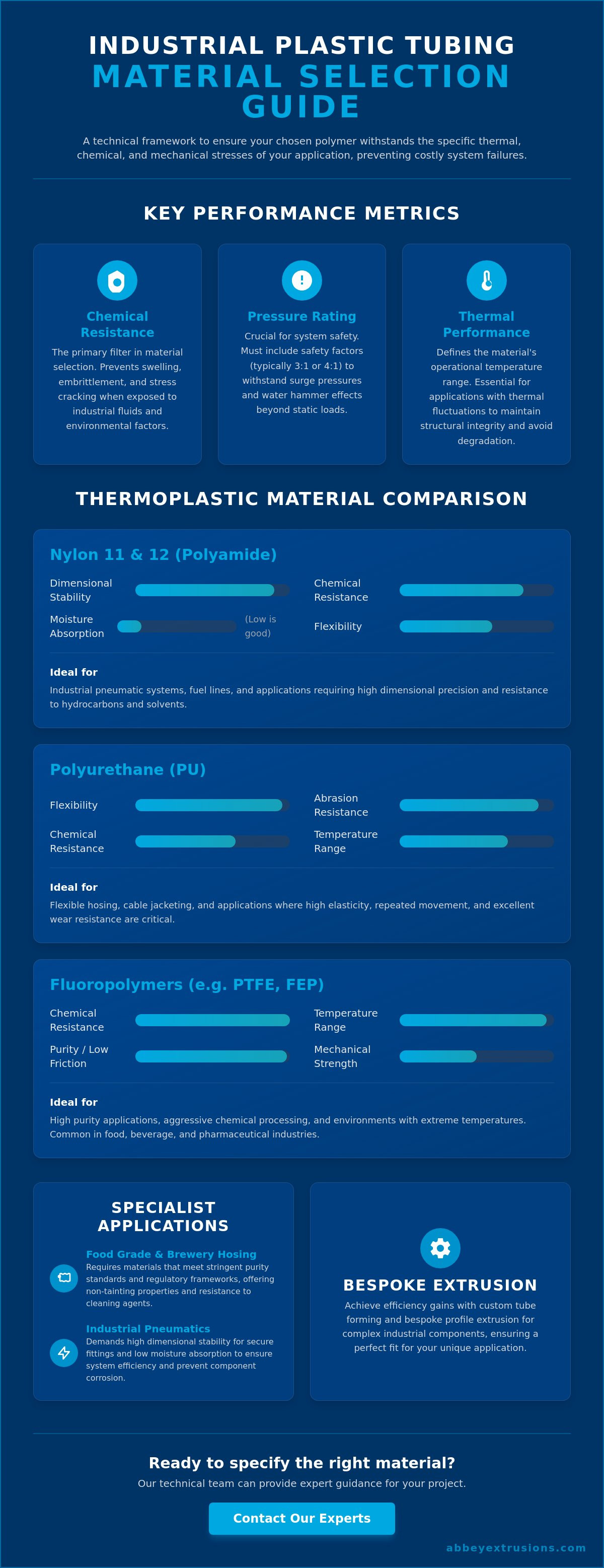
Pressure ratings are a fundamental consideration that must account for more than just static loads. Engineers must incorporate safety factors, often at a ratio of 3:1 or 4:1, to guard against unpredictable surge pressures or water hammer effects. These surges can momentarily exceed standard operating limits and cause catastrophic failure if the safety margin is too narrow. Flexibility requirements also dictate whether an unreinforced tube or a reinforced PVC tube is the more appropriate choice for the installation's geometry.
Chemical Resistance and Compatibility
Chemical compatibility serves as the primary filter during the initial selection phase. When polymers are exposed to incompatible fluids, the chemicals can infiltrate the molecular chains, leading to swelling, softening, or total degradation. It's critical to evaluate compatibility based on specific concentrations and operating temperatures. A material that remains stable in a chemical at 20°C may fail rapidly when that same substance reaches 50°C. For detailed comparisons of how these factors affect specific materials, read our comprehensive guide to nylon tubing properties and industrial applications.
Thermal and Mechanical Stress Factors
Selecting the right balance of these metrics ensures a system that is both cost-effective and durable. If you require assistance in determining the exact tolerances for your application, you can enquire about custom testing to verify material performance under your specific operational conditions.
For technical specifications or to organise a consultation regarding bespoke extrusion profiles, please contact our specialist team.
Technical Advantages of Nylon 11 and 12 in Engineering
Whilst many engineers start their design process with general purpose polymers, this plastic tubing material selection guide emphasises the critical distinction between standard grades and high performance polyamides. Nylon 11 and 12 represent the pinnacle of engineering thermoplastics for fluid transfer. They offer vastly superior dimensional stability when compared to Nylon 6. This stability is a direct result of their molecular structure, which resists the swelling and softening often seen in lower grade materials when exposed to environmental moisture.
Pneumatic systems rely on the predictable behaviour of their components to maintain system pressure and timing. Nylon 11 and 12 are the preferred choice for these systems because of their exceptionally low moisture absorption. Where Nylon 6 might absorb up to 9 per cent of its weight in water, Nylon 12 remains stable at approximately 1.5 per cent. These characteristics ensure that a Nylon tube retains its tight tolerances and push fit compatibility throughout its service life. These polymers also demonstrate excellent resistance to industrial oils, greases, and hydraulic fluids, making them indispensable in automotive and heavy machinery sectors.
Comparing Nylon 11 and Nylon 12 Properties
The choice between these two polyamides often depends on sustainability requirements and specific mechanical demands. Nylon 11 is a bio-based polymer derived from castor oil, offering a lower carbon footprint and superior impact resistance at sub-zero temperatures. In contrast, Nylon 12 is petroleum-based and provides slightly better dimensional stability and chemical resistance. Both materials exhibit an impressive fatigue life, which is why they remain the global industry standard for air brake systems and high pressure fuel lines. Their ability to withstand high vibration environments without stress cracking is a hallmark of their engineering pedigree.
Applications for Nylon Recoil and Spiral Guards
The inherent "memory" of these polyamides allows for the production of highly effective Nylon recoil air hoses. These components can be repeatedly extended and retracted without losing their original coiled shape, which is vital for maintaining an organised and safe workspace in assembly plants. To protect more sensitive primary lines, a Nylon spiral cut hose guard can be applied to provide a robust sacrificial layer against external friction. Nylon 12 typically maintains its integrity even under constant abrasive contact in harsh industrial centres, ensuring that the internal fluid-carrying tubes remain uncompromised by surface wear or environmental debris.
To request technical datasheets for our specialist hosing range or to discuss a custom project, please contact our engineering department.
Specialist Materials for High Performance Industrial Hosing
General purpose polymers often fail when exposed to the rigorous demands of specific industrial sectors. This plastic tubing material selection guide recognises that applications involving consumable liquids or volatile fuels require a higher tier of material integrity. For these environments, the molecular stability of the polymer must be absolute to prevent contamination or mechanical breakdown. Selecting the wrong grade doesn't just risk system failure; in the food and beverage industry, it risks consumer safety and regulatory non-compliance.
Food and Beverage Industry Requirements
In food production, the priority is the elimination of toxicity and the prevention of leachates. Materials must be phthalate-free and non-toxic to meet the stringent safety standards enforced in 2026. This is particularly critical in commercial brewing, where the brewery hose must be entirely neutral. It cannot impart any taste or odour to the product, even when exposed to high temperature cleaning cycles. These specialist hoses are designed for ease of sterilisation, with smooth internal bores that prevent bacterial build-up and resist common sanitising chemicals.
Fuel and Chemical Transfer Solutions
The transfer of hydrocarbons presents a different set of engineering challenges. A dedicated diesel fuel hose is engineered to resist aromatic hydrocarbons that would cause standard plastics to swell and lose their physical strength. For even more aggressive chemical environments, PTFE and FEP offer superior resistance to solvents and acids that would dissolve most other thermoplastics. For applications requiring additional mechanical strength, you should consult our engineering guide to reinforced PVC hose selection and performance. This resource details how braid reinforcement integrates with polymer selection to handle higher working pressures.
Ensuring your hosing meets these specific industrial standards is essential for maintaining operational safety. If you're unsure which specialist polymer suits your chemical environment, enquire with our technical team today for a comprehensive material compatibility assessment.
If you require bespoke profiles or technical advice on material compatibility for your next project, please reach out to our specialist advisors.
Selecting a UK Manufacturer for Custom Plastic Extrusions
Sourcing components from a domestic manufacturer provides distinct advantages that extend beyond simple logistics. Shorter supply chains ensure more predictable lead times, whilst a shared technical language facilitates clearer communication during the design phase. This plastic tubing material selection guide concludes by highlighting the importance of the manufacturing partner in translating material science into functional industrial components. A reliable partner doesn't just supply raw tubing; they provide the engineering expertise required to optimise the final product's performance, while Packaging For Industry (PFI) offers custom packaging solutions to ensure those components are protected during transit.
This commitment to expertise is also vital during the installation phase of any construction project. To ensure that high-performance materials are supported by high-quality workmanship, organisations like YTA Training offer accredited trade courses, including professional tiling, to equip the next generation of construction professionals with essential skills.
Quality control is the cornerstone of the plastic extrusion process. Precision in melt temperature and cooling rates is vital for ensuring that the polymer's structural integrity remains uncompromised. When you work with an established UK manufacturer, you gain access to rigorous testing protocols that verify dimensional accuracy and material consistency. This level of oversight is often difficult to maintain when sourcing from international suppliers, where distance and different regulatory standards can obscure technical nuances.
Bespoke Profiles and Industrial Components
Many industrial applications require more than standard circular tubing. Bespoke profile extrusion allows for the integration of specific functional features, such as sealing lips or structural ridges, directly into the component. For example, the transport industry relies on precision engineered curtainsider pelmet sections to provide durable weather sealing for heavy goods vehicles. Similarly, specialist profiles like Kedar cord are essential for high strength fabric tensioning systems. These custom shapes are engineered to perform specific structural roles that off-the-shelf solutions simply cannot replicate.
Similarly, maintaining the efficiency of industrial administrative offices requires specialised equipment and care; Custom Binding Products provides the professional-grade maintenance supplies needed to keep finishing and document-processing machinery in peak condition.
The pursuit of excellence in these technical sectors often draws talent to specific academic regions; for those relocating to study, unipad.co.uk provides a detailed guide on the benefits of living in Lancaster.
Beyond industrial applications, the utility of custom polymer products extends to residential projects; for example, you can learn more about 2d6 Designs and their range of 3D-printed solutions for home improvement.
The Benefits of Technical Tube Forming
Advanced tube forming techniques allow engineers to specify permanent, complex geometries that improve the ergonomics and efficiency of machinery layouts. By heat-setting polymers into dedicated shapes, we can create components that fit perfectly within confined spaces, significantly reducing assembly time and eliminating potential leak points associated with traditional elbows and fittings. This process involves heating the material to a specific point below its melting temperature before cooling it in a custom jig to lock in the required form. We encourage engineers to consult with technical experts early in the design phase to ensure that the chosen polymer is suitable for these forming processes. This collaborative approach ensures that the final assembly is both robust and cost effective.
To discuss your project specifications or request a bespoke material evaluation, please reach out to our engineering team.
Optimising Industrial Systems through Technical Material Precision
Frequently Asked Questions
What is the difference between LDPE and HDPE tubing for industrial use
LDPE (Low Density Polyethylene) offers superior flexibility and ease of installation compared to the more rigid HDPE (High Density Polyethylene). Whilst LDPE is favoured for lower pressure applications requiring tight bend radii, HDPE provides enhanced tensile strength and chemical resistance for more demanding structural roles. Both materials remain staple choices in any plastic tubing material selection guide due to their cost effectiveness and excellent moisture resistance.
Can Nylon 12 tubing be used for high pressure hydraulic applications
Nylon 12 tubing is highly effective for high pressure pneumatic systems and certain hydraulic return lines due to its excellent dimensional stability. However, for extreme high pressure hydraulic applications involving heavy machinery, wire reinforced hoses are typically required to ensure safety. Nylon 12 remains the industry standard for air brake systems and fuel lines where vibration resistance and pressure integrity are paramount.
Which plastic tubing material is best for alcohol and brewery transfer
Brewery hose manufactured from specialist food grade materials is the optimal choice for alcohol and beverage transfer. These hoses are engineered to be entirely neutral, ensuring they don't impart any taste or odour to the product during the transfer process. They must also withstand the high temperature cleaning and sterilisation cycles common in commercial brewing environments whilst maintaining their structural integrity.
How do I determine the chemical compatibility of a polymer with a specific solvent
Determining chemical compatibility requires a rigorous assessment of the specific polymer resistance to the concentration and temperature of the solvent in question. Engineers should consult verified technical compatibility charts or request material samples for immersion testing under actual operating conditions. This methodology is a core component of a professional plastic tubing material selection guide to prevent premature material failure or stress cracking.
What are the advantages of using a reinforced PVC hose over a standard tube
Reinforced PVC hose offers significantly higher working pressure ratings and improved kink resistance compared to unreinforced tubes. The integration of a high tensile textile braid allows the hose to withstand pressure surges whilst maintaining flexibility and ease of handling. This reinforcement also provides better protection against external abrasion, extending the service life of the component in harsh industrial centres.
Is it possible to get custom colours for industrial plastic extrusions
Custom colours are readily available for industrial plastic extrusions to assist with line identification, safety coding, or corporate branding. We can match specific RAL or Pantone references to ensure consistency across your machinery or product range. This service allows engineers to organise complex fluid systems more effectively, reducing the risk of maintenance errors in the field.
Why is Nylon 11 often preferred for fuel lines in the automotive sector
Nylon 11 is often preferred for automotive fuel lines because of its exceptional resistance to hydrocarbons and superior impact strength at sub zero temperatures. Being a bio based polymer derived from castor oil, it also supports sustainability goals whilst providing better flexibility than petroleum based alternatives. Its ability to withstand the constant vibration and thermal cycling of an engine bay makes it a reliable engineering choice.
What information is needed to request a quote for a bespoke plastic profile
To provide an accurate quote for a bespoke plastic profile, we require a detailed technical drawing or a physical sample of the required cross section. You should also specify the intended material, estimated annual quantities, and the specific application environment. Providing these details early allows our technical team to assess the feasibility of the extrusion and ensure the profile meets your mechanical and chemical requirements.

Article by
Bryan Cowan
Bryan Cowan is the Founder and Managing Director of Abbey Extrusions Ltd, a leading UK manufacturer of high-quality plastic tubes and hoses. With over 40 years of industry experience, Bryan established the company in 1985, growing it from a startup into a BS ISO9001-registered supplier for global sectors including aerospace, automotive, and pharmaceuticals.
Disclaimer
This article is intended for informational purposes only. Please ensure you seek expert advice or carry out your own research to confirm the information is suitable for your specific needs.