Selecting a sulphuric acid resistant plastic hose is not merely a standard procurement task; it is a critical safety decision where the margin for error is effectively zero. We recognise that for many industrial engineers, the primary concern remains the rapid degradation of standard materials, which often leads to hazardous leaks and costly process interruptions. It is a common frustration that whilst some polymers perform adequately with diluted solutions, they fail catastrophically when exposed to 98 percent concentrations.
This technical guide provides the precise material knowledge required to specify the correct polymer for safe and durable sulphuric acid transfer. You will gain a clear understanding of how different linings, such as those found in high-performance fluoropolymer ranges, manage chemical permeation and thermal stress. We will outline the exact parameters for material compatibility, giving you the confidence to select a hose that adheres to the most stringent UK safety and performance standards.
Key Takeaways
- Understand why sulphuric acid concentrations ranging from 10 percent to 98 percent require vastly different polymer specifications to ensure long term integrity.
- Identify the technical limitations of standard materials like PVC and Nylon whilst learning why fluoropolymers are the industry standard for aggressive chemical transfer.
- Analyse how external variables such as elevated temperatures and pressure cycles impact the service life of a sulphuric acid resistant plastic hose.
- Learn the methodical steps for specifying new acid lines, focusing on the vital requirement of verifying exact chemical concentrations at the design stage.
- Discover the advantages of sourcing custom extruded solutions from a UK manufacturer to meet precise technical and safety requirements.
For detailed technical specifications and material compatibility data, please feel free to speak with our engineering specialists today.
Challenges of Transporting Sulphuric Acid in Industrial Systems
The transport of sulphuric acid requires a nuanced understanding of sulphuric acid's chemical properties, particularly its role as a potent oxidising and dehydrating agent. When this substance comes into contact with an incompatible polymer, it initiates a process of chain scission. This chemical attack effectively breaks the long molecular chains that provide the plastic with its structural integrity. Selecting a high-quality sulphuric acid resistant plastic hose is therefore essential to prevent the catastrophic failure of industrial fluid systems and ensure the safety of the operating environment.
One of the most significant challenges involves the extreme reactivity of concentrated acid when it encounters moisture. An exothermic reaction occurs, generating substantial heat that can exceed the thermal limits of the hose material. If a manufacturer does not possess deep expertise in technical extrusion, the resulting hose may have internal stresses or inconsistent wall thicknesses that become points of failure under these conditions. We prioritise precision in our manufacturing to ensure that every profile can withstand these specific chemical stresses.
Understanding Acid Concentration and Material Stress
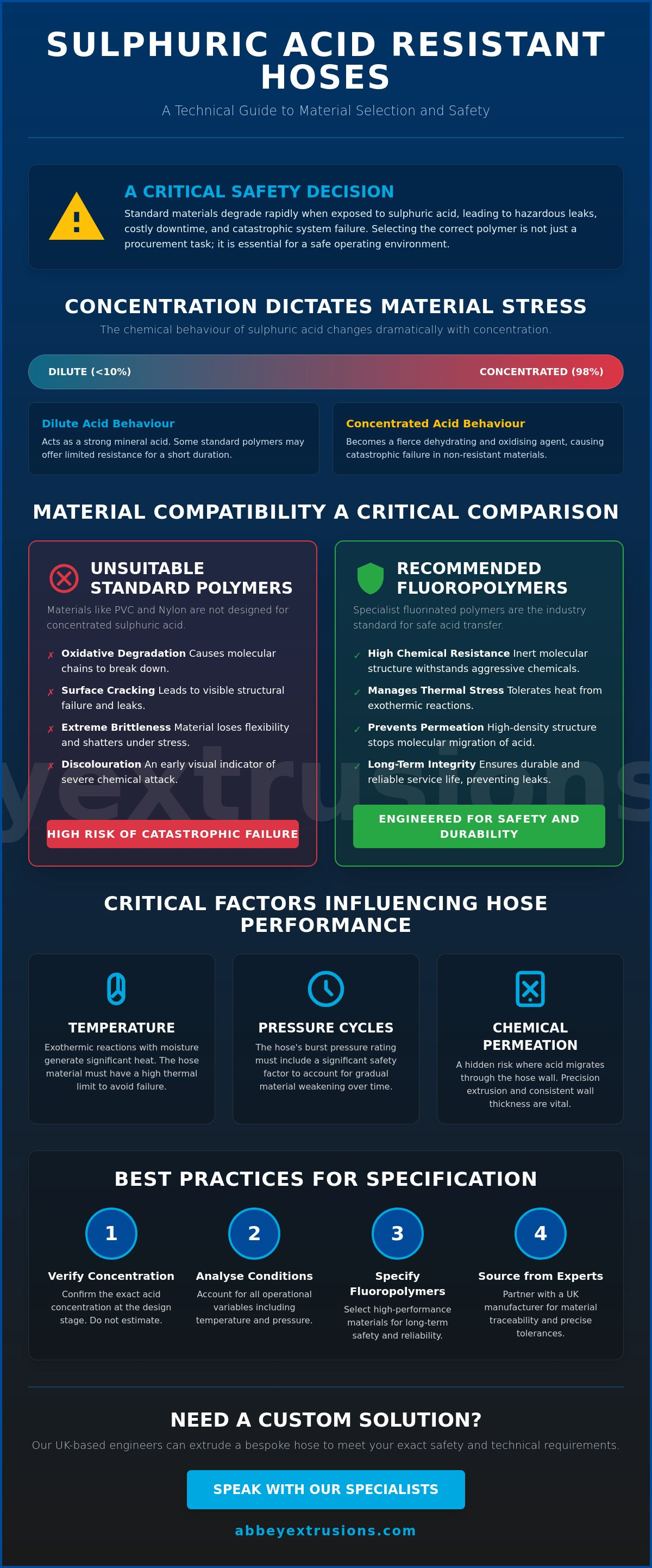
Concentration levels dictate the specific type of material stress the hose will encounter. Dilute sulphuric acid, typically below 10 percent, behaves primarily as a strong mineral acid. However, at concentrations reaching 98 percent, the acid becomes a fierce dehydrating agent. Standard industrial plastics like PVC tube or Nylon tube often suffer from oxidative degradation when exposed to these higher concentrations. Physical signs of failure are usually evident; the material may show deep discolouration, surface cracking, or a sudden transition to extreme brittleness, which indicates that the polymer matrix has been compromised and the hose is no longer fit for purpose.
Safety Implications for Chemical Transfer
Chemical permeation represents a hidden but severe risk in hazardous fluid transfer. This occurs when acid molecules migrate through the polymer structure at a molecular level, eventually reaching the exterior of the hose without a visible puncture. To mitigate this, we ensure that every sulphuric acid resistant plastic hose we produce maintains a consistent wall thickness through precision extrusion processes. Specifiers must also account for burst pressure ratings that include a significant safety factor. As the acid weakens the polymer over time, the hose's ability to withstand pressure fluctuations diminishes, making the initial specification of high-grade UK manufactured tubing a vital safety requirement. By sourcing from a domestic manufacturer, engineers can verify the traceability of raw materials and ensure that the extrusion profiles meet the exact tolerances required for hazardous chemical handling.
To ensure your fluid transfer system meets the necessary safety specifications, we invite you to consult with our technical department regarding material suitability.
Material Compatibility and Chemical Resistance for Acid Transfer
Selecting a sulphuric acid resistant plastic hose requires a rigorous assessment of how different polymer families respond to varying acid concentrations. Whilst standard industrial polymers offer cost-effective solutions for water or air transfer, their molecular stability often falters when subjected to the intense oxidative environment created by concentrated sulphuric acid. Scientific data found in studies on the Chemical Resistance of Plastic Polymers confirms that high-density structures and fluorinated chains provide the most reliable barrier against chemical attack. Our manufacturing process focuses on maintaining the structural integrity of these polymers to ensure they do not become brittle or porous over time.
A critical but often overlooked factor in material selection is the safety implication of permeation. In many lower-grade hoses, acid molecules can slowly migrate through the hose wall even if the material appears intact. This process is significantly accelerated by pressure. High-performance materials are engineered to resist this molecular migration, ensuring that the hazardous fluid remains entirely contained within the flow path. Our engineers can provide a bespoke material recommendation based on your specific concentration and temperature profile to mitigate these risks effectively.
Fluoropolymer Excellence with PTFE FEP and PFA
For aggressive chemical environments, fluoropolymers represent the gold standard of industrial tubing. PTFE is frequently specified for its near-universal chemical resistance, whilst FEP and PFA are preferred when applications require transparency for visual flow monitoring or enhanced mechanical toughness. These materials are virtually inert, meaning they won't react with even the most concentrated acid solutions. This inertness also ensures high material purity, preventing any contamination of the fluid being transported. You can examine our technical specifications for these high-performance options in our Fluoropolymer Tubing range.
Limitations of Standard Industrial Plastics
Standard plastics have clear operational boundaries that must be respected. For example, PVC tube is generally limited to diluted sulphuric acid at ambient temperatures; at higher concentrations, it quickly loses its plasticisers and becomes prone to cracking. Similarly, Polyurethane tube carries a high risk of hydrolysis and rapid degradation when exposed to acidic solutions. Even Low Density Polythene tube, whilst more resistant than some, has limited mechanical strength in concentrated acid environments. We also advise that Nylon 11 and 12 are generally unsuitable for concentrated sulphuric acid as they are susceptible to both hydrolytic and oxidative attack, which compromises the hose's burst pressure rating.
For bespoke advice on safety factors and material specifications, please contact our technical support team to discuss your specific application requirements.
Critical Factors Influencing Hose Performance and Safety
Specifying a sulphuric acid resistant plastic hose requires more than a simple material compatibility check; it demands a comprehensive analysis of the operational environment. Even the most chemically inert polymer can fail prematurely if the impact of elevated temperatures and pressure fluctuations is ignored. In industrial settings, these variables often act in tandem to accelerate the degradation of the hose structure. Engineers must also consider the physical placement of the hose, as factors such as UV exposure in outdoor chemical storage centres can compromise the external integrity of the tubing, leading to surface micro-cracking and eventual failure.
Flow dynamics represent another vital consideration. Choosing the correct hose diameter is essential to manage flow velocity and minimise internal friction. High velocity transfer of concentrated acid can lead to localised heat build up, which further stresses the polymer chains. Adhering to the principles outlined in the Safe Handling of Sulphuric Acid guide ensures that both the mechanical and chemical limits of the hose assembly are respected, maintaining a safe working environment for all personnel.
Temperature and Concentration Synergy
The rate of chemical attack on a polymer speeds up significantly as temperature increases, often doubling with every ten degree rise in certain conditions. When handling concentrated solutions, a framework for assessing the required safety factor must account for the peak operating temperature rather than just the average. Fluoropolymers generally offer excellent thermal stability, yet specifiers must still account for their specific thermal expansion properties. If a hose is constrained in a rigid system, thermal expansion can create internal stresses that make the material more vulnerable to oxidative attack over time.
Mechanical Stress and Bend Radius
Mechanical stress often provides the catalyst for chemical failure. Over-bending a hose beyond its rated limit creates tension points in the polymer matrix, which become primary targets for acid penetration. To mitigate this risk, we recommend utilising our Tube Forming services to create permanent, stress-free bends tailored to your system layout. For applications where external wear is a concern, applying a Nylon Spiral Cut Hose Guard provides a robust layer of abrasion protection. This ensures the primary sulphuric acid resistant plastic hose remains shielded from physical damage whilst maintaining its flexibility and chemical containment properties.
For technical assistance with your specific industrial application, please contact our specialist team for a detailed consultation.
Best Practices for Specifying and Maintaining Acid Resistant Hoses
Specifying a sulphuric acid resistant plastic hose requires a methodical process that extends beyond simple material selection. We observe that many procurement errors stem from a lack of precise data regarding the exact chemical concentration and the presence of secondary cleaning agents. These agents can interact with the primary acid to create a more aggressive environment for the polymer lining. The integrity of the entire system depends on the selection of compatible couplings and fittings. Even the highest grade fluoropolymer hose will fail if the connection points allow for chemical ingress or mechanical stress. Engineers should also establish clear cleaning and flushing protocols to prevent acid residues from stagnating within the hose during downtime, as this can lead to localised concentration increases and accelerated material fatigue.
Selection Checklist for Engineers
A rigorous selection process begins with three fundamental steps. Step 1 involves identifying the maximum operating temperature and pressure, including any potential spikes during system start up or shut down. Step 2 requires confirming the exact chemical concentration and identifying any potential cleaning agents or detergents used in the system. These can sometimes be more damaging to the polymer than the acid itself. Step 3 focuses on the physical environment, where you must account for bend requirements and the risk of external abrasion. By following this structured approach, you ensure that the specified hose meets the unique demands of your facility whilst maintaining a necessary safety margin.
Inspection and Maintenance Protocols
Reliability is built on a foundation of proactive maintenance rather than reactive repair. We recommend a strict schedule for visual inspections to identify early signs of chemical fatigue, such as discolouration, surface hardening, or a loss of flexibility. Hoses should be replaced before they reach their theoretical failure point to prevent hazardous leaks. Proper storage of spare hoses is equally vital; they should be kept in a cool, dry environment away from direct sunlight to prevent environmental degradation. This disciplined approach to maintenance ensures that your sulphuric acid resistant plastic hose remains a safe and dependable component of your industrial infrastructure. To ensure your facility maintains the highest safety standards, request a technical review of your hose specifications from our engineering department.
To discuss your specific manufacturing requirements or to request a technical consultation, please get in touch with our engineering team today.
Bespoke Extrusion Solutions for Aggressive Chemical Environments
Industrial facilities often present complex spatial challenges that standardised products cannot address effectively. Since 1985, we have utilised our technical expertise to develop tailored solutions that ensure the safe transfer of hazardous fluids in demanding environments. A bespoke sulphuric acid resistant plastic hose can be manufactured to meet exact dimensional tolerances, ensuring it integrates perfectly with existing chemical processing equipment. This level of precision manufacturing reduces the risk of mechanical stress on the polymer chains, which is a primary cause of chemical degradation in aggressive environments. By focusing on the specific needs of each application, we help our partners improve the overall efficiency and safety of their chemical handling systems.
Our commitment to quality is reflected in our choice of raw materials and our rigorous manufacturing processes. We understand that in the chemical industry, a minor specification error can lead to significant operational downtime or safety risks. Therefore, we maintain a strict focus on precision, ensuring that every profile we produce meets the high standards expected of a specialist UK manufacturer. This dedication to excellence has made us a trusted partner for industrial engineers who require reliable, long term solutions for acid transfer.
Custom Profiles and Tube Forming
Engineering bespoke shapes allows for the efficient use of restricted industrial spaces where a standard flexible hose might be prone to kinking or physical obstruction. By utilising our specialist tube forming capabilities, we provide pre-formed sections that significantly reduce the total number of joints and potential leak points in a system. These custom profiles are engineered to maintain their structural integrity even when navigating tight bends. Additionally, for environments where flammable vapours are present alongside corrosive chemicals, we can manufacture anti-static variants to mitigate the risk of electrostatic discharge during the transfer process.
The Advantage of UK Manufacturing
Choosing a UK manufacturer offers distinct advantages in terms of quality assurance and technical responsiveness. Our local production facility ensures that every sulphuric acid resistant plastic hose adheres to strict British quality and safety standards, providing peace of mind for specifiers. We possess the flexibility to provide small batches for specialist research applications or large production runs for major industrial facilities. This agility, combined with our deep technical knowledge, allows us to provide support throughout the entire lifecycle of a project. We encourage engineers and procurement specialists to contact our technical team to receive expert advice on material compatibility and custom profile design tailored to their specific acid-handling needs.
For more information on our manufacturing capabilities or to discuss a specific application, please get in touch with our technical department today.
Securing Long Term Integrity in Acid Transfer Systems
Selecting the correct material for hazardous fluid transfer is a decision that impacts both operational efficiency and personnel safety. We have explored the necessity of matching polymer properties to specific acid concentrations whilst managing the synergistic effects of temperature and pressure. As a specialist UK manufacturer of high performance tubing since 1985, we provide the technical expertise required to specify a sulphuric acid resistant plastic hose that meets rigorous industrial standards. Reliability in these environments is achieved through precise engineering and a commitment to material purity.
Our deep expertise in Fluoropolymers, including PTFE, FEP, and PFA, allows us to offer solutions that remain inert even in the most aggressive conditions. Combined with our bespoke tube forming and custom profile extrusion capabilities, we ensure that every system is optimised for its unique industrial footprint. We invite you to request a technical consultation for your acid resistant hose requirements to ensure your facility maintains the highest levels of safety and performance. We look forward to supporting your next project with our proven manufacturing solutions.
Frequently Asked Questions
Is PTFE the best material for 98 percent sulphuric acid
PTFE is widely considered the superior material for handling 98 percent sulphuric acid because it is virtually inert to chemical attack. Unlike standard polymers that suffer from oxidative degradation at high concentrations, PTFE maintains its structural integrity across a broad thermal range. This makes it a dependable choice for aggressive environments where safety and long term performance are paramount. We often recommend fluoropolymers for these specific applications to ensure maximum containment.
Can I use a standard PVC hose for diluted sulphuric acid
A standard PVC hose can be used for diluted sulphuric acid, typically at concentrations below 10 percent and at ambient temperatures. However, its effectiveness diminishes rapidly as the concentration or heat increases. The acid can leach plasticisers from the material, leading to brittleness and eventual cracking. It is essential to verify the exact concentration and temperature profile before specifying PVC to avoid premature system failure and hazardous leaks.
How does temperature affect the acid resistance of a plastic hose
Temperature has a profound impact on chemical resistance because heat increases the kinetic energy of the acid molecules, which accelerates the rate of chemical attack on the polymer chains. A hose that performs well at 20 degrees Celsius may fail rapidly at 50 degrees Celsius. As temperatures rise, the material may soften and become more permeable, making the selection of a high quality sulphuric acid resistant plastic hose even more critical for operational safety.
What are the signs that a sulphuric acid hose is starting to fail
Early signs of hose failure often include visible discolouration, such as yellowing or charring of the internal lining. You may also notice the material becoming increasingly brittle or showing signs of surface micro-cracking. In some cases, the hose might exhibit swelling or softening, which indicates that the acid has begun to permeate the polymer matrix. Regular visual inspections are vital to identify these symptoms before a catastrophic leak occurs in the industrial system.
Does Abbey Extrusions provide custom diameters for acid resistant hoses
Yes, we specialise in manufacturing bespoke tubing and custom profiles tailored to specific industrial requirements. This includes the production of custom diameters and wall thicknesses to ensure a precise fit within your existing chemical processing equipment. By providing bespoke extrusion solutions, we help engineers manage flow velocity and minimise pressure drops whilst maintaining the high safety standards required for the transfer of aggressive and hazardous fluids.
Is it safe to use a reinforced hose for high pressure acid transfer
Using a reinforced hose for high pressure acid transfer is safe provided the internal lining is fully compatible with the acid concentration. The reinforcement provides the necessary mechanical strength to withstand pressure, whilst the chemical resistant liner ensures the fluid remains contained. It is crucial that the reinforcement material itself is protected from any potential acid ingress, as chemical contact could compromise the structural braid and lead to a burst.
How long does a typical sulphuric acid resistant hose last
The service life of a sulphuric acid resistant plastic hose varies significantly based on the acid concentration, operating temperature, and frequency of use. Whilst a high performance fluoropolymer hose can provide several years of reliable service under stable conditions, aggressive thermal cycling or mechanical stress can shorten this lifespan. We recommend establishing a proactive replacement schedule based on regular inspections rather than relying solely on theoretical service life estimates for hazardous applications.
Can I use Nylon tubing for any concentration of sulphuric acid
Nylon tubing is generally unsuitable for sulphuric acid transfer, particularly at higher concentrations. Nylon 11 and 12 are susceptible to hydrolytic and oxidative attack when exposed to strong mineral acids, which quickly compromises their mechanical properties. This degradation can lead to sudden failure under pressure. For acid handling, we strongly advise selecting materials with higher chemical stability, such as fluoropolymers or specifically engineered polyethylene, to ensure safe operation.

Article by
Bryan Cowan
Bryan Cowan is the Founder and Managing Director of Abbey Extrusions Ltd, a leading UK manufacturer of high-quality plastic tubes and hoses. With over 40 years of industry experience, Bryan established the company in 1985, growing it from a startup into a BS ISO9001-registered supplier for global sectors including aerospace, automotive, and pharmaceuticals.
Disclaimer
This article is intended for informational purposes only. Please ensure you seek expert advice or carry out your own research to confirm the information is suitable for your specific needs.