Designing for compact industrial spaces often feels like a compromise between spatial efficiency and system reliability. Many engineers believe that achieving a tubing with tight bend radius is simply a matter of mechanical force, yet the real solution lies in the precise synergy between polymer science and advanced heat-setting techniques. It's a common frustration to see a tube kink during a critical installation or witness a system fail because of flow restriction in a tight assembly. These issues aren't just inconveniences; they represent significant risks to operational uptime and can lead to premature material fatigue.
This guide provides the technical clarity needed to select high-performance plastic tubing that maintains its internal profile and flow integrity, even within the most restricted envelopes. We'll analyse the specific bend limits for various polymers, such as Nylon 12 and Polyurethane, whilst demonstrating how custom formed profiles can practically eliminate kinking risks. By understanding these material behaviours, you'll be able to organise more reliable, compact assemblies that stand up to the rigours of frequent movement and high-pressure environments.
Key Takeaways
- Define the minimum bend radius to establish a clear threshold for maintaining flow integrity whilst preventing structural kinking in industrial systems.
- Evaluate the flexibility of various high performance polymers to determine which materials are best suited for tubing with tight bend radius requirements.
- Analyse how the specific ratio of outside diameter to wall thickness dictates a tube's ability to resist collapse in confined assemblies.
- Implement practical path organising strategies to reduce material fatigue and eliminate unnecessary stress points within compact designs.
- Explore how custom tube forming provides a permanent and precise engineering solution for the most demanding directional changes.
If you require technical assistance with material selection or custom profiles, please speak with our engineering team through our enquiry form.
Understanding the Importance of Bend Radius in Plastic Tubing
In modern industrial design, the requirement for tubing with tight bend radius specifications is increasingly common as assemblies become more compact. We define the minimum bend radius as the smallest radius a tube can be bent to without kinking, damaging the material, or significantly restricting flow. It's a critical metric because plastic polymers have an elastic limit; once this is exceeded, the tube's cross-section collapses, leading to system failure. Designers must account for this threshold during the early stages of project development to avoid costly downtime later.
Engineers must distinguish between a static bend and a dynamic bend. A static bend is a permanent, fixed installation where the tube doesn't move after the initial setup. In contrast, a dynamic bend involves constant or frequent movement, such as in robotic arms or automated machinery. Maintaining flow integrity in these scenarios is vital, particularly in pneumatic and hydraulic applications where pressure consistency is the backbone of the system's performance. Abbey Extrusions specialises in manufacturing high performance solutions that ensure these limits are respected whilst providing the longevity expected in industrial environments.
Defining Minimum Bend Radius for Industrial Applications
Calculating the safe bend limit is a precise process that usually involves measuring from the centreline of the tube. This threshold is dictated primarily by the outside diameter (OD) and the wall thickness. Generally, a tube with a thicker wall will resist kinking better than a thin-walled counterpart, but it will also require more force to bend. If your design requires tubing with tight bend radius performance, you must ensure the material's structural integrity isn't compromised. Exceeding these limits leads to permanent deformation, which often results in a complete loss of flow or mechanical failure at the point of highest stress.
The Consequences of Kinking and Flow Restriction
A kinked tube doesn't just look unprofessional; it creates immediate operational hazards. When the internal diameter is constricted, it causes a sharp pressure drop, forcing the entire system to work harder to compensate. This inefficiency increases energy consumption and places undue stress on pumps and compressors. Over time, the physical stress at the bend can lead to stress cracking, especially if the polymer is exposed to fluctuating temperatures or chemicals. Standard flexible tubing often fails in extreme geometries because it lacks the necessary wall support. In these cases, it's often necessary to move beyond standard products towards custom-engineered solutions that can handle the specific demands of the application.
To discuss specific material tolerances for your project, you may contact our technical department directly.
Comparing High Performance Polymers for Tight Radius Applications
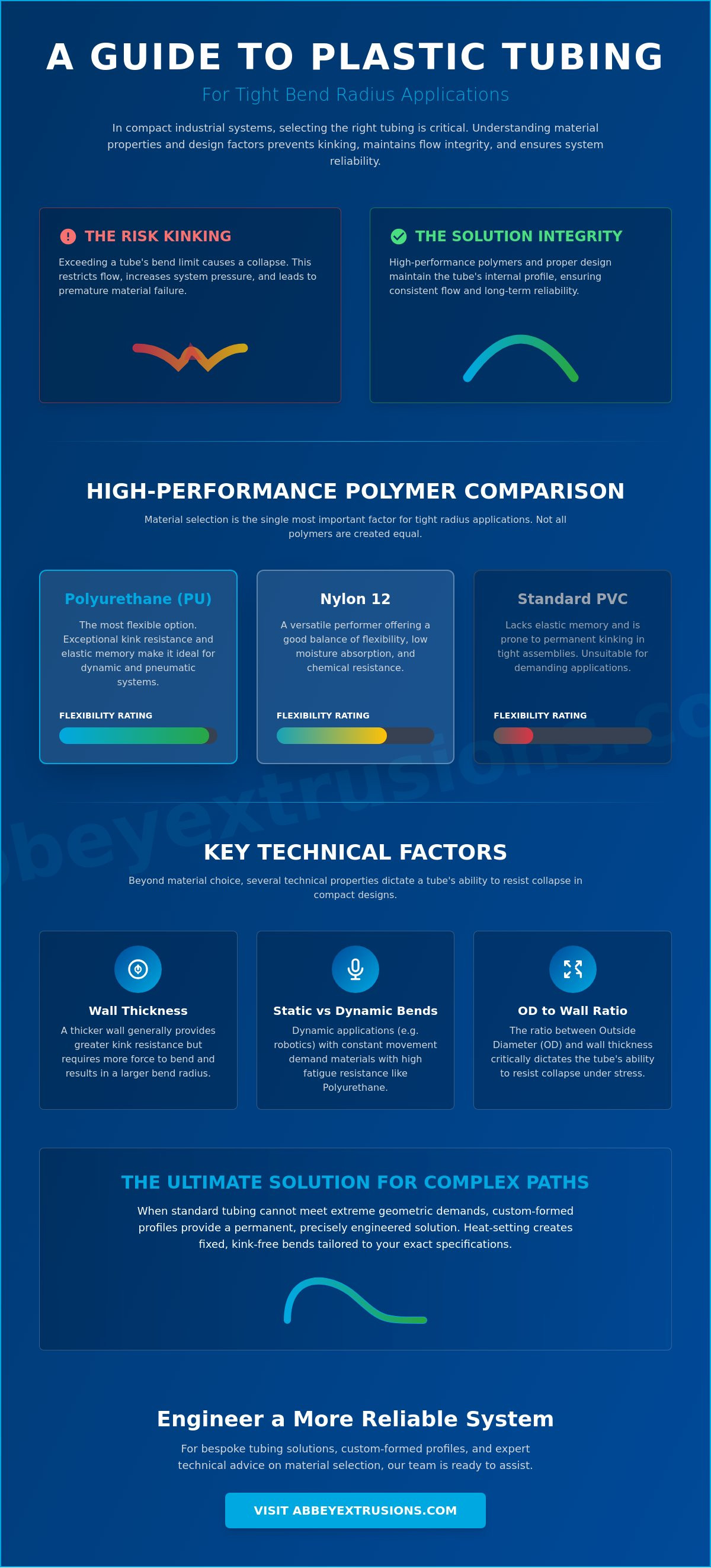
Selecting the correct polymer is the most influential factor in achieving a successful tubing with tight bend radius. Whilst standard PVC is frequently utilised for basic fluid transfer, it often fails in compact assemblies where space is restricted. PVC lacks the elastic memory required to recover from sharp turns, leading to permanent flattening or kinking. In direct contrast, Polyurethane Tube provides a much tighter minimum bend radius, allowing for significantly more compact routing without compromising the internal flow path.
Abbey Extrusions manufactures a wide range of these high performance materials to strict British standards, ensuring consistency in wall thickness and outside diameter. This precision is vital because even a minor variance in material distribution can drastically alter how a tube behaves when bent to its limit. By matching the polymer's mechanical properties to the specific geometry of your system, you can reduce the risk of structural failure and extend the service life of your components.
Polyurethane Tubing for Maximum Flexibility
Polyurethane (PU) is widely regarded as the most flexible option for pneumatic systems. Its exceptional kink resistance is a result of its molecular structure, which allows the material to stretch and recover without losing its circular cross-section. This memory makes PU the standard choice for robotic arms and moving machinery parts that undergo repetitive motion. It handles tight corners with ease, making it a reliable solution for complex internal assemblies where larger hoses would simply collapse.
Nylon 11 and 12 Performance in Confined Spaces
For applications requiring higher pressure ratings or chemical resistance, Nylon tube offers a robust alternative. Nylon 11 and 12 are semi-rigid polymers that boast high fatigue resistance. They don't have the same soft flexibility as PU, but they excel in maintaining dimensional stability under vacuum or high pressure. Nylon 12 is particularly valued in confined automotive and industrial spaces for its ability to hold a shape whilst remaining flexible enough for installation. For a deeper look at these properties, our technical guide to Nylon 11 and 12 provides extensive specification data.
Fluoropolymer Solutions for Chemical and Thermal Resistance
When dealing with aggressive chemicals or extreme temperatures, Fluoropolymers like PTFE, FEP, and PFA are essential. PTFE is highly inert but possesses a relatively large minimum bend radius compared to other plastics. If your design requires tubing with tight bend radius performance in a corrosive environment, FEP or PFA are often superior choices. These materials offer better flexibility than PTFE and are less prone to kinking when routed through narrow channels. Precise wall thickness is paramount here to ensure the material doesn't buckle under stress.
If you require a bespoke technical consultation regarding your specific installation requirements, please reach out to our team via our contact page.
Technical Factors that Influence Tubing Flexibility and Kink Resistance
The successful implementation of tubing with tight bend radius specifications depends on several critical technical variables beyond simple material choice. One of the most significant factors is the ratio between the outside diameter (OD) and the wall thickness. A tube with a high OD to wall thickness ratio is generally more susceptible to kinking because the thin wall lacks the structural mass to resist the compressive forces on the inside of the bend. Conversely, increasing the wall thickness provides greater support for the tube's circular cross-section, although this naturally increases the force required to achieve the desired curve.
Shore hardness also plays a pivotal role in how a polymer behaves under stress. Softer materials, typically measured on the Shore A scale, offer immediate flexibility but may lack the "spring-back" memory required for dynamic applications. Harder materials, such as those on the Shore D scale, provide excellent pressure resistance but require more precise engineering to avoid stress cracking at the apex of a bend. In high-pressure environments where a tight radius is still necessary, a reinforced pvc tube is often the most reliable solution. The internal braiding provides the necessary tensile strength to prevent the tube from expanding and subsequently kinking under load.
The Impact of Wall Thickness on Bend Performance
A thicker wall is an effective safeguard against tube collapse, as it distributes the mechanical load more evenly across the material. However, this added mass increases the stiffness of the extrusion, which can make installation difficult in the most confined spaces. Engineers must find a precise balance between the pressure requirements of the fluid system and the physical space available. Thin-walled tubing might save space and weight, but it is significantly more likely to fail at low angles if the internal pressure fluctuates or if the material is subject to vacuum conditions.
Environmental Factors and Temperature Variations
Material behaviour is never static and changes significantly amongst different operating environments. Cold temperatures are particularly challenging, as they can cause a Low Density Polythene Tube to become brittle and lose its natural flexibility. This increase in stiffness can lead to micro-fractures if the tube is forced into a tight radius during a cold-start procedure. On the other hand, excessive heat softens most polymers, which can lower the kinking point and lead to premature failure. For applications where thermal stability is paramount, we recommend reviewing our polyethylene tubing technical guide to ensure the selected grade matches your environmental parameters.
If you require specific technical guidance for your compact assembly, please consult our engineering team through our bespoke enquiry service.
Practical Design Strategies for Compact Fluid Systems
Designing a compact fluid system requires more than just high performance materials; it demands a strategic approach to routing and installation. Whilst some designers suggest using 90 degree fittings to navigate tight corners, this often introduces unnecessary leak points and increases assembly costs. Implementing tubing with tight bend radius capabilities allows for a continuous, streamlined flow path that is inherently more reliable. By organising the layout to follow natural curves, you can significantly reduce the mechanical stress placed on the polymer and ensure long term system stability.
To maintain radius integrity in extreme conditions, the use of external support coils or internal springs can prevent kinking without restricting flow. This is particularly relevant in dynamic systems where the tube is in constant motion and subject to varying centrifugal forces. Choosing a UK manufacturer for these components ensures that the material quality is consistent and that the tolerances are strictly maintained according to British industrial standards. This level of oversight is essential for preventing the unexpected downtime associated with inferior, inconsistent extrusions.
Installation Best Practices for Flexible Lines
Correct routing is essential to prevent twisting or longitudinal tension, both of which can lower the kinking threshold of even the most flexible polymers. We recommend using clips and guides to centre the tube within its intended path, ensuring that it doesn't rub against sharp edges or other moving components. Leaving a small amount of slack is not a sign of poor design; it is a critical requirement for long term reliability. This slack allows the material to expand and contract with pressure changes or thermal variations without pulling at the connectors or creating stress points at the apex of a bend.
Calculating Safe Operating Limits for Your System
Engineers can estimate the minimum bend radius by using a standard multiplier based on the outside diameter, typically ranging from 10 to 15 times the OD for static applications. However, for dynamic systems or those involving high heat, this margin must be increased to account for material softening and fatigue. When the required geometry exceeds the natural limits of flexible tubing, it is time to transition to custom formed profiles. These pre-shaped sections remove the internal stress of the bend, providing a permanent solution for the most confined industrial envelopes. To ensure your system meets these rigorous standards, you can request a technical review of your system layout from our specialists.
For more information on our specific manufacturing capabilities or to request a quote for custom profiles, please visit our contact page.
Advanced Tube Forming for Permanent Tight Radius Requirements
When the constraints of an industrial assembly exceed the physical limits of standard flexible lines, Tube Forming becomes the definitive engineering choice. This specialised process involves heat setting the polymer into a fixed geometry that remains stable throughout the component's service life. By using dedicated tooling and precise thermal control, we can create tubing with tight bend radius specifications that would be impossible to achieve through manual routing alone. These pre-formed sections effectively eliminate the need for expensive elbow fittings, which not only reduces the total bill of materials but also removes multiple potential leak points from the fluid system.
Abbey Extrusions possesses the technical expertise to produce these bespoke components for niche industries where standard off the shelf products are insufficient. Our forming techniques ensure that the internal diameter remains consistent throughout the bend, preventing the flow turbulence often associated with forced manual curves. This level of precision is essential for maintaining the high standards of reliability expected in traditional manufacturing and heavy industrial environments.
Heat Setting and Permanent Tube Profiles
Plastic memory is a natural property of polymers that causes them to return to their original straight extruded shape. During our forming process, we override this memory by applying controlled thermal energy whilst the tube is held in a precise jig. Once cooled, the material retains its new shape without any residual internal stress or detrimental wall thinning. This is particularly advantageous for fuel lines and cooling systems in the automotive and aerospace sectors, where space is at a premium and flow integrity is non-negotiable. It provides a permanent, kink free flow path that remains consistent even under fluctuating environmental pressures.
Bespoke Extrusion for Unique Engineering Challenges
Every industrial application presents a different set of spatial challenges that require a tailored approach. We work closely with clients to develop bespoke profiles that integrate seamlessly into specialised vehicle sections or complex industrial fluid routing systems. This collaborative design process allows us to refine the geometry during the prototype phase, ensuring that the final production run meets the exact tolerances required for the assembly. Whether you are dealing with a niche machinery project or a large scale manufacturing line, our ability to produce custom tubing with tight bend radius profiles provides a significant engineering advantage. We encourage engineers to reach out to our team to discuss custom prototypes and production runs that address their most demanding design requirements.
For expert assistance with your project specifications, please reach out to our engineering team.
Optimising System Reliability with Precision Polymer Solutions
Designing for compact industrial spaces requires a deep understanding of polymer behaviour and mechanical limits. As discussed, the successful implementation of tubing with tight bend radius specifications relies on matching specific material properties to the environmental demands of the system. Whether your application requires the elastic memory of Polyurethane or the chemical resistance of Fluoropolymers, selecting a high performance solution ensures long term operational integrity whilst reducing the risk of unexpected downtime.
Abbey Extrusions has operated as a specialist UK manufacturer since 1985, providing a comprehensive range of high performance polymers for diverse industrial sectors. Our expert custom tube forming and heat setting services enable the creation of permanent, complex shapes that remove mechanical stress from your assemblies. By choosing a partner with decades of technical experience, you ensure that every component is manufactured to the highest standards of precision and reliability.
Contact our technical engineering team to discuss your bespoke tubing requirements and let us help you achieve a more efficient, reliable design for your most challenging installations.
Frequently Asked Questions
What is the difference between bend radius and centreline radius
The bend radius typically refers to the radius of the inside surface of the curve, whereas the centreline radius is measured from the central axis of the tube. In industrial design, the centreline radius is the more precise metric for tubing with tight bend radius requirements because it accounts for the neutral axis of the material. Understanding this distinction is essential for ensuring that your assembly layouts match the physical capabilities of the extrusion.
Which plastic material offers the tightest bend radius without kinking
Polyurethane provides the most significant flexibility and kink resistance amongst standard polymers due to its excellent elastic memory and soft Shore hardness. For applications that require even more extreme angles than a flexible line can provide, custom formed profiles in materials like Nylon 12 offer a permanent solution. These formed sections maintain their internal diameter without the risk of collapse that often affects standard flexible lines in confined spaces.
Can I use a heat gun to manually bend plastic tubing for a tighter radius
Manual heating with a heat gun is not recommended for industrial applications because it produces inconsistent results and compromises the material's structural integrity. Professional heat setting involves precise temperature control and dedicated jigs to ensure the wall thickness remains uniform throughout the curve. Attempting to manually form a tubing with tight bend radius often leads to localised thinning or internal stresses that cause premature failure under pressure.
How does wall thickness affect the flexibility of Nylon tubing
Increasing the wall thickness of Nylon tubing naturally increases its stiffness and the force required to achieve a bend. However, a thicker wall provides superior support for the tube's circular cross-section, making it less likely to collapse or kink at the apex of a curve. Engineers must balance the need for flexibility with the requirement for structural mass to resist internal pressure or vacuum conditions during operation.
Why is my flexible tubing kinking even though I am within the bend radius
Kinking often occurs due to longitudinal tension or twisting during the installation process, which effectively lowers the material's kinking threshold. If the tube is pulled tight between two connectors, it loses its ability to distribute the mechanical load of the bend evenly. Environmental factors, such as ambient heat softening the polymer, can also cause a tube to fail even if the physical geometry remains within the manufacturer's stated limits.
Does Abbey Extrusions provide custom formed tubing for tight spaces
Yes, we specialise in advanced tube forming and heat setting for permanent, complex geometries that standard flexible lines cannot achieve. Our process involves overriding the plastic memory of the polymer to create a stable, pre-shaped component that fits perfectly within restricted envelopes. This service is ideal for aerospace, automotive, and industrial machinery where spatial constraints are extreme and long term reliability is a critical requirement.
What are the benefits of using a formed tube instead of a 90 degree fitting
Using a pre-formed tube eliminates the need for mechanical elbow fittings, which significantly reduces the number of potential leak points in your fluid system. Formed tubes also provide a smoother internal flow path, reducing turbulence and pressure drops compared to the sharp internal angles of a standard fitting. This approach simplifies the bill of materials and reduces overall assembly time whilst improving the structural integrity of the system.
How do temperature changes amongst different environments affect bend radius
Cold temperatures increase the stiffness of polymers like LDPE and Nylon, making them more brittle and prone to cracking if bent sharply during installation. Conversely, high temperatures soften the material, which can cause the tube to kink more easily under its own weight or internal pressure. Engineers must account for these variations by increasing the safety margin for the bend radius in environments subject to extreme thermal fluctuations.

Article by
Bryan Cowan
Bryan Cowan is the Founder and Managing Director of Abbey Extrusions Ltd, a leading UK manufacturer of high-quality plastic tubes and hoses. With over 40 years of industry experience, Bryan established the company in 1985, growing it from a startup into a BS ISO9001-registered supplier for global sectors including aerospace, automotive, and pharmaceuticals.
Disclaimer
This article is intended for informational purposes only. Please ensure you seek expert advice or carry out your own research to confirm the information is suitable for your specific needs.